

AP Macro units: A complete guide to AP Macroeconomics Units 1-6


Table of contents
- What is AP Macroeconomics?
- What’s on the AP Macro exam?
- Understanding the AP Macro course structure
- AP Macroeconomics Unit 1: Basic Economic Concepts
- What you’ll learn in Unit 1
- Important topics
- Why Unit 1 matters
- AP Macroeconomics Unit 2: Economic Indicators and the Business Cycle
- What you’ll learn in Unit 2
- Important topics
- Why Unit 2 matters
- AP Macroeconomics Unit 3: National Income and Price Determination
- What you’ll learn in Unit 3
- Important topics
- Why Unit 3 matters
- AP Macroeconomics Unit 4: Financial Sector
- What you’ll learn in Unit 4
- Important topics
- Why Unit 4 matters
- AP Macroeconomics Unit 5: Long-run Consequences of Stabilization Policies
- What you’ll learn in Unit 5
- Important topics
- Why Unit 5 matters
- AP Macroeconomics Unit 6: Open Economy—International Trade and Finance
- What you’ll learn in Unit 6
- Important topics
- Why Unit 6 matters
- How are AP Macro units weighted on the exam?
- Most important graphs across all AP Macro units
- Common mistakes students make in AP Macro
- Best study strategies for AP Macro units
- Final thoughts
The six AP Macro units are: (1) Basic Economic Concepts, (2) Economic Indicators and the Business Cycle, (3) National Income and Price Determination, (4) Financial Sector, (5) Long-Run Consequences of Stabilization Policies, and (6) Open Economy—International Trade and Finance. Together, they take you from foundational ideas like scarcity and opportunity cost to global trade and currency markets.
AP Macroeconomics is one of the most popular Advanced Placement courses for students interested in economics, business, finance, public policy, and global affairs. Unlike microeconomics, which focuses on individual consumers and businesses, macroeconomics examines the economy as a whole: economic growth, unemployment, inflation, banking systems, government policies, and international trade.
This guide walks through all six AP Macroeconomics units, explaining the key concepts, major topics, and their connections. First, we’ll cover how the course and exam are structured, then move on to what to expect in each unit.

What is AP Macroeconomics?
AP Macroeconomics is a college-level course that introduces students to the principles that govern entire economies. The course examines how economic systems function, how governments and central banks influence economic activity, and how international trade affects global markets.
Students learn how economists measure economic performance using indicators such as GDP, inflation, and unemployment. They also explore how fiscal and monetary policies are used to address economic challenges and promote growth.
One of the most valuable aspects of AP Macroeconomics is its real-world relevance. The concepts help students understand news headlines, government policies, financial markets, and global economic events.
What’s on the AP Macro exam?
The AP Macroeconomics exam has two sections:
- Multiple-choice questions (MCQs): 60 questions in 70 minutes, worth about 66% of your score. This section tests your understanding of economic concepts, graphs, models, and calculations.
- Free-response questions (FRQs): 3 questions (one long and two short) in 60 minutes, worth about 34% of your score. These require you to apply economic reasoning, analyze scenarios, interpret graphs, and explain economic outcomes.
Success on the AP Macro exam depends not just on memorizing definitions but on understanding how economic concepts connect and influence one another.
Understanding the AP Macro course structure
The AP Macroeconomics curriculum is divided into six units. Each unit builds on the knowledge gained in earlier units, creating a complete picture of economic systems and policy decisions.
The progression generally follows this path:
- Unit 1 introduces foundational economic concepts.
- Unit 2 focuses on measuring economic performance.
- Unit 3 explains how output and prices are determined.
- Unit 4 examines money, banking, and financial institutions.
- Unit 5 explores government and central bank policies.
- Unit 6 expands into international economics and global trade.
By the end of the course, students understand how economies function both domestically and internationally.

AP Macroeconomics Unit 1: Basic Economic Concepts
What you’ll learn in Unit 1
Unit 1 is the foundation for the entire AP Macroeconomics course. Before you can understand inflation, unemployment, banking systems, or government policies, you first need to learn how economists think about choices, resources, and trade-offs.
This unit introduces the idea that resources are limited while human wants are unlimited. Because of this scarcity, individuals, businesses, and governments must constantly make decisions about how to allocate resources efficiently.
Important topics
Scarcity, choice, and opportunity cost
Scarcity is one of the most important concepts in economics. Since resources such as time, labor, capital, and natural resources are limited, every choice involves giving up something else.
The value of the next-best alternative forgone when making a decision is known as opportunity cost. Understanding opportunity cost helps explain why individuals, businesses, and governments make certain economic choices.
Production possibilities curve (PPC)
The Production Possibilities Curve (PPC) is a graph that illustrates the trade-offs between producing two different goods or services.
Students learn how the PPC demonstrates:
- Scarcity
- Efficiency
- Economic growth
- Unemployment of resources
- Opportunity costs
Questions involving PPC graphs are frequently tested on the AP exam because they integrate several economic concepts into a single model.
Comparative advantage and trade
This topic explains why specialization and trade can benefit everyone involved.
Students learn the difference between:
- Absolute advantage
- Comparative advantage
Even if one country or individual is better at producing everything, trade can still be beneficial when comparative advantage is taken into account.
Why Unit 1 matters
Unit 1 creates the foundation for every other AP Macro unit. Concepts such as scarcity, opportunity cost, and trade recur throughout the course and often appear in multiple-choice and free-response questions.
AP Macroeconomics Unit 2: Economic Indicators and the Business Cycle
What you’ll learn in Unit 2
Once you understand the foundational concepts in Unit 1, Unit 2 shifts its focus to measuring an economy's overall health and performance. Economists use a variety of indicators to determine whether an economy is growing, slowing down, or facing challenges.
This unit centers on three major economic indicators: Gross Domestic Product (GDP), unemployment, and inflation. By studying them, students learn how economists, businesses, and governments assess economic conditions and make informed decisions about future policies and investments.
Important topics
GDP measures the total value of all final goods and services produced within a country during a specific period.
Students learn:
- Nominal GDP
- Real GDP
- GDP growth rates
- GDP limitations
Understanding GDP is essential because it is one of the most widely used measures of economic performance.
Unemployment
Unemployment measures the percentage of people who are actively looking for work but cannot find jobs. In this unit, students learn about frictional, structural, and cyclical unemployment and the factors that cause each type.
Students also examine how unemployment affects economic growth and living standards, making it an important indicator of overall economic health.
Inflation
Inflation measures the overall increase in prices across an economy over time. As prices rise, the purchasing power of money decreases, meaning consumers can buy fewer goods and services with the same amount of money.
In this unit, students learn how inflation is measured using the Consumer Price Index (CPI), how inflation rates are calculated, and the economic effects of rising prices on households, businesses, and the overall economy.
Why Unit 2 matters
Economic indicators appear throughout AP Macro. Students cannot fully understand later units involving fiscal policy, monetary policy, and economic stabilization without first understanding GDP, inflation, and unemployment.
AP Macroeconomics Unit 3: National Income and Price Determination
What you’ll learn in Unit 3
Unit 3 is often considered one of the most important units in AP Macroeconomics because it introduces the Aggregate Demand and Aggregate Supply (AD-AS) model.
This model becomes the foundation for understanding recessions, inflation, economic growth, and government policies later in the course.
Important topics
Aggregate demand (AD)
Aggregate Demand represents the total demand for goods and services within an economy.
Students learn the four components of aggregate demand:
- Consumer spending
- Investment spending
- Government spending
- Net exports
Students also learn the factors that cause the AD curve to shift.
Aggregate supply (AS)
Aggregate Supply represents the total output businesses are willing to produce.
The course covers:
- Short-run aggregate supply
- Long-run aggregate supply
Students learn how changes in production costs, wages, and productivity affect aggregate supply.
Economic equilibrium
Economic equilibrium occurs when aggregate demand and aggregate supply intersect, meaning the quantity of goods and services demanded matches the quantity supplied. At this point, the economy is operating at a stable level, with no significant pressure on prices or output.
This equilibrium helps determine the overall price level, the amount of output produced in the economy, and the economy's overall performance.
Inflationary and recessionary gaps
Students learn that economies do not always operate at their long-run equilibrium level. Sometimes the economy produces more than its sustainable level of output, creating an inflationary gap; at other times it produces less, resulting in a recessionary gap.
Why Unit 3 matters
Unit 3 is heavily tested because it connects economic indicators with policy decisions. Students who master AD-AS graphs often find later units significantly easier.

AP Macroeconomics Unit 4: Financial Sector
What you’ll learn in Unit 4
Unit 4 focuses on money, banking, and financial institutions. Students learn how money moves through the economy and how banks influence economic activity.
Important topics
Money and its functions
Students learn the primary functions of money:
- Medium of exchange
- Store of value
- Unit of account
Understanding these functions helps explain how money is a vector for economic activity.
Banking and money creation
One of the most important topics in Unit 4 is fractional-reserve banking, which explains how banks contribute to the creation of money in an economy. Students learn how banks accept deposits, set aside a portion of those funds as reserves, and lend the remainder to borrowers.
This lending process increases the money supply and plays a significant role in economic activity, making it a frequently tested concept on the AP Macroeconomics exam.
Students study the role of the Federal Reserve, the U.S. central bank, and how it helps maintain economic stability. The Federal Reserve regulates banks, manages the money supply, and influences interest rates to support economic growth and control inflation.
Understanding its functions is important because the Fed plays a central role in the monetary policies introduced in Unit 5.
Students learn how interest rates are determined through the interaction of savers and borrowers. This market helps explain investment decisions and economic growth.
Why Unit 4 matters
Unit 4 provides the foundation for understanding monetary policy, one of the most frequently tested topics in AP Macroeconomics.
AP Macroeconomics Unit 5: Long-run Consequences of Stabilization Policies
What you’ll learn in Unit 5
Unit 5 focuses on how governments and central banks respond to economic problems such as inflation and unemployment. It is often considered one of the most important AP Macro units.
Important topics
Fiscal policy
Fiscal policy involves government spending and taxation decisions.
Students learn:
- Expansionary fiscal policy
- Contractionary fiscal policy
- Budget deficits
- Government borrowing
This topic lies at the intersection of economics and social policy.
Monetary policy
Monetary policy is managed by the Federal Reserve and is used to influence economic activity. Students learn how tools such as interest rates, open market operations, and reserve requirements can affect borrowing, spending, investment, and overall economic growth.
These policy tools play a key role in managing inflation and unemployment.
Policy trade-offs
Students learn that economic policies often involve trade-offs, meaning that solving one economic problem can sometimes create another. For example, policies aimed at reducing unemployment may increase inflation, while efforts to control inflation can slow economic growth and reduce employment opportunities.
Understanding these trade-offs is essential for analyzing policy decisions and their potential consequences.
Why Unit 5 matters
Many AP exam questions require students to analyze how fiscal and monetary policies affect GDP, unemployment, inflation, and economic growth.
AP Macroeconomics Unit 6: Open Economy—International Trade and Finance
What you’ll learn in Unit 6
The final AP Macro unit expands the focus from domestic economics to the global economy. Students learn how countries interact through trade, investment, and currency markets.
Important topics
International trade
Students explore:
- Imports
- Exports
- Trade balances
- Comparative advantage
These concepts explain why countries engage in international trade.
Foreign exchange market
One of the most important topics in Unit 6 is the foreign exchange market, where currencies are bought and sold.
Students learn how currency values are determined by supply and demand, why exchange rates fluctuate, and how currency appreciation and depreciation influence international trade, imports, exports, and economic competitiveness.
Balance of payments
The balance of payments is a record of a country’s economic transactions with the rest of the world. Students study the current account, which tracks trade in goods and services, and the financial account, which records investments and financial flows between countries.
Together, these accounts help economists analyze a nation’s international economic position and global financial relationships.
Why Unit 6 matters
Globalization has made international economics increasingly important. Unit 6 helps students understand how events in one country can affect economies around the world.

How are AP Macro units weighted on the exam?
While all six units are important, some carry greater weight on the AP exam than others. Units involving aggregate demand and aggregate supply, fiscal policy, monetary policy, and financial markets tend to receive significant emphasis because they connect multiple economic concepts.
Pay particular attention to:
- Aggregate Demand and Aggregate Supply (Unit 3, which makes up 17-27% of the exam in total)
- Financial Sector concepts (Unit 4, which makes up 18-23% of the exam in total)
- Fiscal and Monetary Policy (Unit 5, which makes up 20-30% of the exam in total)
- Foreign Exchange Markets (Unit 6, which makes up a smaller but important portion of the exam)
Mastering these areas can have a major impact on exam performance.
Most important graphs across all AP Macro units
Graphs are central to AP Macroeconomics and appear frequently on both multiple-choice and free-response questions.
The most important graphs include:
- Production possibilities curve (PPC): Introduced in Unit 1 to demonstrate scarcity, efficiency, and opportunity cost.
- Aggregate demand and aggregate supply (AD-AS): The most important graph in the course, used extensively in Units 3 and 5.
- Money market: Shows how interest rates and money supply interact.
- Loanable funds market: Explains borrowing, lending, and investment activity.
- Foreign exchange market: Used to analyze currency appreciation and depreciation.
- Phillips curve: Illustrates the relationship between inflation and unemployment.
Students who understand these graphs thoroughly often perform significantly better on the AP exam.
Common mistakes students make in AP Macro
Many students struggle not because the concepts are too difficult, but because they confuse related topics.
Common mistakes include:
- Mixing up nominal GDP and real GDP
- Confusing fiscal policy with monetary policy
- Misinterpreting shifts in AD and AS curves
- Forgetting the causes of inflation and unemployment
- Misunderstanding foreign exchange markets
- Incorrectly identifying economic indicators
Recognizing these common errors can help students avoid losing easy points on exams.
Best study strategies for AP Macro units
Unsure where to begin when preparing for the AP Macro test? Follow these tips:
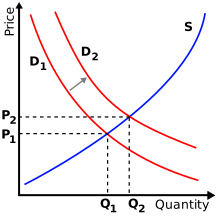
- Learn the graphs thoroughly: Graphs are the language of economics, and understanding them is essential for success.
- Focus on cause-and-effect relationships: Instead of memorizing facts, understand how one economic event leads to another.
- Practice free-response questions: FRQs help you apply concepts and prepare for exam-style thinking.
- Memorize key formulas: GDP calculations, inflation formulas, and other economic measurements appear regularly.
- Connect concepts to current events: Following economic news makes AP Macro concepts easier to understand and remember.
These tried-and-true tactics will help you develop the understanding you need to earn a 4 or 5.
Final thoughts
AP Macroeconomics provides students with a powerful framework for understanding how economies function at both the national and global levels. From basic economic concepts and business cycles to banking systems, monetary policy, and international trade, each unit contributes to a broader understanding of economic decision-making.
The key to success in AP Macro is not simply memorizing definitions but understanding how the concepts connect. Students who focus on the relationships between economic indicators, financial markets, government policies, and international trade are often better prepared for both the AP exam and future studies in economics.
By mastering the six AP Macro units and regularly practicing graphs, calculations, and free-response questions, students can build a strong foundation in macroeconomics and approach the AP exam with greater confidence.