Failed the Series 66 with Kaplan? Whether to switch prep courses, and a retake plan


Table of contents
- Series 66 retake facts
- How to read your score report
- Stay or switch?
- Signs the course was the problem
- Signs the study plan was the problem
- When keeping Kaplan makes sense
- Switching to Achievable from Kaplan: what changes
- A 30-day Series 66 retake plan
- Days 1 to 3: diagnose and enroll again
- Days 4 to 12: rebuild the weakest section
- Days 13 to 20: cover the rest and sit a full exam
- Days 21 to 30: full-length exams until the scores hold
- Series 66 retake FAQ
- Key takeaways
Switch prep courses for your Series 66 retake when the course itself was the problem: its practice scores said you were ready and the real exam said otherwise, the same kinds of mistakes kept coming back, or you had seen its questions so often that you were remembering answers instead of working them out. If you missed by a few points and the explanations made sense to you, keep the course and change the plan. Either way, read your score report first, and know that NASAA makes you wait 30 days after a first or second failed attempt, so your retake is at least a month away.
Start with Achievable’s free full-length Series 66 practice exam: 100 questions with an explanation for every answer. Taken timed, on questions you have never seen, it shows whether your earlier practice scores were real; read it with the signs below. If you do switch, Achievable’s Series 66 course costs $199 for a year and has 29 full-length practice exams, each serving the questions you haven’t seen first. If you studied with Kaplan, the sections below also say what its Series 66 packages include, from Kaplan’s own pages.
Series 66 retake facts
NASAA writes the Series 66 and sets its retake rules; FINRA delivers it. Here is what applies to a retake, from NASAA’s exam FAQ and Series 66 study guide and FINRA’s Series 66 page:
Fact | The rule |
|---|---|
Wait after a first or second failed attempt | 30 days |
Wait after a third or later failed attempt | 180 days, counting failures within two years. For an exam window opened on or after January 4, 2027, 60 days |
Number of attempts | No limit, as long as you meet the waits |
Fee | $177 for each attempt. Each retake needs a new enrollment and a new fee |
Time to test | A 120-day window from enrollment. NASAA doesn’t extend it to give you more study time |
Passing score | 73 of the 100 scored questions. The exam has 110 questions (10 unscored pretest questions you can’t tell apart) in 150 minutes |
Sponsor | None needed. Your firm enrolls you, or you enroll yourself through FINRA’s Test Enrollment Services System (TESS) |
Where | At a test center. Until January 4, 2027, FINRA offers it online only to candidates who need a testing accommodation; from that date NASAA ends remote testing, and accommodations are given in the test center |
NASAA won’t shorten a wait on a window opened before January 4, 2027, so after a third failure, open your next window on or after that date if you want the 60-day wait. A wait applies only to the exam you failed: a failed Series 66 doesn’t touch a Series 7 or SIE you’ve already passed. You can take the three in any order, as long as all three are valid when you register using the Series 66.
How to read your score report
A fail comes with more detail than a pass. NASAA’s study guide says any candidate who fails "will be informed of their scores within each of the four sections of the examination." FINRA’s test center page describes the same report: a fail result shows "your overall exam score and your performance on each of the topic sections on the exam." The four sections, from NASAA’s Series 66 content outline, effective June 12, 2023, carry very different weights:
Section | Scored questions | Share of the exam |
|---|---|---|
I. Economic factors and business information | 8 | 8% |
II. Investment vehicle characteristics | 17 | 17% |
III. Client/customer investment recommendations and strategies | 30 | 30% |
IV. Laws, regulations, and guidelines, including prohibition on unethical business practices | 45 | 45% |
Total | 100 | 100% |
Read your report in three passes:
- How far below the line you were. You need 73 of 100. A result a few points short usually means a few weak topics and a plan problem. A result well below it means the foundations need rebuilding, and that is when the course deserves a hard look.
- Which sections cost you the most. Count the questions, not the percentages. Laws and regulations is 45 of the 100, so a weak result there costs more than a weak result anywhere else; NASAA notes that the sections are weighted differently, so you can’t average them into your overall score. It covers the regulation of investment advisers and their representatives, broker-dealers and their agents, and securities and issuers, along with remedies, communication with clients, and ethical practices and fiduciary obligations.
- Whether the weakness was narrow or broad. One or two weak sections point to gaps you can close in a month. Weak results across all four point to how you studied, or what you studied with.
Don’t read too much into the smallest section. Economic factors has 8 scored questions, so one question moves your result there by 12.5 points. Use the sections to rank where your next month goes, weighted by size.
Stay or switch?
The question is the same for any course, Achievable’s included: did the course let you down, or did the plan? Often the fix is a different plan, not a new course. But the signs that a course was the problem are usually clear once you look for them.
Signs the course was the problem
- Its practice scores didn’t predict your result. You scored comfortably on its practice tests and still failed. Its questions may be easier than the exam’s, or you may have seen them before.
- You had seen the questions before. Your scores climbed because you recognized the questions, and the real exam’s wording felt new. NASAA keeps its questions out of circulation because releasing them would "turn them into memorization tests rather than tests of competency." A question bank you could pass from memory was testing the same thing.
- You finished practice exams far too fast. Getting through a 100-question practice exam in an hour or so, with good scores, usually means you were recognizing questions rather than working them.
- It gave you few full-length timed exams, or none. If you never sat a full exam against the clock before exam day, the course never tested your pacing or your stamina.
- Its explanations didn’t teach you. Much of the Series 66 turns on definitions, exemptions and exceptions. If you could pick an answer but couldn’t say why the other three were wrong, the explanations weren’t doing their job.
- Its material was out of date. NASAA updates its question banks for changes in the law and new model rules, and its FAQ warns that "using outdated study materials carries some risk." Its Series 66 outline page says it is updating the questions affected by the investment adviser advertising rule amendments adopted in May 2026, in early 2027.
One candidate who posted on Achievable’s community forum shows the first of these signs clearly. They had passed the SIE, an insurance exam and the Series 7 on the first try with Kaplan, averaged 89% on Kaplan’s QBank tests for the Series 66, and failed it twice, saying about 30 questions on the real exam felt like ones they weren’t prepared for. Scores that high on a bank that didn’t predict the result are the strongest reason to change what you practice with.
Signs the study plan was the problem
- You ran short of time, or crammed most of the material into the last few days.
- You took one full-length practice exam, or none, under timed conditions.
- You left your weakest section alone, and your score report shows it.
- You sat the exam with practice scores near 73%, hoping the real one would go a little better.
- The trouble was on test day: running short of time, poor sleep, or changing right answers to wrong ones.
When keeping Kaplan makes sense
If most of your signs are in the second list, staying can be the right call. It fits when your Kaplan access still has weeks left, your miss was small and concentrated in one or two sections, you haven’t used up the exams your package includes, and its explanations made sense to you. Kaplan’s QBank generates practice exams at random with unlimited attempts, which makes it good for drilling a weak section. But its exams draw on the pool you’ve already practiced on, so your scores there rise with reuse; judge your readiness on questions you haven’t seen.
Check two things on Kaplan’s Series 66 page first. Its online access lasts 5 months, and a 5-month extension costs $49, so a retake that falls after your access ends needs one. And its Practice, Checkpoint and Midterm Exams can each be taken only once, so if you used them before your first attempt, the QBank and any Mastery Exam you have are what’s left. Ask your firm too, if it paid for your course or requires a particular provider.
Switching to Achievable from Kaplan: what changes
If the course was the problem, here is how the two compare. Achievable’s figures are from its Series 66 course. Kaplan’s prices, access and contents are the list figures on Kaplan’s Series 66 page, before its frequent sales; its class-retake policy is from Kaplan’s securities FAQ, and its pass rate from Kaplan’s pass results page.
Achievable Series 66 | Kaplan Series 66 | |
|---|---|---|
Price | $199 | $149 Basic, $189 Essential, $269 Premium on demand, $299 Premium live online |
Access | 12 months | 5 months; a 5-month extension costs $49 |
Practice exams | 29 full-length, each 100 questions weighted like NASAA’s outline, serving the questions you haven’t seen first | A Practice Exam in every package; unit Checkpoint Exams and a Midterm Exam from Essential up; these three can each be taken only once. A Mastery Exam in Premium, or in the $29 Online Practice and Mastery Exams Package. Plus random QBank exams |
Practice questions | 3,200+ in all, including the 2,900+ exam questions, each with an explanation | QBank in every package; Kaplan doesn’t publish its size |
Guarantee | Pass guarantee; terms below the table | None on its Series 66 page. Live online students can retake the class within their access period (PassProtection) |
Pass rate | 95% (Achievable’s Series 66 students who completed their prep and reached their scheduled exam date) | 90% (surveyed Kaplan students who followed its study plan, retakes included) |
Achievable’s pass rates are the industry’s best. Achievable’s Series 66 pass rate is 95%: of the Achievable Series 66 students who completed their prep and reached their scheduled exam date, 95% passed, based on students’ self-reports and our corporate clients’ exam results. Kaplan reports a 90% Series 66 pass rate from its own survey, 2019 to July 2025, of students who bought a Kaplan course and followed its study plan, and says the figure reflects "students’ ultimate success, which may have required multiple exam attempts."
Achievable’s pass guarantee: pass, or get your money back. Pass one of the course’s full-length practice exams within the standard time before your exam. If you then fail the exam, email a picture of your score report with a valid state ID, and once they’re verified, Achievable refunds the course in full. There is no minimum study time and no chapter to finish. The pass guarantee’s terms are in Achievable’s FAQ.
What else the course gives you:
- New questions first. Each full-length exam draws 100 questions from 2,900+ the way NASAA’s outline splits them (45 on laws and regulations, 30 on client recommendations and strategies, 17 on investment vehicles and 8 on economic factors) in the real exam’s 2 hours 30 minutes, and each new exam serves the questions you haven’t seen first. Your scores measure what you know, not what you remember.
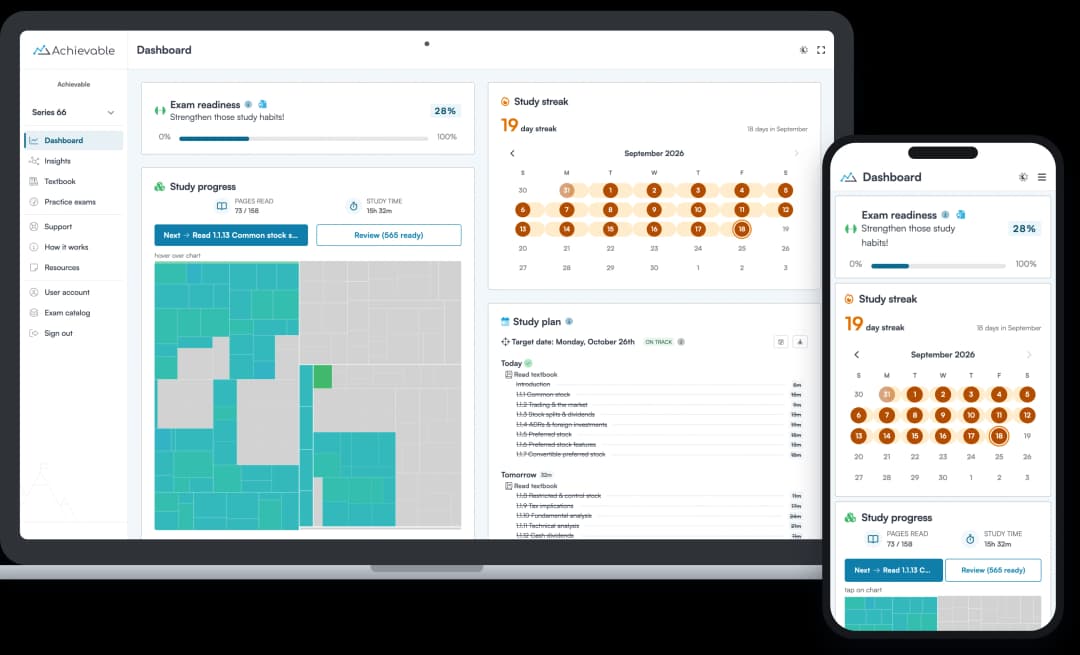
- Review that adapts to you. Its learning engine tracks your retention and mastery of each exam learning objective and adjusts your quiz questions toward the topics that matter most for you.
- Another way into the material. 50+ videos and audio narration alongside the online textbook, if a long textbook was what lost you the first time.
- A year of access. At $199 for 12 months, a retake date that slips doesn’t cost you an extension. The first lessons are free, with no credit card needed.
A 30-day Series 66 retake plan
NASAA’s wait after a first or second failed attempt is 30 days, which makes a month the natural length for a retake plan. It is the earliest you can sit again, not a deadline: book the retake for when your practice scores say you’re ready. For scale, Achievable’s Series 66 students study around 48 hours on average before exam day, and most reach exam-ready in about 10 weeks from the start; a retake builds on what you already know.
Days 1 to 3: diagnose and enroll again
- Take a full-length practice exam timed, with no notes. Achievable’s free Series 66 practice exam works for this. Its 100 questions match the real exam’s scored ones; the real exam adds 10 unscored questions in the same 150 minutes, so aim to finish with about 15 minutes to spare.
- Put its results beside your score report and list your two weakest sections, weighting the larger ones more.
- Open a new enrollment. If your firm enrolled you, it requests the exam again through FINRA’s registration system (CRD). If you enrolled yourself, submit a new request through TESS. Either way you pay the $177 fee again and get a new 120-day window.
Days 4 to 12: rebuild the weakest section
- Reread the chapters behind your weakest section, then work their quizzes until you can explain every wrong answer.
- If laws and regulations wasn’t your weakest, start on it now anyway. At 45 of the 100 scored questions, it decides more results than any other section.
Days 13 to 20: cover the rest and sit a full exam
- Work the remaining sections with mixed quizzes, so you practice switching between topics as the exam does. Give the calculation topics worked practice, not just reading: time value of money (future value, net present value and internal rate of return), basic statistics and financial ratios, bond and stock valuation, taxes and portfolio performance measures.
- Take a full-length timed exam at the end of the stretch, and spend as long reviewing it as you spent taking it. Review every miss, including the ones you guessed right.
Days 21 to 30: full-length exams until the scores hold
- Take a full-length timed exam every other day, each on questions you haven’t seen, and review each one before the next.
- Before you book the Series 66, aim for 100% readiness: score about 83%, 10 points above the 73% passing score, on practice exams, again and again across several full-length exams, so a pass does not depend on the luck of the draw.
- If you aren’t there yet, move the appointment, inside your 120-day window. FINRA’s cancellation policy charges nothing if you reschedule a minimum of 10 business days ahead, $88.50 within 3 to 10 business days, and the full $177 within 2 business days or for a no-show. On a firm enrollment, FINRA bills that fee to your firm. On an enrollment you opened yourself through TESS, a late cancellation forfeits the fee and uses up the enrollment. Past the window, you enroll and pay $177 again.
The Series 66 study plan has a six-week, week-by-week version if you’re starting the material over.
Series 66 retake FAQ
How long do I have to wait to retake the Series 66? 30 days after a first or second failed attempt, and 180 days after a third or later failed attempt, counting failures within two years. For an exam window opened on or after January 4, 2027, the wait after a third or later failure is 60 days. Our article on NASAA’s new waiting period covers the change.
How much does a Series 66 retake cost? The full $177 exam fee again. NASAA gives one attempt per fee and enrollment window.
How many times can I take the Series 66? NASAA sets no limit, only the waiting periods. Some firms limit attempts in their own policies, so ask yours.
Do I have to retake the Series 7 if I failed the Series 66? No. A wait applies only to the exam you failed, and a passed exam isn’t affected. You can take the SIE, the Series 7 and the Series 66 in any order, as long as all three are valid when you register using the Series 66.
How does Achievable’s pass guarantee work? Pass one of the course’s full-length practice exams within the standard time before your exam. If you then fail the exam, email a picture of your score report with a valid state ID, and once they’re verified, Achievable refunds the course in full. There is no minimum study time and no chapter to finish. The Series 66 FAQ answers more questions about the exam and the course.
Should I switch from Kaplan after one failed attempt? Only if the course was the problem: practice scores that didn’t predict your result, questions you had memorized, or too few full-length timed exams. Otherwise keep it, check your access dates, and change the plan. Our Achievable vs. Kaplan Series 66 comparison sets the two courses side by side.
Key takeaways
- Take Achievable’s free full-length Series 66 practice exam on questions you haven’t seen, to check whether your earlier practice scores were real.
- Switch courses when the course was the problem: practice scores that didn’t predict your result, memorized questions, or too few full-length timed exams. Otherwise keep it and change the plan.
- Your failing score report shows your result in each of the four sections. Start with your weakest, and give laws and regulations (45 of the 100 scored questions) time even if it wasn’t.
- NASAA’s wait is 30 days after a first or second failure and 180 days after a third within two years, falling to 60 days for windows opened on or after January 4, 2027.
- A retake needs a new enrollment and the $177 fee again.
- Kaplan’s online access lasts 5 months and its Practice, Checkpoint and Midterm Exams can each be taken once, so check what you have left before deciding to stay.
- Aim for 100% readiness: about 83%, 10 points above the 73% passing score, on practice exams, again and again across several full-length exams.