Changing my mindset helped me pass the Series 7


Adam Pryor is a Financial Professional with Capstone Partners, where he works with individuals and families to build comprehensive financial strategies focused on long-term growth, protection, and stability. Fully licensed, Adam provides guidance across investments, retirement planning, and risk management, helping clients simplify complex financial decisions and stay aligned with their goals.
Before transitioning into financial services, Adam built a strong background in public policy and political organizing. He previously ran for the State Assembly in California and has worked on multiple campaigns and advocacy efforts, developing deep experience in relationship-building, communication, and strategic problem-solving. Adam is particularly passionate about working with professionals in public service, nonprofit organizations, and mission-driven careers, groups that often face unique financial challenges and are underserved by traditional financial planning. His approach emphasizes education, transparency, and long-term partnership. He is fluent in Hungarian, English, and Spanish, and brings a global perspective to his work with clients.
When I started studying for the Series 7 exam, it wasn’t just another test for me. It felt like the final gate. I had already made a pretty big career shift, from politics and public policy into financial services, and I was trying to build something from scratch. No salary, no guaranteed income, just me, a phone, and a list of people to call. At the same time, I still needed to pass my last exam to actually unlock the full scope of what I could do for clients.
So yeah, the Series 7 mattered.
A lot.
The hard part wasn’t the material
Everyone talks about how hard the exam is, and don’t get me wrong, it’s not easy. But the hardest part for me wasn’t learning options or suitability rules; it was trying to do everything at once.
I was working during the day, prospecting, trying to book meetings, dealing with the ups and downs of a commission-based role, and then I’d sit down at night and tell myself, “Alright, time to study.” And most nights, I didn’t want to.
I was tired. Mentally drained. Distracted. I’d open my laptop and, 10 minutes later, somehow end up on my phone. It got to the point where I started getting frustrated with myself because I knew what I needed to do, but I wasn’t doing it consistently.
That’s probably the part people don’t talk about enough: the gap between knowing and doing.
What actually helped
I wish I could say I found some perfect study routine and everything clicked, but that’s not what happened. What helped was lowering the bar. Instead of saying, “I need to study for three hours,” I started saying, “Just do 30 minutes.” That was it.
Some days it stayed 30 minutes. Other days, it turned into more. But it got me moving again, and that mattered more than anything.
I also had to stop beating myself up for bad days. There were days I didn’t study. There were days I half-studied. That didn’t mean I was failing; it just meant I needed to get back on track the next day.
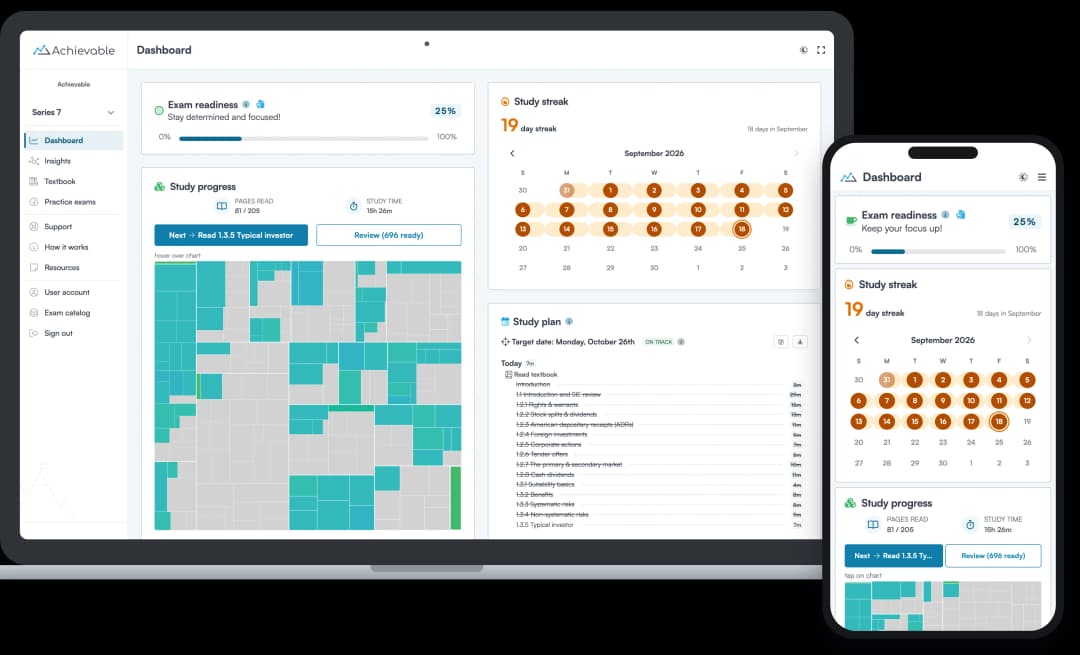
Using Achievable helped too, mostly because it made things feel less overwhelming. It broke the material down in a way that felt manageable, which was huge when my attention span wasn’t exactly at its peak.
The mental side was the real battle
If I’m being completely honest, the biggest challenge wasn’t academic; it was mental.
There were stretches where I felt behind. Times when I avoided studying because I didn’t want to confront how much I still didn’t know. Moments where I started questioning whether I was cut out for this.
And then on top of that, I’m trying to build a business at the same time? It’s a lot.
What changed for me was realizing that I didn’t need to feel confident all the time. I just needed to keep showing up, even when I didn’t feel great about it. Once I accepted that, things got easier.
Not easy, but easier.
Test day
I wasn’t calm as I walked into the exam. But I also wasn’t freaking out. I think the best way to describe it is: I felt “good enough.”
And that was a big shift for me, because earlier in the process I felt like I needed to know everything. By test day, I understood that it wasn’t realistic. I just needed to trust the work I had put in.
When I saw that I passed, it didn’t feel like some huge dramatic moment. It was more like a deep exhale. Like, “Alright… we’re good.”