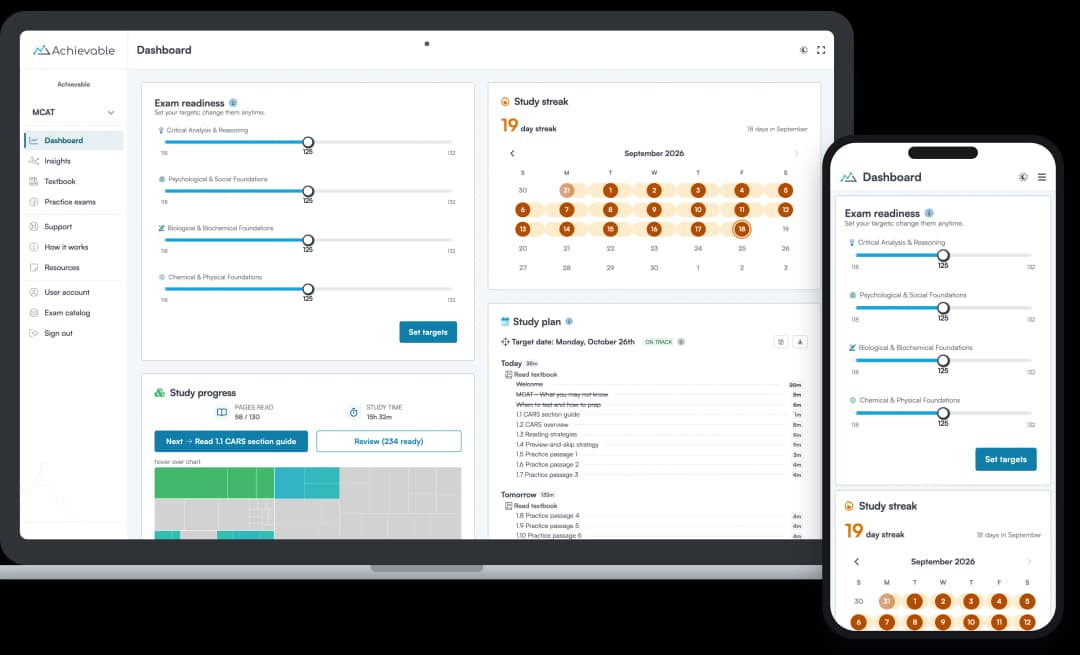
Reverse engineering your MCAT score for med school success


Aliza Kamran Khan is a dedicated and perceptive leader in medical education. As a thesis advisor, USMLE instructor, and professor, she has mentored countless students and professionals in complex subjects, particularly those essential to exams such as the USMLE Step 1. Drawing on years of experience in teaching and curriculum development, she is passionate about making anatomy both engaging and clinically relevant. Currently teaching at Accord University, Aliza emphasizes active learning and deep conceptual understanding, approaches that foster confidence and enhance performance, especially in high-pressure academic settings.
Table of contents
- How to study for the MCAT: Proven strategies to boost your score
- Key insights
- Reverse engineer your target MCAT score
- How to set your MCAT target score
- Why this strategy works
- Build an effective MCAT study schedule
- Start studying early
- Use active recall and spaced repetition
- Avoid passive study habits
- Prioritize practice tests and timed questions
- Why practice exams matter
- Spend more time applying than reviewing
- Improve your mindset and eliminate distractions
- Develop a growth mindset
- Create disciplined study habits
- Reduce digital distractions
- Common MCAT study mistakes to avoid
- Final thoughts on MCAT preparation
How to study for the MCAT: Proven strategies to boost your score
Key insights
- Set your MCAT target score using real admissions data, not arbitrary benchmarks.
- Effective MCAT prep depends more on strategy and consistency than endless study hours.
- Practice exams and timed question sets are the fastest way to improve performance.
- Active recall and spaced repetition outperform passive review methods.
- Discipline, focus, and distraction management can significantly impact your final score.
For aspiring medical students, the MCAT is one of the biggest challenges on the road to medical school. Many students spend months studying, only to feel frustrated when their practice scores plateau or their routines become unsustainable.
The truth is that getting a high MCAT score is not just about working harder. It’s about building a smarter study strategy.
Students who perform well on the MCAT typically focus on three things:
- Setting realistic score goals
- Following an efficient study routine
- Practicing under real testing conditions
If you want to improve your MCAT score without burning out, the strategies below can help you build a more effective and sustainable approach to preparation.
Reverse engineer your target MCAT score
One of the most common mistakes students make is choosing an MCAT goal score that “sounds good” instead of using actual admissions data.
Rather than aiming for a generic “520+,” base your target score on the medical schools you plan to apply to.
According to the AAMC’s Medical School Admission Requirements (MSAR) database, average accepted MCAT scores vary widely between schools. Competitive programs like Harvard Medical School often report median scores around 520, while many state schools accept applicants in the 508-512 range.
How to set your MCAT target score
Start by:
- Listing the medical schools you’re interested in
- Researching their average accepted MCAT scores
- Reviewing score ranges and median GPAs
- Setting a target score slightly above the median
This approach gives you a clearer and more strategic study goal.
Why this strategy works
Using admissions data helps you:
- Avoid overstudying for schools that don’t require elite scores
- Understand how competitive your application is
- Reduce anxiety by replacing vague goals with measurable targets
- Build a more balanced application strategy
Instead of chasing an arbitrary number, you create a focused roadmap for success.
Build an effective MCAT study schedule
One of the best MCAT study tips is to prioritize consistency over cramming.
Research in cognitive science consistently shows that spaced learning and regular review improve long-term retention more effectively than last-minute marathon sessions.
Start studying early
Most successful students prepare for over 2-3 months with a structured schedule.
A realistic MCAT study schedule often includes:
- 10-15 focused study hours per week
- Dedicated content review blocks
- Weekly practice questions
- Regular full-length exams
Studying over a longer period helps reduce burnout and improves retention.
Use active recall and spaced repetition
Passive studying feels productive, but it’s rarely the best way to prepare for the MCAT.
Instead of rereading notes or highlighting textbooks, focus on active learning techniques like:
- Flashcards
- Practice questions
- Self-testing
- Teaching concepts aloud
Spaced repetition systems like Anki can also help reinforce difficult concepts over time.
Avoid passive study habits
Many students overestimate how much they know because passive review creates a false sense of familiarity.
Less effective methods include:
- Endless rereading
- Highlighting without testing yourself
- Watching lectures without follow-up practice
The MCAT rewards application and reasoning, not recognition alone.
Prioritize practice tests and timed questions
If you want to know how to get a high MCAT score, one strategy matters more than almost anything else:
Practice under realistic testing conditions.
Content review is important, but practice questions and full-length exams are what translate knowledge into performance.
Why practice exams matter
Timed MCAT practice tests help you:
- Improve pacing
- Build testing stamina
- Identify weak areas
- Reduce test-day anxiety
- Learn how questions are structured
Research on retrieval practice shows that self-testing improves memory retention far more effectively than passive review.
Spend more time applying than reviewing
Many students spend too much time consuming information and not enough time using it.
As your exam approaches, the majority of your study schedule should include:
- Timed practice passages
- Full-length exams
- Error analysis
- Reviewing missed questions
Your goal is not just to understand the material, but rather to apply it quickly and accurately under pressure.
Improve your mindset and eliminate distractions
Strong MCAT performance depends on more than academic ability.
Your habits, discipline, and environment can have a major impact on your score.
Develop a growth mindset
Students who believe they can improve through effort are more likely to stay consistent and recover from setbacks.
A disappointing practice score does not mean you are incapable of succeeding. It usually means your strategy needs adjustment.
Maintaining a growth-oriented mindset helps you:
- Stay motivated during long study periods
- Learn from mistakes instead of avoiding them
- Build resilience during difficult weeks
Create disciplined study habits
Consistency beats intensity when preparing for the MCAT.
Effective habits include:
- Studying at the same time each day
- Scheduling breaks intentionally
- Tracking progress weekly
- Reviewing mistakes regularly
Small routines compound into major results over time.
Reduce digital distractions
Phone notifications, social media, and multitasking can seriously reduce concentration and retention.
To improve focus:
- Use “Do Not Disturb” mode
- Study in distraction-free environments
- Try website blockers during study sessions
- Keep your phone out of reach during practice exams
Even short interruptions can disrupt deep focus and lower productivity.
Common MCAT study mistakes to avoid
Many students work hard but still struggle because they fall into ineffective study patterns.
Avoid these common MCAT prep mistakes:
- Waiting too long to begin studying
- Spending too much time on passive review
- Ignoring practice exams
- Studying without a clear score target
- Failing to review mistakes carefully
- Comparing your progress to that of other students
The most effective MCAT prep plans are personalized, strategic, and sustainable.
Final thoughts on MCAT preparation
The best MCAT study strategies combine structure, discipline, and realistic practice.
Start by setting a score goal based on the medical schools you want to attend. Build a consistent study routine that emphasizes active recall, spaced repetition, and full-length practice exams. Most importantly, focus on applying knowledge under timed conditions instead of relying solely on content review.
Preparing for the MCAT is challenging, but a smart, focused approach can make the process far more manageable and significantly improve your chances of success.
Whether you’re just beginning your MCAT journey or trying to raise your practice scores, the right strategy can help you study more efficiently, stay motivated, and walk into test day with confidence.