FE exam requirements inevery U.S. state
Interested in earning your engineering-in-training (EIT) credential in your state? Below, you’ll find FE exam and registration information for all 50 states plus the District of Columbia. Get a head start on your engineering career by reviewing all rules and requirements.
The Fundamentals of Engineering (FE) exam is a standardized, national test with eligibility requirements that vary by state. Typically, candidates must either complete an undergraduate engineering program or be in the final year of one, though there are exceptions.
The FE exam is a fundamental test for future engineers, overseen by the National Council of Examiners for Engineering and Surveying (NCEES). As an initial exam and a pathway to licensing, it assesses core engineering principles via a set of discipline-specific assessments.
What is the FE exam?
The FE exams are 110-question, 5-hour, 20-minute assessments that evaluate students’ understanding of core engineering concepts.
Exams are offered for the following disciplines. Students choose one FE exam to take based on their chosen specialty:
- Chemical engineering
- Civil engineering
- Electrical and computer engineering
- Environmental engineering
- Industrial and systems engineering
- Mechanical engineering
- Other disciplines (misc.)
Each FE exam for engineers contains entirely multiple-choice questions and is open-book: the NCEES allows candidates to use discipline-specific FE Reference Handbooks throughout the exam. These handbooks include definitions, equations, and other helpful information, easing the burden of memorization and allowing students to focus on application. Exams are taken on a computer at NCEES-approved Pearson test centers: remote exams are not offered.
Passing the test, which has a national first-time pass rate between 61% and 69%, is what opens the engineer-in-training (EIT) or engineer intern (EI) credential to early-career professionals — most boards then ask you to apply for the certification itself separately. From there, engineers can continue their career pathway toward the Professional Engineer (PE) designation after gaining work experience and passing an additional exam.
What are the general requirements for the FE exam?
In most cases, the FE exam is open to graduates of accredited baccalaureate engineering programs or those close to graduation. These programs must be Engineering Accreditation Commission (EAC)-approved under ABET, the national organization that upholds standards in engineering education. State licensing boards determine specific requirements.
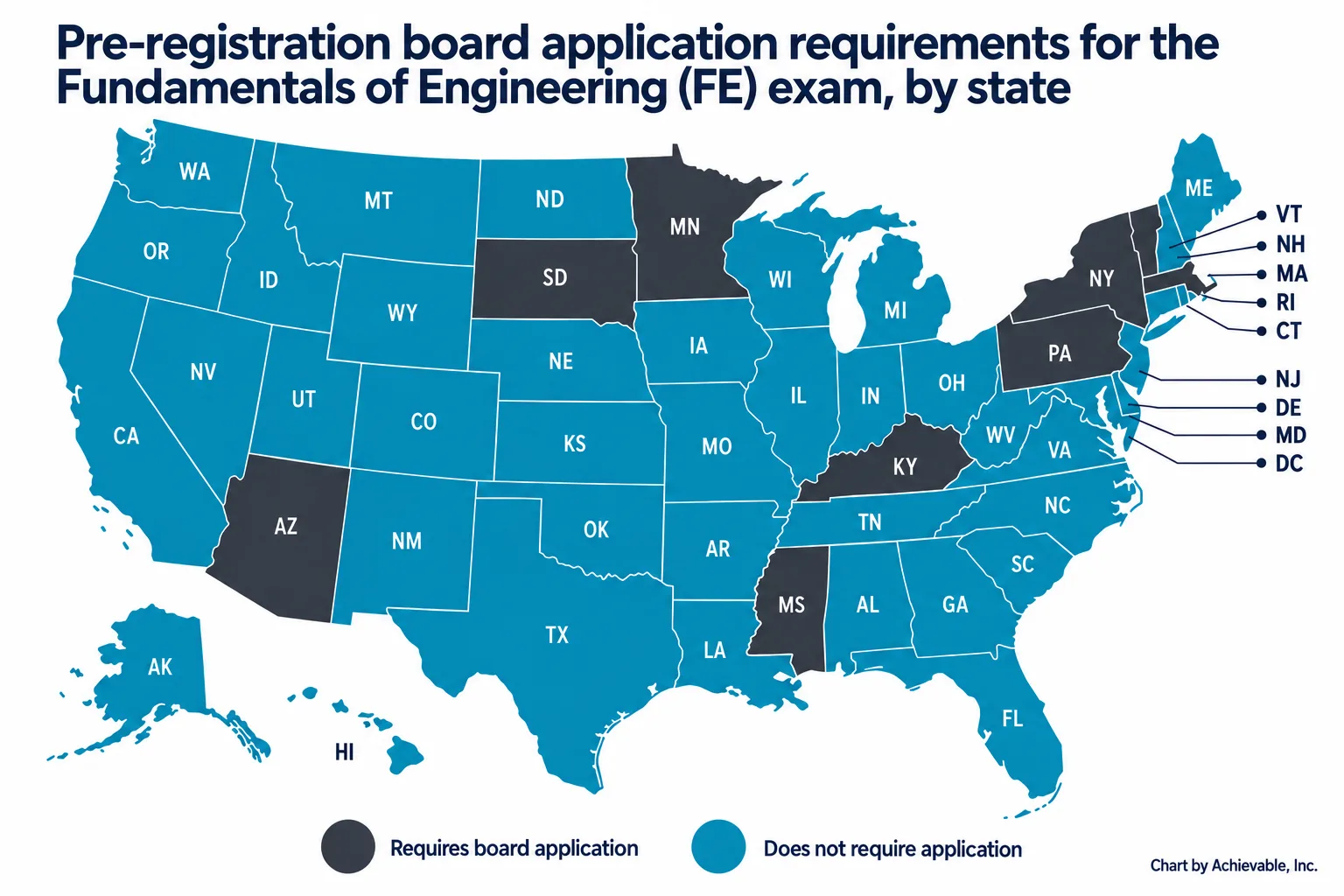
For instance, some candidates may need to seek approval from the state board and pay an additional fee to register for the exam. Note, however, that most states do not require a pre-registration board approval, and most candidates can directly register with the NCEES:
Many states also have alternate pathways for international or non-traditional students without four-year degrees from accredited engineering colleges. Students who graduate from approved master’s programs can qualify to take the test even if their undergraduate degree is in an unrelated field. Some states allow a certain number of years of experience, often between 8 and 10, to count toward education requirements. Always check with your state board to find out which requirements apply to you.
Find your state’s FE requirements
Use our directory to find how to earn your EIT credential in your state and understand specific FE exam requirements. Each page outlines specific prerequisites, exam scheduling, fees, cancellations, and other policies.
- Alabama
- Alaska
- Arizona
- Arkansas
- California
- Colorado
- Connecticut
- Delaware
- District of Columbia
- Florida
- Georgia
- Hawaii
- Idaho
- Illinois
- Indiana
- Iowa
- Kansas
- Kentucky
- Louisiana
- Maine
- Maryland
- Massachusetts
- Michigan
- Minnesota
- Mississippi
- Missouri
- Montana
- Nebraska
- Nevada
- New Hampshire
- New Jersey
- New Mexico
- New York
- North Carolina
- North Dakota
- Ohio
- Oklahoma
- Oregon
- Pennsylvania
- Rhode Island
- South Carolina
- South Dakota
- Tennessee
- Texas
- Utah
- Vermont
- Virginia
- Washington
- West Virginia
- Wisconsin
- Wyoming


















































Each state page includes contact information for the licensing board, allowing you to reach the right office quickly. Scroll through to access everything you need for your EIT certification.
Frequently asked questions (FAQs)
The FE exam is the first step to becoming a fully licensed engineering professional. After completing FE and work experience requirements, you will be eligible to obtain your professional engineer (PE) designation, which grants professionals the ability to sign and seal documents, take legal responsibility for engineering projects, and lead teams across the sector.
- Complete your education requirements: Start the process by earning a four-year bachelor’s degree from an accredited program. Generally, you may major in engineering or a closely related field such as mathematics or chemistry. Special accommodations apply for international and graduate students.
- Pass the FE exam: Study for and pass the FE exam in your discipline (such as Civil or Mechanical Engineering).
- Gain work experience: Fulfill four years of progressive engineering work experience under the supervision of a licensed PE. This stage forms the practical component of the standard engineering track.
- Pass the PE exam: Successfully prepare for and pass the Principles and Practice of Engineering (PE) exam. Like the FE exam, the PE is offered in several specialties.
Altogether, candidates often spend between eight and ten years attaining full PE licensure, including obtaining their engineering degree and fulfilling both professional assessments. Of course, the timeline can vary based on individual study schedules, exam preparation, and the pace at which required experience is obtained.
Yes: you can be licensed in multiple states. Many states use comity/endorsement, where you apply to a new state board using an existing license, exam score, and work history. Exams are offered across the U.S., and you do not need to retest if you move to a different state.
You may use the NCEES Records Program to easily access your documents, though you will need to apply to each board individually. Creating a Record is free; NCEES charges $175 for the first comity transmittal and $100 for each subsequent transmittal.
Note that the FE exam does not vary by state: the format and passing thresholds are consistent across jurisdictions.
In most cases, the FE exam is available to graduates of accredited undergraduate engineering programs or those nearing graduation. International and graduate students may qualify for special accommodations, depending on state regulations.
The passing score for the FE exam varies with each exam cycle. NCEES uses a psychometrically scaled scoring system that adjusts for exam difficulty and test-taker performance. Raw scores, representing the number of correctly answered questions, are converted into scaled scores to decide if a candidate passes or fails.
Minimum passing scores are not publicly available, but it’s recommended to target a raw score of at least 70%.
To take the FE exam, first check whether your state requires pre-approval. Afterward, you can sign up directly with the NCEES, pay your exam fee, pick a local Pearson VUE testing center, and choose a date. All exams are offered year-round at participating testing sites.
The FE Reference Handbook for your chosen test can be downloaded directly from your NCEES account and is an instrumental tool in your exam preparation. Don’t forget to practice with an approved calculator and bring one on test day. While the test allots five hours and 20 minutes to answering questions, be prepared for your total appointment to run about six hours once you account for the tutorial, a scheduled break, and other instructions.
The FE exam is the baseline requirement to becoming an engineer-in-training, and eventually a professional engineer in the U.S. While you can work as an engineer without taking the FE exam, you may risk opportunities that are only open to those who have passed the test, as FE exams demonstrate competency in specific engineering areas. Exam waivers may apply to those on the PE pathway with advanced work or education experience, though you will always need to formally apply and petition your state’s licensing board.
Most experts and educators suggest taking the FE exam in your final college semester or soon after graduation, when your core coursework is still recent. However, many engineers take the test after entering the workforce; if this is the path you choose, make sure you dedicate time to studying and refreshing your knowledge before you take the exam.
Outside the U.S., NCEES exams are available in select foreign countries, including Turkey, Egypt, Saudi Arabia, the UAE (Sharjah), Japan, Korea, and Taiwan, as well as in some Canadian provinces. Similar to domestic candidates, you need to apply for licensure in a specific state to achieve full PE certification in the U.S.
Since many international candidates hold degrees from programs not accredited by ABET (the Accreditation Board for Engineering and Technology), they must formally apply and petition their state’s licensing board and undergo independent evaluation.
Closing thoughts
With a clear direction for FE registration in your state of choice, you can confidently set your testing date and prepare for this milestone exam. Whether you’re ready to build the world’s next urban marvel, improve infrastructure systems, or pursue advanced robotics, the engineering world is waiting for you, and the FE exam is your first step toward it.
FE exam requirements by state