How to register for the AMC


American Mathematics Competitions (AMC) registration is open for the 2026-2027 season: the process is straightforward, and students do not need to meet any qualifying test scores or grades to take part. Students sign up through a school or another competition site that is registered with the Mathematical Association of America (MAA) and compete in their age group (middle school, early high school, or late high school).
For the AMC 10 and AMC 12, the early-bird registration deadline is September 30, 2026 (the AMC 8 deadline is later in October, as it occurs after the other events). Regular registration dates fall in October for AMC 10 and 12 and January for AMC 8. Students can participate individually and do not need to be part of a team to enter these competitions, which serve as entry points to more advanced math competitions. However, tests must be ordered and administered by a registered competition manager, usually a teacher, math club adviser, or school administrator at an official institution.

What is the AMC?
The AMC 8, 10, and 12 are competitions designed to promote the development of problem-solving skills. Run by the MAA, these competitions are challenging, multiple-choice exams that students must complete within a set time limit without calculators. According to the MAA, over 300,000 students from all 50 states and over 30 countries take part in the AMC.
Here are the eligibility rules and exam information for each level:
- AMC 8: Open to students in grade 8 or below who are under 15.5 years of age on the day of the contest, 25 questions in 40 minutes
- AMC 10: Open to students in grade 10 or below who are under 17.5 years of age on the day of the contest, 25 questions in 75 minutes
- AMC 12: Open to students in grade 12 or below who are under 19.5 years of age on the day of the contest, 25 questions in 75 minutes
The exams cover:
- AMC 8: Counting and probability, estimation, proportional reasoning, elementary geometry including the Pythagorean Theorem, spatial visualization, everyday applications, and reading and interpreting graphs and tables
- AMC 10: Elementary algebra, basic geometry, area and volume formulas, elementary number theory, and elementary probability
- AMC 12: The entire high school curriculum, including trigonometry, advanced algebra, and advanced geometry, but excluding calculus
Participation and high performance in the AMC can qualify you for selective competitions and strengthen your academic profile when applying to elite high schools or colleges. Students in the U.S. and Canada take the AMC through a school or other competition site registered with the MAA, including homeschools. Students elsewhere sit the same competitions through the MAA’s AMC International program, so check whether your country participates.
Registration deadlines and pricing
Registration and student licenses are purchased by a competition manager (typically a teacher or school contact) registered with the MAA. Here’s how the deadlines and fees compare across the three competitions for the 2026-2027 season:
| Exam: | AMC 10 & AMC 12 | AMC 8 |
|---|---|---|
| Early bird deadline | Sep 30, 2026 ($55) | Oct 28, 2026 ($55) |
| Regular deadline | Oct 15, 2026 ($75): Final deadline for new competition managers | Jan 5, 2027 ($75): Final deadline for new competition managers |
| Late deadline | Oct 28, 2026 ($115): Returning competition managers only | Jan 14, 2027 ($115): Returning competition managers only |
| Additional bundles deadline | AMC 10/12 A: Nov 4, 2026; AMC 10/12 B: Nov 12, 2026 | Jan 26, 2027 (must be purchased by 11:59 PM the day before your scheduled AMC date) |
| Bundle price (10 student licenses) | $30 | $25 |
For the AMC 10 and 12, there are two competition dates available: competition managers can choose the one that best fits their and their students’ schedules, or have their students compete in both. Two different versions (A or B) of each exam will be administered on each date, but the overall format, content distribution, and skills tested remain the same. The AMC 8 offers a week-long testing window, with schools and managers deciding which date the exam will be administered to their students:
- AMC 12 A / AMC 10 A: November 5, 2026
- AMC 12 B / AMC 10 B: November 13, 2026
- AMC 8: January 21–27, 2027 (testing window)
How bundles work
The AMC provides licenses for students to test in bundles, which exam managers must purchase separately from registration costs. One “bundle” provides ten student licenses and can be applied to either the A or the B version of a competition. A single student who takes both the A and B versions needs two licenses. Additional bundles ordered close to a deadline must be paid for by credit card to ensure payment is received before the competition.
Additional bundle deadlines for the AMC 10/12 fall on November 4, 2026 (A) and November 12, 2026 (B); for the AMC 8, the deadline is January 26, 2027. Bundles must be purchased by 11:59 PM the day before you are scheduled to give the exam.
Preparing for the AMC
Success on the AMC, like many standardized tests, depends not only on mathematical skills but also on consistent, deliberate preparation. Even high-achieving math students find the AMC challenging because of its rigor, quick pace, distinct format, and multi-step problem-solving. To improve your score, dedicate at least a few weeks to practicing with realistic materials and textbooks. Many participating schools offer practice sessions and tutoring to help students sharpen their strategies and assess their progress before the official competition.
Step 1: Lean on focused textbooks
Using high-quality AMC textbooks, courses, and practice materials will allow you to deeply immerse yourself in your prep ahead of time. For example, the Art of Problem Solving (AoPS) textbook series is strongly recommended for preparation. These books emphasize deep mathematical reasoning, proofs, detailed solutions, and challenging problems, all designed to prepare you for AMC-style questions.
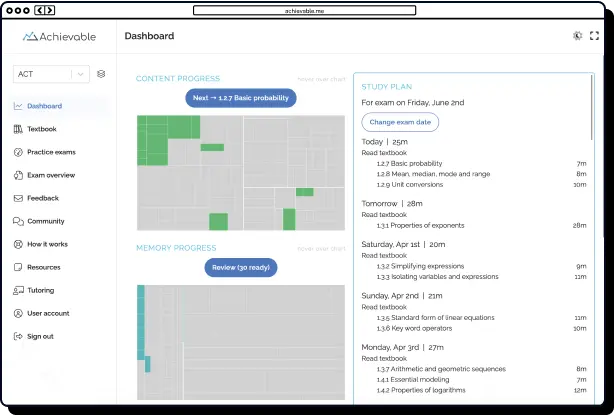
Achievable’s AMC course, featuring specialized content for the AMC 8, 10, and 12, offers even more practice resources and test-taking advice to help students build skills and mathematical competency.
Step 2: Use mock exams
Like any standardized test, proper preparation includes taking full-length practice exams to familiarize yourself with the format, timing, and test-day pressure. These exams also help develop mental stamina and provide a sense of the actual test experience. Additionally, all past AMC questions are available for practice and review, so include these official resources in your prep. Make sure you spend time answering questions without a calculator, as they will not be allowed on the test.
Step 3: Master AMC topics
Having a study plan focused on the major AMC content areas will help you stay organized. Common topics on the AMC include:
- Algebra
- Geometry
- Number theory
- Combinatorics
- Probability
- Inequalities
- Functional equations
- Reasoning and proof strategies
Thoroughly study each topic by practicing numerous problems and reviewing solutions until you can independently solve unfamiliar questions from the beginning, which is essential for the AMC.
Taking part in math competitions provides students with benefits beyond just trophies or certificates. Here’s what they can gain:
- Skills in critical thinking and creative problem-solving that surpass typical classroom learning.
- More competitive college applications, particularly for STEM programs and scholarships.
- Opportunities to network with peers and mentors who share your interests.
- A head start on advanced mathematics topics and methods, setting students up for college courses.
- Greater confidence in addressing unfamiliar or complex problems quickly.
The quantitative skills developed through these competitions are extremely useful, whether students are taking the AMC to enhance their math skills or striving to qualify for more advanced contests.

What happens after the AMC? Invitationals and advanced competitions
The AMC is the first step toward qualifying for advanced national and international math contests. The United States of America Mathematical Olympiad (USAMO) is an annual, proof-based competition for high school students and is among the most prestigious math contests in the country. To qualify for the USAMO, students need to demonstrate exceptional skills by performing well on the national exams leading up to the olympiad.
Students seeking qualification in the USAMO can participate in either the AMC 10 (for grades 10 and below) or the AMC 12 (for grades 12 and below). Students who perform well on these exams move on to the next level: the American Invitational Mathematics Examination (AIME).
The AIME has two versions, AIME I and AIME II, which are equally challenging but held on different dates to ensure security. Students choose one test date to take their exam. After that, the tracks diverge: students with the highest combined scores from the AMC 12 and AIME are invited to the USAMO, while top scorers on the AMC 10 qualify for the USAJMO (the junior olympiad). Both exams demonstrate a student’s preparedness for advanced math olympiads.
The top USAMO and USAJMO participants (roughly 60 out of a total of 500 to 600) are invited to join the Mathematical Olympiad Program (MOP) during the summer following the competition for further mathematical development. After testing at MOP, a select group of students is invited to take the Team Selection Tests (TSTs), a series of exams used to determine the teams that will represent the U.S. at the International Mathematical Olympiad (IMO) and regional competitions such as the European Girls’ Mathematical Olympiad (EGMO).
What if my school isn’t hosting the AMC?
If your school doesn’t offer the AMC, you can either take it at a participating school or speak to staff or faculty about hosting the competition on your campus. Some learning centers and tutoring services also offer the exam, so research your options near you. Make sure you do this well ahead of the relevant registration deadline.
Conclusion: Sign up today
Registration for the AMC 8, 10, and 12 for the 2026-2027 season is now open. The process is simple, and no qualifying test scores or grades are required to participate. Just register through your school or competition site in your age group: middle school, early high school, or late high school. For the AMC 10 and AMC 12, aim to do so before the early-bird deadline on September 30, 2026, to take advantage of discounted registration fees. The math skills and competitive strategies you’ll develop now will offer enormous benefits in your future studies and career.