

AMC 8/10/12
study guide
Every chapter of the course summarized, with each section linked to its lesson.
Reach your target score
Try Achievable AMC 8/10/12
No credit card required
This free AMC 8/10/12 study guide summarizes all 8 chapters of Achievable's AMC 8/10/12 course: what each covers, the points to remember, and its 30 sections in order. Read each chapter after you study it, or work through the whole guide before exam day.
Each section links to its full lesson in Achievable, with the review quizzes and full-length practice exams.
Chapter 1: Algebra
4 sections
Free chapter
- Linear equations: A linear equation is a straight line with variables to first power only, and a system of linear equations has solution as the intersection point.
- Inequalities and systems: Solve linear inequalities like equations, but flip the inequality when multiplying or dividing by negative, and solve SOLE by substitution or combining equations.
- Quadratics and exponents: A quadratic equation has form , while exponent rules, radicals, and logarithms relate powers, roots, and reciprocals.
- Functions and inverses: A function maps input to output as , and inverse functions reverse input-output so is found by swapping and .
In this chapter
Start this chapter free
Chapter 2: Geometry
7 sections
- Triangles basics: Three sides, three angles, interior angles sum to , and triangles are classified by side lengths and angle measures.
- Triangle formulas: Use base-height area, Pythagorean Theorem, and common right triangles like -- and -- to avoid unnecessary calculations.
- Circle relationships: Radius, diameter, area, circumference, chords, secants, tangents, cyclic quadrilaterals, and sector ratios all depend on algebraic relationships, not diagram scale.
- Lines and polygons: Vertical angles are equal, supplementary angles sum to , and polygons use for interior angle sum with standard quadrilateral properties.
- 3D and coordinates: Memorize volume and surface area formulas, then use slope, distance, midpoint, circle equations, and Pick's Theorem on the coordinate plane.
Study this chapter in Achievable
Chapter 3: Number theory
3 sections
- Factors and multiples: A divisor is a whole number dividing another with no remainder, a multiple is the result of multiplying by a whole number, and GCF/LCM come from prime factorization.
- Prime numbers: A prime is a positive integer with exactly two positive divisors, and prime factorization is unique up to order, with Fermat's Little Theorem useful in remainder problems.
- Modular arithmetic: means and have the same remainder when divided by , and operations work when moduli match.
In this chapter
Study this chapter in Achievable
Chapter 4: Counting and probability
3 sections
- Permutations and combinations: Permutations use when order matters, while combinations use when order does not matter.
- Probability rules: Probability is between 0 and 1, and while AND uses multiplication, OR uses addition, and with replacement probabilities remain constant each time.
- Stars and bars method: Stars and Bars distributes identical items into groups, using for at least one per group and when zero is allowed.
In this chapter
Study this chapter in Achievable
Achievable AMC 8/10/12
Prepare with the best online AMC 8/10/12 self-study prep course. Built for today's students: mobile, guided, and personally optimized.
Easy-to-understand online textbook
Chapter quizzes
Practice exams

Chapter 5: Intermediate topics (AMC 10/12)
3 sections
- Polynomials: Polynomials are built from terms coefficient × variable^nonnegative integer exponent, and roots satisfy and appear as -intercepts.
- Rational and recursive tools: Use Vieta's formulas, Newton sums, factoring, and polynomial long division to find root sums, products, and powers efficiently.
- Sequences and symmetry: A sequence is an ordered list, a series is the sum of its terms, and even, odd, and rotated graphs follow the stated symmetry rules.
In this chapter
Study this chapter in Achievable
Chapter 6: Advanced topics (AMC 12)
4 sections
- Logarithms and exponents: Logarithms and exponents are inverse operations, so corresponds to and logarithms solve for variables in exponents.
- Complex numbers: Complex numbers use standard form , with powers of repeating every 4 and conjugates used to rationalize denominators.
- Trigonometric functions: Trig ratios come from right triangles and the unit circle, with and as coordinates, the period of and , and .
- Binomial identities: The binomial theorem expands into distinct terms, and Pascal's identity, Pascal's triangle, and organize the coefficients.
Study this chapter in Achievable
Chapter 7: General approaches
3 sections
- Creative strategies: Seek alternative perspectives, recognize patterns such as symmetry, similarity, and counting, and build pattern recognition through extensive practice.
- Simplify problems: Focus on reducing complex, wordy, or abstract problems to basic, manageable facts, and translate situations into forms that are easy to compute.
- Direct solving: These questions test recognition of the correct equation or operations, require accurate calculation, and do not always use named formulas.
In this chapter
Study this chapter in Achievable
Chapter 8: Practical strategies
3 sections
- Backsolving shortcut: Test answer choices to see which satisfies the problem, using B then D for single-number, increasing order choices when the shortcut applies.
- Estimate wisely: Use approximation when exact solution is difficult or time is short, and estimate or eliminate choices while remembering AMC answer choices are always listed in increasing order.
- Eliminate logically: Rule out impossible answers by number properties, constraints, or answer format, and on AMC 10/12 guess only if at least 2 choices are eliminated.
Study this chapter in Achievable
More on the AMC 8/10/12 competition
- AMC 8/10/12 competition prep courseAchievable's course: online textbook, review quizzes and full-length practice exams.
- AMC 8/10/12 competition format, content and scoringWhat's tested, how long it takes, what it costs, and the score you need to pass.
- AMC 8/10/12 FAQThe questions asked most about the exam and preparing for it, answered.
- Best AMC 8/10/12 competition prep coursesHow the leading providers compare on content, format and price.
- AMC 8/10/12 study resourcesGuides and study advice from Achievable's instructors.
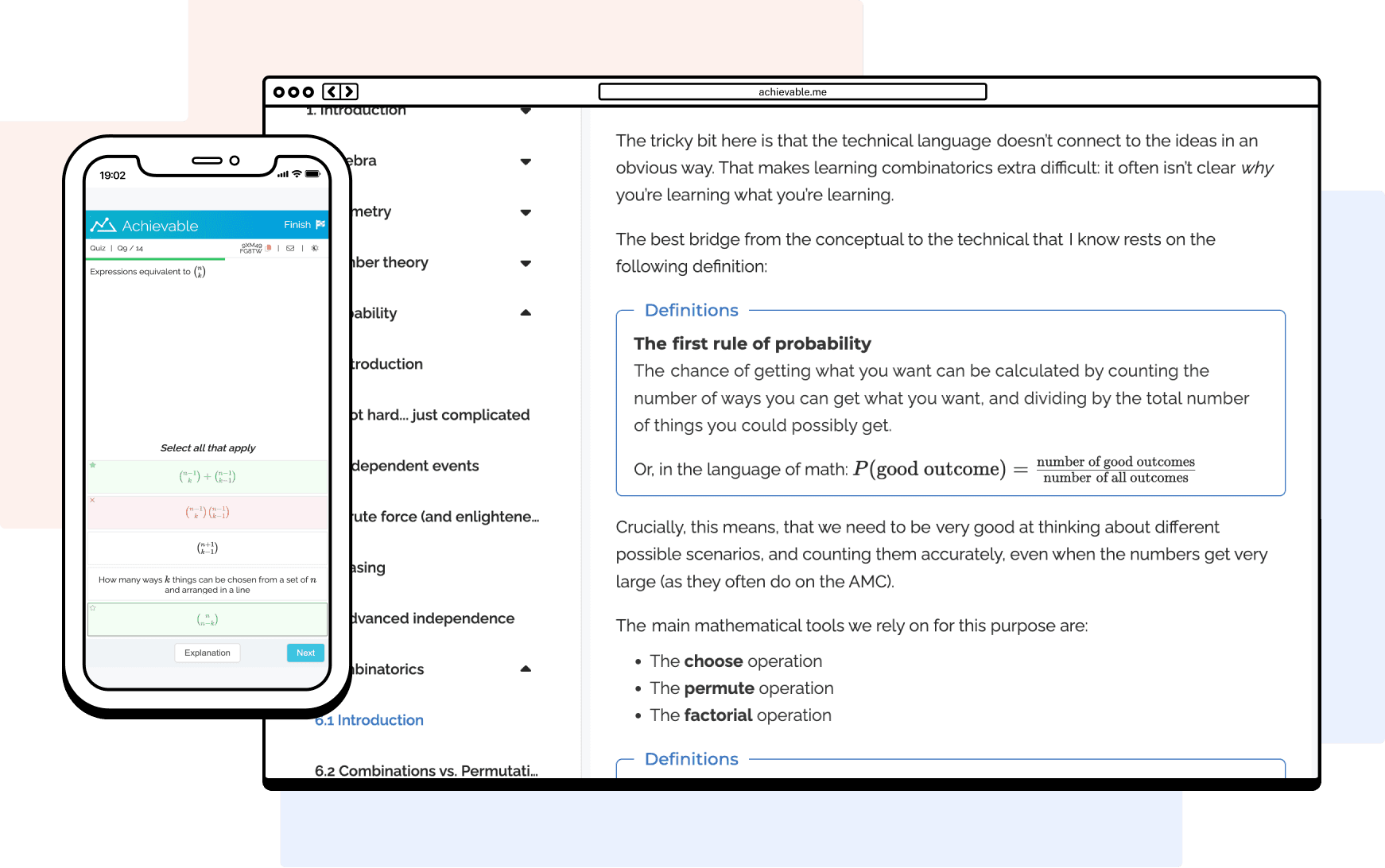
Reach your target score
Achievable is the best online AMC exam prep course: effective, personalized, and convenient. With Achievable, you'll spend less time studying and hit your target score with confidence.