Can you join the military with a GED? ASVAB scores and a study plan


Table of contents
- Why GED holders need a higher AFQT score
- ASVAB minimums for GED holders, branch by branch
- How college credits change your standing
- What an AFQT of 50 takes
- An 8-week study plan to reach 50
- If you score below 50 on the real test
- Other things GED holders should ask a recruiter
- How to prepare with Achievable
- Key takeaways
Yes, you can join the military with a GED. Every branch takes some GED holders, but most of them ask for a higher ASVAB score from you than from a high school graduate: an AFQT of at least 50 instead of 31 in the Navy, Air Force, Space Force and Marine Corps. Fifteen college credits can remove that gap in some branches, and a focused study plan can get you to 50 if you aren’t there yet.
This guide covers why GED holders face a higher bar, what each branch asks for, how college credits change your standing, and a week-by-week plan for reaching your target score.
Why GED holders need a higher AFQT score
The military sorts applicants into education tiers. The Department of Defense’s enlistment standards, DoD Instruction 1145.01, define them this way:
- Tier 1: high school diploma graduates, plus applicants with a college degree or some college credits.
- Tier 2: alternative credential holders, which includes the GED and other test-based equivalency certificates.
- Tier 3: applicants with no diploma or credential.
The same instruction sets two benchmarks for the services’ new recruits each year: at least 90% should be Tier 1, and at least 60% should score 50 or higher on the Armed Forces Qualification Test (AFQT). The remaining 10% are mostly Tier 2.
The reason is attrition. DoD groups credentials into these tiers "based on historical attrition rates," and it bases the 90% benchmark on the link between a recruit’s education credential and the chance they leave before finishing their first term. So the services limit how many GED holders they take and ask them to show more on the ASVAB. A higher AFQT is how a GED holder makes up the difference.
Two things follow from that:
- The score is the main lever you control. You can’t change your credential overnight, but you can raise your AFQT.
- Spots for Tier 2 applicants are limited, so a score well above the minimum makes you a stronger candidate when there are more applicants than spots.
ASVAB minimums for GED holders, branch by branch
Your AFQT is a percentile from 1 to 99 built from four subtests: Arithmetic Reasoning, Mathematics Knowledge, Word Knowledge and Paragraph Comprehension (officialasvab.com). Here is what each branch asks for, from its own page or recruiting manual:
- Army: 31 to enlist (goarmy.com). The Army doesn’t publish a separate figure for GED holders, so ask a recruiter what it currently takes. Applicants who score at least 21 can join the academic track of the Army’s Future Soldier Preparatory Course, which teaches every ASVAB subject and lets you retest.
- Navy: 31 with a diploma, or 50 with a GED, under the Navy Recruiting Manual; navy.com doesn’t publish a number. The Navy also takes applicants with no diploma or GED who score 50 or higher.
- Air Force: 31 with a diploma, 50 with a GED, and 65 with neither (airforce.com).
- Space Force: 36 with a diploma, or 50 with a GED, under the Department of the Air Force’s recruiting manual (DAFMAN 36-2032), which lets each component accept 31 from a diploma holder. spaceforce.com doesn’t publish a number.
- Marine Corps: 31, or 50 with a GED or nontraditional diploma (marines.com).
- Coast Guard: 32 (gocoastguard.com). The Coast Guard doesn’t publish a separate figure for GED holders; ask a recruiter.
These are minimums to enlist. Each job also sets its own line scores, built from the other ASVAB subtests as well as the AFQT ones, so the job you want may need more. For how the AFQT is calculated and what the categories mean, see our AFQT guide and the ASVAB exam overview.
How college credits change your standing
DoD’s tier definitions put applicants with some college credit in Tier 1, alongside diploma graduates. How much counts, and what it changes, is up to each branch, and two of them spell it out:
- Navy: an associate’s or bachelor’s degree, or 15 semester credits, 22 quarter credits or 675 clock hours from an accredited U.S. college, upgrades a Tier 2 or Tier 3 applicant to Tier 1 (Navy Recruiting Manual).
- Air Force and Space Force: you can enlist with a high school diploma, a GED, or 15 college semester hours (airforce.com). The Department of the Air Force’s manual lists 15 semester hours or 22.5 quarter hours as an acceptable education credential (DAFMAN 36-2032), which spares an applicant without a diploma the 65 minimum. It doesn’t say which tier’s minimum then applies, so ask a recruiter whether yours is 31 or 50.
The Army, Marine Corps and Coast Guard don’t publish their own rule, so ask a recruiter whether your credits count before you build a plan around them.
Fifteen semester credits is about one full-time semester, or five three-credit courses. Community college classes generally count if the college is accredited, and English and math courses do double duty, because they build the same skills the AFQT tests. If you’re months away from enlisting anyway, credits can be worth it. If you want to ship soon, raising your AFQT to 50 is usually the faster route.
What an AFQT of 50 takes
An AFQT of 50 means you scored as well as or better than half of the national reference group the test is compared with (officialasvab.com). That makes it a middle-of-the-pack score, not an elite one, and it’s within reach for most people who prepare.
Your AFQT comes from four subtests, and the verbal ones count twice: Word Knowledge and Paragraph Comprehension combine into a Verbal Expression score that is doubled in the formula, alongside Arithmetic Reasoning and Mathematics Knowledge. So roughly half the AFQT is reading and vocabulary, and half is math. A plan that improves only one side leaves points on the table.
Before you plan, find your starting point. Take a timed free ASVAB practice exam, which covers the four AFQT subtests, and note your percent correct on each one: the lowest is where your points are. If you’ve already taken the real ASVAB, read your score report for your AFQT and your score on each subtest.
An 8-week study plan to reach 50
This plan assumes about an hour a day, five or six days a week. If your practice score is already in the 40s, you may need less time; if it’s in the 20s, stretch each phase. Keep the order, though: diagnose, build fundamentals, then practice under time pressure.
Week 1: Diagnose and set up.
- Take a timed practice test of the four AFQT subtests and record your percent correct on each.
- Rank the four subtests from weakest to strongest. Your two weakest get most of your time.
- Start a vocabulary list and a mistakes log: every question you miss, with why you missed it.
Weeks 2 to 4: Build the math.
- Mathematics Knowledge: fractions, decimals and percents, exponents and roots, basic algebra (solving for x, factoring), and area and perimeter.
- Arithmetic Reasoning: word problems on rates, ratios, percentages, averages and simple interest. Practice turning each sentence into an equation before you calculate. Our Arithmetic Reasoning guide walks through the common problem types.
- No calculator: the ASVAB doesn’t allow one, so do every practice problem by hand.
Weeks 2 to 6: Build the verbal side, a little every day.
- Word Knowledge: learn 10 to 15 new words a day, with their prefixes, roots and suffixes, and review the earlier ones. See our Word Knowledge tips.
- Paragraph Comprehension: read one or two short passages a day and answer for the main idea, a detail, and what the author implies. Read the question before the passage.
- Because Verbal Expression counts twice, a gain here moves your AFQT more than the same gain in one math subtest.
Weeks 5 and 6: Mix and time.
- Switch from topic drills to mixed sets of all four subtests, timed.
- The CAT-ASVAB adapts to your answers and gives each subtest a time limit, so practice reading carefully and keeping a steady pace rather than racing.
- Go through your mistakes log every few days. Questions you miss twice are your study list.
Week 7: Full practice test and repair.
- Take a second timed practice test of all four AFQT subtests.
- Compare each subtest with week 1. Spend the rest of the week on the one that moved least.
Week 8: Review and rest.
- Light review of your vocabulary list and mistakes log, plus a few mixed sets.
- Schedule your test with your recruiter, sleep well the night before, and bring a valid photo ID.
Practice-test percentages don’t convert directly into an AFQT percentile, so judge readiness by trend: when every AFQT subtest has stopped being a weak spot and your scores hold steady across two or three tests, you’re ready. If one subtest still lags, give it another week or two before you test.
If you score below 50 on the real test
You can retest. Under the ASVAB retest policy, you wait one calendar month before your first retest, another calendar month before your second, and six months before each one after that. Your most recent score is the one that counts, not your highest (goarmy.com), so don’t retest until your practice scores show you’re ready. A jump of 20 or more AFQT points within six months triggers a confirmation test.
Our ASVAB retake guide covers how to read your subtest scores and plan your study around each waiting period. Meanwhile, ask your recruiter about college credits: in the Navy, 15 semester credits move you to Tier 1, where the minimum is 31.
Other things GED holders should ask a recruiter
- Which jobs and incentives are open to you. Some programs, jobs and enlistment bonuses ask for a diploma or a higher score; ask about the specific job you want.
- Whether the branch is taking Tier 2 applicants right now. Because each branch limits how many it takes, availability changes during the year.
- What else is in your file. Age, medical, fitness and background standards apply to everyone, whatever your score. For transfers, accommodations and other special cases, see our guide to GED, transfers and special circumstances.
How to prepare with Achievable
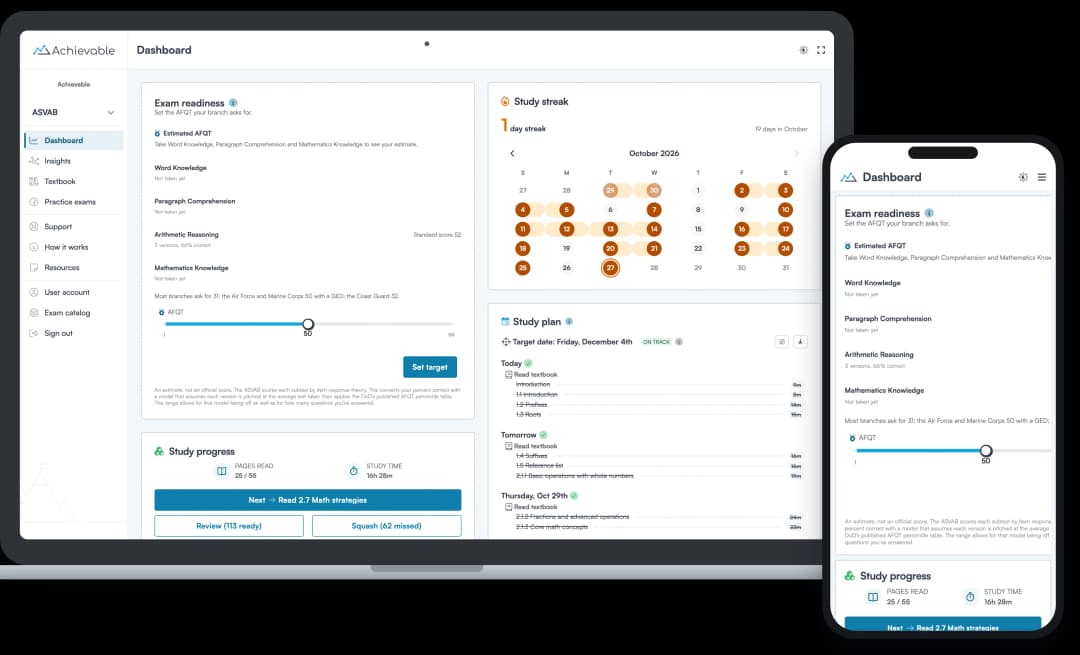
Achievable ASVAB is built for this kind of plan: an online study guide for all ten subtests, review quizzes that adapt to what you’ve mastered, more than 1,100 practice questions with explanations, and five timed practice tests for each subtest, so you can see which AFQT subtest needs more work. It costs $99 for a full year, which leaves time for a retest if you need one, and the first lessons are free.
Key takeaways
- You can join the military with a GED, but the Navy, Air Force, Space Force and Marine Corps ask GED holders for an AFQT of at least 50, compared with 31 (36 in the Space Force) for diploma graduates.
- The Army and Coast Guard don’t publish a separate GED minimum; ask a recruiter.
- Fifteen college semester credits move a GED holder into Tier 1 in the Navy, and the Air Force accepts them as an education credential; elsewhere, ask a recruiter.
- An AFQT of 50 is the median score. Half of it is reading and vocabulary, so study both the verbal and the math subtests.
- Start with a timed practice test, spend most of your time on your two weakest subtests, and retest only when your practice scores have held steady.