How CLT scores can fund your education


The Classic Learning Test (CLT) is a distinctive college admissions assessment and an increasingly popular alternative to the SAT and ACT. For those wondering what the CLT is, this exam stands apart by focusing on key lessons and insights drawn from classic texts, renowned scholars, and influential thinkers throughout history, rather than simply mirroring standard high school curricula. Although the CLT exam is not yet accepted by every college or university in the U.S., its recognition is rapidly expanding as a valuable benchmark of academic achievement.
High CLT test scores, similar to strong results on other college entrance exams, can unlock significant scholarship opportunities and financial awards. Excelling on the CLT test, as well as on the CLT10, which is designed for early high school students, not only enhances your college admission prospects but can also make attending your top-choice institution more affordable.

What is the CLT?
The CLT exam is a college entrance assessment built upon the values of a traditional liberal arts education. Unlike other standardized tests, the CLT test challenges students to analyze extensive texts by renowned authors, philosophers, and scholars from the Western intellectual tradition. Since its launch in 2015, the CLT exam has distinguished itself by its strong emphasis on history, literature, philosophy, and mathematical logic, core disciplines that reflect the exam’s foundation in classical learning.
Students typically take the CLT test for college admission during their junior or senior year as an alternative to the SAT or ACT, with CLT test scores recognized for their rigor in assessing reading comprehension, grammar proficiency, and quantitative reasoning skills required for undergraduate studies. The CLT exam consists of three main sections: Verbal Reasoning, Grammar/Writing, and Quantitative Reasoning. An optional essay section is available for in-school test-takers and requires crafting an analytical response to a thought-provoking passage, further demonstrating college readiness. As a digitally forward exam, the CLT is primarily administered online, enabling both onsite and secure at-home testing.
There are now over 350 CLT colleges that accept the CLT exam for admission, spanning from small, private Christian institutions to large research universities, including nonsectarian schools. As of spring 2026, students in states such as:
- Florida
- Indiana
- North Carolina
- Arkansas
- Louisiana
- Oklahoma
- Texas
- Wyoming
benefit from official state recognition of the CLT test for college admission or scholarship eligibility. All U.S. military academies also now recognize the CLT for prospective cadets, broadening opportunities for students seeking diverse pathways to higher education. The ongoing expansion of partnering institutions continues to increase the value and accessibility of CLT test scores for college applicants nationwide.
What is the CLT10, and why should I take it?
The CLT offers more than just a standard admissions exam. In addition to the main CLT test for college admission, students in 9th and 10th grades can take the CLT10, a college-preparatory version of the CLT exam. Much like the PSAT and PreACT, the CLT10 provides younger students with an early opportunity to familiarize themselves with the format and content of college entrance exams.
High CLT10 test scores are used to identify academically outstanding students nationwide. The top 50 CLT10 scorers are honored as National Award recipients and receive $2,500 scholarships, which can be applied toward tuition, room, and board at any partner institution within the growing network of CLT colleges.
Younger students looking for preparatory experience before the CLT exam may consider the CLT3-8 tests, designed for various grade levels. These assessments not only help students track academic progress but can also fulfill testing requirements for homeschooled students in several states. Both CLT3-8 and CLT10 scores can be advantageous for families evaluating educational options and planning for attendance at CLT partner colleges.
Scholarships awarded for high CLT scores
Nearly 100 schools offer scholarships and financial awards to high school students based on CLT scores, totaling over $100 million in scholarship dollars.
Here’s a selected list of some of the most generous:
- Christendom College: Offers up to five full-tuition scholarships to students who are CLT National Award Recipients or National Merit Finalists. This gives top CLT students the chance to attend the college for the cost of room and board only. Automatic scholarships valued between $6,000 and $15,000 based on qualifying CLT scores are also dispersed.
- Benedictine College: Students who earn at least an 84 on the CLT are eligible to enter the Presidential Scholars Competition, which awards 15 scholarships worth up to full tuition. Students who earn a perfect score (120) on the CLT will also be considered for the Premier Scholarship, worth full tuition. Other scholarships range from $10,000 to $19,000.
- Boyce College: Students who meet GPA requirements and earn at least an 86 on the CLT are eligible to compete for the Boyce Academic Excellence Scholarship, worth up to full tuition.
- Cedarville University: Offers academic scholarships ranging from $11,000 to $22,000 per year, based on factors including GPA and CLT scores.
- Calvin University: Offers academic scholarships ranging from $12,000 to over $20,000 per year, based on GPA and CLT scores.
- Abilene Christian University: Offers academic scholarships ranging from $10,000 to over $20,000 per year, based on GPA and CLT scores.
- Adrian College: Offers academic scholarships ranging from $13,000 to $20,000 per year, based on GPA and CLT scores.
- Florida Bright Futures: Students can use the CLT to satisfy minimum test score requirements for the Bright Futures or Bright Futures Medallion scholarship, which helps high-achieving Florida students attending in-state colleges. These scholarships range in value, with the Florida Academic Scholars Award covering 100% of tuition.
For the full list of participating schools and scholarships, visit the official CLT scholarships page, where you can search through awards alphabetically by college name.
Preparing for the CLT
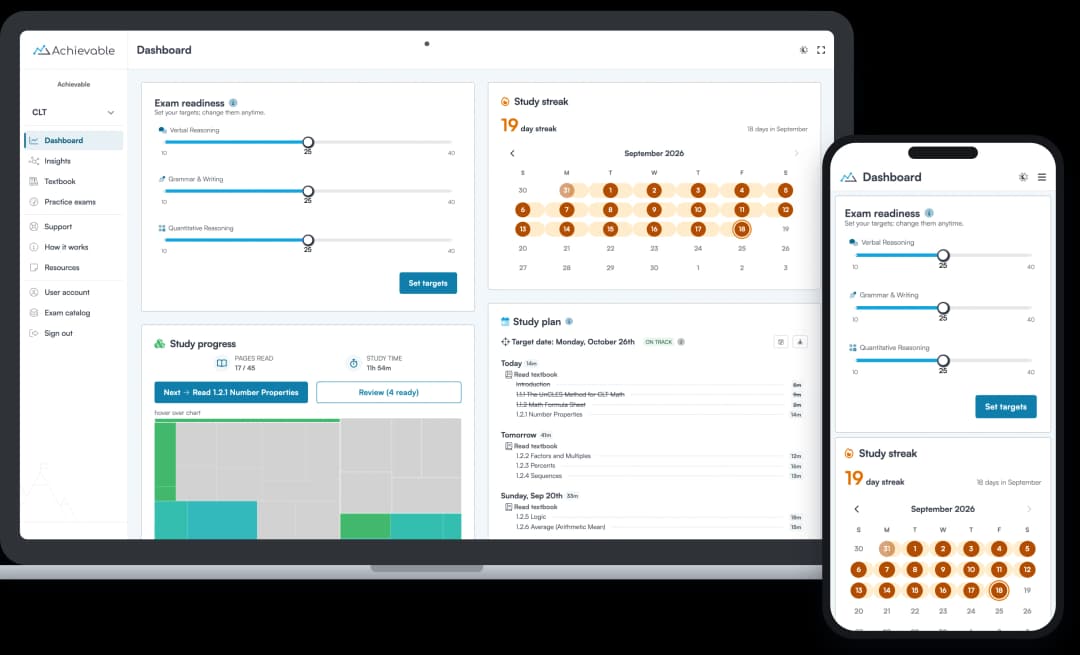
If you’re ready to begin studying for the CLT (and put you in the running for scholarships), follow these study tips:
- Begin with a diagnostic CLT practice exam to gauge your baseline
- Focus on each section and determine your weak areas
- Drill difficult concepts using targeted practice questions
- Continue taking full-length practice tests to increase your familiarity with the full exam
- Read actively, whether in class or on your own time, especially from the classical canon
The CLT is especially well-suited for students from non-traditional academic backgrounds steeped in liberal arts and classical learning, though it still demands focused, proven preparation techniques. Acing the exam during your practice sessions increases the likelihood of scoring highly on your official test day.

When should I take the CLT, and can I retake it?
The CLT can be taken in your junior or senior year of high school, like the ACT or SAT. It’s recommended to schedule your first attempt in the spring of your junior year to ensure you have enough time for a retake in the future. While you can take the exam as many times as you want, you will also have to pay the $69 exam fee each time.
Conclusion
The CLT isn’t just another gateway to college: it can be your key to unlocking valuable scholarships at a wide range of schools. Before taking the test, it’s important to review the comprehensive list of colleges that accept the CLT test and determine whether they offer special merit awards or financial incentives for qualifying students. Achieving strong scores on the CLT can turn attending your dream school from a possibility into an achievable goal, expanding your options among leading colleges across the country.