

CLT
study guide
Every chapter of the course summarized, with each section linked to its lesson.
Reach your target score
Try Achievable CLT
No credit card required
This free CLT study guide summarizes all 3 chapters of Achievable's CLT course: what each covers, the points to remember, and its 43 sections in order. Read each chapter after you study it, or work through the whole guide before exam day.
Each section links to its full lesson in Achievable, with the review quizzes and full-length practice exams.
Chapter 1: Quantitative Reasoning
23 sections
- UnCLES Method: Understand, Clarify, Look, Establish, and Solve to keep key terms, the asked quantity, answer patterns, and a clear strategy in view.
- Formula Sheet: The CLT gives a short formula sheet for circle, sphere, rectangle, triangle, the Pythagorean theorem, trigonometric ratios and two identities, and the two special right triangles.
- Number Properties: Even/odd, positive/negative, consecutive, factor, multiple, perfect square, and perfect cube rules let you reason quickly and test “must be true” claims by plugging in numbers.
- Factors and Percents: Factors, primes, GCD/GCF, LCM, and percent formulas depend on divisibility, memorized facts, and knowing whether the question asks for the part, whole, percent, or change.
- Sequences and Logic: Sequences are arithmetic, geometric, or other patterns, while logic questions use if/then statements, universal or particular claims, and the valid contrapositive.
- Average and Two Conditions: Mean, median, mode, and sum use , and Two Conditions questions count integers in a range that meet both, at least one, or neither condition.
- Angle and Triangle Rules: Supplementary, complementary, vertical, and transversal angle relationships combine with triangle sums, special triangles, similarity, congruence, and the Pythagorean theorem.
- Advanced Algebra: Linear equations, inequalities, multivariable equations, systems, exponents, quadratics, and ratios all rely on isolating variables, substitution, elimination, and careful setup.
In this chapter
- Tools and Strategies
- Math Reasoning
- Number PropertiesFree
- Factors and MultiplesFree
- Percents Free
- SequencesFree
- LogicFree
- Average (Arithmetic Mean)Free
- Two Conditions QuestionsFree
- Number Properties
- Geometry
- Algebra
Start this chapter free
Chapter 2: Verbal Reasoning
5 sections
- Journey Method: CLT is open-book, so the Journey Method keeps the passage visible and uses slow-fast-slow reading to retain central ideas instead of memorizing details.
- Philosophy and science: In philosophy/religion and science passages, focus on the main thesis, logical structure, indicator words, and contrast words like but, however, and therefore.
- Literature passages: Literature passages use the three A's—actors, actions, and attitudes—so track characters, plot significance, and tone for inference questions.
- Paired documents: The final paired passages require quick shifts between close reading and big-picture comparison, especially when relating themes, context, and higher principles across both texts.
Study this chapter in Achievable
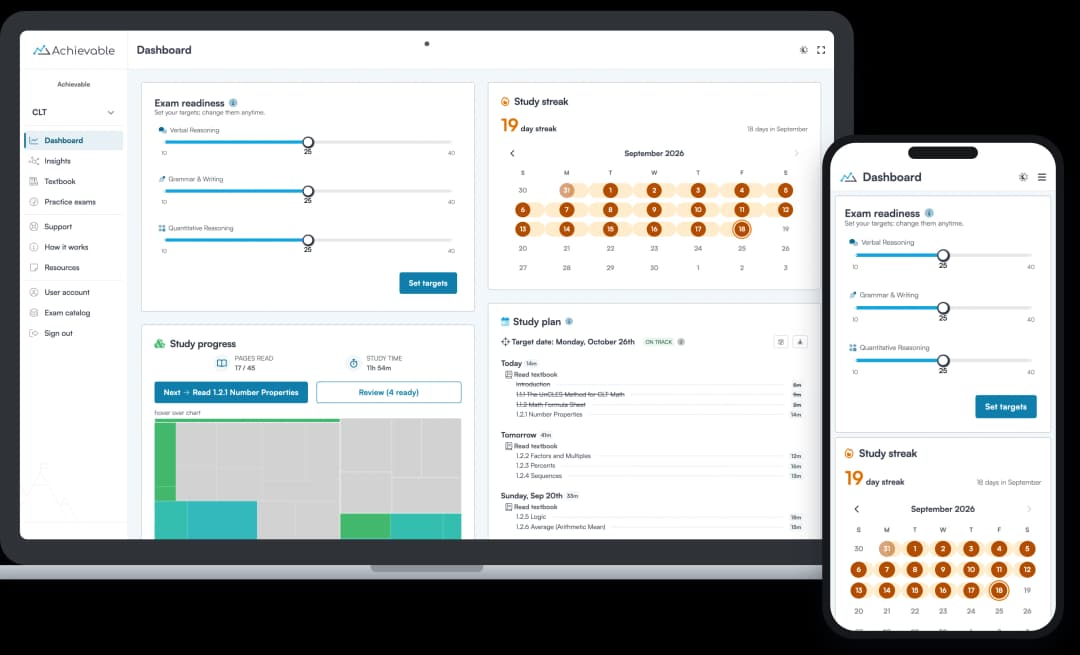
Achievable CLT
Prepare with the best online CLT self-study prep course. Built for today's students: mobile, guided, and personally optimized.
3 full-length practice CLTs
680+ practice questions, explained in depth
Up to 15 more points, or your money back
Unlimited Quant practice, new numbers each time
Chapter 3: Grammar & Writing
15 sections
- DIRECT method: It focuses on repairing writing, not just reading, so don’t read the passage first and zoom in on underlined text before zooming out for context.
- Passage types: Philosophy/religion passages are ancient or medieval and complex, historical profile passages are modern and factual, science passages use context for punctuation and agreement, and modern thinkers passages use contemporary language.
- Philosophy strategies: Logical coherence, the Clause Test, parallelism, word choice, sentence structure, and the Handlebar Rule all depend on reading context and matching grammar to the passage.
- Historical strategies: Use argume that for full propositions, distinguish “reducible,” apply comma, dash, and nonrestrictive-clause rules, and read Marx questions for stages, exploitation, and rhetorical strength.
- Word and transition questions: Word choice depends on context, roots, prefixes, suffixes, connotation, and shades of meaning, while logical coherence questions require the transition that matches contrast, cause and effect, addition, or sequence.
- Sentence, punctuation, and tense: Sentence Structure questions test parallelism, clause types, modifiers, and clarity; punctuation questions use commas, semicolons, colons, dashes, and the Handlebar Rule; verb tense questions depend on time cues and consistency.
- Agreement, parts of speech, pronouns, style, and concision: Subject/verb agreement, part of speech, pronoun choice, tone and style, and clear and concise answers all require context, correct form, and the best balance of clarity and succinctness.
In this chapter
- Intro and Passage Types
- Question Types
Study this chapter in Achievable
CLT exam at a glance
- Questions
- 120 multiple-choice questions
- Time
- 2 hours 20 minutes
- Exam fee
- $69
More on the CLT exam
- CLT exam prep courseAchievable's course: online textbook, review quizzes and full-length practice exams.
- CLT exam format, content and scoringWhat's tested, how long it takes, what it costs, and the score you need to pass.
- Free CLT practice examPractice questions written to match the real thing, with an explanation for every answer.
- CLT FAQThe questions asked most about the exam and preparing for it, answered.
- Best CLT exam prep coursesHow the leading providers compare on content, format and price.
- CLT study resourcesGuides and study advice from Achievable's instructors.
Hit your target score
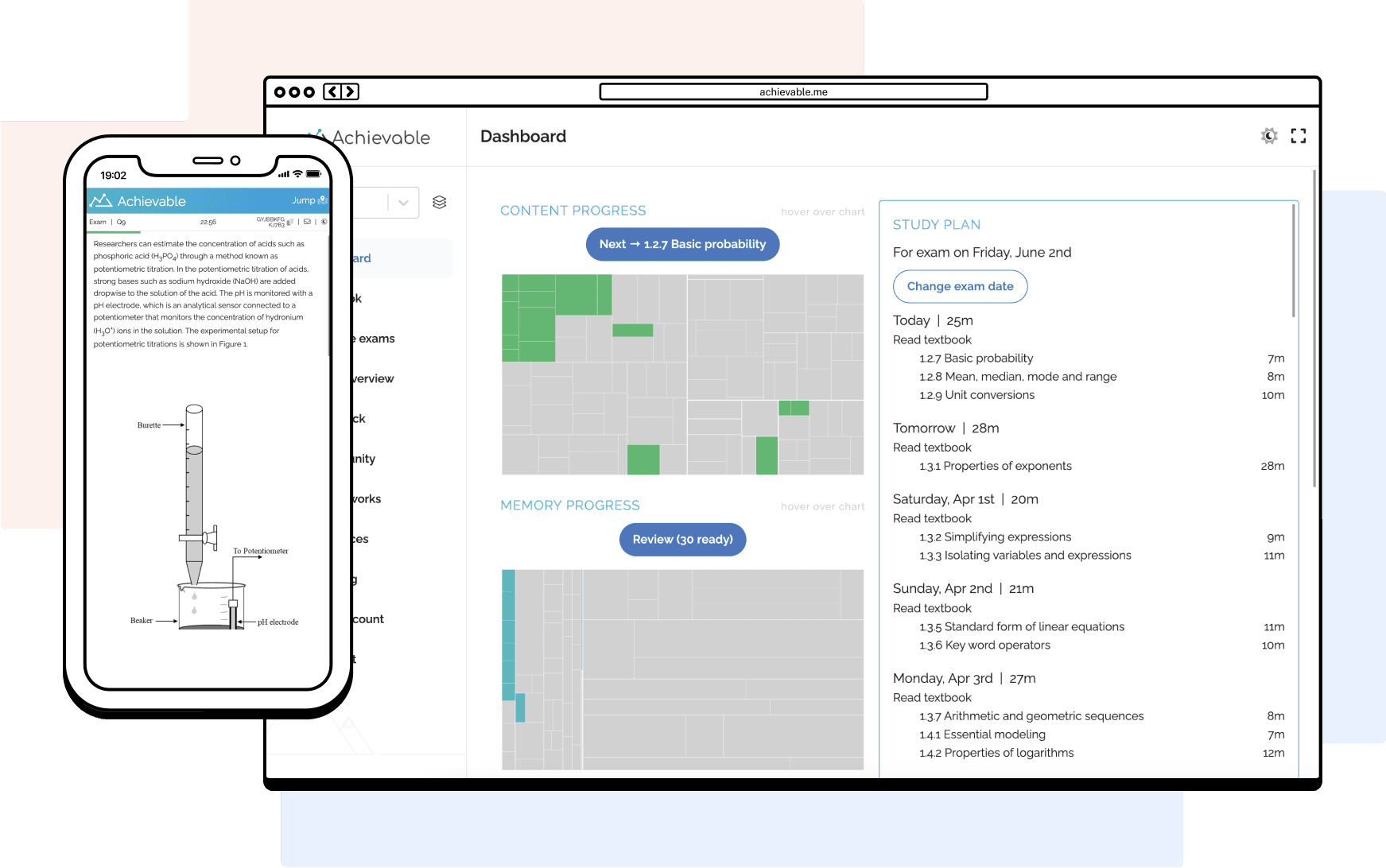
Achievable is the best online CLT exam prep course: effective, personalized, and convenient. With Achievable, you'll spend less time studying and hit your target score with confidence.