Ace the FE Civil exam: Top preparation tips


Table of contents
- Requirements to become a civil engineer
- Is the FE Civil hard?
- How to study for the FE Civil
- Review FE Civil exam requirements
- Know the FE Civil structure
- Preparing for the FE Civil
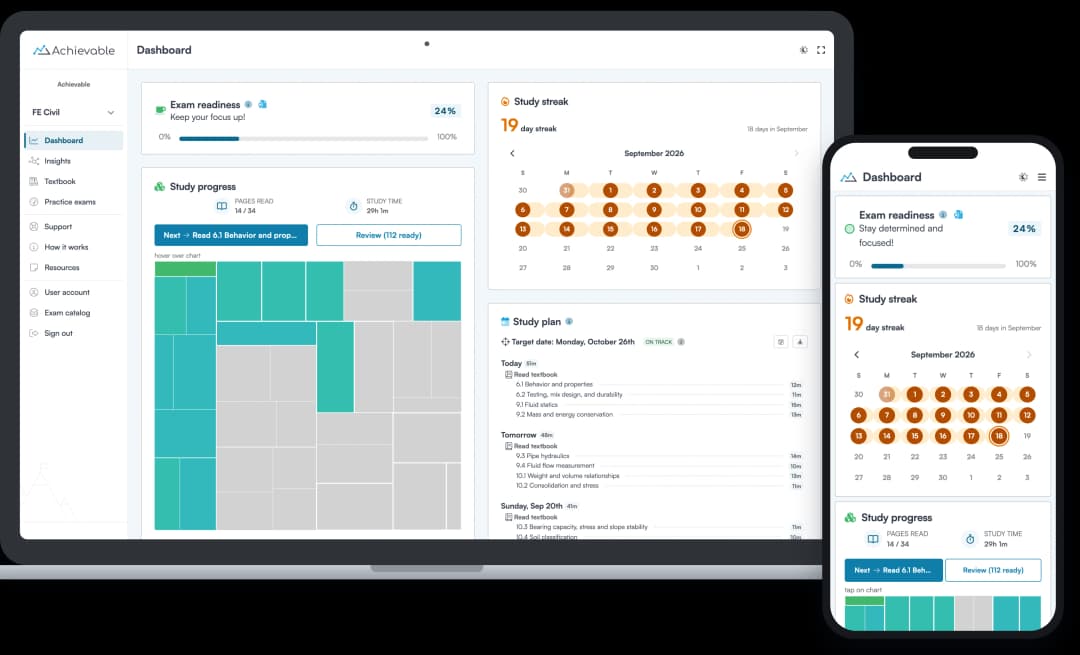
- 1. Develop an effective FE Civil study plan
- How long should I study for the FE Civil?
- 2. Practice under real FE Civil conditions
- 3. Identify and target problem areas
- 4. Prepare for your FE Civil exam day
- 5. Stay strong under pressure: Ace the FE Civil!
- Pro study tips:
- Conclusion
The FE Civil exam (Fundamentals of Engineering for Civil) is a requirement for all early-career civil engineering professionals who aspire to earn the Professional Engineer (PE) designation. Specifically designed for undergraduate students nearing completion of their engineering degrees and recent graduates entering the field, the FE Civil serves as a foundational milestone in the licensure journey.
Civil engineers play a vital role in planning, designing, and overseeing both public and private infrastructure projects. Their expertise spans a wide range of crucial systems, including roads, bridges, sewage treatment facilities, and building structural integrity. As part of civil engineering requirements, only licensed PEs are authorized to sign, seal, and certify technical documentation demonstrating compliance with local and national codes.
If you are interested in city planning, designing major public works, or developing reliable systems that deliver resources efficiently to homes and businesses, passing the FE Civil exam lays the groundwork. Completing the FE Civil awards earns you an Engineer-in-Training (EIT) status, a critical prerequisite on the path to full professional licensing. By preparing strategically for the exam and mastering its content, you will position yourself to launch your career with a strong foundation in engineering principles.

Requirements to become a civil engineer
Passing the FE Civil is an important step toward earning the Professional Engineer (PE) designation. This vital credential highlights an individual’s expertise in engineering fundamentals, commitment to ethical practices, and focus on quality assurance. Obtaining a PE license is often considered the pinnacle of credentialing in the field, offering junior engineers the opportunity to move into senior and leadership roles. To attain this status, candidates must meet rigorous requirements, including education, practical experience, and comprehensive examinations such as the FE Civil exam.
These core civil engineer requirements include:
- Passing the Fundamentals of Engineering (FE) Civil exam
- Earning a four-year engineering degree from an accredited engineering program
- Gaining four years of progressive engineering experience under the supervision of a licensed PE
- Passing the Principles and Practice of Engineering (PE) Civil exam, the final assessment for advanced civil engineers
Completing the FE Civil exam qualifies your subsequent work experience to count toward PE licensure. Licensed professional engineers gain legal authority to oversee engineering projects and take on high-responsibility roles within the profession. Passing the FE allows aspiring engineers to pursue foundational entry-level and early-career positions that are essential to building a successful engineering career.
Is the FE Civil hard?
The FE Civil exam is known for its challenging nature and sheer range of content. Although the exam is open-book, allowing candidates access to the FE Civil Reference Handbook, thorough preparation remains critical. The test encompasses a wide array of fundamental civil engineering subjects, including calculus, statistics, analytic geometry, environmental engineering, structural design, and fluid mechanics, all of which are core topics covered in college-level curricula. Rather than serving as an answer key, the FE Reference Handbook acts as a guidance tool for solving problems across diverse topics during the exam, providing definitions, formulas, and other important information.
Statistically, the FE Civil pass rate is around 60%, indicating that many examinees find it more rigorous than other engineering exams, which typically have pass rates closer to 70%. When discussing the process for achieving a passing score, it’s important to note that the National Council of Examiners for Engineering and Surveying (NCEES) does not fully disclose its scoring methodology or establish a rigid minimum passing score in advance. FE Civil scores are based on the total number of correct responses, with no penalties for incorrect answers. These raw scores are then converted to scaled scores to account for year-over-year variations in exam difficulty. The scaled score reflects performance relative to a benchmark level of minimum ability as determined by subject-matter experts.
While some estimates suggest that scoring between 50% and 70% on questions is sufficient to pass, effective preparation strategies focus on mastering all FE Civil topics and maximizing the number of questions answered correctly. Setting a personal target of correctly answering at least 75% of questions provides a conservative buffer and greatly improves your chances of meeting the minimum passing threshold.
Success on the FE Civil exam comes from robust preparation, strategic use of available resources, and a full review of all exam subjects. The statistics and recommended strategies underscore its difficulty and the importance of diligent preparation.
How to study for the FE Civil
Preparing for the FE Civil requires thoroughly studying civil engineering topics typically covered in university, practicing with realistic exam-style questions, and creating simulated testing conditions. Most candidates schedule the FE Civil exam in their final year of an engineering program or immediately after graduation, when their grasp of FE Civil topics is most up to date. However, many professionals decide to take the FE Civil later in their careers, often dedicating extra time to revisiting academic concepts to ensure command of all subject areas.
Efficient preparation, though, involves focusing on the topics that require the most review, rather than passively reading or overloading on information. With such a large scope and unique format, studying for any FE exam demands a strategy that starts with becoming familiar with exam requirements and ends with applying best practices on test day.

Review FE Civil exam requirements
Requirements to sit for the FE Civil and achieve the EIT title vary slightly by state, but most candidates must satisfy the following:
- Graduate from, or be in the final year of, an engineering program accredited by the Accreditation Board for Engineering and Technology (ABET)
- Register to take the FE Civil exam at an approved Pearson VUE testing center (the exam is offered in all 50 U.S. states and select countries)
- Pay the $225 examination fee
Students or graduates from non-ABET-accredited institutions must complete an additional verification process to confirm their educational background meets NCEES standards for FE Civil eligibility. In some states, students may need to submit an application or registration to the state board overseeing engineering licensing before taking the test. Always review the requirements of the state you plan on practicing in before signing up for the exam to avoid last-minute complications.
Know the FE Civil structure
The FE Civil exam is an entirely computer-based assessment administered at authorized Pearson VUE testing centers.
Here’s how the exam is structured:
- 110 questions in total (100 of which will be scored)
- Includes multiple-choice and alternative item types such as drag-and-drop and point-and-click
- Lasts six hours (five hours and 20 minutes of actual test time, plus scheduled breaks)
While a six-hour exam may seem daunting, most examinees find that with preparation, the pacing is very manageable.
The focus of the FE Civil exam content is on evaluating your understanding of fundamental civil engineering concepts, rather than advanced design or remembering exact definitions, assessing your ability to:
- Apply standard engineering formulas
- Interpret various engineering diagrams
- Exercise sound engineering judgment
- Solve both conceptual and calculation-based questions
The majority of questions are based directly on the core subjects of undergraduate civil engineering courses. The detailed list of FE Civil topics includes:
- Mathematics and Statistics
- Ethics and Professional Practice
- Engineering Economics
- Statics
- Dynamics
- Mechanics of Materials
- Materials
- Fluid Mechanics
- Hydraulics and Hydrology
- Structural Engineering
- Geotechnical Engineering
- Transportation Engineering
- Environmental Engineering
- Surveying
- Construction
Among these FE Civil topics, most exam questions come from Structural Engineering, Geotechnical Engineering, and Transportation Engineering, reflecting their emphasis in the exam.
Exams are offered year-round during quarterly testing windows (January-March, April-June, July-September, and October-December), providing flexibility to plan your test date around your preparation across the full spectrum of FE Civil subjects.

Preparing for the FE Civil
A well-organized plan can help you divide your prep by topic, close knowledge gaps, and focus on high-impact content.
1. Develop an effective FE Civil study plan
Balancing test preparation with school or work is achievable with a clear plan. Use these steps to create an effective study strategy:
- Start with a diagnostic test: Take a full-length practice exam to gauge your current knowledge. Treat the result as a baseline rather than focusing on the score itself.
- Collect study materials: Use reliable FE Civil study guides, practice questions, formula sheets, and study tools to strengthen your understanding.
- Focus on key topics: Use your diagnostic results to prioritize subjects by importance and your level of difficulty with them.
- Create a study schedule: Divide your available study time into manageable blocks and assign them to a subtopic.
One way to organize your study plan is by topic: if you plan to devote about two months to studying and want to set aside time each day to preparation, then you will need to cover a main subject area (listed above) every four days. Some subjects may need more time than others, and you should always prioritize areas you’re less comfortable with. Be sure to include benchmarks for practice tests and review sessions in your study plan. Don’t forget to review the NCEES FE exam prep errata, a published list of content corrections or changes to official practice materials.
How long should I study for the FE Civil?
Test prep experts advise that a typical timeline for studying for the FE exam is about two to three months, though this varies based on your familiarity with the FE Civil exam material and format. When considering how to prepare for the challenges of the exam, additional effective study strategies include:
- Practicing mathematics problems and reviewing any persistent mistakes or rough spots.
- Applying spaced repetition systems (such as flashcards) to master memorization-heavy content efficiently.
- Drilling exam-style practice questions constantly, keeping an eye out for tricky or unclear wording.
- Tackling practice problems shortly after learning new material to strengthen your understanding.
- Building mind maps or outlines to organize key concepts for the FE Civil exam visually.
- Using memory aids and creating mnemonics to reinforce critical information.
- Teaching concepts aloud, as if you’re explaining them to someone unfamiliar with engineering.
- Paraphrasing and summarizing each topic in your own words immediately after studying.
- Concluding each study session by testing yourself on material, rather than simply re-reading notes.
Adopting a consistent approach, by steadily building knowledge over several weeks, will greatly improve retention and increase your overall performance on test day.
2. Practice under real FE Civil conditions
Practicing under realistic test conditions, especially with the FE Reference Handbook, is a crucial component of any effective FE Civil exam study routine. The FE Civil exam is not only a measure of your engineering knowledge but also a rigorous test of your mental endurance and stamina across six hours of intense, sometimes calculation-heavy questions. While a thorough content review is necessary, consistently simulating actual exam conditions with full-length, timed practice tests can significantly improve your performance.
- Use high-quality FE Civil practice exams under strict timed conditions, ensuring you always have the digital FE Reference Handbook (not a hardcopy) on hand to assess both your progress and familiarity with exam resources.
- Remember: the FE Reference Handbook is over 500 pages long. Practice integrating it into every session to develop fast, reliable strategies for locating information and equations during the test.
- Simulate the exact digital exam format by practicing with the approved calculator model exactly as you will on test day.
- Approved calculators include Casio fx-115 or fx-991 models, Hewlett Packard HP 33s or HP 35s models, and Texas Instruments TI-30X and TI-36X models
- Reinforce your learning by reviewing critical concepts using the FE Reference Handbook after each practice session for targeted improvement.
Though the exam’s duration is long, aim to complete at least three full-length mock tests: start with a diagnostic test to identify strengths and weaknesses, take a mid-preparation exam to monitor improvement, and finish with a final practice test shortly before your scheduled FE Civil exam date. Between tests, continue practicing with mock questions that closely mirror the problems on the actual exam. This approach ensures you build confidence, endurance, and expert familiarity, setting you up for success on test day.
3. Identify and target problem areas
As you follow your FE Civil study guide, focus on narrowing down which areas need the most attention. Reviewing all subjects equally isn’t efficient; zero in on the content that challenges you most.
- Keep an error log of mistakes or confusing topics; revisit these regularly.
- Start broad and narrow down: Review major topics first before tackling finer details.
- Invest extra time in weak areas highlighted by your error log and practice test results.
A targeted approach ensures you’re always working on skills that will have the biggest impact on your overall FE Civil score.
4. Prepare for your FE Civil exam day
The night before the FE Civil, focus on getting mentally ready, not last-minute information dumping. Double-check that you have a valid government-issued ID for admission at your testing center.
Additional pre-test advice:
- Get 7-9 hours of sleep before exam day
- Eat a nutritious breakfast
- Pack a calculator
- Quickly review key summaries or flashcards and avoid learning new material, but remember that physical materials are NOT allowed during the test
You’ve spent weeks preparing: trust yourself and your knowledge, and don’t add extra stress before test day.
5. Stay strong under pressure: Ace the FE Civil!
The exam day is your chance to bring together everything you’ve learned from your practice sessions. Use these strategies for peak performance:
- Calm nerves with deep breathing techniques and positive self-talk.
- Pace yourself; don’t dwell on any single question, but remember that you have a generous three minutes for each.
- If stuck on a difficult item, move on: skipping one question is better than sacrificing time on many others.
FE Civil scores are typically available on the Wednesday after the following week of your exam date. If you are satisfied with your results, you can proceed with pursuing your work requirements. You are allowed a retake once per testing window, with a maximum of three attempts within 12 months.
After the exam, you can seek out professional experiences that align with the area you plan on specializing in, as determined by the PE exam you decide to take (Construction, Geotechnical, Structural, Transportation, or Water Resources and Environment). With the FE Civil box checked, you’ll be well on the way to full licensure.
Pro study tips:
Approach your FE Civil study routine with clear planning and intention:
- Use high-quality FE Civil study materials.
- Apply the effective study strategies outlined above.
- Monitor your progress as you prepare.
- Regularly reassess and refine your approach.
Continuously evaluating your progress keeps your studying focused and adaptable, helping you confidently pass the test and reducing the likelihood that you will need a retake.

Conclusion
The FE Civil exam is a pivotal milestone for aspiring engineers, marking the beginning of a professional journey and providing crucial training before attempting the PE exam. Success starts with using the FE Civil Reference Handbook effectively and following a structured FE Civil review plan. To enhance your preparation, rely on a well-structured FE Civil study guide and consistently complete practice questions to reinforce your knowledge and test-taking skills.
Preparing for the FE Civil exam is like revisiting years of engineering coursework in a matter of weeks. Still, with an organized study schedule and a clear approach, you can tackle and conquer each subject area. Focusing your efforts on key topics and areas of improvement will help you improve your scores and feel ready for exam day. A disciplined FE Civil review process, combined with strategic use of study materials, ensures you are well-equipped to pass and advance in your engineering career.