

Series 6
study guide
Every chapter of the course summarized, with each section linked to its lesson.
Pass the first time
Try Achievable Series 6
No credit card required
This free Series 6 study guide summarizes all 14 chapters of Achievable's Series 6 course: what each covers, the points to remember, and its 80 sections in order. Read each chapter after you study it, or work through the whole guide before exam day.
Each section links to its full lesson in Achievable, with the review quizzes and full-length practice exams.
Chapter 1: Common stock
12 sections
- Common stock basics: Common stock is a negotiable equity security that represents ownership in a company and can return capital appreciation or dividends.
- Liquidation and analysis: In corporate liquidation, common stockholders come after preferred stockholders, and fundamental analysis inspects a company's products/services, management, and finances.
- Financial statements: The 10-K annual report is audited, the 10-Q quarterly report is unaudited, and the balance sheet compares assets and liabilities to indicate net worth.
- Suitability and risk: Common stock can provide capital appreciation, income from cash dividends, and a hedge against inflation, but systematic risk cannot be diversified away.
- Options fundamentals: Options contracts are derivative securities that provide the right to perform a transaction at a fixed price, and standard options have expirations of up to 9 months.
- Option contracts: Option contracts cover 100 shares of stock, and calls are bullish while puts are bearish, with premiums equal to intrinsic value plus time value.
In this chapter
Start this chapter free
Chapter 2: Preferred stock
3 sections
- Core characteristics: Preferred stock is a form of ownership (equity), considered a fixed-income security, with market prices influenced by interest rates and dividends approved by the BOD.
- Important features: Cumulative preferred stock pays skipped dividends eventually, straight (non-cumulative) preferred stock does not, and convertible preferred stock can convert into common stock of the same issuer.
- Suitability points: Preferred stock provides income with lower tax rates (15% or 20%), but dividends are not guaranteed and typical investors seek income as the primary benefit.
In this chapter
Study this chapter in Achievable
Chapter 3: Debt securities
4 sections
- Par value and coupon: Par value, or face value, is typically $1,000 for bonds, stays fixed for life of bond, and bond interest rates are based on par.
- Issuance and market price: Bond offerings are initially sold in primary market, then trade in secondary market, while interest rates up push market prices down and interest rates down push market prices up.
- Bond features: Secured bonds have collateral, unsecured bonds have no collateral, call and put features can end bonds before maturity, and call protection is the number of years before a bond may be called.
- Risk and suitability: Bond benefits are interest income, with typical investors seeking income and generally older, risk-averse, while bond ratings consider only default risk and investment grade bonds are BBB or above.
In this chapter
Study this chapter in Achievable
Chapter 4: Corporate debt
4 sections
- Debt and equity: Debt lets a company raise capital without giving up ownership, but it must repay borrowed funds plus interest and bondholders do not have voting rights.
- Corporate bond types: Commercial paper is short-term zero coupon corporate debt with a 270-day maximum maturity, while debentures, funded debt, guaranteed bonds, income bonds, mortgage bonds, ETCs, and collateral trust certificates differ by backing and risk.
- Convertible features: Convertible bonds convert to common stock of the same issuer, and conversion ratio, conversion price, conversion cost per share, and conversion value determine the break-even and profit from converting.
- Bank products and suitability: FDIC insurance covers up to $250k per customer, CDs and brokered CDs are bank products, and corporate debt mainly offers interest income with higher risk, especially default risk.
In this chapter
Study this chapter in Achievable
Chapter 5: Municipal debt
2 sections
- Municipal bonds: Issued by states, cities, counties, and political subdivisions, and municipal bond interest is exempt from federal taxes but subject to state and local taxes.
- Municipal regulation: The Municipal Securities Rulemaking Board (MSRB) is a self-regulatory organization governing the municipal markets; it writes municipal regulations, does not enforce, and enforcement is handled by the SEC, FINRA, The Federal Reserve Board, Office of Comptroller of the Currency, and Federal Deposit Insurance Corporation (FDIC).
- Bond suitability: General obligation bonds fund non-self-supporting projects and are paid off with property (ad valorem) taxes, while revenue bonds finance self-supporting municipal ventures, are paid off with revenues, and have a higher risk of default than G.O. bonds.
In this chapter
Study this chapter in Achievable
Chapter 6: US government debt
3 sections
- Government debt basics: The US Government is the largest and most active securities issuer in the world, primarily funds activities through deficit spending, and debt denominations start at $100.
- Treasury securities: Treasury bills are short-term zero coupon debt issued at discounts and mature at par; notes and bonds pay interest semi-annually, and TIPS adjust principal to CPI.
- Agency and suitability: Mortgage agencies issue mortgage-backed securities with monthly payments and prepayment and extension risk, while these securities suit safer, income-seeking investors despite interest rate, inflation, and reinvestment risk.
In this chapter
Study this chapter in Achievable
Chapter 7: Investment companies
15 sections
- Investment company basics: Investment companies invest their customers' money and are regulated by the Investment Company Act of 1940.
- Company classifications: Investment company classifications are management companies, unit investment trusts (UITs), and face amount certificates.
- Fund types: Fund type is determined by investment objective and securities held, including growth, income, balanced, specialized, index, asset allocation, and international/global funds.
- Open-end companies: Mutual funds are open-end management companies with redeemable shares, prospectus delivery at sale, diversification, and shareholder rights over board and fund matters.
- Mutual fund pricing: Mutual fund transactions use forward pricing, with NAV calculated once per trading day and POP determined from NAV and sales charge.
- Share classes: Class A shares are front-end loaded, Class B shares are back-end loaded, Class C shares have no sales charge or a 1-year CDSC, and 12b-1 fees reduce the expense ratio.
- Closed-end and ETFs: Closed-end management companies trade in the secondary market after the primary offering, while ETFs are negotiable securities that usually track indexes with low expense ratios.
Study this chapter in Achievable
Achievable Series 6
Series 6 exam prep course and study materials, 97% pass rate: online textbook, 2,000+ practice questions, and 35 full-length practice exams.
35 full-length Series 6 practice exams
2,000+ practice questions with explanations
14+ video lessons and audio narration
Pass guaranteed, or your money back

Chapter 8: Insurance products
3 sections
- Annuity basics: Variable annuities allow unlimited non-deductible contributions, tax-deferred growth, and taxable distributions above basis, while immediate and deferred annuities differ by when payments begin.
- Life insurance features: Variable life insurance and universal variable life insurance provide coverage for the entire life of policyholder, use separate account cash value, and are considered a security; viatical settlements transfer the policy to a third party.
- Suitability rules: Annuities are suitable for retirement income and best as a retirement income supplement, while life insurance is suitable for those supporting others and most appropriate for "breadwinner" family situations.
In this chapter
Study this chapter in Achievable
Chapter 9: The primary market
4 sections
- Primary market basics: Issuers sell securities to raise capital, and underwriters are hired by issuers to sell new issues as investment banks.
- Offering types: Primary market transactions send sale proceeds to the issuer, while secondary offerings do not, and combination (split) offerings divide proceeds between the issuer and shareholders.
- IPO process: The Securities Act of 1933 requires disclosures on new issues, and the 20-day cooling-off period allows a preliminary prospectus, indications of interest, and a tombstone before the effective date.
- Exemptions and resale: Exempt securities and exempt transactions can avoid registration, and Rule 144 governs restricted and control stock with holding periods, volume limitations, and Form 144 or Form 4 filings.
In this chapter
Study this chapter in Achievable
Chapter 10: The secondary market
3 sections
- Secondary market roles: Governed by the Securities Exchange Act of 1934, it includes traders, broker-dealers, and market makers, and narrow bid-ask spreads signal efficient, competitive markets.
- Order handling rules: Order tickets are prepared before entry and promptly reviewed by principals, unsuitable customer orders must be marked unsolicited if the customer insists, and trade confirmations follow completion.
- Prohibited conduct: Insider trading, fraudulent acts, painting the tape, marking the close/open, and pump and dump schemes are prohibited forms of market manipulation.
In this chapter
Study this chapter in Achievable
Chapter 11: Brokerage accounts
3 sections
- General account rules: Four critical pieces of information must be collected as per Patriot Act and verified through valid government-issued ID or credit bureau database, and customer info must be confirmed within 30 days of account opening and every 3 years.
- Account types and authority: Cash accounts require full payment and no borrowing, margin accounts may borrow money for investment, and fiduciaries, discretionary authority, and power of attorney each define specific account control and survivorship rules.
- Complaints and disputes: A complaint is written dissatisfaction forwarded to a principal and kept on file for 4 years at OSJ, while disputes may go to mediation or FINRA arbitration, and intra-industry disputes require arbitration except those involving sexual harassment.
In this chapter
Study this chapter in Achievable
Chapter 12: Retirement & education plans
5 sections
- Retirement basics: Retirement plans encourage saving for retirement and supplement Social Security/Medicare through contributions, eligible investments, distributions, and penalties.
- Contributions and withdrawals: Contributions must be made in cash only, and distributions are generally taxed as ordinary income at the investor’s marginal tax bracket.
- ERISA plan rules: Qualified plans meet ERISA requirements, must follow participation, disclosure, funding, and vesting rules, and 404(c) can shield liability if disclosure, diversification, and frequent changes are met.
- IRAs and education plans: Traditional and Roth IRAs, 529 plans, Coverdell ESAs, and ABLE accounts each have specific limits, tax treatment, and penalty rules for contributions and distributions.
Study this chapter in Achievable
Chapter 13: Rules & ethics
11 sections
- Primary regulators: The SEC regulates the primary and secondary markets and enforces the Securities Act of 1933, Securities Exchange Act of 1934, and Investment Company Act of 1940.
- Registration forms: U-4 is filed when joining a firm, U-5 when leaving, and U-6 reports disciplinary actions, reportable events, and arbitration results.
- Market oversight bodies: FINRA regulates financial industry and its participants, MSRB writes municipal regulations but does not enforce them, and NASAA enforces the Uniform Securities Act at the state level.
- Communication standards: Public communications must be fair, balanced, clear, and not misleading, while records are kept for 3 years and communications from the last 2 years are easily accessible.
- Regulation BI rules: Broker-dealers and reps making recommendations to retail investors must disclose material facts, determine risk and benefit profiles, and ensure recommendations are in the client's best interest.
- Ethics and records: Firms must follow rules on CE, outside business activities, private securities transactions, vulnerable investors, penalties, and recordkeeping retention periods.
Study this chapter in Achievable
Chapter 14: Suitability
8 sections
- Product suitability: Common stock suits younger, risk-tolerant, long-term investors, while preferred stock, general debt securities, corporate debt, CDs, municipal debt, US Government debt, and MBS each match different income, safety, tax, and risk needs.
- Fund and objective fit: Investment companies offer instant diversification and professional management, and fund types plus objectives pair risk and return with goals such as preservation of capital, safety of principal, tax-advantaged income, moderate growth, or speculation.
- Suitability standards: FINRA suitability standards include reasonable basis, customer-specific, and quantitative tests, and suitability also depends on financial and non-financial considerations.
- Portfolio methods and analysis: Diversification reduces non-systematic risks, the Rule of 100 uses 100 minus age = % in stocks, and total return, after-tax return, benchmark comparisons, CAPM, and MPT help evaluate portfolios.
- Economic and exam approach: GDP, recession, depression, expansion, peak, trough, and recovery describe economic conditions, and test taking means eliminating wrong answers, using every detail, and thinking like a regulator.
Study this chapter in Achievable
Series 6 exam at a glance
- Questions
- 50 multiple-choice questions
- Time
- 1 hour 30 minutes
- Passing score
- 70% (35/50)
- Exam fee
- $100
More on the Series 6 exam
- Series 6 exam prep courseAchievable's course: online textbook, review quizzes and full-length practice exams.
- Series 6 exam format, content and scoringWhat's tested, how long it takes, what it costs, and the score you need to pass.
- Free Series 6 practice examPractice questions written to match the real thing, with an explanation for every answer.
- Series 6 FAQThe questions asked most about the exam and preparing for it, answered.
- Best Series 6 exam prep coursesHow the leading providers compare on content, format and price.
- Series 6 study resourcesGuides and study advice from Achievable's instructors.
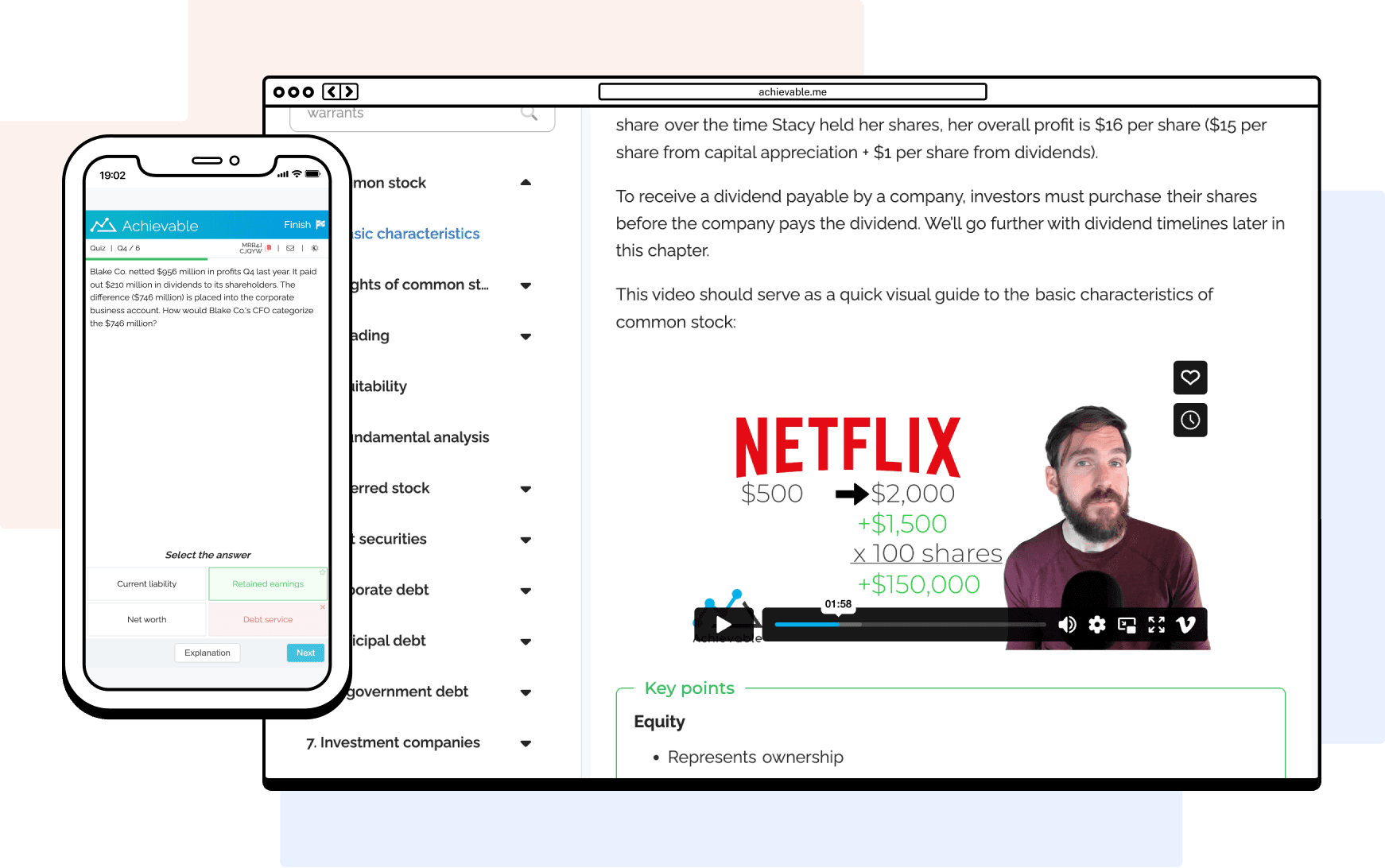
Pass the FINRA Series 6. Guaranteed.
Achievable is the best Series 6 exam prep course: effective, personalized, and convenient. With Achievable, you'll spend less time studying and pass your exam the first time, or your money back.