Series 65 study plan: A 6-week schedule, week by week


Table of contents
- The 6-week Series 65 study plan at a glance
- Week-by-week breakdown
- Week 1: Equities, debt and pooled investments
- Week 2: Options, alternatives, insurance and client strategies
- Week 3: Economics, then the law
- Week 4: Laws, regulations and ethics
- Weeks 5 and 6: Full-length practice exams
- How the plan is built
- Adjust the plan to your schedule
- The last few days before the exam
- Build your own Series 65 plan in Achievable’s study planner
- About the Series 65 exam
- Key takeaways
You can prepare for the Series 65 in about six weeks if you study 1.5 to 2 hours a day. Spend the first four weeks working through the four chapters of Achievable’s Series 65 course, taking a checkpoint exam after each, then use the last two weeks for full-length practice exams, with review days between them. The plan below lays that out week by week, using the same time estimates as the study planner in our app.
The 6-week Series 65 study plan at a glance
Week | What to study | Approx. time |
|---|---|---|
1 | Chapter 1, investment vehicle characteristics: equities, debt, pooled investments and the start of options | 12 hours |
2 | The rest of chapter 1 (options, alternatives, insurance products and other assets) and its checkpoint, then most of chapter 2 on client recommendations and strategies | 12 hours |
3 | The rest of chapter 2, its checkpoint and the midterm, chapter 3 on economic factors and its checkpoint, then the start of chapter 4 on laws and regulations | 12 hours |
4 | The rest of chapter 4 and its checkpoint, then Final exam A | 14 hours |
5 | Final exam B and two full-length practice exams, with review days between them | 11 hours |
6 | Three more full-length practice exams and a final review | 11 hours |
Each week’s time covers reading, the review questions at the end of each section, and the checkpoints and exams, all at the planner’s estimates. A checkpoint or the midterm is 65 questions, and a full practice exam is 130 questions, the length of the real exam.
Week-by-week breakdown
Week 1: Equities, debt and pooled investments
Start with the introduction and chapter 1, by far the longest in the course. Read the equity sections (common and preferred stock, ADRs, fundamental and technical analysis and how stocks are taxed), then debt (corporate, government and municipal bonds, yields, duration and bond taxation), then pooled investments (mutual funds and their share classes, closed-end funds, ETFs, REITs and how funds are taxed). Each section ends with suitability, which the exam tests often: who should, and shouldn’t, own each product. Close the week with the options fundamentals.
Week 2: Options, alternatives, insurance and client strategies
Finish chapter 1 with the options strategies, futures and forwards, alternative investments (limited partnerships, hedge funds and structured products), annuities and life insurance, real estate and digital assets, then take the chapter 1 checkpoint. Chapter 2 is about the client: types of clients (individuals, businesses, estates, trusts and charities), the client profile, portfolio management styles, capital market theory, taxes, retirement and education plans, and account types.
Week 3: Economics, then the law
Finish chapter 2 with trading (order types, short sales, margin accounts) and performance measures, then take its checkpoint and the midterm on chapters 1 and 2. Chapter 3 covers economic factors and business information: monetary and fiscal policy and the Federal Reserve, economic indicators, financial reporting, analytical methods, descriptive statistics, and systematic and non-systematic risk. After its checkpoint, start chapter 4 with the securities laws and the Uniform Securities Act’s definitions.
Week 4: Laws, regulations and ethics
Chapter 4 is the second-longest chapter and 30% of the exam. It covers registration of broker-dealers, agents, investment advisers and their representatives, and securities, then enforcement, communications with clients (disclosures, contracts and advertising), and ethics: compensation, fraud and other prohibited practices, Regulation Best Interest, protecting vulnerable adults and cybersecurity. Take the chapter 4 checkpoint, then Final exam A at the end of the week. Sit it in a single, timed session of 3 hours, as on test day.
Weeks 5 and 6: Full-length practice exams
Take Final exam B, then the full Series 65 practice exam five times over the two weeks, two or three exams a week. Each sitting draws a fresh set of questions from the course’s question bank. A full exam with its review takes about three and a half hours, so plan these for days off. On the days between, go back through every question you missed or guessed on and reread the sections they came from. Before you book the Series 65, aim for 100% readiness: score about 81%, 10 points above the 71% passing score, on practice exams, again and again across several full-length exams, so a pass does not depend on the luck of the draw.
How the plan is built
The plan totals about 71 hours over six weeks, an average of about an hour and three quarters a day. Reading takes about 36 of those hours, including the review questions at the end of each section. Checkpoints, the midterm and practice exams take the other 35, at the planner’s estimate of each exam’s time limit plus a fifth for reviewing your answers.
That’s more than the 52 hours or so Achievable Series 65 students log on average, because the plan schedules every checkpoint and seven full-length practice exams of 3 hours each. If your scores are already well above passing after the first few, you can skip the rest.
For the first four weeks the load is even, a little under 2 hours a day. In the last two, it comes in fewer, longer sessions: a full exam every two or three days, with lighter review days between.
Adjust the plan to your schedule
Six weeks suits most people studying around a job, but the plan stretches or shrinks:
- More time: spread the reading over two to three months at about an hour a day, and keep the last two weeks for practice exams.
- Less time: at 3 to 4 hours a day, the plan fits in about three weeks.
- Weekdays or weekends only: add one or two weeks, and put the full exams on the days you have three or four free hours.
- A finance background: if you’ve passed the Series 7 or work with investments, take the chapter 1 checkpoint early. If you score well, skim chapter 1 and spend the time on chapter 4.
- Practice scores stuck below passing: add a week. Reread the chapters behind most of your missed questions, then retake their checkpoints before the next full exam.
The last few days before the exam
Don’t start new material in the last two or three days. Retake the checkpoint for your weakest chapter, go back over the questions you keep missing, and take your last full exam no later than two or three days out. The day before, confirm your appointment: the test center or online setup, the ID you need, and the time. You’ll see your result on screen when you finish.
For more on the exam and how to prepare, read our Series 65 study guide.
Build your own Series 65 plan in Achievable’s study planner
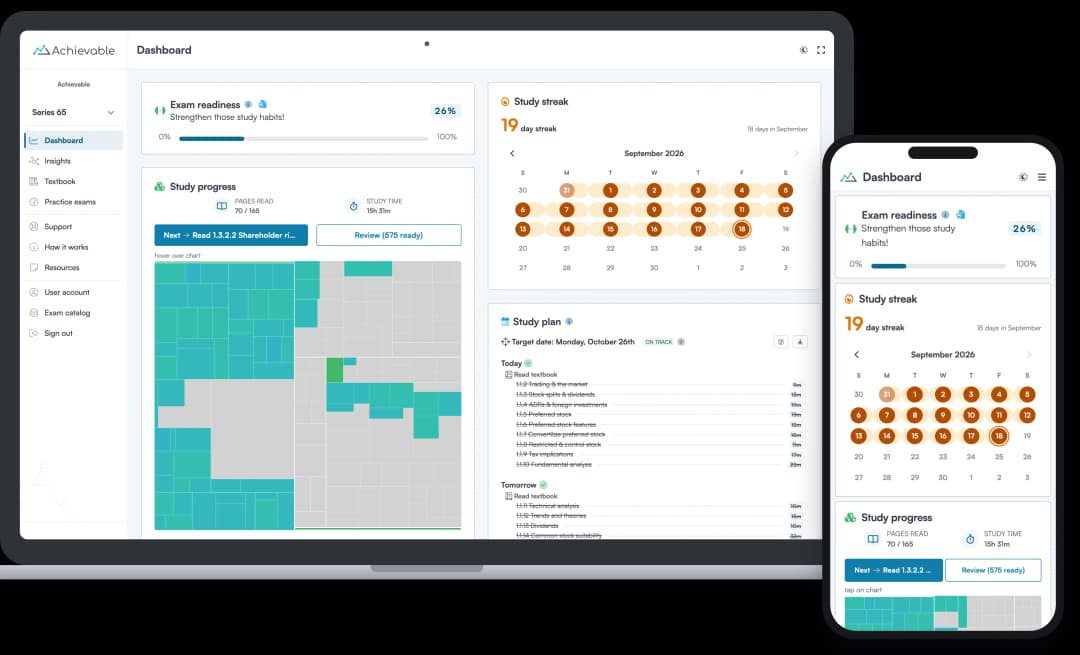
This calendar is a fixed version of what the study planner in Achievable’s Series 65 course does for you. Enter your exam date and choose which days you’ll study (every day, weekdays or weekends), and it lays out every textbook section, checkpoint and practice exam across those days, with a time estimate for each. As you check tasks off, it shows whether you’re on track for your date, and you can print the plan.

The course includes the online textbook, the checkpoints and midterm in this plan, and the full-length practice exams. You can also try a free Series 65 practice exam before you start.
About the Series 65 exam
The Series 65 exam, the Uniform Investment Adviser Law Exam, is a NASAA exam that FINRA administers. Passing it qualifies you to register as an investment adviser representative in most states. It has 130 scored multiple-choice questions plus 10 unscored ones, you have 3 hours, and you pass with 92 of the 130 scored questions right (about 71%). It has no prerequisites or corequisites, and you don’t need a sponsoring firm to take it. NASAA’s content outline splits the questions across four areas:
- Client investment recommendations and strategies: 30% (39 questions)
- Laws, regulations and guidelines, including prohibition on unethical business practices: 30% (39 questions)
- Investment vehicle characteristics: 25% (32 questions)
- Economic factors and business information: 15% (20 questions)
See our Series 65 exam information page for more, and FINRA’s page on scheduling your exam when you’re ready. If you also hold or plan to take the Series 7, compare the Series 65 with the Series 66 study plan.
When you’re ready to book, our guide to Series 65 requirements and how to register and schedule the exam walks through enrolling, your 120-day window and scheduling with Prometric.
Key takeaways
- Six weeks at 1.5 to 2 hours a day is enough for most people to prepare for the Series 65.
- Spend four weeks on the four chapters: about a week and a half on investment vehicles, then client strategies, economics, and the laws and regulations.
- Use the last two weeks for seven full-length practice exams, with review days between them.
- Book the Series 65 once you score about 81% on practice exams, 10 points above the 71% passing score, again and again across several full-length exams.
- Achievable’s study planner builds this kind of plan around your own exam date and study days.