From a 62 to passing the Series 7: What actually got me through


James Drinkwater is a recent graduate from UCF and serves as the Director of Client Relationships at Drinkwater Wealth Management.
When I started studying for the Series 7, I genuinely didn't know if I could pass it. My first practice exam score was a 62. Not exactly the confidence boost you want at the beginning of one of the most comprehensive licensing exams in the financial industry.
But here's what I learned over the next several weeks: starting low doesn't mean finishing low. It just means you have more room to grow.
Why I took the Series 7 exam
I entered the financial services industry knowing that the Series 7 was required to advance my career. It wasn't optional. It was the gateway. So I committed to it fully, even when the material felt overwhelming at first.
The biggest challenge
Honestly? Confidence. The Series 7 covers an enormous amount of material. Options strategies, municipal bonds, taxation, annuities, CMOs, margin, suitability, insurance products, retirement accounts, communications rules, and more. Every time I felt solid on one topic, I would discover three more I hadn't fully mastered.
My scores on practice exams were inconsistent. I would hit 76 one day and drop back to 74 the next. I started questioning whether I was actually improving or just getting lucky on certain draws. That mental battle was harder than any individual concept I had to learn.
What changed everything
Two things shifted my trajectory. First, I stopped trying to learn everything and started being surgical about my weaknesses. Instead of taking full practice exams repeatedly, I drilled specific topic banks until my scores in those areas climbed significantly. I ended up hitting 87% on annuity-specific questions after focused drilling. That kind of targeted improvement is what actually moved my overall score.
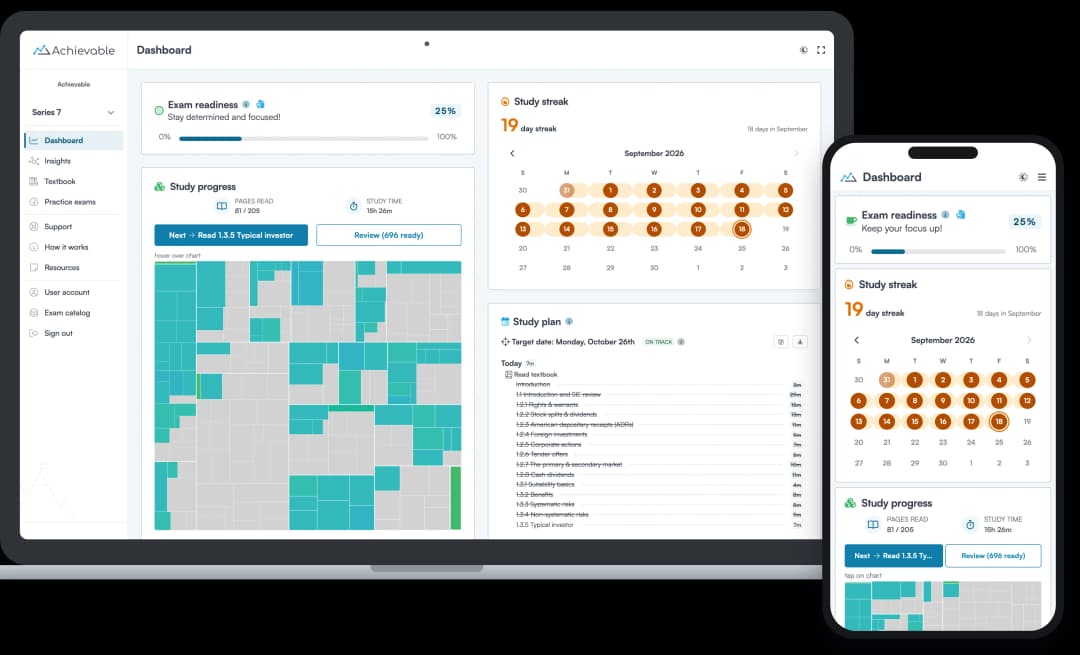
Second, I found Achievable. The platform became the foundation of my entire preparation. The explanations were clear, the questions were well-constructed, and the way the material was presented helped the concepts actually stick rather than just feel memorized. When I got something wrong, the explanations didn't just tell me the right answer. They helped me understand WHY, which made all the difference when similar concepts appeared in different forms on the real exam.
Achievable helped me build a genuine understanding rather than surface-level familiarity. That distinction matters enormously on an exam like the Series 7, where questions are designed to test application, not just recall.
Balancing everything
I was studying while managing real-life responsibilities, which meant some days I had four focused hours and other days I had forty minutes. What helped was treating every session as purposeful rather than just logging time. If I only had thirty minutes, I would drill one specific topic rather than skimming broadly. Quality over quantity became my actual strategy, not just a phrase.
Achievable made this easier because the platform let me focus on specific weak areas rather than forcing me to work through everything in a fixed order. That flexibility was genuinely valuable when my schedule was unpredictable.
How I felt going into test day
Nervous but ready. I knew I had put in the work. My practice scores were consistently improving, and I had built enough confidence in the material to trust my instincts when questions felt uncertain.
I took breaks during the exam, something multiple passers recommend. I read every question carefully, eliminated the obviously wrong answers first, and trusted what I had learned. When I hit the harder middle section and felt uncertain, I reminded myself that everyone feels that way. It is by design.
When I hit submit and saw "PASS" on the screen, it was one of the best moments of my professional life.
What I would tell someone just starting
Your first practice score is not your final score. The gap between where you start and where you need to be is closable. But you have to be honest about your weak spots and attack them directly.
Use Achievable. The clarity of the explanations and the quality of the practice questions genuinely accelerated my understanding, making the real exam feel manageable.
The Series 7 is hard. But it is absolutely passable. And passing it is absolutely worth it.