

Series 7
study guide
Every chapter of the course summarized, with each section linked to its lesson.
Pass the first time
Try Achievable Series 7
No credit card required
This free Series 7 study guide summarizes all 16 chapters of Achievable's Series 7 course: what each covers, the points to remember, and its 203 sections in order. Read each chapter after you study it, or work through the whole guide before exam day.
Each section links to its full lesson in Achievable, with the review quizzes and full-length practice exams.
Chapter 1: Common stock
24 sections
Free chapter
- Common stock basics: Common stock is a negotiable equity security with regular-way settlement in T+1, and proxies provide voting rights to stockholders unable to attend the annual meeting.
- Dilution and voting: Dilutive actions reduce proportionate ownership, must be approved by stockholders, and rights offerings avoid dilution; statutory voting structures benefit large shareholders, while cumulative voting structures benefit small shareholders.
- Transfer and liquidation: The transfer agent maintains the book of stockholders, issues and redeems shares, distributes proxies and dividend payments, securities are registered in book-entry format, and liquidation follows the stated priority.
- Rights and warrants: Rights give current stockholders the right to purchase new shares at a fixed price, while warrants are long term, have no intrinsic value, and issuing warrants is a dilutive action requiring stockholder approval.
- Splits and ADRs: Forward stock splits, reverse stock splits, and stock dividends change share count and price per share without changing overall value, and stock splits require approval while stock dividends do not.
- Markets and actions: ADRs trade in US dollars in US markets with currency exchange risk and no voting or pre-emptive rights, foreign investing adds diversification but also currency risk, and tender offers require long participation periods.
- Suitability and analysis: Common stock suits younger, risk-tolerant investors seeking capital appreciation or income, and fundamental analysis uses financial statements, ratios, and EPS or PE to judge value.
- Technical signals: Technical analysis looks at trading data for short-term trends, using market trends, advance/decline lines, resistance and support, odd lot and short interest theories, and Dow theory.
In this chapter
- Introduction and SIE reviewFree
- Equity securities & trading
- Suitability
- Suitability basicsFree
- BenefitsFree
- Systematic risksFree
- Non-systematic risksFree
- Typical investorFree
- Suitability basics
- Fundamental analysis
- Technical analysis
- The basicsFree
- Market trendsFree
- SaucersFree
- Head & shouldersFree
- Resistance & support Free
- TheoriesFree
- The basics
Start this chapter free
Chapter 2: Preferred stock
8 sections
- Core characteristics: Preferred stock is a form of ownership (equity), is considered a fixed income security, and market prices are influenced by interest rates.
- Settlement and dividends: Regular way settlement is T+1, cash settlement is same day if prior to 2:30pm ET, and dividends must be approved by the BOD and are typically paid quarterly.
- Par value and yield: Par value is also known as face value, typically $100 for preferred stock, never fluctuates, and dividend rate is based on par; yield is based on market price and dividend rate and is inversely related to market price.
- Price movement and features: Fixed income market prices trade at a discount below par or a premium above par, rising interest rates make prices decline, falling interest rates make prices increase, and adjustable-rate preferred stock keeps market value close to par.
- Variations, benefits, and risks: Cumulative, participating, callable, and convertible preferred stock differ in dividend treatment, issuer flexibility, and conversion terms, while preferred stock offers fixed income and tax benefits but carries dividend, interest rate, inflation, call, and reinvestment risk.
In this chapter
Study this chapter in Achievable
Chapter 3: Bond fundamentals
10 sections
- Par and coupon: Par value is a bond's "face value," typically $1,000 for bonds, and interest rate (coupon) is annual interest paid based on par.
- Bond structure: Bearer bonds are owned by whoever physically possesses them, while book-entry bonds track ownership electronically and are the format for all modern securities.
- Maturity features: Zero coupon bonds do not make regular interest payments, short-term maturities are safer than long-term bonds, and secured bonds are safer than unsecured bonds.
- Call and issuance: The call feature lets issuers end a bond before maturity by paying accrued interest, par, plus any call premium, while firm commitment underwritings leave unsold securities with the underwriter.
- Trading mechanics: Bond transactions begin in the primary market and trade in the secondary market, prices move opposite interest rates, and settlement is T+1 with accrued interest handled by 30/360 or Actual/365.
- Yields and risk: Yield reflects return and can be nominal yield, current yield, YTM, or YTC, while bond benefits, risks, and strategies include income, default risk, reinvestment risk, and ladder, barbell, or bullet approaches.
In this chapter
Study this chapter in Achievable
Chapter 4: Corporate debt
17 sections
- Debt versus equity: Debt lets a company raise capital without giving up ownership, and bondholders do not have voting rights.
- Equity tradeoff: Stock avoids repayment and interest, but it gives up ownership and often requires shareholder approval for many corporate decisions.
- Liquidation order: In liquidation, unpaid wages come first and common stockholders come last, after unpaid taxes, secured creditors, unsecured creditors, junior unsecured creditors, and preferred stockholders.
- Corporate debt forms: Commercial paper is short-term zero coupon corporate debt with a 270-day maximum maturity, while debentures are long-term unsecured corporate bonds and funded debt means long-term corporate debt.
- Special bond types: Guaranteed bonds rely on a third party's promise, income bonds pay interest only when the issuer meets the earnings test, and mortgage bonds, ETCs, and collateral trust certificates are secured issues.
- Convertible features: Convertible bonds convert to common stock of the same issuer, use conversion ratio, conversion price, stock parity price, and bond parity price, and anti-dilution covenants adjust them for stock dividends and splits.
- Trading and bank issues: Most corporate bond trades occur in the OTC markets, corporate bond quotes use percentage of par format, and CDs, jumbo CDs, brokered CDs, and banker's acceptances are bank issues with their stated maturity and insurance rules.
- Eurodollars and suitability: Eurobonds and Eurodollar bonds are not subject to SEC jurisdiction or registration, corporate debt offers interest income and possible capital gains with convertible bonds, but it carries default risk and high taxes on interest income.
In this chapter
- Review
- Products
- Trading
- Bank issues
- Suitability
Study this chapter in Achievable
Chapter 5: Municipal debt
17 sections
- Municipal bonds: Issued by states, cities, counties, and political subdivisions, municipal bond interest is exempt from federal taxes but may be subject to state and local taxes if not a resident.
- MSRB oversight: The Municipal Securities Rulemaking Board governs municipal markets, writes municipal regulations, and is enforced by the SEC, FINRA, the Federal Reserve Board, the Office of Comptroller of the Currency, and FDIC.
- General obligation bonds: G.O. bonds fund non-self-supporting projects, are paid off with property taxes, require voter approval and debt limits, and are sold on a firm commitment basis through competitive bids.
- G.O. analysis: Mill rate equals 1 mill = 0.1% = 0.001, property tax liability uses assessed value x mill rate, and debt statements classify direct debt, net direct debt, overlapping debt, and net overall debt.
- Revenue bond basics: Revenue bonds finance self-supporting municipal ventures, are paid off with project revenues, require no voter approval or debt limits, and feasibility studies evaluate whether the venture can avoid default.
- Revenue bond structure: Trust indentures, covenants, flow of funds, DSCR, sinking funds, and additional bonds covenants protect bondholders, while advance refunding and refunding bonds can make bonds defeased or pre-refunded.
- Short-term debt: Anticipation notes are paid off with future municipal cash flows, including TANs, RANs, TRANs, BANs, and GANs, and variable rate demand notes have a short-term redemption put option.
- Trading and suitability: Municipal bond markets have higher liquidity risk and no short sales, quotes are yield basis quotes, and municipal debt appeals to income seekers and wealthy investors at high tax brackets.
In this chapter
- Review
- General obligation bonds
- Revenue bonds
- Short-term municipal debt
- Trading
- Suitability
Study this chapter in Achievable
Chapter 6: US government debt
12 sections
- Government funding: The US Government is the largest and most active securities issuer in the world and primarily funds activities through deficit spending.
- Treasury securities: The US Department of the Treasury manages federal finances, issues securities to fund spending, and all Treasury securities have a minimum denomination of $100.
- Treasury issues: Treasury bills are short-term zero coupon debt securities sold at discount to par, while notes and bonds are sold at par and pay semi-annual interest.
- Auction pattern: Treasury bills are issued weekly except the 52-week bill, notes are issued monthly, and bonds are issued quarterly.
- Special Treasury issues: CMBs are issued as needed to cover short-term funding gaps, STRIPS and Treasury Receipts are long-term zero coupon bonds, and TIPS adjust principal to CPI.
- Agency and market: Agency bonds are indirectly backed and carry some default risk, mortgage securities and CMOs have prepayment and extension risk, and US Government debt is traded OTC after Treasury auctions.
In this chapter
- Review
- Treasury products
- Federal agency products
- The market & quotes
- Suitability
Study this chapter in Achievable
Chapter 7: Investment companies
15 sections
- Foundations: Investment companies invest their customers' money and are regulated by the Investment Company Act of 1940.
- Company classifications: Investment company classifications are management companies, unit investment trusts (UITs), and face amount certificates.
- Fund types: Mutual, closed-end, and ETF fund types are determined by investment objective and securities held, including growth, income, index, asset allocation, and international/global funds.
- Open-end companies: Mutual funds are open-end management companies with redeemable shares, prospectus delivery at sale, NAV-based pricing, and shareholder rights over major fund matters.
- Share classes and taxes: Class A, Class B, and Class C shares differ in load timing and 12b-1 fees, and Subchapter M passes 90% of net investment income to investors.
- Closed-end products: Closed-end funds trade in the secondary market at market price, while ETFs are negotiable and ETNs are debt instruments subject to default risk.
- UITs and suitability: UITs hold fixed portfolios with no ongoing portfolio management, and investment companies generally provide instant diversification, professional expertise and management, dollar cost averaging, alpha, and beta.
In this chapter
Study this chapter in Achievable
Chapter 8: Alternative pooled investments
9 sections
- Pooled investments: Many investors combine money for a shared objective, and these investments fall outside the legal definition of investment company while providing access to non-traditional return sources.
- REIT structure: REITs pool investor money like mutual funds but invest specifically in real estate, usually through an IPO and then the secondary market, with equity, mortgage, and hybrid forms.
- REIT taxation: Under Subchapter M, or the conduit rule, REITs must distribute at least 90% of net investment income and meet the 75% asset and 75% income tests.
- Alternative fund risks: Hedge funds are unregulated, available only to accredited investors, and usually have lock-up periods, while DPPs pass through business returns and losses and often suit investors seeking tax benefits and able to accept liquidity risk.
- Business financing programs: BDCs are registered closed-end investment companies that invest in small businesses, pass income to investors under Subchapter M, and are suitable for aggressive investors with long time horizons.
In this chapter
Study this chapter in Achievable
Achievable Series 7
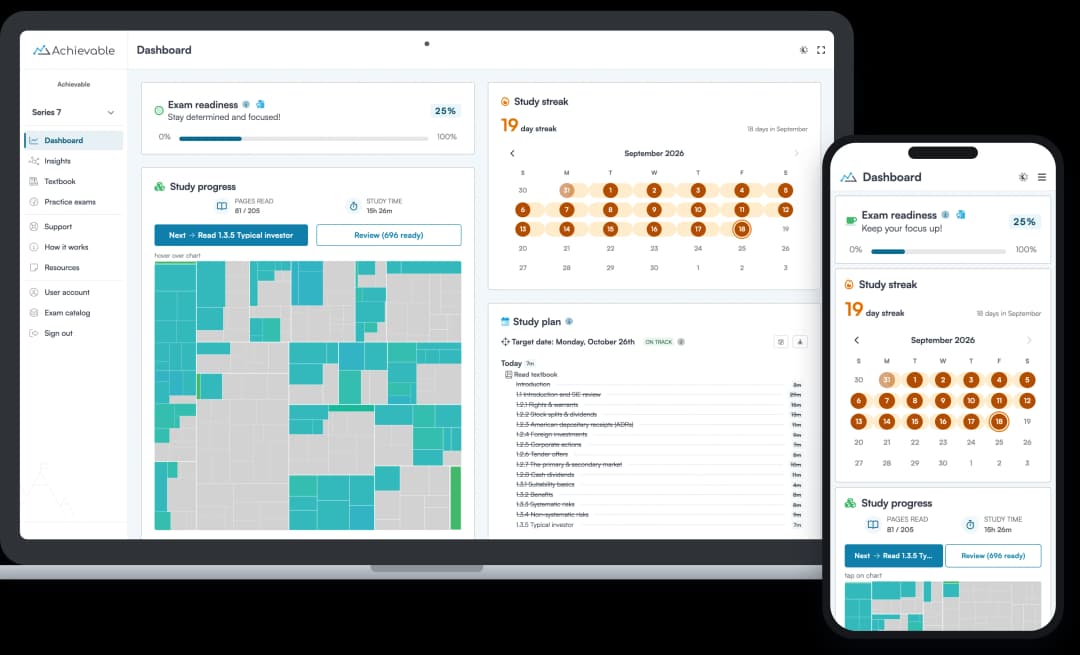
Series 7 exam prep course and study materials, 97% pass rate: online textbook, 4,700+ practice questions, and 35 full-length practice exams.
35 full-length Series 7 practice exams
4,700+ practice questions with explanations
44+ video lessons and audio narration
Pass guaranteed, or your money back
Chapter 9: Options
28 sections
- Core option basics: Options are derivative securities that give the right to perform a transaction at a fixed price and derive value from the underlying asset.
- Contracts and market: Options contracts are standardized by the Options Clearing Corporation, traded on the Chicago Board Options Exchange, and settle in one business day (T+1).
- Contract terms: Option contracts cover 100 shares of stock, with strike price as the fixed exercise price and premium in multiples of 100.
- Premium and exercise: Option premiums equal intrinsic value plus time value, and American style options can be exercised at any time while European style options can only be exercised at expiration.
- Basic equity strategies: Long calls and long puts are bought contracts with limited loss, while short calls and short puts are sold contracts with limited gain and potentially unlimited loss.
- Advanced strategies: Collars, straddles, combinations, and spreads use multiple legs to create complex risk/reward scenarios in different market conditions.
- Non-equity options: Index options, VIX, foreign currency options, and yield-based options derive value from fluctuations in market levels, currencies, or bond yields.
- Rules and suitability: Options accounts require disclosure, approval, and agreements, while suitability depends on the strategy, investor type, and risk tolerance.
In this chapter
- Introduction
- Fundamentals
- Option contracts & the market
- Equity option strategies
- Advanced option strategies
- Non-equity options
- Suitability
- Regulations
Study this chapter in Achievable
Chapter 10: Taxes
5 sections
- Cash and interest: Cash dividends are taxable income received from equity investments and reported on tax form 1099-DIV, while interest from debt securities is reported on tax form 1099-INT.
- Dividend and gain rules: Qualified dividends are taxed at 0%, 15%, or 20%, non-qualified dividends use the federal marginal income tax bracket, and capital gains or losses are reported on tax form 1099-B.
- Basis and income types: Earned income, investment income, and passive income follow different rules, and cost basis adjustments apply to inherited securities, gifted securities, wash sales, and stock dividends and splits.
- Options and bond tax rules: Option tax consequences depend on expiration, trading, or exercise, while accretion, amortization, and municipal bond tax rules determine how discount, premium, and interest are taxed.
Study this chapter in Achievable
Chapter 11: The primary market
5 sections
- Primary market basics: Issuers sell securities to raise capital, and underwriters hired by issuers to sell new issues are also known as investment banks.
- Underwriting commitments: Firm underwriting commitments make the underwriter liable for unsold shares, while best efforts commitments make the issuer liable for unsold shares.
- Offering types: IPOs are the first public sale of a security, APOs are public sales after the initial sale, and primary market transactions send sale proceeds to the issuer.
- IPO rules and exemptions: The Securities Act of 1933 governs the primary market, and exemptions include exempt securities, exempt transactions, Rule 144, and other rules such as shelf registration and Regulation S.
In this chapter
Study this chapter in Achievable
Chapter 12: The secondary market
13 sections
- Market participants: Traders buy and sell securities for clients, broker-dealers may act in an agency or principal capacity, and market makers buy and sell securities with the public only in a principal capacity.
- Agency and principal: Agency capacity matches buyers and sellers for a commission, while principal capacity uses inventory and earns mark-ups and mark-downs.
- Spreads and lots: Bid/ask spreads are maintained by market makers, the bid is where market makers buy and customers sell, the ask is where market makers sell and customers buy, and a round lot is 100 shares of stock.
- Major markets: The New York Stock Exchange is an auction market with a DMM, NASDAQ is a negotiated OTC market with numerous market makers, and CBOE is the primary options trading exchange with a DPM.
- OTC and regulation: OTC markets serve stocks not meeting NYSE/NASDAQ listing standards, the four principal OTC tiers are OTCQX, OTCQB, OTCID Basic Market, and Pink Limited Market, and the Securities Exchange Act of 1934 regulates the secondary market.
- Order basics: Market orders execute at the next available market price with price not guaranteed, limit orders guarantee price but not execution, stop orders become market orders after trigger, and stop limit orders become limit orders after trigger.
- Order rules: Day orders cancel at the end of the trading day, GTC orders stay active until customer cancels, AON, IOC, and FOK have different fill requirements, and order tickets, unsuitable orders, name changes, trade errors, Regulation SHO, and the 5% rule all require firm controls.
Study this chapter in Achievable
Chapter 13: Brokerage accounts
14 sections
- Opening information: Four critical pieces of information—Name, Date of birth (DOB), Address, and SSN or TIN—must be collected as per Patriot Act and verified through valid government-issued I.D. or credit bureau database.
- Account controls: Firms must confirm customer info within 30 days of account opening and every 3 years, keep records for six years, and may not make recommendations without suitability information.
- Statements and orders: Cash accounts require full payment, quarterly statements can be sent by mail or electronically, monthly statements are sent if they customer holds penny stocks, and trade confirmations are sent by completion of the transaction.
- Account registrations: Individual accounts are subject to probate without TOD, joint WROS accounts avoid probate, joint TIC accounts are subject to probate, and POA, fiduciary, business, and other registrations each carry their stated authority and ownership rules.
- Business and custody: Prime brokerage accounts, DVP / RVP accounts, and the listed methods of holding securities each define who holds custody, who executes trades, and how ownership appears on the books.
- Disputes and complaints: Complaints must be submitted in writing and kept on file for 4 years at OSJ, mediation is voluntary and confidential, and arbitration is FINRA-mandated, final, binding, and private in hearing.
- Margin basics: Margin accounts borrow money for investment, require signed hypothecation and credit agreements, use Regulation T and FINRA margin requirements, and apply maintenance, equity, SMA, and frozen-account rules exactly as stated.
In this chapter
Study this chapter in Achievable
Chapter 14: Retirement & education plans
7 sections
- Retirement plan basics: Retirement plans help save for post-retirement living expenses, supplement Social Security/Medicare, and center on contributions, eligible investments, distributions, and penalties.
- Cash and taxation rules: Contributions must be made in cash only, deductible contributions reduce taxable income now, and most plans are tax-deferred except Roth IRAs/401(k)s.
- Investments and distributions: Allowed investments include stocks, bonds, mutual funds, UITs, and US Government coins, while withdrawals are generally taxable as ordinary income and may trigger penalties.
- Qualified plan standards: Qualified plans are governed by ERISA, require a plan document and fiduciary oversight, and include defined benefit plans, 401(k)s, 403(b)s, Keogh, SEP, SIMPLE, and 457 plans.
- IRAs, annuities, and education: Traditional IRAs, Roth IRAs, annuities, life insurance, Coverdell ESAs, 529 plans, and ABLE accounts each follow specific contribution, distribution, tax, and penalty rules.
Study this chapter in Achievable
Chapter 15: Rules & ethics
11 sections
- SEC and FINRA: The SEC regulates the primary and secondary markets and enforces the Securities Act of 1933, Securities Exchange Act of 1934, Trust Indenture Act of 1939, and Investment Company Act of 1940; FINRA regulates the financial industry and its participants.
- Forms and reporting: U-4 is filed when joining a firm and must be updated if information changes, U-5 removes registration status when leaving a firm, and U-6 reports disciplinary actions, reportable events, and arbitration results.
- Market and state regulators: TRACE is FINRA's bond trade reporting system with a 15 minutes reporting deadline, the MSRB writes municipal regulations but does not enforce them, and NASAA regulates the financial industry at the state-level under the Uniform Securities Act.
- Public communications rules: Written supervisory procedures must exist, communications must be fair, balanced, clear, and not misleading, and correspondence, retail communications, institutional communications, and research reports have different filing and pre-approval rules.
- Social media and Reg BI: Social media communications follow the same general rules with 3 years retention, static content needs principal pre-approval, and Regulation BI requires disclosure, care, conflict of interest, and compliance obligations for recommendations to retail investors.
- Representative ethics and records: Registered representative rules restrict outside business activities, private securities transactions, gifts, borrowing, and selling away, while recordkeeping, vulnerable-investor protections, Regulation S-P, Regulation S, and FINRA discipline all impose specific retention and conduct requirements.
Study this chapter in Achievable
Chapter 16: Suitability
8 sections
- Product suitability: Common stock, preferred stock, debt securities, CDs, municipal debt, US Government debt, mortgage backed securities, investment companies, REITs, hedge funds, and DPPs each match different risk and income profiles.
- Objectives and standards: Preservation of capital, safety of principal, tax-advantaged income, moderate income, moderate growth, high yield income, aggressive growth, and speculation are judged under reasonable basis, customer-specific, and quantitative suitability standards.
- Investor profile factors: Financial considerations include annual income, net worth, tax status, and liquidity needs, while non-financial considerations include stage in life, investment objectives, risk tolerance, investment experience, and investment goals.
- Portfolio analysis: Diversification reduces non-systematic risks, the Rule of 100 says 100 minus age equals % in stocks, and total return, after-tax return, benchmarks, CAPM, and MPT measure performance and risk.
- Economic and exam skills: GDP, recession, depression, expansion, peak, trough, and recovery describe the economy, while eliminating wrong answers, tracking every detail, and thinking like a regulator improve suitability choices.
Study this chapter in Achievable
Series 7 exam at a glance
- Questions
- 125 multiple-choice questions
- Time
- 3 hours 45 minutes
- Passing score
- 72% (90/125)
- Exam fee
- $395
More on the Series 7 exam
- Series 7 exam prep courseAchievable's course: online textbook, review quizzes and full-length practice exams.
- Series 7 exam format, content and scoringWhat's tested, how long it takes, what it costs, and the score you need to pass.
- Free Series 7 practice examPractice questions written to match the real thing, with an explanation for every answer.
- Series 7 FAQThe questions asked most about the exam and preparing for it, answered.
- Best Series 7 exam prep coursesHow the leading providers compare on content, format and price.
- Series 7 study resourcesGuides and study advice from Achievable's instructors.
Pass the FINRA Series 7. Guaranteed.
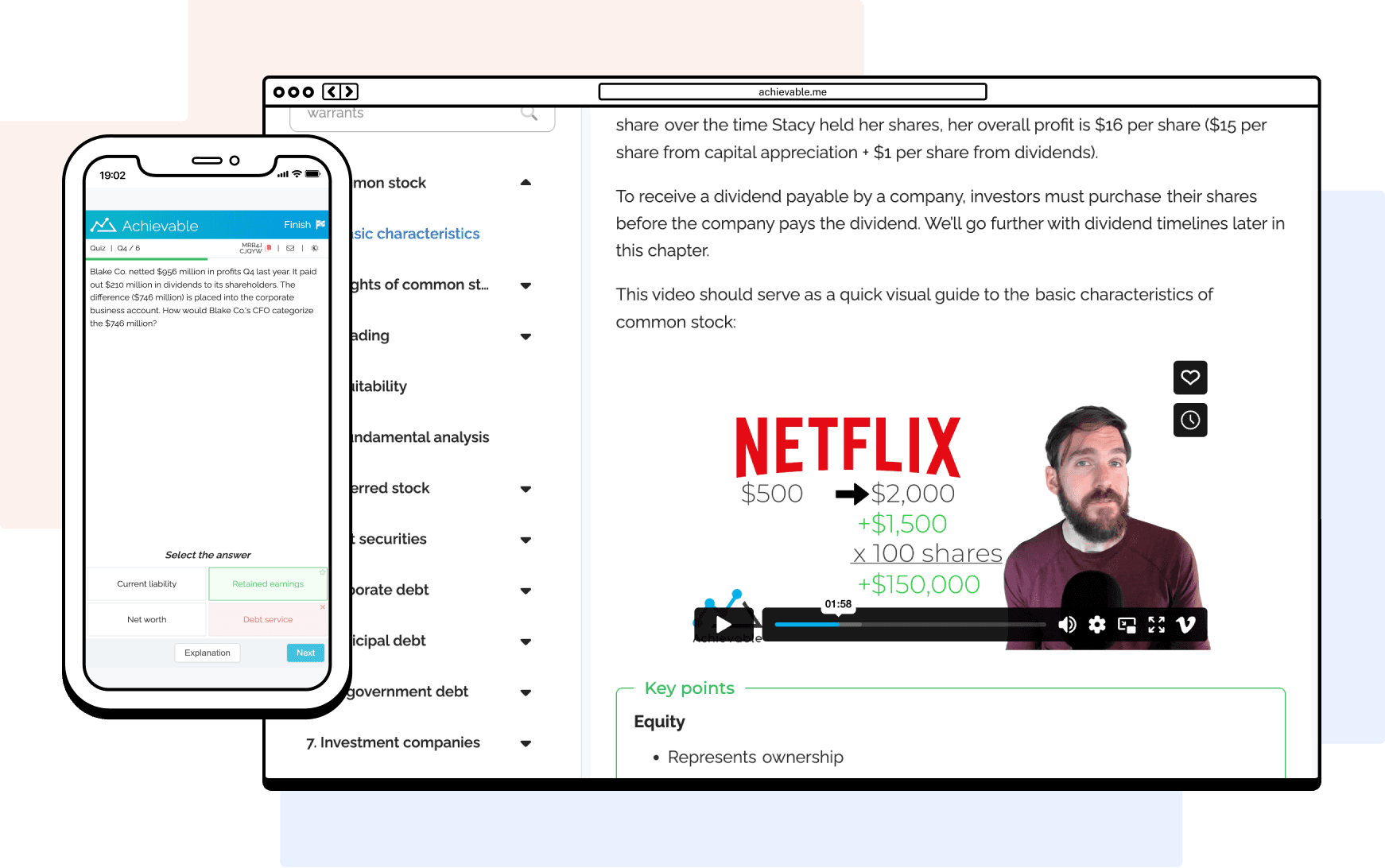
Achievable is the best Series 7 exam prep course: effective, personalized, and convenient. With Achievable, you'll spend less time studying and pass your exam the first time, or your money back.