Building the foundation for a career in finance


Tommy is a finance student at Cal Poly San Luis Obispo and an aspiring wealth advisor. He took the SIE to learn more broadly about the finance industry and set himself up for future FINRA exams.
Preparing for the SIE exam was a personal goal that represented a bigger step toward my future in finance. As a junior at Cal Poly San Luis Obispo, I knew I wanted to build a broader understanding of the finance industry, especially because I plan to become a wealth advisor. In that career path, licensure is important, and I saw the SIE as a strong starting point. I decided that after the SIE, I wanted to pursue the Series 65 since it does not require sponsorship, and later work toward the Series 7 and CFP® certifications. For me, passing the SIE was not just about checking a box. It was about proving to myself that I could take initiative early and begin building the foundation for the career I want.
Time management challenges
The biggest challenge during my prep was time management. More specifically, it was the feeling that I was never studying quite enough. I would sometimes miss a few days at a time, and when that happened, it would throw off both my progress and my target test date. Then I would try to rebalance my schedule while keeping the same exam date, which usually meant I had to add more hours of studying to each day. That created extra pressure and made the process feel heavier than it probably needed to be. I think that was one of the hardest parts; not necessarily the material itself, but managing the pace of preparation in a consistent way.
At the same time, I was balancing exam prep with being a full-time student and working part-time. My weekly routine usually looked like studying three to four days per week for about 1 to 2 hours each day. That was manageable, but it also meant I had to stay disciplined. If I were consistent, it would work well. If I let a few days slip by, I felt it immediately. Even if the daily workload is not overwhelming, falling behind can make everything feel more stressful later.
Creating a study plan that actually works
As I went through the material, I developed a study system that worked well for me. I would read through the text, take brief notes, complete the quiz for that section until I scored above 80%, and then move on. After finishing the sections in a chapter, I would take the chapter exam and again make sure I scored at least 80% before continuing. Having that system gave me structure and made the process feel more organized. Instead of just studying randomly, I had a clear standard for when I was actually ready to move forward. That helped me stay accountable and gave me more confidence over time.
The test day itself was a mix of preparation and uncertainty. I felt ready going into the exam, but I still had one major concern. I had read online reviews saying the actual SIE could feel very different from what they had prepared for, and that worried me. Even when you study hard, it is easy to let those kinds of comments get into your head. To help with that, I used online YouTube videos and did a cram session the night before. That final review helped reinforce key concepts and made me feel more confident walking in. I would not say I felt completely relaxed, but I did feel prepared. Ultimately, confidence in my ability to pass is what carried me through the actual exam.
The clarity in hindsight
If I could change one thing about my prep, I would shorten the overall timeline. I stretched my studying out over about ten weeks, and in hindsight, I think that was longer than it needed to be. If I were doing it again, I would probably aim for a more concentrated five-week schedule. My ideal version would be to get through about three chapters per week for four weeks, then use the final week to take at least five full practice exams. I found that once I was scoring in the mid-70s to low-80s on practice exams and carefully reviewing what I got wrong, my understanding improved a lot.
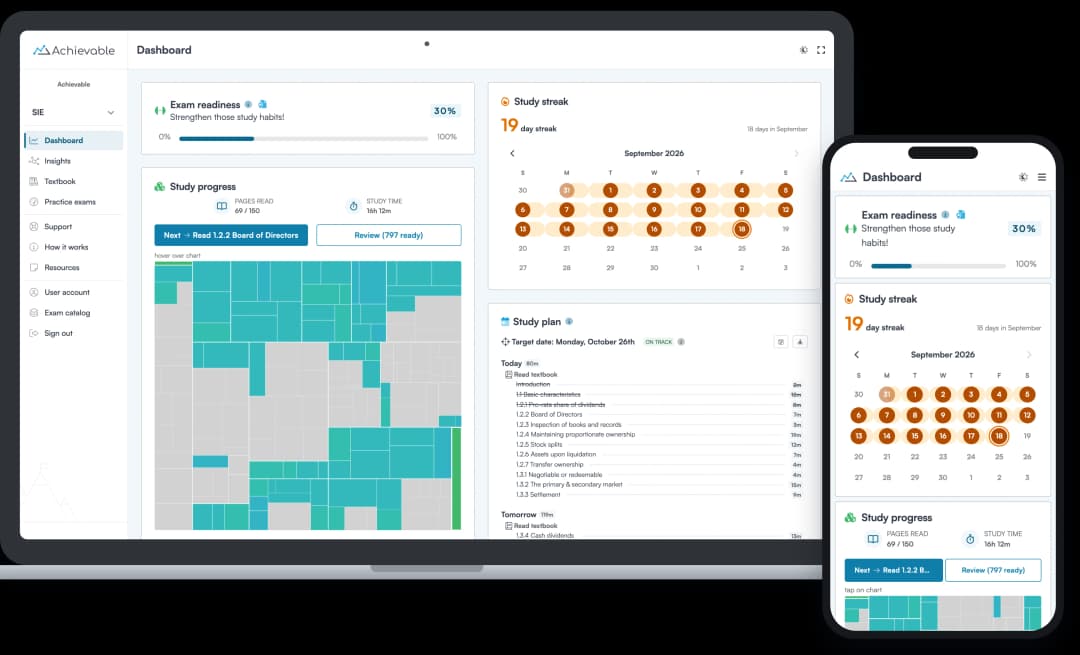
Achievable played a big role in making my preparation effective. What stood out most to me was its lean approach to learning. I felt like it gave more than enough information on each subject without becoming overwhelming. That balance mattered because exam prep can already feel mentally heavy, and I appreciated having materials that were direct and manageable. I also found the videos helpful because hearing someone explain a concept added another layer to the learning process, especially when I could first try to work through a problem on my own. Another feature I liked was the embedded links within lessons. If I wanted to learn more about a company, story, or theory, it was easy to go a little deeper. Overall, I thought Achievable did a great job of providing the study materials I needed for the SIE.
Looking forward
Now that the exam is behind me, I am back focused on school and continuing to work toward a career in finance. The next steps will likely include studying for the Series 65 and Series 7 while also getting more familiar with wealth management technicals. More than anything, the SIE showed me that progress comes from having a plan, staying honest with yourself, and adjusting when needed.