How I passed the SIE exam while working full-time: My journey from customer service to finance


Cesar is a FIU finance graduate (2022) seeking to enter wealth management, with 10 years of customer service experience as a server and 5 years of personal market experience. He passed the SIE and is currently pursuing the Series 66.
Breaking into the financial services industry can be challenging, especially for career changers. After earning a finance degree and spending years building customer service and sales experience, Cesar Batista knew that passing the Securities Industry Essentials (SIE) Exam would help demonstrate the knowledge and commitment needed to transition into wealth management.
Cesar shares what motivated him to take the SIE, the study strategies that led to a passing score, and how the exam became the first step toward a career in financial advising.
What motivated you to take this exam?
I took the SIE exam because I’m making a serious career shift into wealth management and financial advising. I have a finance degree from FIU, years of customer service and sales experience, and a strong interest in markets and investing, but I wanted to prove that I had real foundational securities knowledge.
Passing the SIE was the first step toward becoming a stronger candidate for advisor development programs and licensed roles, and eventually for becoming a financial advisor.
What was the biggest challenge during your prep?
The biggest challenge was balancing studying with work and family responsibilities while staying consistent. I work in a demanding customer-facing job, so I had to study around my schedule and manage my energy.
Another challenge was learning how the exam phrases questions. Sometimes I understood the concept, but the wording made it tricky. I had to train myself to slow down, read carefully, and not rush.
How did you balance studying with other responsibilities?
I treated studying like a commitment, not something I would only do when I felt motivated. I studied before and after work, used practice exams to measure progress, and adjusted my routine when I saw weak areas. I use Google Calendar to stay organized.
What strategies, habits, or tools helped you most?
The biggest things that helped me were:
- Full-length practice exams: They helped me build stamina and get comfortable with the test format.
- Reviewing every wrong answer: I did not just look at the score. I focused on why I got questions wrong.
- Setting block study time: I spent 3 hours a day studying to pass in around a month
- Tracking my scores: Seeing my practice scores improve gave me confidence.
- Staying consistent: Even when I was tired, I tried to do something productive rather than lose momentum.
Did your background or life circumstances shape your prep?
Yes, definitely. English is not my first language, so I had to be extra careful with the wording of the questions. Some questions were not just testing knowledge; they were testing attention to detail.
Also, I have been working in restaurants/customer service for years while trying to transition into financial services. That gave me a strong reason to stay disciplined. I knew passing this exam could help open doors for the next stage of my career.
What role did Achievable play in your prep?
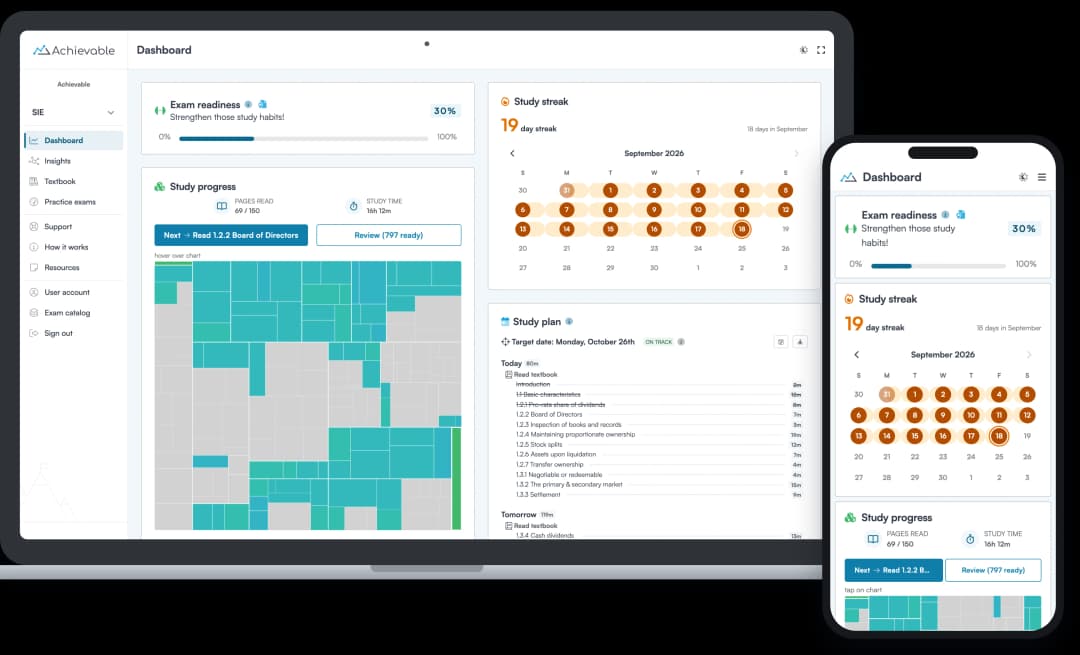
Achievable helped me organize the material and gave me a clear structure to follow. The practice exams were especially helpful because they showed me where I stood and helped me build confidence before the real exam.
It made the material easier to digest and helped me stay consistent throughout the process.
How did you feel going into test day?
I felt nervous, but prepared. I had taken enough practice exams to know I was capable of passing, but I still respected the exam. What helped me was reminding myself that I had already put in the work.
I focused on staying calm, reading each question carefully, and not letting one difficult question affect the rest of the exam.
What would you do differently, if anything?
I would probably start reviewing weak areas earlier, rather than focusing only on getting through the material. Practice exams are important, but the real improvement came from understanding why I was missing certain questions.
I also would have spent more time earlier learning the way the exam worded questions, because that matters a lot.
What’s next for you now?
Next, I’m studying for the Series 66, which I have scheduled for July 29. After that, my goal is to aggressively network and apply for wealth management and financial advisor development roles.
The SIE was not the finish line for me. It was the first serious step toward building a career in financial advising.