How to build an SIE study plan that works


Bryce is currently located out of Milwaukee, Wisconsin and is in the process of becoming a financial advisor through Schneider Financial Corp.
If you’re new to finance, or it’s been a while since you last studied financial concepts, you may be wondering about the best way to approach preparing for the Securities Industry Essentials (SIE) exam. Thousands of learners feel overwhelmed when they start their licensing exam preparation. That’s why Bryce Schneider, a Milwaukee-based financial advisor, is sharing his recent experience passing the SIE, along with practical tips and motivation to help you stay on track and reach your goals.
There’s no shortage of study resources available, but firsthand insight can be hard to come by. Bryce’s story offers a real-world perspective, confidence, and encouragement to support you as you build the foundation for your career.
What motivated you to take this exam?
I recently quit my job doing business valuation (BV) at an accounting firm on August 22nd, 2025. Before that, I went to college for a Bachelor of Business Administration (BBA) in finance (from UW-Milwaukee) with an added certificate in investment management. I found that after graduating from college in May 2024 and working full-time in BV for a year and three months, many of the concepts had escaped my mind, especially those related to the regulatory side and investment products. To be fair, although I was not taught a lot of that material in school, I had some familiarity with financial statements and portfolio management. However, these topics showed up minimally on the SIE, so I had to study extensively to achieve a passing score.
What was the biggest challenge you faced during your prep?
I was a little slow to start studying at the end of August 2025 while I had been unemployed with a financial advising job lined up, pending passing the three licensing exams (SIE, Series 7, and Series 63). Overall, I spent one month and two weeks studying for the exam and passed it on the first try. I only studied one weekend over the 1.5 months and mostly kept it to the business week.
There were days when I would stare at the material, get through 2-3 sub-units, and make very little progress. This was my life until I really kicked it into high gear for the last 3 weeks out of the 1.5 months of studying. I found myself hanging on every word and trying to get the best score possible on the end-of-sub-unit practice questions, which really stunted my progress. Furthermore, I found that taking 1.5 months led to the loss of information I had learned at the beginning of my studies. Keep that in mind if your study timeline is long: more review will likely be necessary.
What role did Achievable play in your prep?
I used Achievable for my study program, and I found it to be very good. I was also studying before for the Series 7 using Kaplan (which I would not recommend). I would also not recommend studying for the Series 7 before the SIE exam. I did so thinking the SIE would be a walk in the park and could just take the two back-to-back. Oh...how I was wrong.
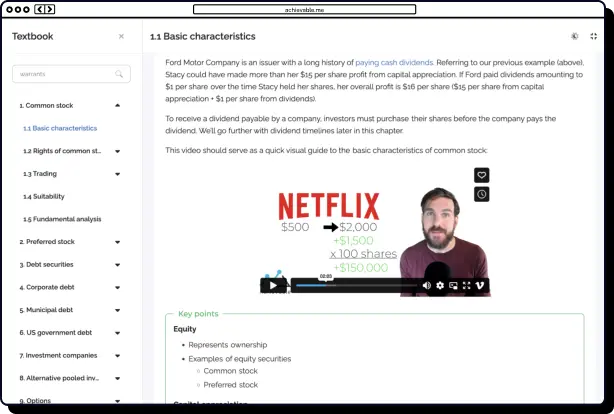
I prefer reading each chapter and doing practice questions, and I found the Achievable material to be engaging and digestible. The follow-up practice questions for each section help you solidify concepts, as you can read the solution to each set instantly and move on (Achievable recommends a 70% score on each unit to progress).
Overall, my metrics according to Achievable were:
- 105 hours & 17 minutes spent studying
- 149/149 pages read
- Final exam A (64%): Fail (instant review question-to-question (QTQ))
- Final exam B (65%): Fail (instant review QTQ)
- SIE full exam #1 (80%): Pass (instant review QTQ)
- SIE full exam #2 (76%): Pass (instant review QTQ)
- SIE full exam #3 (83%): Pass (blind test - review afterwards)
- SIE full exam #4 (75%): Pass (instant review QTQ)
- SIE full exam #5 (85%): Pass (blind test - review afterwards)
- FINRA's SIE Practice Test (73%): Pass (blind test - review afterwards)
Before taking any final/full exam, I took the 20/20 practice quizzes for each unit (excluding units 14 and 15, as those were the most recent units). I also took a few midterm exams, but minimally.
What advice would you give to someone just starting?
In the end, I would recommend reading the whole book from front to back, unless you are extremely familiar with the concepts and/or doing well on end-of-sub-unit practice quizzes. Once each practice quiz is completed, the readiness score (on a scale of 0% to 100%) begins to increase. If you finish the 149/149 pages and complete every practice quiz, your readiness score will be 60%. Taking practice exams and consistently achieving good scores will raise the "exam readiness" meter higher and closer to 100%. I ended up getting to 91%; 31% was added on from the 60% because of the 5 practice exams I took.
I also created Quizlet flashcards using Achievable material on concepts I was getting wrong on the practice exams. I did not use the 2 dump sheets they provided, which contain broad overviews of concepts and formulas.
You can use my flashcards to help you review: Securities Industry Essentials (SIE) Exam - Flashcards (2025) Flashcards | Quizlet
Generally, this isn't a particularly difficult test per se, but it does require effort. Based on experience, at least 100 hours of studying are recommended. I estimate that, in total, I studied 130 hours for the exam over 1.5 months, which equates to approximately 21 2/3 hours per week.
Also, ask your firm if there are any deals for buying Achievable (the full price of their SIE course is $100 without coupons). Otherwise, $100 is not bad if someone is taking it without a job lined up. I plan to use Achievable for the Series 7. Best of luck to anyone trying for the SIE!