How to approach GRE practice tests strategically and lift scores


Mike Bergin is the founder of Chariot Learning, a Rochester, New York–based test preparation and educational consulting firm. A nationally recognized leader in the field, Mike brings decades of experience and a deep understanding of what makes test preparation effective. Along with overseeing Chariot Learning’s national programs, Mike is an ACT Certified Educator, helping train educators across the country to prepare students for college and career readiness. Mike was also the Founding President (now President Emeritus) of the National Test Prep Association, a nonprofit organization committed to advancing high ethical standards and best practices in the test preparation industry.
Table of contents
- Treat official practice tests as simulations, not just assessments
- Build skills with intentional, targeted practice
- Review every mistake to improve faster
- Use spaced review instead of cramming
- Make every practice test count
- Simulate test day for maximum readiness
- Replicate the real GRE experience
- Build endurance alongside knowledge
- Evaluate your test-day strategy
- Turn every simulation into a learning opportunity
- Plan your study calendar mindfully
- Choose a realistic study timeline
- Schedule practice tests strategically
- Let your results shape your study plan
- Balance preparation with rest
- The bottom line: Use official practice tests as strategic tools
GRE practice tests are one of the most effective tools for improving your score, but only if you use them strategically. While many students view practice exams as simple score checks, they can provide much more than a prediction of test-day performance. Every practice test offers valuable insights into your strengths, weaknesses, pacing, and test-taking habits, helping you create a smarter and more effective GRE study plan.
The key is knowing when to take practice tests, which tests to use, and how to analyze your results afterward. Official GRE practice tests from ETS are the closest representation of the real exam, making them invaluable resources when used at the right stage of your preparation. Third-party practice tests, meanwhile, can help you build experience and identify knowledge gaps early without exhausting your limited supply of official exams.
In this guide, you'll learn how to use GRE practice tests to maximize your preparation, develop stronger study habits, and build the confidence needed to perform at your best on test day.
Treat official practice tests as simulations, not just assessments
It can be tempting to take an official GRE practice test on the first day of your preparation to establish a baseline score. While that may seem like a logical starting point, using these limited resources too early often reduces their long-term value.
Official GRE practice tests from ETS closely mirror the real exam in content, question style, pacing, and adaptive format. Because they're the most accurate predictor of your eventual performance, they're best reserved for the later stages of your preparation. Your first priority should be building a solid foundation in GRE Quant, Verbal, and Analytical Writing.
If you take an official exam before learning the underlying concepts, your score will largely reflect unfamiliarity with the test rather than your actual potential. More importantly, you'll lose an opportunity to measure how prepared you truly are as test day approaches.
ETS provides a limited number of official practice exams, including two free POWERPREP® Online tests and several additional paid practice tests. Since each exam is a valuable resource, use them strategically throughout your study plan rather than all at once.
Instead, begin your preparation with high-quality third-party GRE practice tests and targeted practice questions. Although these exams aren't perfect replicas of the official GRE, they help you:
- Identify your strongest and weakest content areas.
- Become familiar with the GRE's structure and question types.
- Practice pacing before using official exams.
- Build confidence without using your most valuable study resources.
Once you're consistently performing well in individual practice sessions, transition to official GRE practice tests. Treat each one as a full dress rehearsal rather than simply another study session.
To get the most accurate results, simulate the real testing experience as closely as possible:
- Complete every section in order.
- Follow the official time limits.
- Take only the scheduled breaks.
- Eliminate distractions by silencing your phone and avoiding interruptions.
- Test at the same time of day you plan to take the actual GRE, if possible.
Afterward, don't stop at your score report. The real value comes from analyzing your performance. Ask yourself:
- Which question types consistently slowed me down?
- Did I miss questions because I lacked the necessary knowledge or because I rushed?
- Which concepts should become priorities for my next week of studying?
- Did my accuracy decline later in the exam because of fatigue?
Answering these questions turns each official GRE practice test into a roadmap for improvement rather than simply another number on a score report.
By saving official practice tests until you're ready to use them as realistic simulations, you'll gain more accurate feedback, build confidence under authentic testing conditions, and arrive on test day knowing exactly what to expect.
Build skills with intentional, targeted practice
Taking one GRE practice test after another may feel productive, but improvement doesn't come from repetition alone. The biggest score gains happen when you combine practice exams with focused study, deliberate review, and targeted skill-building between tests.
Rather than relying exclusively on full-length exams, divide your study time into smaller sessions that strengthen specific GRE skills. This approach allows you to address weaknesses before they become recurring mistakes on future practice tests.
For example, dedicate individual study sessions to areas such as:
- GRE vocabulary and sentence equivalence
- Reading comprehension strategies
- Quantitative reasoning concepts
- Data analysis and interpretation
- Analytical Writing planning and organization
Breaking the exam into manageable components helps you make steady progress without becoming overwhelmed. As your understanding improves, you'll begin to recognize patterns across different question types and solve problems more efficiently.
Review every mistake to improve faster
The most valuable part of any GRE practice test begins after you finish it.
Instead of simply checking your score and moving on, carefully review every question, especially the ones you answered incorrectly or guessed correctly. Each mistake provides clues about what you should study next.
As you review, classify your errors into categories such as:
- Concept errors: You didn't know the underlying math concept, vocabulary word, or grammar rule.
- Strategy errors: You understood the material but chose an inefficient or incorrect approach.
- Timing errors: You spent too long on difficult questions or rushed through easier ones.
- Careless errors: You misread the question, overlooked important information, or made a simple calculation mistake.
Keeping an error log can make this process even more effective. Record the question type, the reason for the mistake, and what you'll do differently next time. Over several practice tests, recurring patterns often emerge, allowing you to focus your study where it will have the greatest impact.
For example, if most of your Quant mistakes come from geometry concepts, spending another week drilling algebra won't produce the same improvement as reviewing geometry fundamentals.
Use spaced review instead of cramming
Long-term improvement depends on consistently revisiting what you've learned.
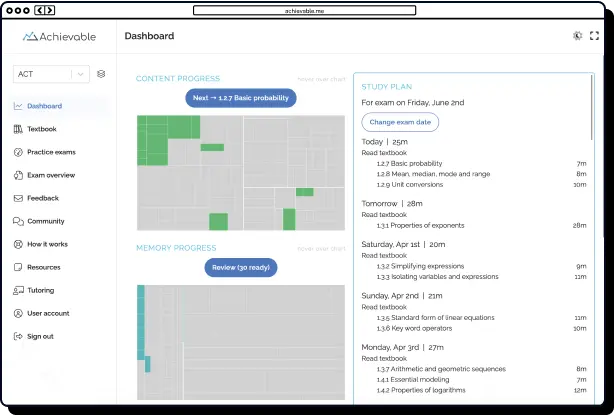
Research has repeatedly shown that spaced repetition, sometimes called spaced retrieval, helps students retain information far more effectively than cramming everything into a few intensive study sessions. Revisiting concepts over time strengthens memory and makes it easier to recall information under pressure.
A balanced GRE study plan should rotate between:
- Learning new material.
- Reviewing previously studied concepts.
- Practicing weak areas.
- Reinforcing your strongest skills to keep them sharp.
This cycle helps prevent forgetting while steadily expanding your knowledge.
Make every practice test count
It's easy to fall into the trap of measuring progress by the number of practice tests you've completed. However, five carefully reviewed exams often teach you far more than ten tests taken with little reflection.
After each GRE practice test, ask yourself:
- What have I improved since my last exam?
- Which mistakes happened repeatedly?
- What topics should I prioritize before my next practice test?
- Am I losing points because of knowledge gaps, timing, or test-taking habits?
Your answers should directly shape your next week's study schedule.
Many modern GRE prep platforms also provide adaptive quizzes, personalized recommendations, and detailed performance analytics. These tools help reinforce weak areas without requiring another full-length practice exam every few days.
Ultimately, the goal isn't simply to complete more GRE practice tests: it's to learn something valuable from every one. By combining targeted practice, thoughtful analysis of mistakes, and regular review, you'll steadily improve both your skills and your confidence before test day.
Simulate test day for maximum readiness
One of the biggest advantages of taking full-length GRE practice tests is the opportunity to prepare for more than just the questions. By recreating the testing experience as closely as possible, you can build the focus, stamina, and confidence needed to perform your best on exam day.
The GRE is a lengthy exam that requires sustained concentration. Even students who know the material well can struggle if they aren't accustomed to maintaining their attention for several hours. That's why every official GRE practice test should be treated as a realistic dress rehearsal rather than simply another study session.
Replicate the real GRE experience
When you're ready to take an official GRE practice test, create conditions that closely resemble the actual exam.
For the most realistic simulation:
- Complete every section in one uninterrupted sitting.
- Follow the official time limits for each section.
- Take only the scheduled breaks.
- Silence your phone and eliminate distractions.
- Use the same scratch paper, note-taking methods, and calculator policies you'll encounter on test day.
- If you're taking the GRE at a testing center, practice in a quiet environment. If you're taking the GRE at home, recreate your planned testing space as closely as possible.
Small details can make a surprisingly big difference. If possible, begin your practice test at the same time of day as your scheduled GRE appointment. Eat a similar breakfast, stay hydrated, and follow the same routine you intend to use on exam day. Establishing these habits ahead of time reduces uncertainty and helps you feel more comfortable when the real exam begins.
Build endurance alongside knowledge
Many students notice that their performance changes throughout a full-length practice test. They may answer questions accurately during the first hour but lose focus, rush through problems, or make careless mistakes later in the exam.
These patterns often have little to do with content knowledge and much more to do with mental endurance.
Full-length GRE practice tests help you identify issues such as:
- Losing concentration during later sections.
- Spending too much time on difficult questions.
- Rushing because of poor pacing.
- Becoming distracted after breaks.
- Experiencing mental fatigue that affects decision-making.
The more often you practice under realistic conditions, the better prepared you'll be to manage these challenges on test day.
Evaluate your test-day strategy
After each full-length practice test, evaluate more than your score.
Ask yourself questions like:
- Did I manage my time effectively?
- Which section felt the most mentally demanding?
- Did I stick to my pacing strategy?
- When did my accuracy begin to decline?
- Did I stay calm after encountering difficult questions?
Your answers can reveal opportunities to improve your overall testing strategy, not just your academic knowledge.
For example, if you consistently spend too much time on challenging Quant problems, practice recognizing when it's better to make an educated guess and move on. If your Verbal accuracy drops during the final sections, you may benefit from building greater reading stamina or refining your pacing strategy.
Turn every simulation into a learning opportunity
Every GRE practice test should leave you with a clear plan for what to do next. Rather than focusing solely on whether your score increased or decreased, look for trends that can guide your preparation.
Perhaps your timing has improved, but vocabulary questions remain a weakness. Identifying patterns allows you to adjust your study plan before your next practice test.
Treating each full-length exam as both a performance evaluation and a learning opportunity will help you develop the knowledge, endurance, and confidence needed to perform at your highest level when your official GRE arrives.
Plan your study calendar mindfully
A well-designed GRE study schedule is just as important as the materials you use. Even the best GRE practice tests won't improve your score if they're taken at random or without enough time to review your results.
Instead of studying whenever you have spare time, create a structured GRE study plan that balances learning new material, reinforcing key concepts, and taking practice tests at strategic points throughout your preparation.
Choose a realistic study timeline
The ideal amount of preparation depends on your starting score, target score, and weekly availability. However, many students see the greatest improvement by following a focused study plan lasting six to twelve weeks rather than spreading their preparation over many months with inconsistent effort.
A shorter, more intentional timeline helps you:
- Stay motivated and maintain momentum.
- Retain information more effectively.
- Reduce the likelihood of burnout.
- Keep recently learned concepts fresh for test day.
If you have a demanding work or school schedule, don't worry about studying for several hours every day. Consistency matters far more than marathon study sessions.
For most students, one to two hours of focused study on most days of the week is more effective than cramming everything into occasional weekend sessions.
Schedule practice tests strategically
Rather than taking full-length GRE practice tests whenever you're curious about your score, build them into your study calendar with a specific purpose.
A typical progression might look like this:
| Week | Primary focus |
|---|---|
| 1–2 | Learn core Quant and Verbal concepts with targeted practice. |
| 3–4 | Continue skill-building and take a third-party practice test to identify remaining weaknesses. |
| 5–6 | Focus on your weakest topics while increasing timed practice. |
| Final 2–3 weeks | Take official ETS GRE practice tests under realistic testing conditions and use the results to fine-tune your preparation. |
Spacing practice tests several weeks apart gives you enough time to make meaningful improvements before measuring your progress again.
Let your results shape your study plan
Every practice test should influence what you study next.
After reviewing your results, ask yourself:
- Which question types consistently lower my score?
- Which mistakes appeared more than once?
- Am I improving my pacing?
- Which topics deserve the most attention before my next practice test?
Your answers should determine how you spend your next study sessions.
For example, if you continue missing geometry questions but perform well in algebra, shift more of your study time toward geometry instead of reviewing material you've already mastered. Likewise, if timing, not content, is limiting your score, prioritize timed practice sets instead of learning entirely new concepts.
This targeted approach helps you improve more efficiently than following the same weekly study routine.
Balance preparation with rest
Effective GRE preparation isn't about studying every available minute. Building regular breaks into your schedule helps maintain motivation and prevents mental fatigue.
Plan time to rest, exercise, spend time with family or friends, and get enough sleep, especially during the final week before your exam. These habits support concentration, memory, and overall performance just as much as additional study hours.
Remember that consistency beats intensity. A realistic study calendar that you can follow from beginning to end is far more valuable than an ambitious plan you'll abandon after the first week.
By organizing your preparation around focused study sessions, strategic GRE practice tests, and regular review, you'll make steady progress while arriving at test day feeling prepared rather than overwhelmed.
The bottom line: Use official practice tests as strategic tools
GRE practice tests are much more than score predictors. They're powerful learning tools that can help you study smarter and perform with greater confidence on exam day. When used strategically, they reveal your strengths, expose recurring weaknesses, and provide a clear roadmap for improving your GRE score.
Save your official ETS GRE practice tests for the later stages of your preparation, after you've built a solid foundation in Quant, Verbal, and Analytical Writing. Treat each one as a realistic simulation by following the official timing, minimizing distractions, and recreating your testing environment as closely as possible. The goal isn't simply to earn a higher score, but to prepare yourself for every aspect of the real GRE experience.
Between full-length exams, focus on targeted practice rather than endless repetition. Review every mistake carefully, identify whether it resulted from a knowledge gap, a strategy issue, poor pacing, or a careless error, and let those insights guide your study plan. This deliberate approach turns every practice test into an opportunity for measurable improvement.
As you prepare, remember to ask yourself three simple questions after each practice exam:
- What did I do well?
- What needs the most improvement?
- What should I study before my next practice test?
Answering these questions consistently will help you spend your study time where it matters most.
Finally, pair strategic practice tests with a structured study schedule that emphasizes consistency over cramming. By combining focused skill-building, thoughtful review, and realistic test-day simulations, you'll be well-positioned to maximize your GRE score.
If you're looking for additional guidance, explore our resources on GRE scoring, GRE percentiles, how long to study for the GRE, and GRE study plans to build a preparation strategy tailored to your goals. With the right approach, every practice test becomes another step toward success in graduate school.