

Casualty Insurance
study guide
Every chapter of the course summarized, with each section linked to its lesson.
Pass the first time
Try Achievable Casualty Insurance
No credit card required
This free Casualty Insurance study guide summarizes all 13 chapters of Achievable's Casualty Insurance course: what each covers, the points to remember, and its 19 sections in order. Read each chapter after you study it, or work through the whole guide before exam day.
Each section links to its full lesson in Achievable, with the review quizzes and full-length practice exams.
Chapter 1: General Insurance Concepts
7 sections
Free chapter
- Risk and insurance basics: Insurance spreads financial risk across pooled premiums, and pure risk is insurable while speculative risk is not.
- Core principles: The Law of Large Numbers improves loss predictions, indemnity prevents profit, insurable interest is required, and both parties must disclose honestly under Utmost Good Faith.
- Risk management methods: Avoidance, retention, reduction, and transfer are the four risk management methods, and insurance is the most common transfer method.
- Contract structure and property coverage: Declarations, the insuring agreement, conditions, and exclusions shape the contract, while property insurance covers physical loss with perils and deductibles.
- Producers, sources, and markets: Producers advise and service clients, and insurance may come from private insurers, government programs, service providers, or authorized marketing systems and distribution channels.
Start this chapter free
Chapter 2: Casualty Insurance Basics
- Loss and cause: Direct loss is physical damage from a covered peril, indirect/resultant loss stems from a direct loss, and covered perils apply unless excluded; proximate cause is the efficient cause of loss.
- Indemnity rules: The insured is restored to the pre-loss financial position only, supported by insurable interest, subrogation, other insurance clauses, depreciation, and ACV, where .
- Liability and claims: Liability insurance covers legal responsibility for bodily injury/property damage to others, negligence needs duty, breach, injury/damage, and causation, and claims may involve cancellation, vacancy, appraisal, arbitration, assignment, or salvage.
Study this chapter in Achievable
Chapter 3: Legal Liability Concepts
- Contract interpretations: Policy is a contract of adhesion, ambiguities are construed against the insurer, and the reasonable expectations doctrine may follow the insured's reasonable expectations, even over fine print.
- Damages and liability: Damages are money awarded for wrongful acts, and liability usually rests on negligence, absolute liability, strict liability, or vicarious liability.
- Loss and limits: Accident is a sudden, unexpected event, occurrence is broader, and limits may be per accident, per person, aggregate, split limits, or combined single limit.
Study this chapter in Achievable
Chapter 4: Common Policy Provisions
- Policy timing and territory: Policy period runs from inception to expiration, typically 12:01 a.m. standard time at insured's address, and coverage applies only within the policy territory.
- Deductibles and sharing: A deductible lowers premium because the insured pays first, SIR means insurer's duty starts only above the retention, and other insurance may be pro rata or by equal shares.
- Named insured and insurer terms: The first named insured has the administrative rights, assignment needs insurer's written consent, subrogation and endorsement rules apply, and CPPs use common conditions and interline endorsements.
Study this chapter in Achievable
Chapter 5: Underwriting
- Underwriting basics: Insurers can reject applications because too many poor risks threaten insolvency, and underwriters classify risks as standard or substandard to match premiums with risk level and equity.
- Risk information: The application is the most important underwriting source, and producer's reports, inspections, and consumer reports help reveal physical, moral, and morale hazards and determine acceptability and premium level.
- Other underwriting rules: Premium rate factors include loss experience, occupancy/operation, construction type, overall exposures, and loss ratios, while legal discrimination is allowed and waiver and estoppel limit later changes in position.
Study this chapter in Achievable
Chapter 6: Claims Settlement
- Valuation methods: Policies pay "up to specified limits," and market value, valued policy, agreed value, stated amount, and functional replacement cost each define a different settlement basis.
- Actual cash value: ACV prevents profit beyond actual loss and is typically replacement cost minus depreciation, or determined by the broad evidence rule.
- Replacement and coinsurance: Replacement cost pays like kind and quality without depreciation but within policy limit, while coinsurance penalizes underinsurance using the stated formula and 80% rule.
Study this chapter in Achievable
Chapter 7: Personal Auto Insurance (PAP)
- Policy basics: Personal Auto Policy (PAP) is a package policy for property damage, liability protection, and injury coverage for insured/family, with Coverage Territory in the US, its possessions, Puerto Rico, and Canada.
- Liability and medical: Part A pays damages for BI/PD to others when insured is legally responsible, Part B pays medical/funeral expenses within 3 years, and Part C covers uninsured/underinsured motorist BI damages.
- Damage and rules: Part D covers collision and other-than-collision loss with deductibles, and Parts E and F require prompt notice, written proof when requested, written endorsements for changes, and 10 days' or 20 days' notice for cancellation.
Study this chapter in Achievable
Achievable Casualty Insurance
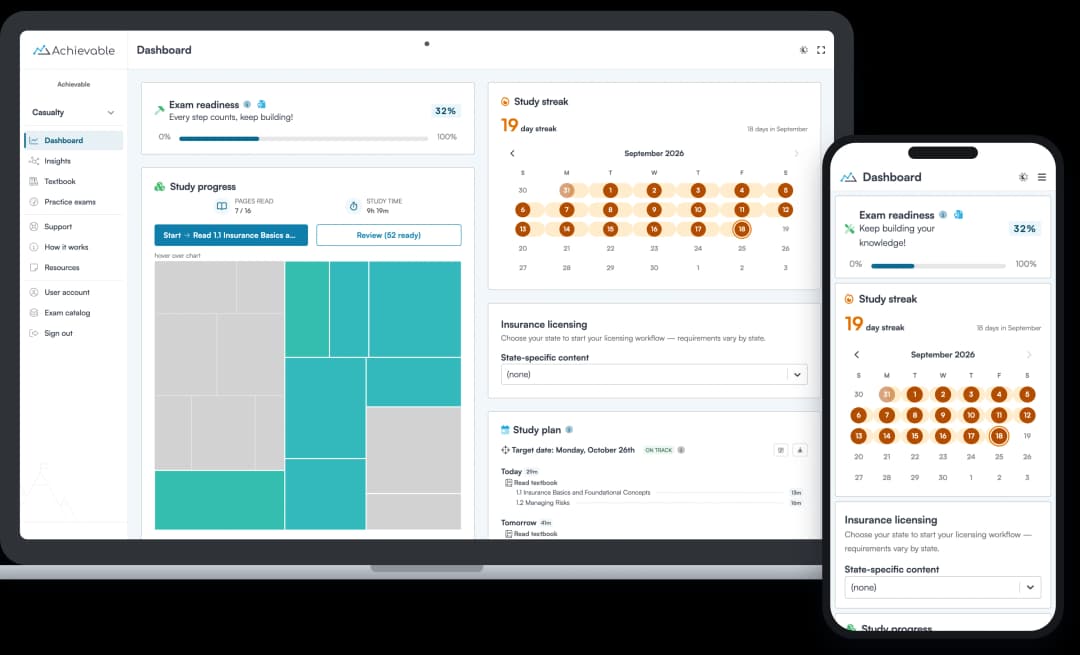
Pass the Casualty Insurance license exam on your first try with Achievable's interactive online license exam prep course. Includes everything you need: easy-to-understand online textbook, 990+ practice questions, and 6 full-length practice exams.
6 full-length practice exams for your state
990+ practice questions, explained in depth
State law questions for 45 states and DC
Pass guaranteed, or your money back
Chapter 8: Commercial General Liability (CGL)
- Exposure and basis: Common exposures include property ownership, operations on/off premises, manufacturing, completed operations, and contractual liability, and CGL is written on occurrence or claims-made basis.
- Claims-made reporting: Claims-made coverage has no coverage for injury before the retroactive date or after the policy period ends, and the claim must be first made during the policy period; mini, midi, and maxi tails extend reporting only.
- Core coverage and terms: Coverage A, B, and C, the key exclusions, CGL conditions, limits and territory, and who is insured define what CGL pays and how the policy applies.
Study this chapter in Achievable
Chapter 9: Commercial Auto Insurance
- Coverage overview: Commercial auto coverage is added to CPP and protects against BI/PD from ownership, maintenance, or use of covered autos.
- Covered auto symbols: Coverage is triggered by covered auto symbols on the declarations page, including Symbol 1 (Any Auto), Symbol 7 (Specifically Described Autos), Symbol 8 (Hired Autos Only), and Symbol 9 (Non-Owned Autos Only).
- Key forms and rules: Business Auto Coverage, Garage Coverage, Garage keepers' Liability, and Truckers' Coverage are the main forms, while regulation requires MCS-90 and minimum financial responsibility limits of $750,000, $5 million, and $1 million.
Study this chapter in Achievable
Chapter 10: Crime and Professional Liability
- Crime coverage basics: Commercial crime insurance covers money, securities, other property losses from theft, robbery, forgery, and employee dishonesty, and is written standalone or in a package policy.
- Crime forms and rules: The seven insuring agreements apply only if a limit of insurance is shown, and discovery or loss sustained forms, exclusions, conditions, and valuation rules control coverage.
- Liability protections: Professional liability covers negligence, EPLI and employee benefits liability cover employment and plan claims, and cyber liability covers data breaches, network security failures, and cyberattacks.
Study this chapter in Achievable
Chapter 11: Businessowners Policy: Section II Liability
- BOP structure: Businessowners policy is the commercial equivalent of homeowners policy, and the standard form is Businessowners Coverage Form with one form, three sections.
- Liability coverages: Section II includes business liability and medical expenses, and bodily injury, property damage, personal/advertising injury, and products-completed operations hazard are handled under the listed rules and limits.
- Coverage rules: Key exclusions, who is an insured, Section II general conditions, and the main definitions control when coverage applies, including occurrence, offense, coverage territory, cancellation, and separation of insureds.
Study this chapter in Achievable
Chapter 12: Business Owners Policy (BOP) & Workers Comp
- BOP coverage: Business Owners Policy (BOP) combines property and liability coverage for small businesses, but liability excludes employer's obligations under workers' comp law and injury to own employees in course of employment.
- Workers comp basics: Workers Compensation covers work-related injuries/sickness only as a no-fault system, employers pay the full cost, and Part I pays statutory benefits while Part II protects against employee lawsuits.
- Federal laws and terms: Longshore and Harbor Workers' Compensation Act, Jones Act, Federal Employees Compensation Act, and Federal Employers Liability Act apply to specific workers, and covered employment excludes farming, casual employment, and domestic servants.
Study this chapter in Achievable
Chapter 13: Bonding
- Basic distinction: Suretyship is a three-party agreement, insurance is two parties, and suretyship protects the other party if one fails to perform.
- Surety contracts: The surety answers for the principal's obligation, its obligation is secondary, payment is capped at the bond's penal sum, and it can recover from the principal.
- Bond types: Fidelity bonds protect employers against employee dishonesty, while surety bonds guarantee promised acts will happen, including contract, judicial, license and permit, and public official bonds.
Study this chapter in Achievable
Casualty Insurance license exam at a glance
- Questions
- ~100 multiple-choice questions
- Time
- ~2 hours
- Passing score
- Around 70%
- Exam fee
- $40-$60
More on the Casualty Insurance license exam
- Casualty Insurance license exam prep courseAchievable's course: online textbook, review quizzes and full-length practice exams.
- Casualty Insurance license exam format, content and scoringWhat's tested, how long it takes, what it costs, and the score you need to pass.
- Casualty Insurance FAQThe questions asked most about the exam and preparing for it, answered.
- Casualty Insurance study resourcesGuides and study advice from Achievable's instructors.
Pass the Casualty Insurance exam.
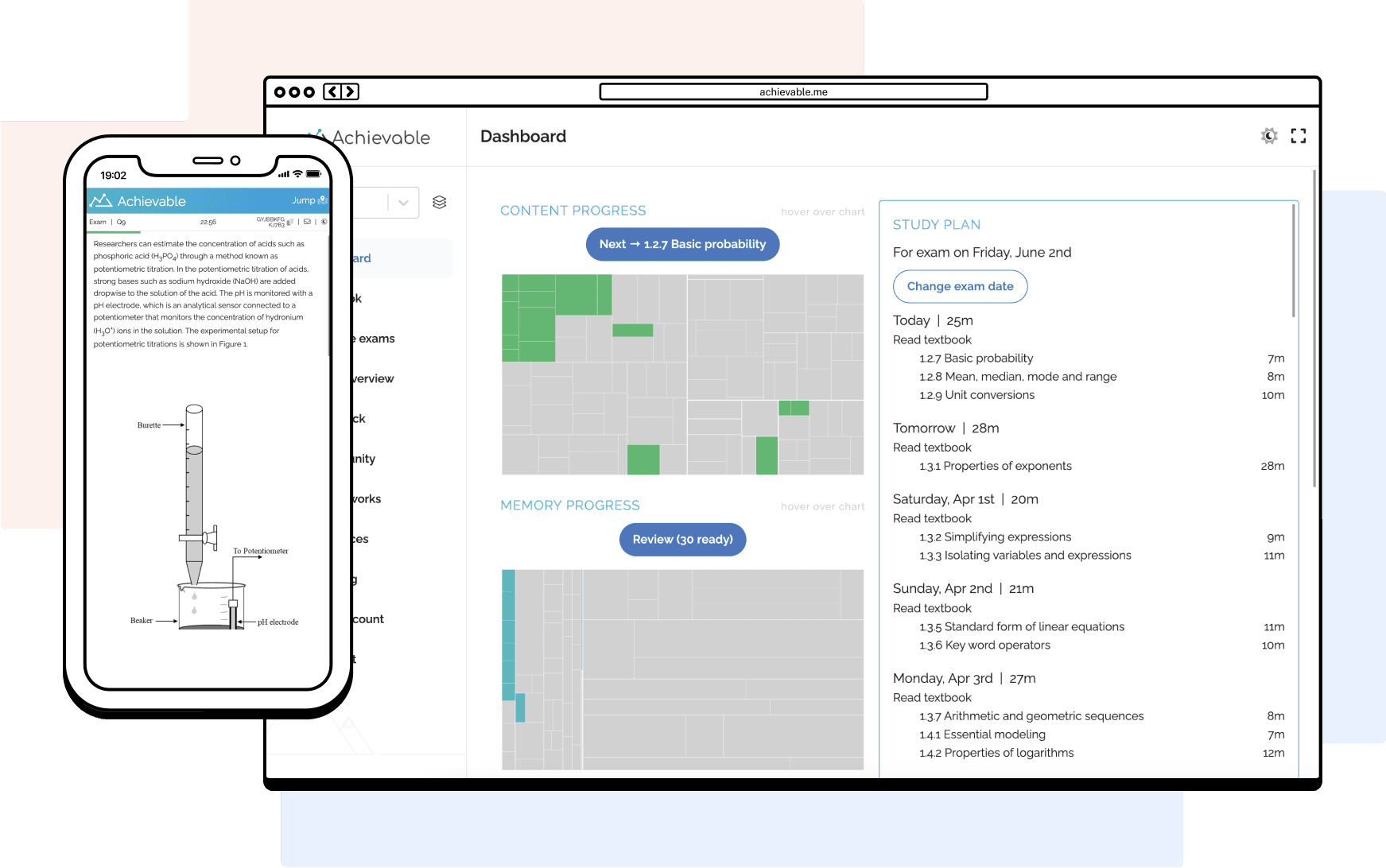
Guaranteed.Achievable is the best Casualty Insurance exam prep course: effective, personalized, and convenient. With Achievable, you'll spend less time studying and pass your exam the first time, or your money back.