Personal Lines Insurance Exam study guide


Table of contents
- What is the Personal Lines Insurance Exam?
- Who should take the Personal Lines exam?
- How many questions are on the Personal Lines insurance exam?
- What’s covered on the Personal Lines exam?
- 1. Insurance basics and contract law
- 2. Personal auto insurance
- 3. Homeowners’ and renters’ insurance
- 4. Personal inland marine and umbrella policies
- 5. State insurance laws and regulations
- Best strategies for studying
- Start early, review often
- Use scenario-based practice
- Take practice exams
- Focus on high-yield areas
- Review your state’s rules
- Conclusion
If you’re preparing to sell or service personal lines insurance products, such as auto, homeowners’, or renters’ policies, your first step is passing the Personal Lines Insurance Exam. Whether you’re new to the insurance industry or seeking to expand your credentials, this personal lines exam study guide will help you navigate the exam structure, understand core content areas, and master proven study strategies. With the right preparation, you can approach the exam with confidence and achieve your licensing goals on the first attempt.

What is the Personal Lines Insurance Exam?
The Personal Lines Insurance Exam is a state-required licensing test for individuals who intend to sell or handle non-commercial insurance products for individuals and families. This includes:
- Personal auto insurance
- Homeowners’ and renters’ insurance
- Personal umbrella liability
- Inland marine and other specialty personal coverages
Unlike the broader Property and Casualty (P&C) license, the Personal Lines license focuses exclusively on individual clients, not businesses. The exam is typically administered by companies such as Pearson VUE or Prometric and covers both general insurance concepts and state-specific laws.
Who should take the Personal Lines exam?
You should take the Personal Lines Insurance Exam if you plan to work in roles such as:
- Insurance sales agent specializing in personal lines insurance for individuals and families
- Customer service representative at an agency handling personal lines insurance products
- Support staff at a personal insurance brokerage focused on home, auto, or renters policies
- Call center representative for a carrier offering personal lines insurance, including home and auto coverage
If your career does not involve commercial lines like business liability or workers’ compensation, the Personal Lines insurance license is typically faster to obtain and ideally suited for consumer-facing positions. Preparing with a personal lines insurance practice exam can help you succeed in these roles by ensuring you are ready to serve clients’ personal insurance needs.
How many questions are on the Personal Lines insurance exam?
State-specific personal lines exams vary by state, but the general exam structure and details are as follows:
- 50 - 150 multiple-choice questions
- About 2 hours to complete
- The passing score is around 70%
- The exam fee is typically between $30 - $100
The study guide outlines the main topics covered on the exam below.

What’s covered on the Personal Lines exam?
The exam is typically divided into two main sections:
- General insurance knowledge: National content that applies across all states
- State-specific laws and requirements: Regulations unique to your licensing state
Here’s a breakdown of the core content areas:
1. Insurance basics and contract law
Start with the foundations of how insurance works:
- Basic terms: Risk, hazard, peril, loss, indemnity
- Elements of insurable risk
- Components of an insurance contract: Offer, acceptance, consideration, legal purpose
- Types of insurers: Stock vs. mutual, admitted vs. non-admitted
- Roles and responsibilities of producers (agents and brokers)
- Legal concepts: Warranties, representations, misrepresentations, fraud
Understanding these basics is crucial for comprehending all policy types and coverages.
2. Personal auto insurance
The personal auto policy (PAP) is one of the most heavily tested areas on the exam. You’ll need to understand:
- Parts A - F of the policy: liability, medical payments, uninsured motorist, damage to your auto, duties after a loss
- Coverage limits and split vs. combined limits
- Exclusions and endorsements
- Claims procedures and settlement terms
- State-specific auto insurance requirements (like minimum liability limits and no-fault rules)
3. Homeowners’ and renters’ insurance
This section focuses on protecting the home and personal belongings from a wide range of perils:
- Homeowners policy forms (HO-2, HO-3, HO-5, etc.)
- Coverage sections: A (Dwelling), B (Other Structures), C (Personal Property), D (Loss of Use), E (Liability), F (Medical Payments)
- Named vs. open perils
- Policy exclusions and common endorsements (e.g., sewer backup, inflation guard)
- Claims settlement: Replacement cost vs. actual cash value
Also, expect to see questions about policies on renters (HO-4) and condo (HO-6).
4. Personal inland marine and umbrella policies
These specialty policies are often tested briefly, but are important to understand:
- Inland marine: Covers valuable personal property like jewelry, art, electronics, and collectibles
- Umbrella liability: Provides excess liability coverage above auto and homeowners’ limits
- Eligibility, exclusions, and how these policies interact with underlying coverages
5. State insurance laws and regulations
Every exam includes a section on state-specific content, which may include:
- Licensing and continuing education requirements
- Producer appointment procedures
- Policy cancellation and nonrenewal laws
- Required disclosures to clients
- Unfair trade practices and consumer protection rules
- State guarantee associations
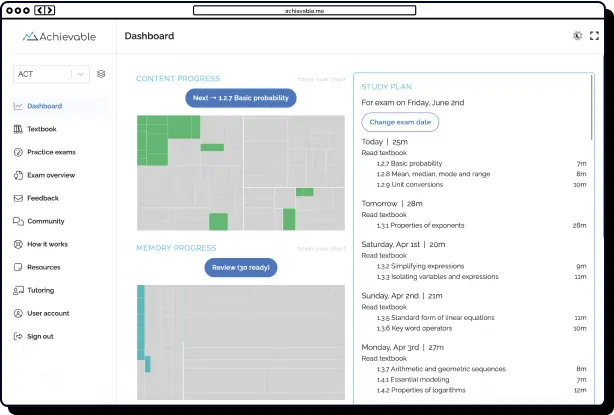
Use your state’s candidate handbook and a prep tool like Achievable to ensure full coverage of this content.
Best strategies for studying
Start early, review often
Allow yourself at least 3-4 weeks of regular study time, and aim to review the content in multiple short sessions rather than cramming.
Use scenario-based practice
The exam doesn’t just test definitions: it presents real-life examples. Practice applying policies to realistic client situations.
Take practice exams
Simulated exams help you gauge your readiness, identify areas for improvement, and become accustomed to the exam format and pacing.
Focus on high-yield areas
Auto and homeowners policies are typically the most heavily tested. Master these inside and out.
Review your state’s rules
Don’t overlook the state-specific content in your personal lines exam study guide. This portion of your study materials often determines whether you pass or fail the Personal Lines licensing exam.

Conclusion
A personal lines exam study guide is essential for mastering the licensing exam and advancing your career in insurance sales or service. Although the amount of information in the personal lines exam study guide can seem overwhelming, centering your efforts on the most important policies and foundational principles will help you study efficiently and confidently. With targeted prep, you’ll be well on the way to obtaining your insurance license, transacting personal lines products, and helping people protect their assets.