PTIN renewal for 2027: What enrolled agents need to know


Tax season starts in a few months, and so does one of the easiest deadlines to miss. On November 4, 2026, the IRS reminded tax professionals to renew their preparer tax identification numbers (PTINs) for 2027. Every current PTIN expires on December 31, 2026. “The PTIN program helps the IRS identify legitimate paid preparers and reinforces the responsibility that comes with preparing federal tax returns,” said IRS Chief Executive Officer Frank J. Bisignano.
Renewal is a quick and relatively inexpensive process, making it an easy step to prioritize ahead of the new year. It costs $18.75 and takes about 15 minutes online. Here’s who needs to renew, how to do it, and how PTIN renewal fits with renewing your enrollment as an enrolled agent.

What is a PTIN, and who needs one?
A PTIN is the number the IRS uses to identify paid tax return preparers. According to the IRS, anyone who prepares or assists in preparing federal tax returns for compensation must have a valid 2027 PTIN before preparing returns, including enrolled agents. PTINs are renewed every year.
The rule applies to credentialed and non-credentialed preparers alike, including:
- Enrolled agents (EAs): The IRS requires every EA to hold a valid PTIN, and you can’t renew your enrollment without one.
- Certified Public Accountants (CPAs) and tax attorneys: Like EAs, they have unlimited representation rights before the IRS, and they need a PTIN to prepare returns for pay.
- CFP® professionals: Financial planners who prepare clients’ federal returns for a fee need a PTIN too.
- Members of the Association of Chartered Certified Accountants (ACCA) working in the U.S.: An international accounting qualification doesn’t change the rule. Preparing U.S. federal returns for pay requires a PTIN.
- Non-credentialed preparers: Those who join the IRS’s voluntary Annual Filing Season Program must also renew their PTIN for the coming year.
Whatever your title, if you’re paid to prepare federal returns, the same December 31 deadline applies.
How to renew your PTIN for 2027
Before you start, the IRS’s renewal checklist suggests having your personal and business details, any professional credential numbers with their expiration dates, and a card for the fee. Then follow these steps:
- Sign in to the PTIN system on IRS.gov and select “Renew my PTIN.”
- Review and update your account information, including your credentials.
- Submit the application and pay the $18.75 fee, which is nonrefundable and nontransferable.
You’ll receive confirmation once the renewal goes through. If you prefer paper, you can file Form W-12, but it takes about six weeks to process, so online renewal is the safer choice this close to the deadline.
Your PTIN account is also where you can check the continuing education (CE) credits that IRS-approved providers have reported for you, which is useful if your enrollment renewal is coming up.
PTIN renewal vs. enrolled agent renewal
PTIN renewal is separate from renewing your enrollment, and many EAs face both this season. Enrolled agents whose Social Security numbers end in 7, 8, or 9, or who have no SSN, are in the current enrollment renewal cycle, which runs from October 1, 2026, to January 31, 2027.
Enrollment renewal means filing Form 8554, paying a $140 fee, and showing 72 hours of CE over the three-year cycle, with at least 16 hours each year. You’ll also need an active PTIN to renew, so it makes sense to take care of it first. Our guide to enrolled agent renewal walks through the CE rules and deadlines.

Thinking about becoming an enrolled agent?
If you’re a preparer considering the EA credential, a PTIN is also your first step. You need one to register for the Enrolled Agent exam, officially the Special Enrollment Examination (SEE). Here’s what to know:
- Format: The SEE has three parts, each with 100 multiple-choice questions in 3.5 hours, and you must pass all three within three years.
- Cost: Each part costs $317, paid when you schedule with PSI, the exam’s vendor since March 2026.
- Timing: The current testing window runs from July 1, 2026, to February 28, 2027, and there’s no testing in March and April while the exam is updated.
- Enrollment: After passing, you apply for enrollment with Form 23 and a $140 fee within one year.
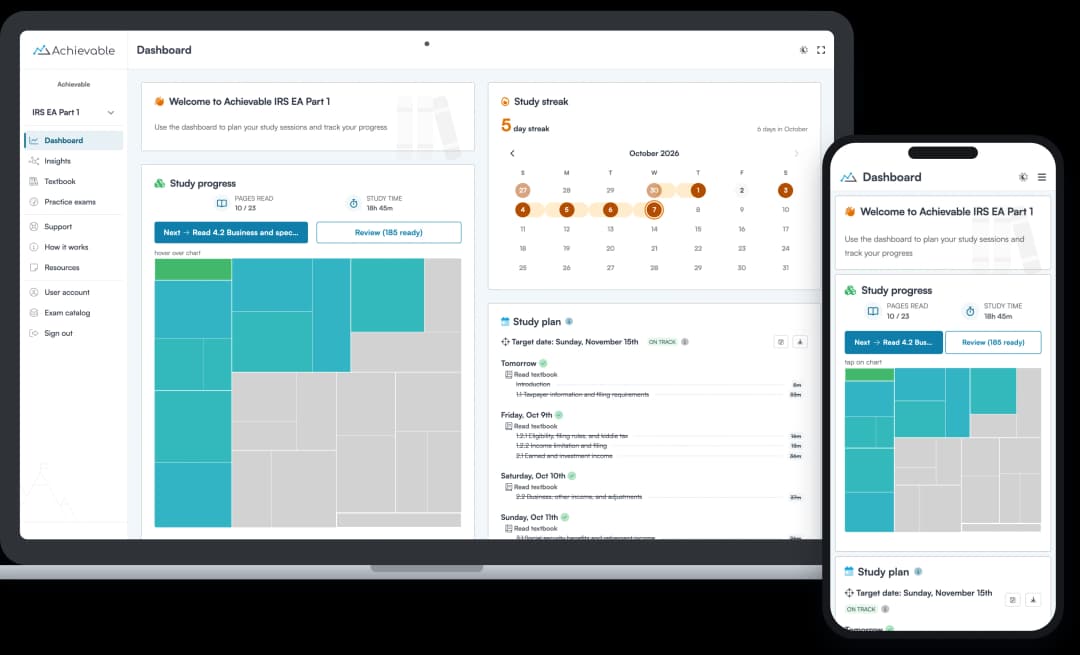
Unlike CPAs, EAs earn unlimited representation rights by proving their tax knowledge on one exam, with no degree requirement. Our enrolled agent exam guide covers pass rates and study tips, and EA vs. CPA compares the two paths. Achievable’s IRS EA Part 1 course can help you prepare for the first part.
Final thoughts
Renewing your PTIN is a small task with a firm deadline. Set aside 15 minutes before December 31, 2026, confirm your credentials are up to date, and you’ll be ready to prepare returns from the first day of the 2027 filing season. If your enrollment renewal is also due, taking care of your PTIN now makes the rest of the process easier.