MCAT: Chemistry and Physics practice exam


Free MCAT practice exam
A pharmaceutical company is developing a new drug derived from plant extracts. They need to separate and collect a specific bioactive compound from a complex mixture of other plant metabolites for further testing. Which of the following techniques would be most suitable for isolating this compound based on its polarity?
During ATP hydrolysis, which specific bond is broken to release energy?
Chemical reactions can be described by how their free energy changes. If a reaction has a of , what kind of energy profile does it follow and how would introducing a catalyst affect the of this process?
A chemical system is at equilibrium. If the volume of the container is halved, what happens to the equilibrium if the reaction is ?
A medical student is preparing phosphate-buffered saline (PBS) for a lab experiment. She recalls that a buffer solution resists changes in pH upon the addition of small amounts of acid or base. While selecting chemical reagents, she considers combining the following pairs of compounds to create a buffer that functions around physiological pH (~7.4). Which of the following combinations is most likely to produce an effective buffer?
A chemist is analyzing how different substitution reactions affect molecular structure. She starts with a pure sample of (S)-2-bromo-2-methylbutane and runs several reactions. After one, she finds the product is a racemic mixture of ( R)- and (S)-2-methylbutanol. Which reaction mechanism most likely produced this result?
A ball is thrown vertically upward with an initial velocity of . Neglecting air resistance, what is the maximum height the ball reaches? (Assume )
A 1200 W hair dryer is plugged into a 120 V outlet. What is the current flowing through the hair dryer?
A sound wave has a frequency of Hz and a wavelength of meters. What is the speed of the sound wave?
A lens has a focal length of cm. If an object is placed cm in front of the lens, where is the image formed?
A radioactive isotope has a half-life of 8 days. If a sample initially contains 100 grams of the isotope, how much of the isotope remains after 24 days?
A uniform, 4-meter-long horizontal beam is balanced on a fulcrum positioned at its midpoint. The beam itself is massless and extends 2 meters on either side of the fulcrum. A 40 N mass is suspended exactly 1 meter from the left end of the beam. To keep the beam perfectly horizontal and prevent it from rotating, a second mass of 20 N must be suspended from the right side. Where should the 20 N mass be placed on the right side of the fulcrum in order to maintain equilibrium?
A vertical cylindrical tank is filled completely with water to a height of 3.0 meters. A pressure gauge is installed at the very bottom of the tank and is used to measure the pressure exerted by the water column alone (gauge pressure). Assume standard conditions, neglect any atmospheric pressure, and use the following constants: , . What is the pressure recorded by the gauge at the bottom of the tank?
A proton is launched into a region of space where a uniform magnetic field points into the page. The proton enters the magnetic field perpendicularly, with an initial speed of v₀ and immediately begins to travel in a circular path due to the magnetic force acting on it. Later, the speed of the proton is increased to , while the strength of the magnetic field remains unchanged. What will happen to the radius of the circular path the proton travels?
A radioactive isotope undergoes beta decay. Which of the following occurs during this process?
Vehicle accidents on icy roads result in significant property damage and injuries annually. National transportation statistics indicate that winter-related collisions cost millions in repairs and lost productivity. A local municipality is investigating methods to improve vehicle traction on a particularly hazardous, inclined bridge during freezing conditions. A diagram of the bridge is shown below.

One approach to reducing these accidents is to implement advanced road surface treatments that enhance tire grip.
Test vehicles, equipped with specialized winter tires, were used to assess the frictional properties of the bridge surface. The coefficients of friction between the winter tires and the icy bridge surface are as follows:
Coefficient of static friction = 0.2 Coefficient of kinetic friction = 0.1
A 1500 kg vehicle is stationary on the icy bridge. The coefficient of static friction between the tires and the ice is 0.4. If the component of the gravitational force acting parallel to the bridge surface is 5000 N, what is the minimum normal force required to prevent the vehicle from sliding?
Vehicle accidents on icy roads result in significant property damage and injuries annually. National transportation statistics indicate that winter-related collisions cost millions in repairs and lost productivity. A local municipality is investigating methods to improve vehicle traction on a particularly hazardous, inclined bridge during freezing conditions. A diagram of the bridge is shown below.
One approach to reducing these accidents is to implement advanced road surface treatments that enhance tire grip.
Test vehicles, equipped with specialized winter tires, were used to assess the frictional properties of the bridge surface. The coefficients of friction between the winter tires and the icy bridge surface are as follows:
Coefficient of static friction = 0.2 Coefficient of kinetic friction = 0.1
A vehicle is traveling at a constant velocity up the icy bridge. Conceptually, how does the driving force required from the vehicle's engine relate to the forces of gravity and kinetic friction?
Vehicle accidents on icy roads result in significant property damage and injuries annually. National transportation statistics indicate that winter-related collisions cost millions in repairs and lost productivity. A local municipality is investigating methods to improve vehicle traction on a particularly hazardous, inclined bridge during freezing conditions. A diagram of the bridge is shown below.
One approach to reducing these accidents is to implement advanced road surface treatments that enhance tire grip.
Test vehicles, equipped with specialized winter tires, were used to assess the frictional properties of the bridge surface. The coefficients of friction between the winter tires and the icy bridge surface are as follows:
Coefficient of static friction = 0.2 Coefficient of kinetic friction = 0.1
A vehicle starts from rest at the top of the icy bridge and accelerates down. If the bridge has a length of 20 meters and the vehicle reaches a speed of 10 m/s at the bottom, what is the average acceleration of the vehicle?
Vehicle accidents on icy roads result in significant property damage and injuries annually. National transportation statistics indicate that winter-related collisions cost millions in repairs and lost productivity. A local municipality is investigating methods to improve vehicle traction on a particularly hazardous, inclined bridge during freezing conditions. A diagram of the bridge is shown below.
One approach to reducing these accidents is to implement advanced road surface treatments that enhance tire grip.
Test vehicles, equipped with specialized winter tires, were used to assess the frictional properties of the bridge surface. The coefficients of friction between the winter tires and the icy bridge surface are as follows:
Coefficient of static friction = 0.2 Coefficient of kinetic friction = 0.1
Due to a temperature increase, the coefficient of static friction on the icy bridge decreases. Conceptually, how does this affect the maximum incline at which a stationary vehicle can remain at rest?
Vehicle accidents on icy roads result in significant property damage and injuries annually. National transportation statistics indicate that winter-related collisions cost millions in repairs and lost productivity. A local municipality is investigating methods to improve vehicle traction on a particularly hazardous, inclined bridge during freezing conditions. A diagram of the bridge is shown below.
One approach to reducing these accidents is to implement advanced road surface treatments that enhance tire grip.
Test vehicles, equipped with specialized winter tires, were used to assess the frictional properties of the bridge surface. The coefficients of friction between the winter tires and the icy bridge surface are as follows:
Coefficient of static friction = 0.2 Coefficient of kinetic friction = 0.1
A vehicle with a mass of 1500kg is on the bridge. A sensor detects that the normal force on the vehicle is 12000 N. If the coefficient of static friction is 0.3, what is the maximum static friction force that can act on the tires?
Energy Losses on a Swinging-Ship Ride
A swinging-ship ride is a giant pendulum: a boat-shaped gondola hangs from a pivot and swings back and forth along a circular arc. Each time the gondola passes through the bottom of the arc, a motor-driven tire presses against the hull and pushes it, adding energy until the gondola reaches its operating height. Between pushes, the gondola's mechanical energy shifts back and forth between gravitational potential energy at the ends of the arc and kinetic energy at the bottom, while air resistance and friction at the pivot convert some of it into thermal energy.
Engineers tested a ride whose loaded gondola has a mass of 5,000 kg and whose center of mass hangs 16 m below the pivot. They drove the gondola until its center of mass rose 7.20 m above its lowest point at the end of each swing, then pulled the tire away and let the gondola coast. Table 1 gives the greatest height the center of mass reached at the end of each full swing that followed, where a full swing is one complete back-and-forth cycle, lasting one period. For calculations, treat the ride as a simple pendulum whose period, about 8.0 s, does not depend on the size of the swing, and use g = 10 m/s².
Table 1. Maximum height of the gondola's center of mass while coasting
| Full swings completed | Maximum height above lowest point (m) |
|---|---|
| 0 | 7.20 |
| 1 | 6.56 |
| 2 | 6.00 |
| 3 | 5.52 |
| 4 | 5.10 |
Ignoring energy losses, what is the gondola's speed when its center of mass is 2.20 m above its lowest point, after starting from rest at 7.20 m?
Energy Losses on a Swinging-Ship Ride
A swinging-ship ride is a giant pendulum: a boat-shaped gondola hangs from a pivot and swings back and forth along a circular arc. Each time the gondola passes through the bottom of the arc, a motor-driven tire presses against the hull and pushes it, adding energy until the gondola reaches its operating height. Between pushes, the gondola's mechanical energy shifts back and forth between gravitational potential energy at the ends of the arc and kinetic energy at the bottom, while air resistance and friction at the pivot convert some of it into thermal energy.
Engineers tested a ride whose loaded gondola has a mass of 5,000 kg and whose center of mass hangs 16 m below the pivot. They drove the gondola until its center of mass rose 7.20 m above its lowest point at the end of each swing, then pulled the tire away and let the gondola coast. Table 1 gives the greatest height the center of mass reached at the end of each full swing that followed, where a full swing is one complete back-and-forth cycle, lasting one period. For calculations, treat the ride as a simple pendulum whose period, about 8.0 s, does not depend on the size of the swing, and use g = 10 m/s².
Table 1. Maximum height of the gondola's center of mass while coasting
| Full swings completed | Maximum height above lowest point (m) |
|---|---|
| 0 | 7.20 |
| 1 | 6.56 |
| 2 | 6.00 |
| 3 | 5.52 |
| 4 | 5.10 |
Based on Table 1, how much mechanical energy did the gondola lose during the first two full swings after the tire was pulled away?
Energy Losses on a Swinging-Ship Ride
A swinging-ship ride is a giant pendulum: a boat-shaped gondola hangs from a pivot and swings back and forth along a circular arc. Each time the gondola passes through the bottom of the arc, a motor-driven tire presses against the hull and pushes it, adding energy until the gondola reaches its operating height. Between pushes, the gondola's mechanical energy shifts back and forth between gravitational potential energy at the ends of the arc and kinetic energy at the bottom, while air resistance and friction at the pivot convert some of it into thermal energy.
Engineers tested a ride whose loaded gondola has a mass of 5,000 kg and whose center of mass hangs 16 m below the pivot. They drove the gondola until its center of mass rose 7.20 m above its lowest point at the end of each swing, then pulled the tire away and let the gondola coast. Table 1 gives the greatest height the center of mass reached at the end of each full swing that followed, where a full swing is one complete back-and-forth cycle, lasting one period. For calculations, treat the ride as a simple pendulum whose period, about 8.0 s, does not depend on the size of the swing, and use g = 10 m/s².
Table 1. Maximum height of the gondola's center of mass while coasting
| Full swings completed | Maximum height above lowest point (m) |
|---|---|
| 0 | 7.20 |
| 1 | 6.56 |
| 2 | 6.00 |
| 3 | 5.52 |
| 4 | 5.10 |
In normal operation, the tire keeps the gondola swinging to 7.20 m. Based on Table 1, about how much average power must the tire deliver to the gondola to replace the energy lost?
Energy Losses on a Swinging-Ship Ride
A swinging-ship ride is a giant pendulum: a boat-shaped gondola hangs from a pivot and swings back and forth along a circular arc. Each time the gondola passes through the bottom of the arc, a motor-driven tire presses against the hull and pushes it, adding energy until the gondola reaches its operating height. Between pushes, the gondola's mechanical energy shifts back and forth between gravitational potential energy at the ends of the arc and kinetic energy at the bottom, while air resistance and friction at the pivot convert some of it into thermal energy.
Engineers tested a ride whose loaded gondola has a mass of 5,000 kg and whose center of mass hangs 16 m below the pivot. They drove the gondola until its center of mass rose 7.20 m above its lowest point at the end of each swing, then pulled the tire away and let the gondola coast. Table 1 gives the greatest height the center of mass reached at the end of each full swing that followed, where a full swing is one complete back-and-forth cycle, lasting one period. For calculations, treat the ride as a simple pendulum whose period, about 8.0 s, does not depend on the size of the swing, and use g = 10 m/s².
Table 1. Maximum height of the gondola's center of mass while coasting
| Full swings completed | Maximum height above lowest point (m) |
|---|---|
| 0 | 7.20 |
| 1 | 6.56 |
| 2 | 6.00 |
| 3 | 5.52 |
| 4 | 5.10 |
Engineers propose a children's version of the ride with a pivot arm one-quarter as long and a loaded gondola one-half the mass. Treated as a simple pendulum, its period would be closest to:
Energy Losses on a Swinging-Ship Ride
A swinging-ship ride is a giant pendulum: a boat-shaped gondola hangs from a pivot and swings back and forth along a circular arc. Each time the gondola passes through the bottom of the arc, a motor-driven tire presses against the hull and pushes it, adding energy until the gondola reaches its operating height. Between pushes, the gondola's mechanical energy shifts back and forth between gravitational potential energy at the ends of the arc and kinetic energy at the bottom, while air resistance and friction at the pivot convert some of it into thermal energy.
Engineers tested a ride whose loaded gondola has a mass of 5,000 kg and whose center of mass hangs 16 m below the pivot. They drove the gondola until its center of mass rose 7.20 m above its lowest point at the end of each swing, then pulled the tire away and let the gondola coast. Table 1 gives the greatest height the center of mass reached at the end of each full swing that followed, where a full swing is one complete back-and-forth cycle, lasting one period. For calculations, treat the ride as a simple pendulum whose period, about 8.0 s, does not depend on the size of the swing, and use g = 10 m/s².
Table 1. Maximum height of the gondola's center of mass while coasting
| Full swings completed | Maximum height above lowest point (m) |
|---|---|
| 0 | 7.20 |
| 1 | 6.56 |
| 2 | 6.00 |
| 3 | 5.52 |
| 4 | 5.10 |
Which conclusion about the coasting gondola is best supported by Table 1?
Water Pressure, Lung Gas and Buoyancy in Breath-Hold Diving
Because the chest wall is flexible, the gas in a submerged person's lungs is squeezed to nearly the pressure of the surrounding water. In seawater (density 1020 kg/m³), that pressure rises by about 10 kPa for every meter of depth. Take atmospheric pressure at the surface as 100 kPa and g as 9.8 m/s².
Water pressure limits snorkeling. A snorkeler draws in air at atmospheric pressure while the water presses on her chest. In one test in seawater, a volunteer could expand her chest to inhale only when the water pressure on her chest exceeded the pressure of the inhaled air by no more than 8.0 kPa.
Water pressure also compresses a breath-hold diver's lungs. Researchers modeled a diver who inhales 6.0 L of air at the surface and then descends. The model assumes the lung gas stays at body temperature and exchanges no gas with the blood (Table 1). Together, the diver and her equipment have a mass of 78.5 kg and, not counting the lung gas, a volume of 74.0 L.
Table 1. Modeled lung gas volume during a descent in seawater
| Depth (m) | Absolute pressure (kPa) | Lung gas volume (L) |
|---|---|---|
| 0 | 100 | 6.0 |
| 10 | 200 | 3.0 |
| 20 | 300 | 2.0 |
| 30 | 400 | 1.5 |
In a real dive, the blood also takes up oxygen from the lung gas. When the diver reached the bottom of a 30-m dive, oxygen made up 5.0% of her lung gas, and this fraction changed little during her rapid ascent. Divers can lose consciousness from lack of oxygen in the last few meters of an ascent, even when they felt well at the bottom.
Under the model's assumptions, if the diver had inhaled only 4.5 L of air at the surface, what would her lung gas volume be at a depth of 20 m?
Water Pressure, Lung Gas and Buoyancy in Breath-Hold Diving
Because the chest wall is flexible, the gas in a submerged person's lungs is squeezed to nearly the pressure of the surrounding water. In seawater (density 1020 kg/m³), that pressure rises by about 10 kPa for every meter of depth. Take atmospheric pressure at the surface as 100 kPa and g as 9.8 m/s².
Water pressure limits snorkeling. A snorkeler draws in air at atmospheric pressure while the water presses on her chest. In one test in seawater, a volunteer could expand her chest to inhale only when the water pressure on her chest exceeded the pressure of the inhaled air by no more than 8.0 kPa.
Water pressure also compresses a breath-hold diver's lungs. Researchers modeled a diver who inhales 6.0 L of air at the surface and then descends. The model assumes the lung gas stays at body temperature and exchanges no gas with the blood (Table 1). Together, the diver and her equipment have a mass of 78.5 kg and, not counting the lung gas, a volume of 74.0 L.
Table 1. Modeled lung gas volume during a descent in seawater
| Depth (m) | Absolute pressure (kPa) | Lung gas volume (L) |
|---|---|---|
| 0 | 100 | 6.0 |
| 10 | 200 | 3.0 |
| 20 | 300 | 2.0 |
| 30 | 400 | 1.5 |
In a real dive, the blood also takes up oxygen from the lung gas. When the diver reached the bottom of a 30-m dive, oxygen made up 5.0% of her lung gas, and this fraction changed little during her rapid ascent. Divers can lose consciousness from lack of oxygen in the last few meters of an ascent, even when they felt well at the bottom.
Based on the passage, what was the partial pressure of oxygen in the diver's lung gas at the bottom of the 30-m dive and on reaching the surface?
Water Pressure, Lung Gas and Buoyancy in Breath-Hold Diving
Because the chest wall is flexible, the gas in a submerged person's lungs is squeezed to nearly the pressure of the surrounding water. In seawater (density 1020 kg/m³), that pressure rises by about 10 kPa for every meter of depth. Take atmospheric pressure at the surface as 100 kPa and g as 9.8 m/s².
Water pressure limits snorkeling. A snorkeler draws in air at atmospheric pressure while the water presses on her chest. In one test in seawater, a volunteer could expand her chest to inhale only when the water pressure on her chest exceeded the pressure of the inhaled air by no more than 8.0 kPa.
Water pressure also compresses a breath-hold diver's lungs. Researchers modeled a diver who inhales 6.0 L of air at the surface and then descends. The model assumes the lung gas stays at body temperature and exchanges no gas with the blood (Table 1). Together, the diver and her equipment have a mass of 78.5 kg and, not counting the lung gas, a volume of 74.0 L.
Table 1. Modeled lung gas volume during a descent in seawater
| Depth (m) | Absolute pressure (kPa) | Lung gas volume (L) |
|---|---|---|
| 0 | 100 | 6.0 |
| 10 | 200 | 3.0 |
| 20 | 300 | 2.0 |
| 30 | 400 | 1.5 |
In a real dive, the blood also takes up oxygen from the lung gas. When the diver reached the bottom of a 30-m dive, oxygen made up 5.0% of her lung gas, and this fraction changed little during her rapid ascent. Divers can lose consciousness from lack of oxygen in the last few meters of an ascent, even when they felt well at the bottom.
Based on the snorkel test, what is the greatest depth in seawater at which the volunteer's chest could be held while she inhales air from the surface through a long snorkel?
Water Pressure, Lung Gas and Buoyancy in Breath-Hold Diving
Because the chest wall is flexible, the gas in a submerged person's lungs is squeezed to nearly the pressure of the surrounding water. In seawater (density 1020 kg/m³), that pressure rises by about 10 kPa for every meter of depth. Take atmospheric pressure at the surface as 100 kPa and g as 9.8 m/s².
Water pressure limits snorkeling. A snorkeler draws in air at atmospheric pressure while the water presses on her chest. In one test in seawater, a volunteer could expand her chest to inhale only when the water pressure on her chest exceeded the pressure of the inhaled air by no more than 8.0 kPa.
Water pressure also compresses a breath-hold diver's lungs. Researchers modeled a diver who inhales 6.0 L of air at the surface and then descends. The model assumes the lung gas stays at body temperature and exchanges no gas with the blood (Table 1). Together, the diver and her equipment have a mass of 78.5 kg and, not counting the lung gas, a volume of 74.0 L.
Table 1. Modeled lung gas volume during a descent in seawater
| Depth (m) | Absolute pressure (kPa) | Lung gas volume (L) |
|---|---|---|
| 0 | 100 | 6.0 |
| 10 | 200 | 3.0 |
| 20 | 300 | 2.0 |
| 30 | 400 | 1.5 |
In a real dive, the blood also takes up oxygen from the lung gas. When the diver reached the bottom of a 30-m dive, oxygen made up 5.0% of her lung gas, and this fraction changed little during her rapid ascent. Divers can lose consciousness from lack of oxygen in the last few meters of an ascent, even when they felt well at the bottom.
As the diver descends from the surface to 10 m, her lung gas is compressed at constant temperature (Table 1). Which statement about work during this compression is correct?
Water Pressure, Lung Gas and Buoyancy in Breath-Hold Diving
Because the chest wall is flexible, the gas in a submerged person's lungs is squeezed to nearly the pressure of the surrounding water. In seawater (density 1020 kg/m³), that pressure rises by about 10 kPa for every meter of depth. Take atmospheric pressure at the surface as 100 kPa and g as 9.8 m/s².
Water pressure limits snorkeling. A snorkeler draws in air at atmospheric pressure while the water presses on her chest. In one test in seawater, a volunteer could expand her chest to inhale only when the water pressure on her chest exceeded the pressure of the inhaled air by no more than 8.0 kPa.
Water pressure also compresses a breath-hold diver's lungs. Researchers modeled a diver who inhales 6.0 L of air at the surface and then descends. The model assumes the lung gas stays at body temperature and exchanges no gas with the blood (Table 1). Together, the diver and her equipment have a mass of 78.5 kg and, not counting the lung gas, a volume of 74.0 L.
Table 1. Modeled lung gas volume during a descent in seawater
| Depth (m) | Absolute pressure (kPa) | Lung gas volume (L) |
|---|---|---|
| 0 | 100 | 6.0 |
| 10 | 200 | 3.0 |
| 20 | 300 | 2.0 |
| 30 | 400 | 1.5 |
In a real dive, the blood also takes up oxygen from the lung gas. When the diver reached the bottom of a 30-m dive, oxygen made up 5.0% of her lung gas, and this fraction changed little during her rapid ascent. Divers can lose consciousness from lack of oxygen in the last few meters of an ascent, even when they felt well at the bottom.
Based on the passage and Table 1, at approximately what depth is the diver neutrally buoyant?
Arteriole Radius and Flow in an Isolated Vessel
Arterioles account for most of the resistance to blood flow in the systemic circulation, and their smooth muscle adjusts that resistance by narrowing or widening the lumen. For steady, laminar flow of a fluid of constant viscosity through a rigid tube, Poiseuille's law gives the volume flow rate:
where is the pressure difference between the ends of the tube, is its inner radius, is the fluid's viscosity and is its length.
In one study, researchers removed a 2.0-mm segment of arteriole from a rat's skeletal muscle and mounted it between two glass cannulas. They held the pressure difference along the segment at 1.0 mmHg and perfused it with a salt solution. They measured the flow rate at baseline, after adding either a vasodilator (adenosine) or a vasoconstrictor (phenylephrine) to the bath, and, in a final trial with no drug, after adding dextran, a large sugar polymer, to raise the perfusate's viscosity. In each trial they measured the vessel's inner radius through a microscope (Table 1).
Table 1. Flow through the arteriole at a constant pressure difference of 1.0 mmHg
| Condition | Inner radius (μm) | Perfusate viscosity (mPa·s) | Flow rate (μL/min) |
|---|---|---|---|
| Baseline | 40 | 1.0 | 4.0 |
| Adenosine | 50 | 1.0 | 9.8 |
| Phenylephrine | 30 | 1.0 | 1.3 |
| Dextran, no drug | 40 | 2.0 | 2.0 |
In every trial, the measured flow rate matched the value Poiseuille's law predicts from the measured radius and viscosity.
If phenylephrine were applied while the arteriole was perfused with the dextran solution, the flow rate would be closest to:
Arteriole Radius and Flow in an Isolated Vessel
Arterioles account for most of the resistance to blood flow in the systemic circulation, and their smooth muscle adjusts that resistance by narrowing or widening the lumen. For steady, laminar flow of a fluid of constant viscosity through a rigid tube, Poiseuille's law gives the volume flow rate:
where is the pressure difference between the ends of the tube, is its inner radius, is the fluid's viscosity and is its length.
In one study, researchers removed a 2.0-mm segment of arteriole from a rat's skeletal muscle and mounted it between two glass cannulas. They held the pressure difference along the segment at 1.0 mmHg and perfused it with a salt solution. They measured the flow rate at baseline, after adding either a vasodilator (adenosine) or a vasoconstrictor (phenylephrine) to the bath, and, in a final trial with no drug, after adding dextran, a large sugar polymer, to raise the perfusate's viscosity. In each trial they measured the vessel's inner radius through a microscope (Table 1).
Table 1. Flow through the arteriole at a constant pressure difference of 1.0 mmHg
| Condition | Inner radius (μm) | Perfusate viscosity (mPa·s) | Flow rate (μL/min) |
|---|---|---|---|
| Baseline | 40 | 1.0 | 4.0 |
| Adenosine | 50 | 1.0 | 9.8 |
| Phenylephrine | 30 | 1.0 | 1.3 |
| Dextran, no drug | 40 | 2.0 | 2.0 |
In every trial, the measured flow rate matched the value Poiseuille's law predicts from the measured radius and viscosity.
The dextran trial models the effect of more viscous blood. Which condition would, like dextran, reduce blood flow through a vascular bed held at a constant pressure difference?
Arteriole Radius and Flow in an Isolated Vessel
Arterioles account for most of the resistance to blood flow in the systemic circulation, and their smooth muscle adjusts that resistance by narrowing or widening the lumen. For steady, laminar flow of a fluid of constant viscosity through a rigid tube, Poiseuille's law gives the volume flow rate:
where is the pressure difference between the ends of the tube, is its inner radius, is the fluid's viscosity and is its length.
In one study, researchers removed a 2.0-mm segment of arteriole from a rat's skeletal muscle and mounted it between two glass cannulas. They held the pressure difference along the segment at 1.0 mmHg and perfused it with a salt solution. They measured the flow rate at baseline, after adding either a vasodilator (adenosine) or a vasoconstrictor (phenylephrine) to the bath, and, in a final trial with no drug, after adding dextran, a large sugar polymer, to raise the perfusate's viscosity. In each trial they measured the vessel's inner radius through a microscope (Table 1).
Table 1. Flow through the arteriole at a constant pressure difference of 1.0 mmHg
| Condition | Inner radius (μm) | Perfusate viscosity (mPa·s) | Flow rate (μL/min) |
|---|---|---|---|
| Baseline | 40 | 1.0 | 4.0 |
| Adenosine | 50 | 1.0 | 9.8 |
| Phenylephrine | 30 | 1.0 | 1.3 |
| Dextran, no drug | 40 | 2.0 | 2.0 |
In every trial, the measured flow rate matched the value Poiseuille's law predicts from the measured radius and viscosity.
A muscle is supplied by 10 arterioles arranged in parallel, each identical to the baseline vessel and each with the same 1.0-mmHg pressure difference. If adenosine dilates 5 of them as in Table 1 and the other 5 are unchanged, the total flow is closest to:
Arteriole Radius and Flow in an Isolated Vessel
Arterioles account for most of the resistance to blood flow in the systemic circulation, and their smooth muscle adjusts that resistance by narrowing or widening the lumen. For steady, laminar flow of a fluid of constant viscosity through a rigid tube, Poiseuille's law gives the volume flow rate:
where is the pressure difference between the ends of the tube, is its inner radius, is the fluid's viscosity and is its length.
In one study, researchers removed a 2.0-mm segment of arteriole from a rat's skeletal muscle and mounted it between two glass cannulas. They held the pressure difference along the segment at 1.0 mmHg and perfused it with a salt solution. They measured the flow rate at baseline, after adding either a vasodilator (adenosine) or a vasoconstrictor (phenylephrine) to the bath, and, in a final trial with no drug, after adding dextran, a large sugar polymer, to raise the perfusate's viscosity. In each trial they measured the vessel's inner radius through a microscope (Table 1).
Table 1. Flow through the arteriole at a constant pressure difference of 1.0 mmHg
| Condition | Inner radius (μm) | Perfusate viscosity (mPa·s) | Flow rate (μL/min) |
|---|---|---|---|
| Baseline | 40 | 1.0 | 4.0 |
| Adenosine | 50 | 1.0 | 9.8 |
| Phenylephrine | 30 | 1.0 | 1.3 |
| Dextran, no drug | 40 | 2.0 | 2.0 |
In every trial, the measured flow rate matched the value Poiseuille's law predicts from the measured radius and viscosity.
Compared with the baseline trial, the average speed of the perfusate through the vessel in the adenosine trial is:
Arteriole Radius and Flow in an Isolated Vessel
Arterioles account for most of the resistance to blood flow in the systemic circulation, and their smooth muscle adjusts that resistance by narrowing or widening the lumen. For steady, laminar flow of a fluid of constant viscosity through a rigid tube, Poiseuille's law gives the volume flow rate:
where is the pressure difference between the ends of the tube, is its inner radius, is the fluid's viscosity and is its length.
In one study, researchers removed a 2.0-mm segment of arteriole from a rat's skeletal muscle and mounted it between two glass cannulas. They held the pressure difference along the segment at 1.0 mmHg and perfused it with a salt solution. They measured the flow rate at baseline, after adding either a vasodilator (adenosine) or a vasoconstrictor (phenylephrine) to the bath, and, in a final trial with no drug, after adding dextran, a large sugar polymer, to raise the perfusate's viscosity. In each trial they measured the vessel's inner radius through a microscope (Table 1).
Table 1. Flow through the arteriole at a constant pressure difference of 1.0 mmHg
| Condition | Inner radius (μm) | Perfusate viscosity (mPa·s) | Flow rate (μL/min) |
|---|---|---|---|
| Baseline | 40 | 1.0 | 4.0 |
| Adenosine | 50 | 1.0 | 9.8 |
| Phenylephrine | 30 | 1.0 | 1.3 |
| Dextran, no drug | 40 | 2.0 | 2.0 |
In every trial, the measured flow rate matched the value Poiseuille's law predicts from the measured radius and viscosity.
Which additional result would most weaken the assumption that the baseline arteriole behaves as a rigid tube whose radius changes only when a drug is applied?
Maintaining a stable blood pH is crucial for survival and involves various regulatory systems working together. Under normal conditions, the pH of blood plasma is tightly regulated around 7.4. Deviations below 6.9 or above 7.7 can be fatal.
One major contributor to this balance is the enzyme carbonic anhydrase, which speeds up the reaction converting carbon dioxide () and water into carbonic acid. This carbonic acid can dissociate into hydrogen ions and bicarbonate, forming the carbonic acid–bicarbonate buffer system shown below:
In the absence of a catalyst, and in the blood can bind to hemoglobin after it releases oxygen in peripheral tissues. Once hemoglobin reaches the lungs, it rebinds oxygen and releases and , reversing the prior binding. This continuous exchange of gases is part of the process of respiration.
Which of the following statements regarding respiratory control of blood pH is INCORRECT?
Maintaining a stable blood pH is crucial for survival and involves various regulatory systems working together. Under normal conditions, the pH of blood plasma is tightly regulated around 7.4. Deviations below 6.9 or above 7.7 can be fatal.
One major contributor to this balance is the enzyme carbonic anhydrase, which speeds up the reaction converting carbon dioxide () and water into carbonic acid. This carbonic acid can dissociate into hydrogen ions and bicarbonate, forming the carbonic acid–bicarbonate buffer system shown below:
In the absence of a catalyst, and in the blood can bind to hemoglobin after it releases oxygen in peripheral tissues. Once hemoglobin reaches the lungs, it rebinds oxygen and releases and , reversing the prior binding. This continuous exchange of gases is part of the process of respiration.
Which of the following best characterizes carbonic acid?
Maintaining a stable blood pH is crucial for survival and involves various regulatory systems working together. Under normal conditions, the pH of blood plasma is tightly regulated around 7.4. Deviations below 6.9 or above 7.7 can be fatal.
One major contributor to this balance is the enzyme carbonic anhydrase, which speeds up the reaction converting carbon dioxide () and water into carbonic acid. This carbonic acid can dissociate into hydrogen ions and bicarbonate, forming the carbonic acid–bicarbonate buffer system shown below:
In the absence of a catalyst, and in the blood can bind to hemoglobin after it releases oxygen in peripheral tissues. Once hemoglobin reaches the lungs, it rebinds oxygen and releases and , reversing the prior binding. This continuous exchange of gases is part of the process of respiration.
If is steadily introduced into a container of water, forming carbonic acid, which statements are accurate?
I. Adding carbonic anhydrase will raise the of the system.
II. Carbonic acid will accumulate until equilibrium is reached.
III. Adding bicarbonate will cause the pH to rise.
Maintaining a stable blood pH is crucial for survival and involves various regulatory systems working together. Under normal conditions, the pH of blood plasma is tightly regulated around 7.4. Deviations below 6.9 or above 7.7 can be fatal.
One major contributor to this balance is the enzyme carbonic anhydrase, which speeds up the reaction converting carbon dioxide () and water into carbonic acid. This carbonic acid can dissociate into hydrogen ions and bicarbonate, forming the carbonic acid–bicarbonate buffer system shown below:
In the absence of a catalyst, and in the blood can bind to hemoglobin after it releases oxygen in peripheral tissues. Once hemoglobin reaches the lungs, it rebinds oxygen and releases and , reversing the prior binding. This continuous exchange of gases is part of the process of respiration.
Estimate the pH of a buffer solution prepared by mixing 40 mL of 0.040 M acetic acid () with 20 mL of 0.10 M sodium acetate.
Maintaining a stable blood pH is crucial for survival and involves various regulatory systems working together. Under normal conditions, the pH of blood plasma is tightly regulated around 7.4. Deviations below 6.9 or above 7.7 can be fatal.
One major contributor to this balance is the enzyme carbonic anhydrase, which speeds up the reaction converting carbon dioxide () and water into carbonic acid. This carbonic acid can dissociate into hydrogen ions and bicarbonate, forming the carbonic acid–bicarbonate buffer system shown below:
In the absence of a catalyst, and in the blood can bind to hemoglobin after it releases oxygen in peripheral tissues. Once hemoglobin reaches the lungs, it rebinds oxygen and releases and , reversing the prior binding. This continuous exchange of gases is part of the process of respiration.
In addition to this system, another buffering mechanism involves phosphoric acid (), which plays a lesser but still important role. As a triprotic acid, can release three protons in a stepwise manner, shown below with their respective acid dissociation constants:
1. ⇌ + ,
2. ⇌ + ,
3. ⇌ + ,
The decreasing pattern in acid dissociation constants for phosphoric acid () is mostly due to:
Carnosine: A Built-In Buffer for Sprinting Muscle
During a sprint, fast-twitch muscle makes lactic acid faster than it can export it, and the hydrogen ions released can push intracellular pH from about 7.1 toward 6.5, low enough to inhibit enzymes such as phosphofructokinase-1. Besides bicarbonate, phosphate and proteins, these fibers buffer acid with carnosine (β-alanyl-L-histidine), a dipeptide stored at high concentrations in the muscles of sprinting animals. Between pH 5.5 and 7.5, the only group of carnosine that gains or loses a proton is the imidazole ring of its histidine, written below as Im:
To measure this group's buffering, researchers prepared a 30 mM carnosine solution in 150 mM KCl at 37 °C, adjusted it to pH 7.13, and added HCl in steps, recording the pH after each addition. A KCl solution with no carnosine, also adjusted to pH 7.13, served as the control (Table 1).
Table 1. pH after adding HCl (mmol per liter of solution)
| HCl added (mM) | 30 mM carnosine | KCl only |
|---|---|---|
| 0 | 7.13 | 7.13 |
| 5 | 6.83 | 2.30 |
| 10 | 6.53 | 2.00 |
| 15 | 6.13 | 1.82 |
| 18 | 5.68 | 1.74 |
Before any HCl is added, what are the concentrations of the two forms of the imidazole group in the carnosine solution?
Carnosine: A Built-In Buffer for Sprinting Muscle
During a sprint, fast-twitch muscle makes lactic acid faster than it can export it, and the hydrogen ions released can push intracellular pH from about 7.1 toward 6.5, low enough to inhibit enzymes such as phosphofructokinase-1. Besides bicarbonate, phosphate and proteins, these fibers buffer acid with carnosine (β-alanyl-L-histidine), a dipeptide stored at high concentrations in the muscles of sprinting animals. Between pH 5.5 and 7.5, the only group of carnosine that gains or loses a proton is the imidazole ring of its histidine, written below as Im:
To measure this group's buffering, researchers prepared a 30 mM carnosine solution in 150 mM KCl at 37 °C, adjusted it to pH 7.13, and added HCl in steps, recording the pH after each addition. A KCl solution with no carnosine, also adjusted to pH 7.13, served as the control (Table 1).
Table 1. pH after adding HCl (mmol per liter of solution)
| HCl added (mM) | 30 mM carnosine | KCl only |
|---|---|---|
| 0 | 7.13 | 7.13 |
| 5 | 6.83 | 2.30 |
| 10 | 6.53 | 2.00 |
| 15 | 6.13 | 1.82 |
| 18 | 5.68 | 1.74 |
In Table 1, the last 3 mM of HCl (from 15 to 18 mM) lowers the carnosine solution's pH by more than the first 5 mM did. Which statement best explains this?
Carnosine: A Built-In Buffer for Sprinting Muscle
During a sprint, fast-twitch muscle makes lactic acid faster than it can export it, and the hydrogen ions released can push intracellular pH from about 7.1 toward 6.5, low enough to inhibit enzymes such as phosphofructokinase-1. Besides bicarbonate, phosphate and proteins, these fibers buffer acid with carnosine (β-alanyl-L-histidine), a dipeptide stored at high concentrations in the muscles of sprinting animals. Between pH 5.5 and 7.5, the only group of carnosine that gains or loses a proton is the imidazole ring of its histidine, written below as Im:
To measure this group's buffering, researchers prepared a 30 mM carnosine solution in 150 mM KCl at 37 °C, adjusted it to pH 7.13, and added HCl in steps, recording the pH after each addition. A KCl solution with no carnosine, also adjusted to pH 7.13, served as the control (Table 1).
Table 1. pH after adding HCl (mmol per liter of solution)
| HCl added (mM) | 30 mM carnosine | KCl only |
|---|---|---|
| 0 | 7.13 | 7.13 |
| 5 | 6.83 | 2.30 |
| 10 | 6.53 | 2.00 |
| 15 | 6.13 | 1.82 |
| 18 | 5.68 | 1.74 |
A second solution contains 60 mM carnosine in the same medium, also at pH 7.13. How much HCl, in mmol per liter, would lower its pH to 6.53?
Carnosine: A Built-In Buffer for Sprinting Muscle
During a sprint, fast-twitch muscle makes lactic acid faster than it can export it, and the hydrogen ions released can push intracellular pH from about 7.1 toward 6.5, low enough to inhibit enzymes such as phosphofructokinase-1. Besides bicarbonate, phosphate and proteins, these fibers buffer acid with carnosine (β-alanyl-L-histidine), a dipeptide stored at high concentrations in the muscles of sprinting animals. Between pH 5.5 and 7.5, the only group of carnosine that gains or loses a proton is the imidazole ring of its histidine, written below as Im:
To measure this group's buffering, researchers prepared a 30 mM carnosine solution in 150 mM KCl at 37 °C, adjusted it to pH 7.13, and added HCl in steps, recording the pH after each addition. A KCl solution with no carnosine, also adjusted to pH 7.13, served as the control (Table 1).
Table 1. pH after adding HCl (mmol per liter of solution)
| HCl added (mM) | 30 mM carnosine | KCl only |
|---|---|---|
| 0 | 7.13 | 7.13 |
| 5 | 6.83 | 2.30 |
| 10 | 6.53 | 2.00 |
| 15 | 6.13 | 1.82 |
| 18 | 5.68 | 1.74 |
Which finding would most weaken the conclusion that carnosine's buffering in Table 1 comes from its imidazole group?
Carnosine: A Built-In Buffer for Sprinting Muscle
During a sprint, fast-twitch muscle makes lactic acid faster than it can export it, and the hydrogen ions released can push intracellular pH from about 7.1 toward 6.5, low enough to inhibit enzymes such as phosphofructokinase-1. Besides bicarbonate, phosphate and proteins, these fibers buffer acid with carnosine (β-alanyl-L-histidine), a dipeptide stored at high concentrations in the muscles of sprinting animals. Between pH 5.5 and 7.5, the only group of carnosine that gains or loses a proton is the imidazole ring of its histidine, written below as Im:
To measure this group's buffering, researchers prepared a 30 mM carnosine solution in 150 mM KCl at 37 °C, adjusted it to pH 7.13, and added HCl in steps, recording the pH after each addition. A KCl solution with no carnosine, also adjusted to pH 7.13, served as the control (Table 1).
Table 1. pH after adding HCl (mmol per liter of solution)
| HCl added (mM) | 30 mM carnosine | KCl only |
|---|---|---|
| 0 | 7.13 | 7.13 |
| 5 | 6.83 | 2.30 |
| 10 | 6.53 | 2.00 |
| 15 | 6.13 | 1.82 |
| 18 | 5.68 | 1.74 |
The 30 mM carnosine solution at pH 7.13 is diluted tenfold with the same KCl medium. Compared with the undiluted solution, the diluted solution has:
Three Alcohols, One Enzyme: Why Methanol Is Dangerous
Methanol, ethanol and 2-propanol are all oxidized in the liver by alcohol dehydrogenase (ADH), which removes a hydride ion from the carbon bearing the –OH group and passes it to . Aldehyde products are then oxidized further, by aldehyde dehydrogenases, to carboxylic acids. For methanol, this path ends at formic acid (). Humans convert formate to only slowly, so after a large methanol dose, formic acid accumulates and blood pH falls.
In one study, researchers purified a human liver ADH and measured its kinetics with each alcohol at saturating (Table 1).
Table 1. Kinetic constants of purified liver ADH at 37 °C
| Substrate | Km (mM) | Vmax (relative to ethanol) | Product |
|---|---|---|---|
| Ethanol | 0.8 | 100 | Acetaldehyde |
| Methanol | 24 | 12 | Formaldehyde |
| 2-Propanol | 9 | 35 | Acetone |
The researchers then measured how much of each carbonyl product exists as its hydrate, a geminal diol, at equilibrium in water at 25 °C (Table 2):
Table 2. Hydration equilibria of the carbonyl products
| Compound | Hydrate at equilibrium (%) | |
|---|---|---|
| Formaldehyde | 99.95 | |
| Acetaldehyde | 1.1 | 52 |
| Acetone | 0.14 |
A patient who drank windshield-washer fluid arrives with a blood methanol concentration of 15 mM. Until dialysis can remove the methanol, clinicians infuse ethanol to hold blood ethanol near 22 mM.
Based on Table 1, why does holding blood ethanol near 22 mM sharply slow the patient's production of formaldehyde?
Three Alcohols, One Enzyme: Why Methanol Is Dangerous
Methanol, ethanol and 2-propanol are all oxidized in the liver by alcohol dehydrogenase (ADH), which removes a hydride ion from the carbon bearing the –OH group and passes it to . Aldehyde products are then oxidized further, by aldehyde dehydrogenases, to carboxylic acids. For methanol, this path ends at formic acid (). Humans convert formate to only slowly, so after a large methanol dose, formic acid accumulates and blood pH falls.
In one study, researchers purified a human liver ADH and measured its kinetics with each alcohol at saturating (Table 1).
Table 1. Kinetic constants of purified liver ADH at 37 °C
| Substrate | Km (mM) | Vmax (relative to ethanol) | Product |
|---|---|---|---|
| Ethanol | 0.8 | 100 | Acetaldehyde |
| Methanol | 24 | 12 | Formaldehyde |
| 2-Propanol | 9 | 35 | Acetone |
The researchers then measured how much of each carbonyl product exists as its hydrate, a geminal diol, at equilibrium in water at 25 °C (Table 2):
Table 2. Hydration equilibria of the carbonyl products
| Compound | Hydrate at equilibrium (%) | |
|---|---|---|
| Formaldehyde | 99.95 | |
| Acetaldehyde | 1.1 | 52 |
| Acetone | 0.14 |
A patient who drank windshield-washer fluid arrives with a blood methanol concentration of 15 mM. Until dialysis can remove the methanol, clinicians infuse ethanol to hold blood ethanol near 22 mM.
Which ranking of methanol and its two oxidation products, from highest to lowest boiling point, is correct?
Three Alcohols, One Enzyme: Why Methanol Is Dangerous
Methanol, ethanol and 2-propanol are all oxidized in the liver by alcohol dehydrogenase (ADH), which removes a hydride ion from the carbon bearing the –OH group and passes it to . Aldehyde products are then oxidized further, by aldehyde dehydrogenases, to carboxylic acids. For methanol, this path ends at formic acid (). Humans convert formate to only slowly, so after a large methanol dose, formic acid accumulates and blood pH falls.
In one study, researchers purified a human liver ADH and measured its kinetics with each alcohol at saturating (Table 1).
Table 1. Kinetic constants of purified liver ADH at 37 °C
| Substrate | Km (mM) | Vmax (relative to ethanol) | Product |
|---|---|---|---|
| Ethanol | 0.8 | 100 | Acetaldehyde |
| Methanol | 24 | 12 | Formaldehyde |
| 2-Propanol | 9 | 35 | Acetone |
The researchers then measured how much of each carbonyl product exists as its hydrate, a geminal diol, at equilibrium in water at 25 °C (Table 2):
Table 2. Hydration equilibria of the carbonyl products
| Compound | Hydrate at equilibrium (%) | |
|---|---|---|
| Formaldehyde | 99.95 | |
| Acetaldehyde | 1.1 | 52 |
| Acetone | 0.14 |
A patient who drank windshield-washer fluid arrives with a blood methanol concentration of 15 mM. Until dialysis can remove the methanol, clinicians infuse ethanol to hold blood ethanol near 22 mM.
A second patient drinks rubbing alcohol, which is mostly 2-propanol. As the liver metabolizes it, which finding is most likely?
Three Alcohols, One Enzyme: Why Methanol Is Dangerous
Methanol, ethanol and 2-propanol are all oxidized in the liver by alcohol dehydrogenase (ADH), which removes a hydride ion from the carbon bearing the –OH group and passes it to . Aldehyde products are then oxidized further, by aldehyde dehydrogenases, to carboxylic acids. For methanol, this path ends at formic acid (). Humans convert formate to only slowly, so after a large methanol dose, formic acid accumulates and blood pH falls.
In one study, researchers purified a human liver ADH and measured its kinetics with each alcohol at saturating (Table 1).
Table 1. Kinetic constants of purified liver ADH at 37 °C
| Substrate | Km (mM) | Vmax (relative to ethanol) | Product |
|---|---|---|---|
| Ethanol | 0.8 | 100 | Acetaldehyde |
| Methanol | 24 | 12 | Formaldehyde |
| 2-Propanol | 9 | 35 | Acetone |
The researchers then measured how much of each carbonyl product exists as its hydrate, a geminal diol, at equilibrium in water at 25 °C (Table 2):
Table 2. Hydration equilibria of the carbonyl products
| Compound | Hydrate at equilibrium (%) | |
|---|---|---|
| Formaldehyde | 99.95 | |
| Acetaldehyde | 1.1 | 52 |
| Acetone | 0.14 |
A patient who drank windshield-washer fluid arrives with a blood methanol concentration of 15 mM. Until dialysis can remove the methanol, clinicians infuse ethanol to hold blood ethanol near 22 mM.
Which statement best explains the trend in Table 2?
Three Alcohols, One Enzyme: Why Methanol Is Dangerous
Methanol, ethanol and 2-propanol are all oxidized in the liver by alcohol dehydrogenase (ADH), which removes a hydride ion from the carbon bearing the –OH group and passes it to . Aldehyde products are then oxidized further, by aldehyde dehydrogenases, to carboxylic acids. For methanol, this path ends at formic acid (). Humans convert formate to only slowly, so after a large methanol dose, formic acid accumulates and blood pH falls.
In one study, researchers purified a human liver ADH and measured its kinetics with each alcohol at saturating (Table 1).
Table 1. Kinetic constants of purified liver ADH at 37 °C
| Substrate | Km (mM) | Vmax (relative to ethanol) | Product |
|---|---|---|---|
| Ethanol | 0.8 | 100 | Acetaldehyde |
| Methanol | 24 | 12 | Formaldehyde |
| 2-Propanol | 9 | 35 | Acetone |
The researchers then measured how much of each carbonyl product exists as its hydrate, a geminal diol, at equilibrium in water at 25 °C (Table 2):
Table 2. Hydration equilibria of the carbonyl products
| Compound | Hydrate at equilibrium (%) | |
|---|---|---|
| Formaldehyde | 99.95 | |
| Acetaldehyde | 1.1 | 52 |
| Acetone | 0.14 |
A patient who drank windshield-washer fluid arrives with a blood methanol concentration of 15 mM. Until dialysis can remove the methanol, clinicians infuse ethanol to hold blood ethanol near 22 mM.
At a blood pH of 7.40, approximately what is the ratio of formate to formic acid?
Penicillin is widely regarded as one of the most iconic and influential antibiotics in medical history. Its chemical structure is defined by a key component called a beta-lactam—a four-membered ring containing an amide group. Figure 1 demonstrates the beta-lactam structure in several different antibiotics. This beta-lactam structure allows the drug to form a covalent bond with Penicillin Binding Proteins (PBPs), which play a crucial role in bacterial cell wall integrity by facilitating the cross-linking of peptidoglycan chains. When penicillin or related compounds attach to PBPs, this cross-linking process is disrupted, weakening the cell wall and leading to bacterial death through lysis.
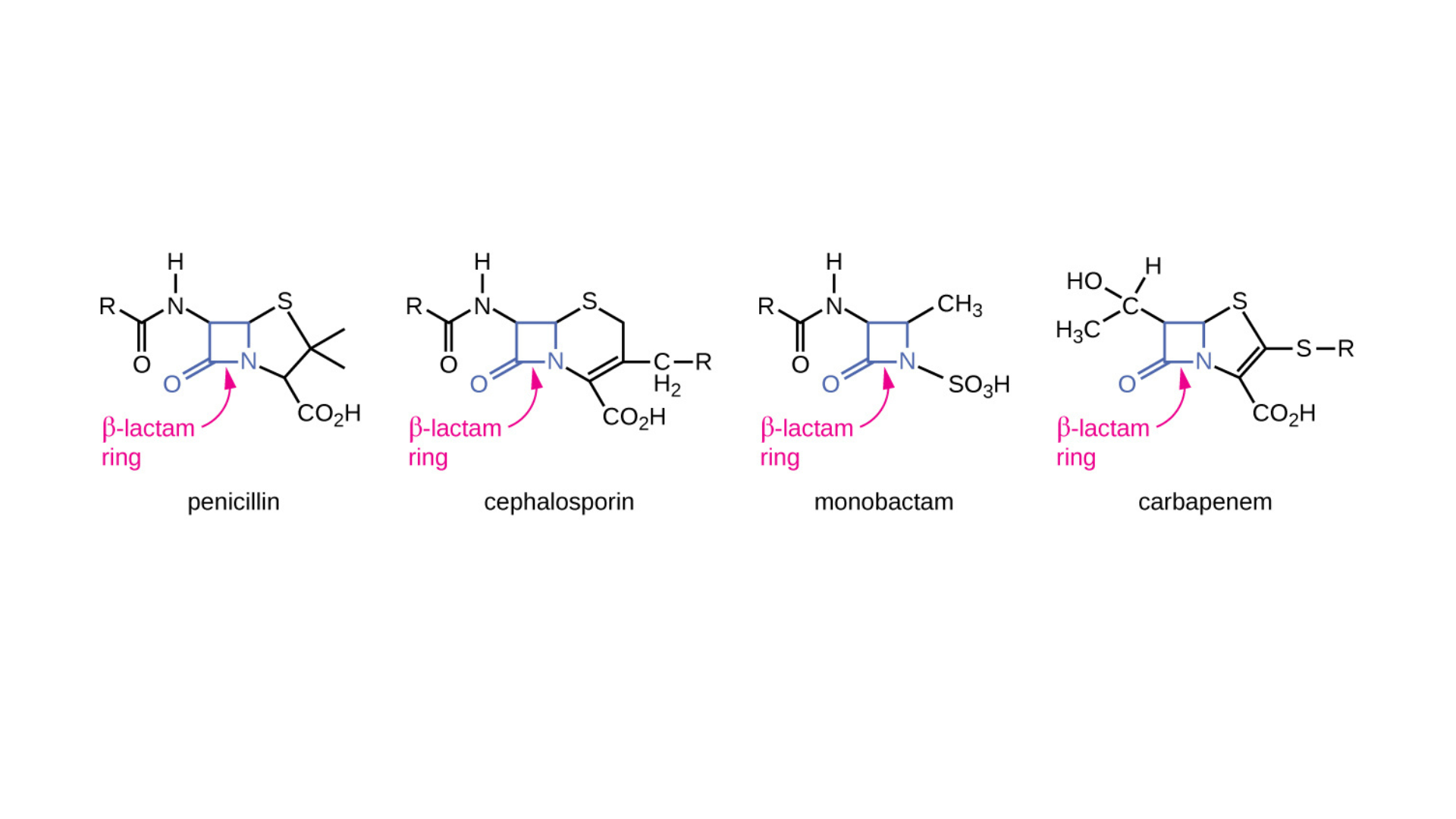
The beta-lactam ring is especially reactive due to its geometric strain; the four-membered ring creates 90° bond angles, which deviate significantly from ideal angles for sp or sp hybridized atoms. This strain contributes to the ring's high reactivity and ability to acylate PBPs effectively. In contrast, larger lactam rings, which are less strained, show markedly lower reactivity. To counteract the effects of beta-lactam antibiotics, some bacteria produce an enzyme called beta-lactamase. This enzyme cleaves the beta-lactam ring, neutralizing the antibiotic's activity by preventing it from interacting with PBPs.
When a beta-lactam forms a permanent covalent bond with a Penicillin Binding Protein (PBP), what type of enzyme inhibition is this an example of?
Penicillin is widely regarded as one of the most iconic and influential antibiotics in medical history. Its chemical structure is defined by a key component called a beta-lactam—a four-membered ring containing an amide group. Figure 1 demonstrates the beta-lactam structure in several different antibiotics. This beta-lactam structure allows the drug to form a covalent bond with Penicillin Binding Proteins (PBPs), which play a crucial role in bacterial cell wall integrity by facilitating the cross-linking of peptidoglycan chains. When penicillin or related compounds attach to PBPs, this cross-linking process is disrupted, weakening the cell wall and leading to bacterial death through lysis.
The beta-lactam ring is especially reactive due to its geometric strain; the four-membered ring creates 90° bond angles, which deviate significantly from ideal angles for sp or sp hybridized atoms. This strain contributes to the ring's high reactivity and ability to acylate PBPs effectively. In contrast, larger lactam rings, which are less strained, show markedly lower reactivity. To counteract the effects of beta-lactam antibiotics, some bacteria produce an enzyme called beta-lactamase. This enzyme cleaves the beta-lactam ring, neutralizing the antibiotic's activity by preventing it from interacting with PBPs.
The beta-lactam ring undergoes a reaction with the serine hydroxyl () group in the active site of PBPs. Considering the strain on the four-membered ring, which type of chemical reaction best characterizes this interaction?
Penicillin is widely regarded as one of the most iconic and influential antibiotics in medical history. Its chemical structure is defined by a key component called a beta-lactam—a four-membered ring containing an amide group. Figure 1 demonstrates the beta-lactam structure in several different antibiotics. This beta-lactam structure allows the drug to form a covalent bond with Penicillin Binding Proteins (PBPs), which play a crucial role in bacterial cell wall integrity by facilitating the cross-linking of peptidoglycan chains. When penicillin or related compounds attach to PBPs, this cross-linking process is disrupted, weakening the cell wall and leading to bacterial death through lysis.
The beta-lactam ring is especially reactive due to its geometric strain; the four-membered ring creates 90° bond angles, which deviate significantly from ideal angles for sp or sp hybridized atoms. This strain contributes to the ring's high reactivity and ability to acylate PBPs effectively. In contrast, larger lactam rings, which are less strained, show markedly lower reactivity. To counteract the effects of beta-lactam antibiotics, some bacteria produce an enzyme called beta-lactamase. This enzyme cleaves the beta-lactam ring, neutralizing the antibiotic's activity by preventing it from interacting with PBPs.
Which of the following would not be a viable bacterial defense mechanism against beta-lactam antibiotics?
Penicillin is widely regarded as one of the most iconic and influential antibiotics in medical history. Its chemical structure is defined by a key component called a beta-lactam—a four-membered ring containing an amide group. Figure 1 demonstrates the beta-lactam structure in several different antibiotics. This beta-lactam structure allows the drug to form a covalent bond with Penicillin Binding Proteins (PBPs), which play a crucial role in bacterial cell wall integrity by facilitating the cross-linking of peptidoglycan chains. When penicillin or related compounds attach to PBPs, this cross-linking process is disrupted, weakening the cell wall and leading to bacterial death through lysis.
The beta-lactam ring is especially reactive due to its geometric strain; the four-membered ring creates 90° bond angles, which deviate significantly from ideal angles for sp or sp hybridized atoms. This strain contributes to the ring's high reactivity and ability to acylate PBPs effectively. In contrast, larger lactam rings, which are less strained, show markedly lower reactivity. To counteract the effects of beta-lactam antibiotics, some bacteria produce an enzyme called beta-lactamase. This enzyme cleaves the beta-lactam ring, neutralizing the antibiotic's activity by preventing it from interacting with PBPs.
In the structure of a beta-lactam ring, which atom is most likely to exhibit sp hybridization?
A Cyclist Who Cannot Sprint: The Isozymes of Lactate Dehydrogenase
Lactate dehydrogenase (LDH) catalyzes the last step of anaerobic glycolysis:
Active LDH is a tetramer built from two kinds of subunit: M, encoded by the LDHA gene and dominant in skeletal muscle, and H, encoded by LDHB and dominant in heart. Heart muscle takes up lactate from the blood, runs the reaction in reverse, and oxidizes the resulting pyruvate in its mitochondria. In one study, the two pure tetramers were compared at low pyruvate concentrations (Table 1).
Table 1. Pyruvate affinity of the two pure LDH tetramers
| Isozyme | Main tissue | Km for pyruvate (mM) |
|---|---|---|
| M4 | Skeletal muscle | 0.30 |
| H4 | Heart | 0.08 |
A 19-year-old cyclist reports cramps and dark urine after short sprints, yet can ride for hours at an easy pace. Clinicians performed an ischemic forearm test: with a cuff stopping blood flow to the forearm, the patient squeezed a hand grip hard for one minute; the cuff was then released. Blood was drawn from a forearm vein before exercise and two minutes after it. Ammonia, which muscle releases by deaminating AMP during intense effort, rises whether or not glycolysis works, so it confirms that the effort was adequate. A healthy volunteer served as the control (Table 2). A later muscle biopsy found no M subunits.
Table 2. Venous blood in the ischemic forearm test
| Analyte | Patient, before | Patient, after | Control, before | Control, after |
|---|---|---|---|---|
| Lactate (mM) | 1.0 | 1.3 | 1.0 | 5.5 |
| Pyruvate (mM) | 0.08 | 0.60 | 0.08 | 0.25 |
| Ammonia (µM) | 30 | 150 | 30 | 140 |
Suppose that in the control subject's exercised muscle, cytosolic is 45 and equals the post-exercise venous ratio in Table 2. At pH 7.0 and 37 °C, where , what is for the LDH reaction as written?
A Cyclist Who Cannot Sprint: The Isozymes of Lactate Dehydrogenase
Lactate dehydrogenase (LDH) catalyzes the last step of anaerobic glycolysis:
Active LDH is a tetramer built from two kinds of subunit: M, encoded by the LDHA gene and dominant in skeletal muscle, and H, encoded by LDHB and dominant in heart. Heart muscle takes up lactate from the blood, runs the reaction in reverse, and oxidizes the resulting pyruvate in its mitochondria. In one study, the two pure tetramers were compared at low pyruvate concentrations (Table 1).
Table 1. Pyruvate affinity of the two pure LDH tetramers
| Isozyme | Main tissue | Km for pyruvate (mM) |
|---|---|---|
| M4 | Skeletal muscle | 0.30 |
| H4 | Heart | 0.08 |
A 19-year-old cyclist reports cramps and dark urine after short sprints, yet can ride for hours at an easy pace. Clinicians performed an ischemic forearm test: with a cuff stopping blood flow to the forearm, the patient squeezed a hand grip hard for one minute; the cuff was then released. Blood was drawn from a forearm vein before exercise and two minutes after it. Ammonia, which muscle releases by deaminating AMP during intense effort, rises whether or not glycolysis works, so it confirms that the effort was adequate. A healthy volunteer served as the control (Table 2). A later muscle biopsy found no M subunits.
Table 2. Venous blood in the ischemic forearm test
| Analyte | Patient, before | Patient, after | Control, before | Control, after |
|---|---|---|---|---|
| Lactate (mM) | 1.0 | 1.3 | 1.0 | 5.5 |
| Pyruvate (mM) | 0.08 | 0.60 | 0.08 | 0.25 |
| Ammonia (µM) | 30 | 150 | 30 | 140 |
At the resting venous pyruvate concentration in Table 2, and assuming Michaelis–Menten kinetics, at about what fraction of its Vmax would each isozyme in Table 1 work?
A Cyclist Who Cannot Sprint: The Isozymes of Lactate Dehydrogenase
Lactate dehydrogenase (LDH) catalyzes the last step of anaerobic glycolysis:
Active LDH is a tetramer built from two kinds of subunit: M, encoded by the LDHA gene and dominant in skeletal muscle, and H, encoded by LDHB and dominant in heart. Heart muscle takes up lactate from the blood, runs the reaction in reverse, and oxidizes the resulting pyruvate in its mitochondria. In one study, the two pure tetramers were compared at low pyruvate concentrations (Table 1).
Table 1. Pyruvate affinity of the two pure LDH tetramers
| Isozyme | Main tissue | Km for pyruvate (mM) |
|---|---|---|
| M4 | Skeletal muscle | 0.30 |
| H4 | Heart | 0.08 |
A 19-year-old cyclist reports cramps and dark urine after short sprints, yet can ride for hours at an easy pace. Clinicians performed an ischemic forearm test: with a cuff stopping blood flow to the forearm, the patient squeezed a hand grip hard for one minute; the cuff was then released. Blood was drawn from a forearm vein before exercise and two minutes after it. Ammonia, which muscle releases by deaminating AMP during intense effort, rises whether or not glycolysis works, so it confirms that the effort was adequate. A healthy volunteer served as the control (Table 2). A later muscle biopsy found no M subunits.
Table 2. Venous blood in the ischemic forearm test
| Analyte | Patient, before | Patient, after | Control, before | Control, after |
|---|---|---|---|---|
| Lactate (mM) | 1.0 | 1.3 | 1.0 | 5.5 |
| Pyruvate (mM) | 0.08 | 0.60 | 0.08 | 0.25 |
| Ammonia (µM) | 30 | 150 | 30 | 140 |
Heart muscle converts lactate to pyruvate even though for the LDH reaction favors lactate. Which statement best explains this?
A Cyclist Who Cannot Sprint: The Isozymes of Lactate Dehydrogenase
Lactate dehydrogenase (LDH) catalyzes the last step of anaerobic glycolysis:
Active LDH is a tetramer built from two kinds of subunit: M, encoded by the LDHA gene and dominant in skeletal muscle, and H, encoded by LDHB and dominant in heart. Heart muscle takes up lactate from the blood, runs the reaction in reverse, and oxidizes the resulting pyruvate in its mitochondria. In one study, the two pure tetramers were compared at low pyruvate concentrations (Table 1).
Table 1. Pyruvate affinity of the two pure LDH tetramers
| Isozyme | Main tissue | Km for pyruvate (mM) |
|---|---|---|
| M4 | Skeletal muscle | 0.30 |
| H4 | Heart | 0.08 |
A 19-year-old cyclist reports cramps and dark urine after short sprints, yet can ride for hours at an easy pace. Clinicians performed an ischemic forearm test: with a cuff stopping blood flow to the forearm, the patient squeezed a hand grip hard for one minute; the cuff was then released. Blood was drawn from a forearm vein before exercise and two minutes after it. Ammonia, which muscle releases by deaminating AMP during intense effort, rises whether or not glycolysis works, so it confirms that the effort was adequate. A healthy volunteer served as the control (Table 2). A later muscle biopsy found no M subunits.
Table 2. Venous blood in the ischemic forearm test
| Analyte | Patient, before | Patient, after | Control, before | Control, after |
|---|---|---|---|---|
| Lactate (mM) | 1.0 | 1.3 | 1.0 | 5.5 |
| Pyruvate (mM) | 0.08 | 0.60 | 0.08 | 0.25 |
| Ammonia (µM) | 30 | 150 | 30 | 140 |
Before the biopsy, which result in Table 2 best indicated that the patient's block lies at the LDH step rather than at an earlier step of glycolysis?
A Cyclist Who Cannot Sprint: The Isozymes of Lactate Dehydrogenase
Lactate dehydrogenase (LDH) catalyzes the last step of anaerobic glycolysis:
Active LDH is a tetramer built from two kinds of subunit: M, encoded by the LDHA gene and dominant in skeletal muscle, and H, encoded by LDHB and dominant in heart. Heart muscle takes up lactate from the blood, runs the reaction in reverse, and oxidizes the resulting pyruvate in its mitochondria. In one study, the two pure tetramers were compared at low pyruvate concentrations (Table 1).
Table 1. Pyruvate affinity of the two pure LDH tetramers
| Isozyme | Main tissue | Km for pyruvate (mM) |
|---|---|---|
| M4 | Skeletal muscle | 0.30 |
| H4 | Heart | 0.08 |
A 19-year-old cyclist reports cramps and dark urine after short sprints, yet can ride for hours at an easy pace. Clinicians performed an ischemic forearm test: with a cuff stopping blood flow to the forearm, the patient squeezed a hand grip hard for one minute; the cuff was then released. Blood was drawn from a forearm vein before exercise and two minutes after it. Ammonia, which muscle releases by deaminating AMP during intense effort, rises whether or not glycolysis works, so it confirms that the effort was adequate. A healthy volunteer served as the control (Table 2). A later muscle biopsy found no M subunits.
Table 2. Venous blood in the ischemic forearm test
| Analyte | Patient, before | Patient, after | Control, before | Control, after |
|---|---|---|---|---|
| Lactate (mM) | 1.0 | 1.3 | 1.0 | 5.5 |
| Pyruvate (mM) | 0.08 | 0.60 | 0.08 | 0.25 |
| Ammonia (µM) | 30 | 150 | 30 | 140 |
During the ischemic test, which glycolytic enzyme in the patient's forearm muscle is most directly slowed by the failure to regenerate through LDH?
Continue your practice
MCAT: Critical Analysis and Reasoning Skills
MCAT: Psychology and Sociology
MCAT: Biology and Biochemistry