

PTA
study guide
Every chapter of the course summarized, with each section linked to its lesson.
Pass the first time
Try Achievable NPTE-PTA
No credit card required
This free PTA study guide summarizes all 7 chapters of Achievable's PTA course: what each covers, the points to remember, and its 69 sections in order. Read each chapter after you study it, or work through the whole guide before exam day.
Each section links to its full lesson in Achievable, with the review quizzes and full-length practice exams.
Chapter 1: Cardiovascular system
6 sections
- Heart structure and flow: The heart has endocardium, myocardium, and epicardium, and blood flows SVC/IVC → right heart → lungs → left heart → aorta → body.
- Conduction and function: SA node → AV node → bundle of His → bundle branches → Purkinje fibers, and preload, afterload, stroke volume, and cardiac output determine pumping performance.
- Cardiac disorders and monitoring: Hypertension, orthostatic hypotension, angina, myocardial infarction, heart failure, pericarditis, congenital defects, PVD, and DVT require the PTA to stop or modify activity when symptoms or abnormal signs appear.
- Rehab, ECG, and labs: Cardiac rehab, ECG rhythms, exercise testing, medications, and lab values guide intensity and safety, and the PTA uses RPE, vitals, and contraindications to monitor response.
Start this chapter free
Chapter 2: Pulmonary system
4 sections
- Anatomy and ventilation: Upper airways are air entry, lower airways are air conduction and gas exchange, and inspiration uses the diaphragm and external intercostals while quiet exhalation is passive.
- Breathing and PFTs: Chest wall excursion is measured at the axilla, xiphoid, and lower ribs, and below 70% suggests obstruction while restrictive patterns reduce TLC and vital capacity.
- Auscultation and tubes: Vesicular sounds are normal over most lung fields, bronchial sounds are abnormal if heard peripherally, and new dyspnea, chest pain, SpO2 drop, arrhythmia, or a dislodged line must be reported immediately.
- ABGs and interventions: ABGs assess , , and pH, and PTA uses pacing, breathing exercises, airway clearance, and secretion removal techniques while reporting abnormal findings to the supervising PT.
Study this chapter in Achievable
Chapter 3: Neuromuscular system
15 sections
- Motor neuron lesions: Both cause weakness, but UMN lesions show hyperreflexia and hypertonia, while LMN lesions show hyporeflexia or areflexia, hypotonia, atrophy, and fasciculations present.
- Brain organization: The right hemisphere controls the left body side and the left hemisphere controls the right body side, with the corpus callosum connecting them across the longitudinal fissure.
- Brain regions: The frontal, parietal, temporal, and occipital lobes each have distinct functions, while the cerebellum, brainstem, thalamus, hypothalamus, and basal ganglia support coordination, homeostasis, relay, and movement.
- Blood supply and PTA safety: Circle of Willis artery injuries produce predictable deficits, PTA observes and reports new or worsening vascular signs, and sudden stroke signs require emergency services.
- Spinal cord and PNS: The spinal cord relays sensory and motor information, the PNS includes all neural tissue outside brain and spinal cord, and PTA collects data while PT interprets findings and modifies plan of care.
- Root and nerve patterns: Dermatomes, myotomes, reflexes, plexuses, and cranial nerve screening localize dysfunction, while autonomic dysreflexia at T6 or above requires sitting the patient upright and removing the trigger immediately.
- Disorders and interventions: Stroke, TBI, SCI, neurodegenerative disease, peripheral nerve injury, epilepsy, and vestibular dysfunction each have distinct signs, and PTA focuses on observing changes, protecting safety, and carrying out the PT's established plan of care.
In this chapter
- Central nervous system
- Anatomy and function of spinal cord
- Peripheral nervous system
- Stroke deficits and recovery
- Traumatic brain injury
- Spinal cord injury
- Neurodegenerative disorders and epilepsy
- Peripheral nervous system conditions
- Other neurological conditions
- Interventions for neurological conditions
- Vestibular system
Study this chapter in Achievable
Chapter 4: Pediatrics
5 sections
- Developmental milestones: Skills and behaviors are expected at specific ages, and the key sequence moves from head control to independent walking and advanced skills.
- Primitive reflexes: Persistent or abnormal reflexes past their integration age are a red flag, and the PTA should document and report them to the supervising PT, not diagnose or alter plan of care.
- Newborn measures: Full term is ~40 weeks (37-42wk), APGAR is scored at 1 and 5 min with repeat q5min up to 20min if <7, and outcome measures are organized by age range and purpose.
- Congenital and acquired conditions: Pediatric disorders include CP, Down syndrome, DMD, SMA, spina bifida, DDH, clubfoot, scoliosis, autism spectrum disorder, and birth injuries, and the PTA follows the PT's plan while reporting changes promptly.
In this chapter
- Pediatric foundations
- Congenital disorders
- Developmental and acquired disorders
Study this chapter in Achievable
Achievable NPTE-PTA
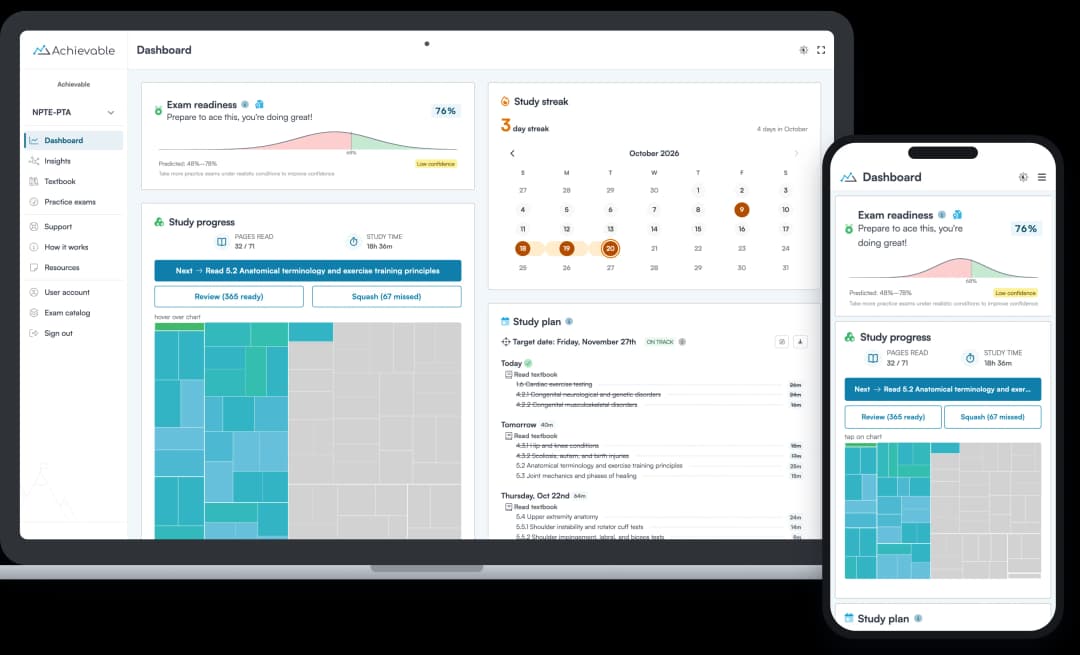
The PTA exam (NPTE-PTA, the National Physical Therapy Exam for Physical Therapist Assistants) is the gateway to licensing for physical therapist assistants in the U.S. Achievable's interactive online PTA exam prep course makes complex topics simple and engaging. Our adaptive platform and AI tutor personalize your study plan, while memory science ensures effective physical therapy prep that gets results.
1 full-length practice exam, 16 section tests
2,200+ practice questions with explanations
Pass guaranteed, or your money back
Free first lessons, no credit card needed
Chapter 5: Musculoskeletal system
27 sections
- Extremity anatomy: Upper and lower extremity motions are organized by joint, with prime movers and supplying nerves or roots paired to each motion.
- Measurement basics: Goniometry uses the joint axis, proximal stationary arm, distal moving arm, and end-feel helps distinguish soft, firm, hard, and empty limits.
- Strength and exercise: MMT grades 0 to 5 strength, while strengthening principles include overload, specificity, reversibility, and matching isometric, isotonic, or isokinetic exercise to healing phase.
- Joint mechanics: Osteokinematics moves bones, arthrokinematics uses roll, glide, and spin, and mobilization grades I-II control pain while grades III-IV restore ROM.
- Upper limb testing: Special tests help identify shoulder, elbow, wrist, and hand instability, tendon, and nerve problems, but the supervising PT interprets findings and changes care.
- Lower limb testing: Hip, knee, ankle, and foot tests screen for ligament, meniscus, patellar, neural, and fracture problems, with positive findings reported to the supervising PT.
- Spine and pelvis: Spinal motion, disc and facet mechanics, SI alignment, cervical and lumbar tests, and red flags guide safe care and immediate PT notification when neurologic signs appear.
- Other musculoskeletal care: Arthritis, inflammation, pain syndromes, gait deviations, prosthetics, orthotics, imaging, medications, fractures, and surgical precautions all require PTA monitoring, reporting, and strict plan-of-care follow-through.
In this chapter
- Anatomy of musculoskeletal system
- Anatomical terminology and exercise training principles
- Joint mechanics and phases of healing
- Upper extremity anatomy
- Special tests of upper extremity
- Comparing clinical presentation and interventions for upper extremity
- Lower extremity anatomy
- Special tests of lower extremity
- Comparing clinical presentation and interventions for lower extremity
- Spine and pelvis anatomy
- Special tests of the spine, pelvis, and temporomandibular joint
- Comparing clinical presentation and interventions for the spine, pelvis, and temporomandibular joint
- Other musculoskeletal conditions
- Gait
- Prosthetics
- Orthotics
- Medications, imaging, and fractures
- Surgical protocols
Study this chapter in Achievable
Chapter 6: Other systems
9 sections
- Skin and wounds: Skin layers, wound healing phases, drainage, measurement, PTA scope, dressing selection, debridement, wound depth, etiology, pressure injuries, and burn classification guide safe care and reporting.
- Skin and lymph disorders: Impetigo, cellulitis, shingles, dermatitis, psoriasis, scleroderma, lymphedema staging, MLD, CDT, bandaging, exercise, and contraindications require monitoring, precautions, and PT referral.
- GI and reproductive systems: PTAs must avoid Valsalva, watch bleeding and fatigue, recognize referred pain and reproductive disorders, and use pregnancy exercise rules, stop signs, and postpartum return guidelines.
- Urinary, renal, endocrine, and metabolic: Incontinence types, AKI, CKD, nephrotic syndrome, hemodialysis, thyroid and adrenal disorders, diabetes, hypoglycemia, and metabolic conditions require glucose, BP, and symptom monitoring.
- Cancer, infection, blood, and psychosocial care: Red flags, common cancers, trauma and psychological conditions, psychiatric medications, HIV, bacterial infections, anemia, sickle cell anemia, and hemophilia depend on PTA reporting and precautions.
Study this chapter in Achievable
Chapter 7: Non-systems
3 sections
- Heat and cold therapy: Heat increases circulation/extensibility and is used for subacute/chronic pain, spasm, and stiffness, while cold reduces inflammation/pain/spasm in acute/post-surgical conditions.
- Ultrasound and e-stim: Therapeutic ultrasound uses sound waves for thermal/non-thermal healing, and electrical stimulation includes TENS, NMES, FES, IFC, HVPC, and iontophoresis with specific indications and precautions.
- Safety and responsibilities: Standard precautions, assistive-device safety, emergency response, and PTA responsibilities require following the plan of care, reporting changes, protecting PHI, and using evidence, documentation, and scope rules correctly.
In this chapter
Study this chapter in Achievable
PTA exam at a glance
- Questions
- 180 multiple-choice questions
- Time
- 4 hours
- Passing score
- 600+
- Exam fee
- $485
More on the PTA exam
- PTA exam prep courseAchievable's course: online textbook, review quizzes and full-length practice exams.
- PTA exam format, content and scoringWhat's tested, how long it takes, what it costs, and the score you need to pass.
- Free PTA practice examPractice questions written to match the real thing, with an explanation for every answer.
- PTA FAQThe questions asked most about the exam and preparing for it, answered.
- Best PTA exam prep coursesHow the leading providers compare on content, format and price.
- PTA study resourcesGuides and study advice from Achievable's instructors.
Pass the NPTE-PTA. Guaranteed.
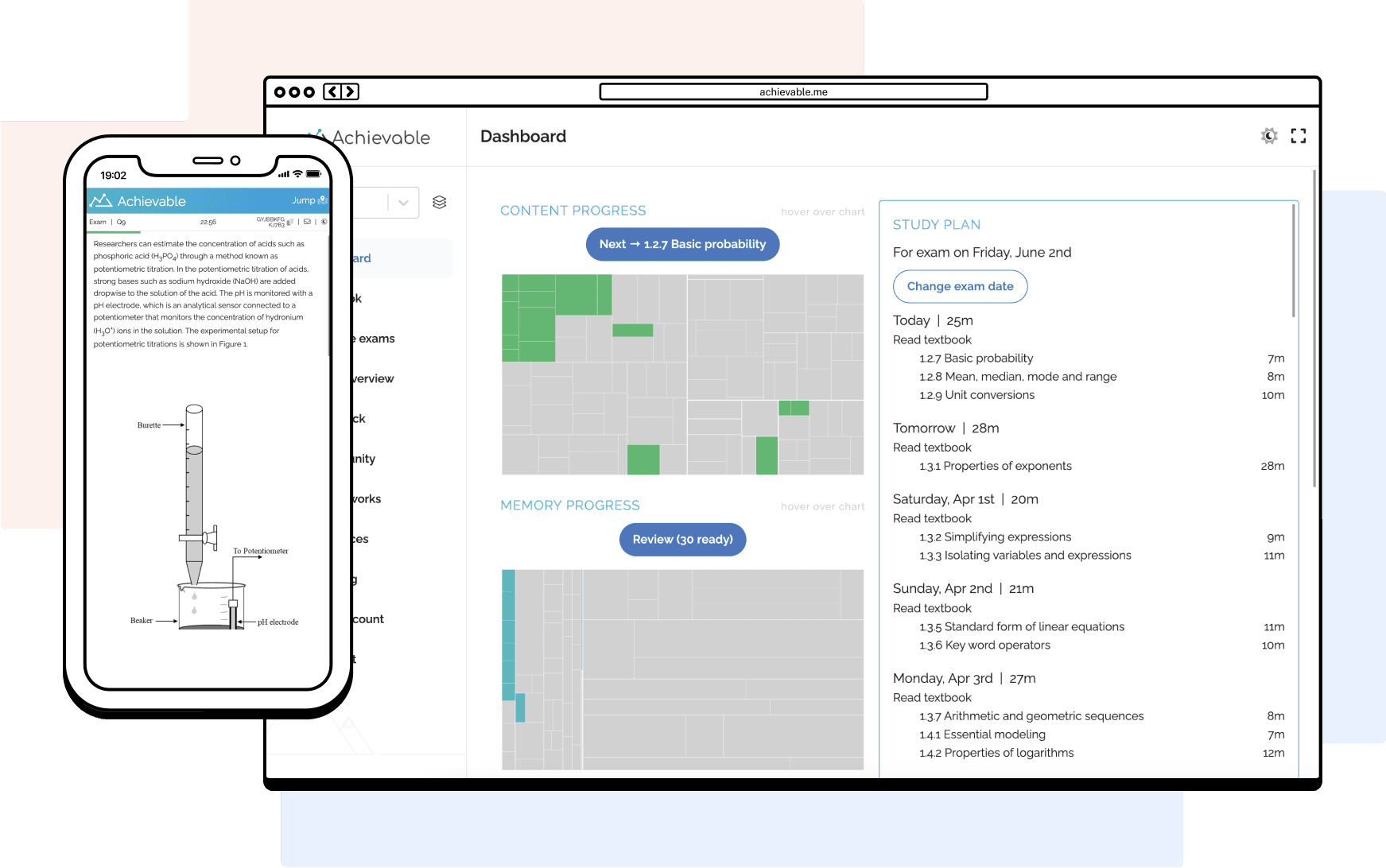
Achievable is the best online NPTE-PTA exam prep course: effective, personalized, and convenient. With Achievable, you'll spend less time studying and pass your exam the first time, or your money back.