

Free Praxis Core: Reading practice exam
This passage is from "Babbit," a novel by Sinclair Lewis.
The towers of Zenith aspired above the morning mist; austere towers of steel and cement and limestone, sturdy as cliffs and delicate as silver rods. They were neither citadels nor churches, but frankly and beautifully office-buildings.
The mist took pity on the fretted structures of earlier generations: the Post Office with its shingle-tortured mansard, the red brick minarets of hulking old houses, factories with stingy and sooted windows, wooden tenements colored like mud. The city was full of such grotesqueries, but the clean towers were thrusting them from the business center, and on the farther hills were shining new houses, homes—they seemed—for laughter and tranquillity.
Over a concrete bridge fled a limousine of long sleek hood and noiseless engine. These people in evening clothes were returning from an all-night rehearsal of a Little Theater play, an artistic adventure considerably illuminated by champagne. Below the bridge curved a railroad, a maze of green and crimson lights. The New York Flyer boomed past, and twenty lines of polished steel leaped into the glare.
In one of the skyscrapers the wires of the Associated Press were closing down. The telegraph operators wearily raised their celluloid eye-shades after a night of talking with Paris and Peking. Through the building crawled the scrubwomen, yawning, their old shoes slapping. The dawn mist spun away.
Which statement best describes the structure of the passage?
Rayon, originally marketed as “artificial silk,” is a semi-synthetic material made from reconstituted cellulose fiber. Although the possibility of using cellulose was first suggested in the seventeenth century, it was another two centuries before Hilaire de Chardonnet patented the first commercially viable rayon, a product that looked and felt like silk. This miracle fabric was not without its problems, however, because the chemicals used in processing wood into cellulose are extremely toxic to workers and the environment. In addition, the manufacturing process creates large amounts of wastewater and vapor which can go on to contaminate the environment. Newer production methods that seek to mitigate this problem have had some success, but the byproducts of manufacturing this material continue to be a concern.
In context, the best synonym for “caustic” would be
The following passage is from "Hard Times," by Charles Dickens.
In the formal drawing-room of Stone Lodge, standing on the hearthrug, warming himself before the fire, Mr. Bounderby delivered some observations to Mrs. Gradgrind on the circumstance of its being his birthday. He stood before the fire, partly because it was a cool spring afternoon, though the sun shone; partly because the shade of Stone Lodge was always haunted by the ghost of damp mortar; partly because he thus took up a commanding position, from which to subdue Mrs. Gradgrind. 'I hadn't a shoe to my foot. As to a stocking, I didn't know such a thing by name. I passed the day in a ditch, and the night in a pigsty. That's the way I spent my tenth birthday. Not that a ditch was new to me, for I was born in a ditch.' Mrs. Gradgrind, a little, thin, white, pink-eyed bundle of shawls, of surpassing feebleness, mental and bodily; who was always taking physic without any effect, and who, whenever she showed a symptom of coming to life, was invariably stunned by some weighty piece of fact tumbling on her; Mrs. Gradgrind hoped it was a dry ditch? 'No! As wet as a sop. A foot of water in it,' said Mr. Bounderby. 'Enough to give a baby cold,' Mrs. Gradgrind considered. 'Cold? I was born with inflammation of the lungs, and of everything else, I believe, that was capable of inflammation,' returned Mr. Bounderby. 'For years, ma'am, I was one of the most miserable little wretches ever seen. I was so sickly, that I was always moaning and groaning. I was so ragged and dirty, that you wouldn't have touched me with a pair of tongs.'
The passage suggests that Mrs. Gradgrind is most like
This passage is from "Letters from a Woman Homesteader" by Elinore Pruitt Stewart.
A neighbor and his daughter were going to Green River, the county-seat, and said I might go along, so I did, as I could file there as well as at the land office; and oh, that trip! I had more fun to the square inch than Mark Twain or Samantha Allen ever provoked. It took us a whole week to go and come. We camped out, of course, for in the whole sixty miles there was but one house, and going in that direction there is not a tree to be seen, nothing but sage, sand, and sheep. About noon the first day out we came near a sheep-wagon, and stalking along ahead of us was a lanky fellow, a herder, going home for dinner. Suddenly it seemed to me I should starve if I had to wait until we got where we had planned to stop for dinner, so I called out to the man, "Little Bo-Peep, have you anything to eat? If you have, we'd like to find it." And he answered, "As soon as I am able it shall be on the table, if you'll but trouble to get behind it." Shades of Shakespeare! Songs of David, the Shepherd Poet! What do you think of us? Well, we got behind it, and a more delicious "it" I never tasted. Such coffee! And out of such a pot! I promised Bo-Peep that I would send him a crook with pink ribbons on it, but I suspect he thinks I am a crook without the ribbons.
Which detail from the passage best supports the narrator’s claim that “I had more fun to the square inch than Mark Twain or Samantha Allen ever provoked?”
This passage is from “Wuthering Heights,” by Emily Brontë.
The apartment and furniture would have been nothing extraordinary as belonging to a homely, northern farmer, with a stubborn countenance, and stalwart limbs set out to advantage in knee-breeches and gaiters. Such an individual seated in his arm-chair, his mug of ale frothing on the round table before him, is to be seen in any circuit of five or six miles among these hills, if you go at the right time after dinner. But Mr. Heathcliff forms a singular contrast to his abode and style of living. He is a dark-skinned gipsy in aspect, in dress and manners a gentleman: that is, as much a gentleman as many a country squire: rather slovenly, perhaps, yet not looking amiss with his negligence, because he has an erect and handsome figure; and rather morose. Possibly, some people might suspect him of a degree of under-bred pride; I have a sympathetic chord within that tells me it is nothing of the sort: I know, by instinct, his reserve springs from an aversion to showy displays of feeling—to manifestations of mutual kindliness. He'll love and hate equally under cover, and esteem it a species of impertinence to be loved or hated again. No, I'm running on too fast: I bestow my own attributes over-liberally on him. Mr. Heathcliff may have entirely dissimilar reasons for keeping his hand out of the way when he meets a would-be acquaintance, to those which actuate me. Let me hope my constitution is almost peculiar: my dear mother used to say I should never have a comfortable home; and only last summer I proved myself perfectly unworthy of one.
Why does the narrator caution the reader that his description of Mr. Heathcliff may not be accurate?
This passage is from “Middlemarch,” a novel by George Eliot.
Miss Brooke had that kind of beauty which seems to be thrown into relief by poor dress. Her hand and wrist were so finely formed that she could wear sleeves not less bare of style than those in which the Blessed Virgin appeared to Italian painters; and her profile as well as her stature and bearing seemed to gain the more dignity from her plain garments, which by the side of provincial fashion gave her the impressiveness of a fine quotation from the Bible,—or from one of our elder poets,—in a paragraph of to-day's newspaper. She was usually spoken of as being remarkably clever, but with the addition that her sister Celia had more common-sense. Nevertheless, Celia wore scarcely more trimmings; and it was only to close observers that her dress differed from her sister's, and had a shade of coquetry in its arrangements; for Miss Brooke's plain dressing was due to mixed conditions, in most of which her sister shared. The pride of being ladies had something to do with it: the Brooke connections, though not exactly aristocratic, were unquestionably “good:” if you inquired backward for a generation or two, you would not find any yard-measuring or parcel-tying forefathers—anything lower than an admiral or a clergyman; and there was even an ancestor discernible as a Puritan gentleman who served under Cromwell, but afterwards conformed, and managed to come out of all political troubles as the proprietor of a respectable family estate. Young women of such birth, living in a quiet country-house, and attending a village church hardly larger than a parlor, naturally regarded frippery as the ambition of a huckster's daughter.
One difference between the two sisters is that
This passage is adapted from “Childhood and Adolescent Obesity in the United States: A Public Health Concern, by Adekunle Sanyaolu, et al., 2021.
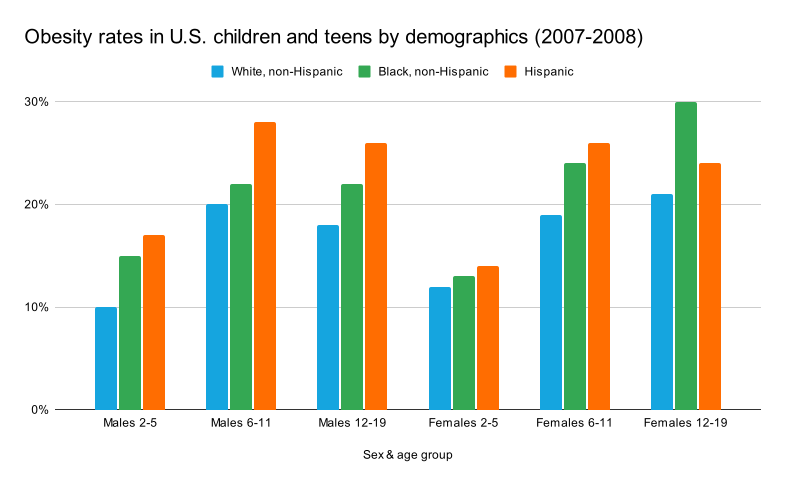
Childhood obesity continues to rise, and the risk only rises as a child grows. Researchers have determined that those risks may be partly determined by a child's race and sex, although other variables, such as socioeconomic status, access to safe outdoor spaces, or opportunities to participate in organized sports. The risk for Hispanic girls peaks before adolescence, when it drops three percent, but African American girls' risk of obesity jumps five percent during the same years. Although girls are at more risk of obesity than boys between ages two and five, boys surpass them in middle childhood before thinning out as adolescents. Caucasian boys in the two to five range are the slimmest overall. However, their risk more than doubles in the twelve to nineteen age bracket. African American boys are the only demographic whose risk of obesity remains steady across two age categories. Only two demographics show a decrease. Previous prevention efforts have been ineffective, and success will require a multipronged approach that includes increasing children's access to safe outdoor spaces, replacing screen time with physical activities, reducing their caloric intake, and educating parents about their children's dietary needs.
Select the two demographics most at risk for childhood obesity between ages 12 and 19.
The following passage is from "Hard Times," by Charles Dickens.
In the formal drawing-room of Stone Lodge, standing on the hearthrug, warming himself before the fire, Mr. Bounderby delivered some observations to Mrs. Gradgrind on the circumstance of its being his birthday. He stood before the fire, partly because it was a cool spring afternoon, though the sun shone; partly because the shade of Stone Lodge was always haunted by the ghost of damp mortar; partly because he thus took up a commanding position, from which to subdue Mrs. Gradgrind. 'I hadn't a shoe to my foot. As to a stocking, I didn't know such a thing by name. I passed the day in a ditch, and the night in a pigsty. That's the way I spent my tenth birthday. Not that a ditch was new to me, for I was born in a ditch.' Mrs. Gradgrind, a little, thin, white, pink-eyed bundle of shawls, of surpassing feebleness, mental and bodily; who was always taking physic without any effect, and who, whenever she showed a symptom of coming to life, was invariably stunned by some weighty piece of fact tumbling on her; Mrs. Gradgrind hoped it was a dry ditch? 'No! As wet as a sop. A foot of water in it,' said Mr. Bounderby. 'Enough to give a baby cold,' Mrs. Gradgrind considered. 'Cold? I was born with inflammation of the lungs, and of everything else, I believe, that was capable of inflammation,' returned Mr. Bounderby. 'For years, ma'am, I was one of the most miserable little wretches ever seen. I was so sickly, that I was always moaning and groaning. I was so ragged and dirty, that you wouldn't have touched me with a pair of tongs.'
The passage includes Mr. Bounderby’s remarks about his childhood to
When Jolene Hernandez moved from Boston, Massachusetts to Nashville, Tennessee in 1987, she thought she was prepared for the heat. However, she didn't know that the warmer weather in the south meant longer active seasons for many pests, among them fleas and mosquitoes. When her dog and cat brought fleas into the house, the insects multiplied: “The last straw was when my mother visited and went home with flea bites.” After “bombing” her home with anti-flea foggers three times in one summer, a friend told her that his uncle had a surefire, completely free, way to rid the house of bugs: Place a small table lamp on the floor. Fill a large shallow pan with soapy water, and place it under the light. At night, turn off all other lights in the house. The light attracts all of the bugs in the house, often a surprisingly large number. When they try to drink from the pan of soapy water, it coats their wings, so they drown. Now, thirty-five years of bug-attracting pets later, Jolene's anti-bug set up has become a regular “water feature” of her home.
What would be the best title for the passage?
This passage is excerpted from “Eight Cousins,” by Louisa May Alcott. Rose has recently been orphaned and sent to live with Aunt Peace and Aunt Plenty.
Rose sat all alone in the big best parlor, with her little handkerchief laid ready to catch the first tear, for she was thinking of her troubles, and a shower was expected. She had retired to this room as a good place in which to be miserable; for it was dark and still, full of ancient furniture, sombre curtains, and hung all around with portraits of solemn old gentlemen in wigs, severe-nosed ladies in top-heavy caps, and staring children in little bob-tailed coats or short-waisted frocks. It was an excellent place for woe; and the fitful spring rain that pattered on the window-pane seemed to sob, “Cry away: I'm with you.”
Rose really did have some cause to be sad; for she had no mother, and had lately lost her father also, which left her no home but this with her great-aunts. She had been with them only a week, and, though the dear old ladies had tried their best to make her happy, they had not succeeded very well, for she was unlike any child they had ever seen, and they felt very much as if they had the care of a low-spirited butterfly.
They had given her the freedom of the house, and for a day or two she had amused herself roaming all over it, for it was a capital old mansion, and was full of all manner of odd nooks, charming rooms, and mysterious passages. Windows broke out in unexpected places, little balconies overhung the garden most romantically, and there was a long upper hall full of curiosities from all parts of the world; for the Campbells had been sea-captains for generations.
What literary techniques are used in the passage?
This passage is from “The Yosemite,” by John Muir.
Though of such stupendous depth, these canyons are not gloom gorges, savage and inaccessible. With rough passages here and there they are flowery pathways conducting to the snowy, icy fountains; mountain streets full of life and light, graded and sculptured by the ancient glaciers, and presenting throughout all their course a rich variety of novel and attractive scenery—the most attractive that has yet been discovered in the mountain ranges of the world. In many places, especially in the middle region of the western flank, the main canyons widen into spacious valleys or parks diversified like landscape gardens with meadows and groves and thickets of blooming bushes, while the lofty walls, infinitely varied in form are fringed with ferns, flowering plants, shrubs of many species and tall evergreens and oaks that find footholds on small benches and tables, all enlivened and made glorious with rejoicing [should this be: streams] that come chanting in chorus over the cliffs and through side canyons in falls of every conceivable form, to join the river that flow in tranquil, shining beauty down the middle of each one of them.
With which statement is the author of the passage likely to disagree?
This passage is from “Wuthering Heights,” by Emily Brontë.
The apartment and furniture would have been nothing extraordinary as belonging to a homely, northern farmer, with a stubborn countenance, and stalwart limbs set out to advantage in knee-breeches and gaiters. Such an individual seated in his arm-chair, his mug of ale frothing on the round table before him, is to be seen in any circuit of five or six miles among these hills, if you go at the right time after dinner. But Mr. Heathcliff forms a singular contrast to his abode and style of living. He is a dark-skinned gipsy in aspect, in dress and manners a gentleman: that is, as much a gentleman as many a country squire: rather slovenly, perhaps, yet not looking amiss with his negligence, because he has an erect and handsome figure; and rather morose. Possibly, some people might suspect him of a degree of under-bred pride; I have a sympathetic chord within that tells me it is nothing of the sort: I know, by instinct, his reserve springs from an aversion to showy displays of feeling—to manifestations of mutual kindliness. He'll love and hate equally under cover, and esteem it a species of impertinence to be loved or hated again. No, I'm running on too fast: I bestow my own attributes over-liberally on him. Mr. Heathcliff may have entirely dissimilar reasons for keeping his hand out of the way when he meets a would-be acquaintance, to those which actuate me. Let me hope my constitution is almost peculiar: my dear mother used to say I should never have a comfortable home; and only last summer I proved myself perfectly unworthy of one.
In context, what is the best definition of the word “constitution” in the last sentence of the passage?
Passage A
The ACT and SAT college entrance exams loom large in the lives of many college-bound high school students. Student scores provide colleges with a metric that allows them to compare students from different schools objectively, even when those students hail from schools of varying quality. They also help to counteract the effects of grade inflation as well as the bonus points that many schools add to the grades of students in honors and Advanced Placement classes.
Colleges that offer test-optional admissions offer students who may not be strong test takers an alternative. However, in the absence of a metric against which to measure the transcripts and recommendation letters that students must submit with their applications, students risk finding themselves in schools where the rigor and expectations do not match their own. A student who earns a 4.0 average in an underfunded, overcrowded school is almost certainly not as well prepared for college as one with the same average who attends an elite private school.
Passage B
As of 2024, more than sixty percent of four-year colleges did not require applicants to submit their SAT or ACT scores, a move that forces them to look at each applicant holistically instead of only seriously considering those with high test scores. This decision benefits a number of demographics: students without access to test prep classes or tutors, second language learners, and those who excel in non-academic areas such as theater, creative writing, or dance. Test-optional policies also help families minimize the stress and cost of applying to college. They also acknowledge that those who work after school or care for younger siblings at home are often precluded from participation in activities that traditionally provide heft on college applications.
How would the author of Passage A respond to Passage B's claim that after-school jobs and family obligations prevent some students from academic excellence?
This passage is from “MR. PERCY AND THE PROPHET,” a novel by Wilkie Collins.
The disasters that follow the hateful offense against Christianity, which men call war, were severely felt in England during the peace that ensued on the overthrow of Napoleon at Waterloo. With rare exceptions, distress prevailed among all classes of the community. The starving nation was ripe and ready for a revolutionary rising against its rulers, who had shed the people's blood and wasted the people's substance in a war which had yielded to the popular interests absolutely nothing in return. Among the unfortunate persons who were driven, during the disastrous early years of this century, to strange shifts and devices to obtain the means of living, was a certain obscure medical man, of French extraction, named Lagarde. The Doctor (duly qualified to bear the title) was an inhabitant of London; living in one of the narrow streets which connect the great thoroughfare of the Strand with the bank of the Thames. The method of obtaining employment chosen by poor Lagarde, as the one alternative left in the face of starvation, was, and is still considered by the medical profession to be, the method of a quack. He advertised in the public journals.
What can you infer from the passage?
This passage is from “Wuthering Heights,” by Emily Brontë.
The apartment and furniture would have been nothing extraordinary as belonging to a homely, northern farmer, with a stubborn countenance, and stalwart limbs set out to advantage in knee-breeches and gaiters. Such an individual seated in his arm-chair, his mug of ale frothing on the round table before him, is to be seen in any circuit of five or six miles among these hills, if you go at the right time after dinner. But Mr. Heathcliff forms a singular contrast to his abode and style of living. He is a dark-skinned gipsy in aspect, in dress and manners a gentleman: that is, as much a gentleman as many a country squire: rather slovenly, perhaps, yet not looking amiss with his negligence, because he has an erect and handsome figure; and rather morose. Possibly, some people might suspect him of a degree of under-bred pride; I have a sympathetic chord within that tells me it is nothing of the sort: I know, by instinct, his reserve springs from an aversion to showy displays of feeling—to manifestations of mutual kindliness. He'll love and hate equally under cover, and esteem it a species of impertinence to be loved or hated again. No, I'm running on too fast: I bestow my own attributes over-liberally on him. Mr. Heathcliff may have entirely dissimilar reasons for keeping his hand out of the way when he meets a would-be acquaintance, to those which actuate me. Let me hope my constitution is almost peculiar: my dear mother used to say I should never have a comfortable home; and only last summer I proved myself perfectly unworthy of one.
What is the function of the first sentence in the passage?
This passage is from "Babbit," a novel by Sinclair Lewis.
The towers of Zenith aspired above the morning mist; austere towers of steel and cement and limestone, sturdy as cliffs and delicate as silver rods. They were neither citadels nor churches, but frankly and beautifully office-buildings.
The mist took pity on the fretted structures of earlier generations: the Post Office with its shingle-tortured mansard, the red brick minarets of hulking old houses, factories with stingy and sooted windows, wooden tenements colored like mud. The city was full of such grotesqueries, but the clean towers were thrusting them from the business center, and on the farther hills were shining new houses, homes—they seemed—for laughter and tranquillity.
Over a concrete bridge fled a limousine of long sleek hood and noiseless engine. These people in evening clothes were returning from an all-night rehearsal of a Little Theater play, an artistic adventure considerably illuminated by champagne. Below the bridge curved a railroad, a maze of green and crimson lights. The New York Flyer boomed past, and twenty lines of polished steel leaped into the glare.
In one of the skyscrapers the wires of the Associated Press were closing down. The telegraph operators wearily raised their celluloid eye-shades after a night of talking with Paris and Peking. Through the building crawled the scrubwomen, yawning, their old shoes slapping. The dawn mist spun away.
What part of “Babbit” does the passage most likely appear in?
Passage A
The ACT and SAT college entrance exams loom large in the lives of many college-bound high school students. Student scores provide colleges with a metric that allows them to compare students from different schools objectively, even when those students hail from schools of varying quality. They also help to counteract the effects of grade inflation as well as the bonus points that many schools add to the grades of students in honors and Advanced Placement classes.
Colleges that offer test-optional admissions offer students who may not be strong test takers an alternative. However, in the absence of a metric against which to measure the transcripts and recommendation letters that students must submit with their applications, students risk finding themselves in schools where the rigor and expectations do not match their own. A student who earns a 4.0 average in an underfunded, overcrowded school is almost certainly not as well prepared for college as one with the same average who attends an elite private school.
Passage B
As of 2024, more than sixty percent of four-year colleges did not require applicants to submit their SAT or ACT scores, a move that forces them to look at each applicant holistically instead of only seriously considering those with high test scores. This decision benefits a number of demographics: students without access to test prep classes or tutors, second language learners, and those who excel in non-academic areas such as theater, creative writing, or dance. Test-optional policies also help families minimize the stress and cost of applying to college. They also acknowledge that those who work after school or care for younger siblings at home are often precluded from participation in activities that traditionally provide heft on college applications.
With which statement are the authors of both passages most likely to agree?
The following passage is from "Hard Times," by Charles Dickens.
In the formal drawing-room of Stone Lodge, standing on the hearthrug, warming himself before the fire, Mr. Bounderby delivered some observations to Mrs. Gradgrind on the circumstance of its being his birthday. He stood before the fire, partly because it was a cool spring afternoon, though the sun shone; partly because the shade of Stone Lodge was always haunted by the ghost of damp mortar; partly because he thus took up a commanding position, from which to subdue Mrs. Gradgrind. 'I hadn't a shoe to my foot. As to a stocking, I didn't know such a thing by name. I passed the day in a ditch, and the night in a pigsty. That's the way I spent my tenth birthday. Not that a ditch was new to me, for I was born in a ditch.' Mrs. Gradgrind, a little, thin, white, pink-eyed bundle of shawls, of surpassing feebleness, mental and bodily; who was always taking physic without any effect, and who, whenever she showed a symptom of coming to life, was invariably stunned by some weighty piece of fact tumbling on her; Mrs. Gradgrind hoped it was a dry ditch? 'No! As wet as a sop. A foot of water in it,' said Mr. Bounderby. 'Enough to give a baby cold,' Mrs. Gradgrind considered. 'Cold? I was born with inflammation of the lungs, and of everything else, I believe, that was capable of inflammation,' returned Mr. Bounderby. 'For years, ma'am, I was one of the most miserable little wretches ever seen. I was so sickly, that I was always moaning and groaning. I was so ragged and dirty, that you wouldn't have touched me with a pair of tongs.'
Which statement best describes the structure of the passage?
Passage A
The ACT and SAT college entrance exams loom large in the lives of many college-bound high school students. Student scores provide colleges with a metric that allows them to compare students from different schools objectively, even when those students hail from schools of varying quality. They also help to counteract the effects of grade inflation as well as the bonus points that many schools add to the grades of students in honors and Advanced Placement classes.
Colleges that offer test-optional admissions offer students who may not be strong test takers an alternative. However, in the absence of a metric against which to measure the transcripts and recommendation letters that students must submit with their applications, students risk finding themselves in schools where the rigor and expectations do not match their own. A student who earns a 4.0 average in an underfunded, overcrowded school is almost certainly not as well prepared for college as one with the same average who attends an elite private school.
Passage B
As of 2024, more than sixty percent of four-year colleges did not require applicants to submit their SAT or ACT scores, a move that forces them to look at each applicant holistically instead of only seriously considering those with high test scores. This decision benefits a number of demographics: students without access to test prep classes or tutors, second language learners, and those who excel in non-academic areas such as theater, creative writing, or dance. Test-optional policies also help families minimize the stress and cost of applying to college. They also acknowledge that those who work after school or care for younger siblings at home are often precluded from participation in activities that traditionally provide heft on college applications.
In context, the word “heft” in Passage B most closely means
The following passage is from "Hard Times," by Charles Dickens.
In the formal drawing-room of Stone Lodge, standing on the hearthrug, warming himself before the fire, Mr. Bounderby delivered some observations to Mrs. Gradgrind on the circumstance of its being his birthday. He stood before the fire, partly because it was a cool spring afternoon, though the sun shone; partly because the shade of Stone Lodge was always haunted by the ghost of damp mortar; partly because he thus took up a commanding position, from which to subdue Mrs. Gradgrind. 'I hadn't a shoe to my foot. As to a stocking, I didn't know such a thing by name. I passed the day in a ditch, and the night in a pigsty. That's the way I spent my tenth birthday. Not that a ditch was new to me, for I was born in a ditch.' Mrs. Gradgrind, a little, thin, white, pink-eyed bundle of shawls, of surpassing feebleness, mental and bodily; who was always taking physic without any effect, and who, whenever she showed a symptom of coming to life, was invariably stunned by some weighty piece of fact tumbling on her; Mrs. Gradgrind hoped it was a dry ditch? 'No! As wet as a sop. A foot of water in it,' said Mr. Bounderby. 'Enough to give a baby cold,' Mrs. Gradgrind considered. 'Cold? I was born with inflammation of the lungs, and of everything else, I believe, that was capable of inflammation,' returned Mr. Bounderby. 'For years, ma'am, I was one of the most miserable little wretches ever seen. I was so sickly, that I was always moaning and groaning. I was so ragged and dirty, that you wouldn't have touched me with a pair of tongs.'
In the passage, the underlined phrase serves to
This passage is from “Middlemarch,” a novel by George Eliot.
Miss Brooke had that kind of beauty which seems to be thrown into relief by poor dress. Her hand and wrist were so finely formed that she could wear sleeves not less bare of style than those in which the Blessed Virgin appeared to Italian painters; and her profile as well as her stature and bearing seemed to gain the more dignity from her plain garments, which by the side of provincial fashion gave her the impressiveness of a fine quotation from the Bible,—or from one of our elder poets,—in a paragraph of to-day's newspaper. She was usually spoken of as being remarkably clever, but with the addition that her sister Celia had more common-sense. Nevertheless, Celia wore scarcely more trimmings; and it was only to close observers that her dress differed from her sister's, and had a shade of coquetry in its arrangements; for Miss Brooke's plain dressing was due to mixed conditions, in most of which her sister shared. The pride of being ladies had something to do with it: the Brooke connections, though not exactly aristocratic, were unquestionably “good:” if you inquired backward for a generation or two, you would not find any yard-measuring or parcel-tying forefathers—anything lower than an admiral or a clergyman; and there was even an ancestor discernible as a Puritan gentleman who served under Cromwell, but afterwards conformed, and managed to come out of all political troubles as the proprietor of a respectable family estate. Young women of such birth, living in a quiet country-house, and attending a village church hardly larger than a parlor, naturally regarded frippery as the ambition of a huckster's daughter.
The allusion to “yard-measuring or parcel-tying forefathers.” suggests that
There were roughly twelve hundred all-Black towns in the United States in the half century following the Civil War, but only thirteen remain today. Of those, two have provided memorable settings for novels: Their Eyes Were Watching God, by Zora Neale Hurston, and The Healer's Daughter, by Charlotte Hinger. Hurston's novel, published in 1937, portrays Eatonville, Florida, where she grew up, as if the white-dominated world outside does not exist. The only white characters are the judge and jury at Janie's trial, but they remain offstage and silent. The Healer's Daughter, published in 2019, is set in Nicodemus, Kansas, a place that is less idyllic, but perhaps more historically accurate in its description of the tensions between the residents of Nicodemus and their white neighbors. As a result, The Healer's Daughter portrays the survival of Nicodemus as a near thing, while Their Eyes Were Watching God depicts its all-Black characters as living freely and without fear.Their Eyes Were Watching God is the story of Janie's quest for love and self-actualization, whereas Hinger's characters must prioritize physical survival and safety.
What is the main idea of the passage?
This passage is excerpted from “Eight Cousins,” by Louisa May Alcott. Rose has recently been orphaned and sent to live with Aunt Peace and Aunt Plenty.
Rose sat all alone in the big best parlor, with her little handkerchief laid ready to catch the first tear, for she was thinking of her troubles, and a shower was expected. She had retired to this room as a good place in which to be miserable; for it was dark and still, full of ancient furniture, sombre curtains, and hung all around with portraits of solemn old gentlemen in wigs, severe-nosed ladies in top-heavy caps, and staring children in little bob-tailed coats or short-waisted frocks. It was an excellent place for woe; and the fitful spring rain that pattered on the window-pane seemed to sob, “Cry away: I'm with you.”
Rose really did have some cause to be sad; for she had no mother, and had lately lost her father also, which left her no home but this with her great-aunts. She had been with them only a week, and, though the dear old ladies had tried their best to make her happy, they had not succeeded very well, for she was unlike any child they had ever seen, and they felt very much as if they had the care of a low-spirited butterfly.
They had given her the freedom of the house, and for a day or two she had amused herself roaming all over it, for it was a capital old mansion, and was full of all manner of odd nooks, charming rooms, and mysterious passages. Windows broke out in unexpected places, little balconies overhung the garden most romantically, and there was a long upper hall full of curiosities from all parts of the world; for the Campbells had been sea-captains for generations.
What might the names of Rose, Aunt Peace, and Aunt Plenty symbolize in the passage?
The following passage is from "Hard Times," by Charles Dickens.
In the formal drawing-room of Stone Lodge, standing on the hearthrug, warming himself before the fire, Mr. Bounderby delivered some observations to Mrs. Gradgrind on the circumstance of its being his birthday. He stood before the fire, partly because it was a cool spring afternoon, though the sun shone; partly because the shade of Stone Lodge was always haunted by the ghost of damp mortar; partly because he thus took up a commanding position, from which to subdue Mrs. Gradgrind. 'I hadn't a shoe to my foot. As to a stocking, I didn't know such a thing by name. I passed the day in a ditch, and the night in a pigsty. That's the way I spent my tenth birthday. Not that a ditch was new to me, for I was born in a ditch.' Mrs. Gradgrind, a little, thin, white, pink-eyed bundle of shawls, of surpassing feebleness, mental and bodily; who was always taking physic without any effect, and who, whenever she showed a symptom of coming to life, was invariably stunned by some weighty piece of fact tumbling on her; Mrs. Gradgrind hoped it was a dry ditch? 'No! As wet as a sop. A foot of water in it,' said Mr. Bounderby. 'Enough to give a baby cold,' Mrs. Gradgrind considered. 'Cold? I was born with inflammation of the lungs, and of everything else, I believe, that was capable of inflammation,' returned Mr. Bounderby. 'For years, ma'am, I was one of the most miserable little wretches ever seen. I was so sickly, that I was always moaning and groaning. I was so ragged and dirty, that you wouldn't have touched me with a pair of tongs.'
Which sentence best describes the structure of the passage?
The Great Inflation of the 1970s was a period of unprecedented price increases in the United States. At its height in 1980, it was 14%, and food prices rose nearly 11%. These increases were primarily due to introducing too much money into circulation, devaluing it while oil prices rose and economic productivity dropped. The inflationary period that began during the COVID-19 pandemic has been linked to a sudden influx of cash into the American economy--the stimulus payments that many people received. Although overall inflation peaked at around 8% in 2022, food prices have risen 23% during the same period as a result of supply chain problems, avian flu outbreaks, and the Russian invasion of Ukraine, one of Europe's breadbasket nations.
Based on the passage, one can infer that
This passage is adapted from “Childhood and Adolescent Obesity in the United States: A Public Health Concern, by Adekunle Sanyaolu, et al., 2021.
Childhood obesity continues to rise, and the risk only rises as a child grows. Researchers have determined that those risks may be partly determined by a child's race and sex, although other variables, such as socioeconomic status, access to safe outdoor spaces, or opportunities to participate in organized sports. The risk for Hispanic girls peaks before adolescence, when it drops three percent, but African American girls' risk of obesity jumps five percent during the same years. Although girls are at more risk of obesity than boys between ages two and five, boys surpass them in middle childhood before thinning out as adolescents. Caucasian boys in the two to five range are the slimmest overall. However, their risk more than doubles in the twelve to nineteen age bracket. African American boys are the only demographic whose risk of obesity remains steady across two age categories. Only two demographics show a decrease. Previous prevention efforts have been ineffective, and success will require a multipronged approach that includes increasing children's access to safe outdoor spaces, replacing screen time with physical activities, reducing their caloric intake, and educating parents about their children's dietary needs.
Which of these sentences is supported by both the passage and the graph?
This passage is taken from The Blue Castle, by L. M. Montgomery. Valancy, who is not yet married, has recently turned twenty-nine.
There was a rosebush on the little Stirling lawn, growing beside the gate. It was called “Doss's rosebush.” Cousin Georgiana had given it to Valancy five years ago and Valancy had planted it joyfully. She loved roses. But—of course—the rosebush never bloomed. That was her luck. Valancy did everything she could think of and took the advice of everybody in the clan, but still the rosebush would not bloom. It throve and grew luxuriantly, with great leafy branches untouched of rust or spider; but not even a bud had ever appeared on it. Valancy, looking at it two days after her birthday, was filled with a sudden, overwhelming hatred for it. The thing wouldn't bloom: very well, then, she would cut it down. She marched to the tool-room in the barn for her garden knife and she went at the rosebush viciously. A few minutes later horrified Mrs. Frederick came out to the verandah and beheld her daughter slashing insanely among the rosebush boughs. Half of them were already strewn on the walk. The bush looked sadly dismantled.
Which supporting detail best illustrates Valancy's anger?
Teaching children to write well can seem like an impossible task because they make so many mistakes that it's hard to know what to focus on first. The response of one sixth grader to a 5-sentence assignment about the pros and cons of growing up provides an excellent example of why teachers find it hard to grade student writing. One sixth grader wrote:
“Growing up is good and bad. Im exited to grow up because there are more experiences I can do when I get older. There are also more responsibilities I will have when I get older such as babysitting and keeping my room clean. A year I am very exited for is high school.”
The assignment is a sentence short--an automatic 80%, if you will, and “I am exited” will give any grammarian the shivers. High school is not, as the writer suggests, only a year long, but four. However, since some students are overwhelmed if their papers are too marked up, a teacher who wants to focus on idea development might decide instead to point out that the paragraph is vague--what experiences?--or that the writer doesn't say whether having more responsibilities is good or bad. Mechanical errors can always be cleaned up, but unexpressed ideas need to make it onto the paper so that the quality of the student's thought can be appraised in addition to his or her comma skills.
What is the main idea of the passage?
Passage A: Homework has long been a stalwart of a top-notch education because it allows teachers to cover more material in class. Many teachers assign reading as homework because in-class reading leaves little time for in-depth analysis or discussion. They may also assign projects or essays as homework, although that practice is declining in the ChatGPT era. Many parents also believe their children should have homework, although others complain about homework that is too difficult for their child to complete without help. Large assignments help students learn valuable skills, such as time management and how to organize large amounts of information into a coherent narrative. Finally, reading homework teaches students to read--preferably daily--and digest large amounts of text, sharpening both their fluency and their critical thinking skills.
Passage B: Homework is a perennial source of tension between students and their teachers, students and their parents, and teachers and parents. Students want to leave academics in school, and many parents prefer to allot that time to sports and other enrichment activities. Many parents resent the time their children's homework takes, especially when it requires their involvement. Others dread the arguing and temper tantrums that homework assignments can precipitate, and still others are unwilling or unable to supervise at all. Older students may have part-time jobs or responsibilities at home, and athletes may be so exhausted from after-school sports that it's really not reasonable to expect them to be able to do their calculus homework. In today's diverse classrooms, minimizing homework reduces economic and situational inequities and makes it possible for all students to excel.
With which statement would the authors of both passages agree?
Teaching children to write well can seem like an impossible task because they make so many mistakes that it's hard to know what to focus on first. The response of one sixth grader to a 5-sentence assignment about the pros and cons of growing up provides an excellent example of why teachers find it hard to grade student writing. One sixth grader wrote:
“Growing up is good and bad. Im exited to grow up because there are more experiences I can do when I get older. There are also more responsibilities I will have when I get older such as babysitting and keeping my room clean. A year I am very exited for is high school.”
The assignment is a sentence short--an automatic 80%, if you will, and “I am exited” will give any grammarian the shivers. High school is not, as the writer suggests, only a year long, but four. However, since some students are overwhelmed if their papers are too marked up, a teacher who wants to focus on idea development might decide instead to point out that the paragraph is vague--what experiences?--or that the writer doesn't say whether having more responsibilities is good or bad. Mechanical errors can always be cleaned up, but unexpressed ideas need to make it onto the paper so that the quality of the student's thought can be appraised in addition to his or her comma skills.
Which statement best describes the structure of the passage?
The following passage is from "Hard Times," by Charles Dickens.
In the formal drawing-room of Stone Lodge, standing on the hearthrug, warming himself before the fire, Mr. Bounderby delivered some observations to Mrs. Gradgrind on the circumstance of its being his birthday. He stood before the fire, partly because it was a cool spring afternoon, though the sun shone; partly because the shade of Stone Lodge was always haunted by the ghost of damp mortar; partly because he thus took up a commanding position, from which to subdue Mrs. Gradgrind. 'I hadn't a shoe to my foot. As to a stocking, I didn't know such a thing by name. I passed the day in a ditch, and the night in a pigsty. That's the way I spent my tenth birthday. Not that a ditch was new to me, for I was born in a ditch.' Mrs. Gradgrind, a little, thin, white, pink-eyed bundle of shawls, of surpassing feebleness, mental and bodily; who was always taking physic without any effect, and who, whenever she showed a symptom of coming to life, was invariably stunned by some weighty piece of fact tumbling on her; Mrs. Gradgrind hoped it was a dry ditch? 'No! As wet as a sop. A foot of water in it,' said Mr. Bounderby. 'Enough to give a baby cold,' Mrs. Gradgrind considered. 'Cold? I was born with inflammation of the lungs, and of everything else, I believe, that was capable of inflammation,' returned Mr. Bounderby. 'For years, ma'am, I was one of the most miserable little wretches ever seen. I was so sickly, that I was always moaning and groaning. I was so ragged and dirty, that you wouldn't have touched me with a pair of tongs.'
The narrator suggests that Bitzer is
There were roughly twelve hundred all-Black towns in the United States in the half century following the Civil War, but only thirteen remain today. Of those, two have provided memorable settings for novels: Their Eyes Were Watching God, by Zora Neale Hurston and The Healer's Daughter, by Charlotte Hinger. Hurston's novel, published in 1937, portrays Eatonville, Florida, where she grew up, as if the white-dominated world outside does not exist. The only white characters are the judge and jury at Janie's trial, but they remain offstage and silent. The Healer's Daughter, published in 2019, is set in Nicodemus, Kansas, a place that is less idyllic, but perhaps more historically accurate in its description of the tensions between the residents of Nicodemus and their white neighbors. As a result, The Healer's Daughter portrays the survival of Nicodemus as a near thing, while Their Eyes Were Watching God depicts its all-Black characters as living freely and without fear.Their Eyes Were Watching God is the story of Janie's quest for love and self-actualization, whereas Hinger's characters must prioritize physical survival and safety.
According to the passage, the relationship between Their Eyes Were Watching God and The Healer's Daughter can best be described as
This passage is from “Middlemarch,” a novel by George Eliot.
Miss Brooke had that kind of beauty which seems to be thrown into relief by poor dress. Her hand and wrist were so finely formed that she could wear sleeves not less bare of style than those in which the Blessed Virgin appeared to Italian painters; and her profile as well as her stature and bearing seemed to gain the more dignity from her plain garments, which by the side of provincial fashion gave her the impressiveness of a fine quotation from the Bible,—or from one of our elder poets,—in a paragraph of to-day's newspaper. She was usually spoken of as being remarkably clever, but with the addition that her sister Celia had more common-sense. Nevertheless, Celia wore scarcely more trimmings; and it was only to close observers that her dress differed from her sister's, and had a shade of coquetry in its arrangements; for Miss Brooke's plain dressing was due to mixed conditions, in most of which her sister shared. The pride of being ladies had something to do with it: the Brooke connections, though not exactly aristocratic, were unquestionably “good:” if you inquired backward for a generation or two, you would not find any yard-measuring or parcel-tying forefathers—anything lower than an admiral or a clergyman; and there was even an ancestor discernible as a Puritan gentleman who served under Cromwell, but afterwards conformed, and managed to come out of all political troubles as the proprietor of a respectable family estate. Young women of such birth, living in a quiet country-house, and attending a village church hardly larger than a parlor, naturally regarded frippery as the ambition of a huckster's daughter.
What is the purpose of the passage?
This passage is from “MR. PERCY AND THE PROPHET,” a novel by Wilkie Collins.
The disasters that follow the hateful offense against Christianity, which men call war, were severely felt in England during the peace that ensued on the overthrow of Napoleon at Waterloo. With rare exceptions, distress prevailed among all classes of the community. The starving nation was ripe and ready for a revolutionary rising against its rulers, who had shed the people's blood and wasted the people's substance in a war which had yielded to the popular interests absolutely nothing in return. Among the unfortunate persons who were driven, during the disastrous early years of this century, to strange shifts and devices to obtain the means of living, was a certain obscure medical man, of French extraction, named Lagarde. The Doctor (duly qualified to bear the title) was an inhabitant of London; living in one of the narrow streets which connect the great thoroughfare of the Strand with the bank of the Thames. The method of obtaining employment chosen by poor Lagarde, as the one alternative left in the face of starvation, was, and is still considered by the medical profession to be, the method of a quack. He advertised in the public journals.
Which statement provides the best summary of the passage?
Rayon, originally marketed as “artificial silk,” is a semi-synthetic material made from reconstituted cellulose fiber. Although the possibility of using cellulose was first suggested in the seventeenth century, it was another two centuries before Hilaire de Chardonnet patented the first commercially viable rayon, a product that looked and felt like silk. This miracle fabric was not without its problems, however, because the chemicals used in processing wood into cellulose are extremely toxic to workers and the environment. In addition, the manufacturing process creates large amounts of wastewater and vapor which can go on to contaminate the environment. Newer production methods that seek to mitigate this problem have had some success, but the byproducts of manufacturing this material continue to be a concern.
This passage would be most appropriate for
This passage is from "Babbit," a novel by Sinclair Lewis.
The towers of Zenith aspired above the morning mist; austere towers of steel and cement and limestone, sturdy as cliffs and delicate as silver rods. They were neither citadels nor churches, but frankly and beautifully office-buildings.
The mist took pity on the fretted structures of earlier generations: the Post Office with its shingle-tortured mansard, the red brick minarets of hulking old houses, factories with stingy and sooted windows, wooden tenements colored like mud. The city was full of such grotesqueries, but the clean towers were thrusting them from the business center, and on the farther hills were shining new houses, homes—they seemed—for laughter and tranquillity.
Over a concrete bridge fled a limousine of long sleek hood and noiseless engine. These people in evening clothes were returning from an all-night rehearsal of a Little Theater play, an artistic adventure considerably illuminated by champagne. Below the bridge curved a railroad, a maze of green and crimson lights. The New York Flyer boomed past, and twenty lines of polished steel leaped into the glare.
In one of the skyscrapers the wires of the Associated Press were closing down. The telegraph operators wearily raised their celluloid eye-shades after a night of talking with Paris and Peking. Through the building crawled the scrubwomen, yawning, their old shoes slapping. The dawn mist spun away.
Based on context, the New York Flyer is most probably
This passage is excerpted from “Eight Cousins,” by Louisa May Alcott. Rose has recently been orphaned and sent to live with Aunt Peace and Aunt Plenty.
Rose sat all alone in the big best parlor, with her little handkerchief laid ready to catch the first tear, for she was thinking of her troubles, and a shower was expected. She had retired to this room as a good place in which to be miserable; for it was dark and still, full of ancient furniture, sombre curtains, and hung all around with portraits of solemn old gentlemen in wigs, severe-nosed ladies in top-heavy caps, and staring children in little bob-tailed coats or short-waisted frocks. It was an excellent place for woe; and the fitful spring rain that pattered on the window-pane seemed to sob, “Cry away: I'm with you.”
Rose really did have some cause to be sad; for she had no mother, and had lately lost her father also, which left her no home but this with her great-aunts. She had been with them only a week, and, though the dear old ladies had tried their best to make her happy, they had not succeeded very well, for she was unlike any child they had ever seen, and they felt very much as if they had the care of a low-spirited butterfly.
They had given her the freedom of the house, and for a day or two she had amused herself roaming all over it, for it was a capital old mansion, and was full of all manner of odd nooks, charming rooms, and mysterious passages. Windows broke out in unexpected places, little balconies overhung the garden most romantically, and there was a long upper hall full of curiosities from all parts of the world; for the Campbells had been sea-captains for generations.
What is the main idea of the passage?
This passage is from “Middlemarch,” a novel by George Eliot.
Miss Brooke had that kind of beauty which seems to be thrown into relief by poor dress. Her hand and wrist were so finely formed that she could wear sleeves not less bare of style than those in which the Blessed Virgin appeared to Italian painters; and her profile as well as her stature and bearing seemed to gain the more dignity from her plain garments, which by the side of provincial fashion gave her the impressiveness of a fine quotation from the Bible,—or from one of our elder poets,—in a paragraph of to-day's newspaper. She was usually spoken of as being remarkably clever, but with the addition that her sister Celia had more common-sense. Nevertheless, Celia wore scarcely more trimmings; and it was only to close observers that her dress differed from her sister's, and had a shade of coquetry in its arrangements; for Miss Brooke's plain dressing was due to mixed conditions, in most of which her sister shared. The pride of being ladies had something to do with it: the Brooke connections, though not exactly aristocratic, were unquestionably “good:” if you inquired backward for a generation or two, you would not find any yard-measuring or parcel-tying forefathers—anything lower than an admiral or a clergyman; and there was even an ancestor discernible as a Puritan gentleman who served under Cromwell, but afterwards conformed, and managed to come out of all political troubles as the proprietor of a respectable family estate. Young women of such birth, living in a quiet country-house, and attending a village church hardly larger than a parlor, naturally regarded frippery as the ambition of a huckster's daughter.
In context, what is the meaning of “frippery” in the passage?
This passage is from “MR. PERCY AND THE PROPHET,” a novel by Wilkie Collins.
The disasters that follow the hateful offense against Christianity, which men call war, were severely felt in England during the peace that ensued on the overthrow of Napoleon at Waterloo. With rare exceptions, distress prevailed among all classes of the community. The starving nation was ripe and ready for a revolutionary rising against its rulers, who had shed the people's blood and wasted the people's substance in a war which had yielded to the popular interests absolutely nothing in return. Among the unfortunate persons who were driven, during the disastrous early years of this century, to strange shifts and devices to obtain the means of living, was a certain obscure medical man, of French extraction, named Lagarde. The Doctor (duly qualified to bear the title) was an inhabitant of London; living in one of the narrow streets which connect the great thoroughfare of the Strand with the bank of the Thames. The method of obtaining employment chosen by poor Lagarde, as the one alternative left in the face of starvation, was, and is still considered by the medical profession to be, the method of a quack. He advertised in the public journals.
In context, the best synonym for “ensued” is
Does how much you drive depend on where you live? According to recent data, it probably does. Inhabitants of the District of Columbia drive the least--only about 7,000 miles annually--whereas people in Montana drive more than three times that amount. In fact, rural drivers clock more miles than those from more developed states, and that has a cost in both time and money. Everything is farther apart because things are more spread out. People may also have to make more trips. Imagine driving to a supermarket 20 miles away and then having to go back because you forgot the milk. It could take the whole morning! Compare that to just running down to the corner bodega or local convenience store. People who live in rural states also have higher transportation costs due to gas, tolls, car repairs, and car insurance--required in every state except New Hampshire--as well as because they often have no other option for getting where they need to go. Rural areas are also less likely to have well-developed public transportation networks. Ride-for-hire and delivery services are also much more costly in rural areas because of the distances involved.
Figure A: The five states where people drive the fewest miles per year.

Which statement accurately expresses information from both the passage and Figure A?
Rayon, originally marketed as “artificial silk,” is a semi-synthetic material made from reconstituted cellulose fiber. Although the possibility of using cellulose was first suggested in the seventeenth century, it was another two centuries before Hilaire de Chardonnet patented the first commercially viable rayon, a product that looked and felt like silk. This miracle fabric was not without its problems, however, because the chemicals used in processing wood into cellulose are extremely toxic to workers and the environment. In addition, the manufacturing process creates large amounts of wastewater and vapor which can go on to contaminate the environment. Newer production methods that seek to mitigate this problem have had some success, but the byproducts of manufacturing this material continue to be a concern.
Which choice best summarizes the structure of the passage?
This passage is from “Middlemarch,” a novel by George Eliot.
Miss Brooke had that kind of beauty which seems to be thrown into relief by poor dress. Her hand and wrist were so finely formed that she could wear sleeves not less bare of style than those in which the Blessed Virgin appeared to Italian painters; and her profile as well as her stature and bearing seemed to gain the more dignity from her plain garments, which by the side of provincial fashion gave her the impressiveness of a fine quotation from the Bible,—or from one of our elder poets,—in a paragraph of to-day's newspaper. She was usually spoken of as being remarkably clever, but with the addition that her sister Celia had more common-sense. Nevertheless, Celia wore scarcely more trimmings; and it was only to close observers that her dress differed from her sister's, and had a shade of coquetry in its arrangements; for Miss Brooke's plain dressing was due to mixed conditions, in most of which her sister shared. The pride of being ladies had something to do with it: the Brooke connections, though not exactly aristocratic, were unquestionably “good:” if you inquired backward for a generation or two, you would not find any yard-measuring or parcel-tying forefathers—anything lower than an admiral or a clergyman; and there was even an ancestor discernible as a Puritan gentleman who served under Cromwell, but afterwards conformed, and managed to come out of all political troubles as the proprietor of a respectable family estate. Young women of such birth, living in a quiet country-house, and attending a village church hardly larger than a parlor, naturally regarded frippery as the ambition of a huckster's daughter.
What is the main idea of the passage?
This passage is from "The Blue Castle", by L. M. Montgomery. Valancy, who is not yet married, has recently turned twenty-nine.
There was a rosebush on the little Stirling lawn, growing beside the gate. It was called “Doss's rosebush.” Cousin Georgiana had given it to Valancy five years ago and Valancy had planted it joyfully. She loved roses. But—of course—the rosebush never bloomed. That was her luck. Valancy did everything she could think of and took the advice of everybody in the clan, but still the rosebush would not bloom. It throve and grew luxuriantly, with great leafy branches untouched of rust or spider; but not even a bud had ever appeared on it. Valancy, looking at it two days after her birthday, was filled with a sudden, overwhelming hatred for it. The thing wouldn't bloom: very well, then, she would cut it down. She marched to the tool-room in the barn for her garden knife and she went at the rosebush viciously. A few minutes later horrified Mrs. Frederick came out to the verandah and beheld her daughter slashing insanely among the rosebush boughs. Half of them were already strewn on the walk. The bush looked sadly dismantled.
Why does Valancy destroy the rosebush?
Teaching children to write well can seem like an impossible task because they make so many mistakes that it's hard to know what to focus on first. The response of one sixth grader to a 5-sentence assignment about the pros and cons of growing up provides an excellent example of why teachers find it hard to grade student writing. One sixth grader wrote:
“Growing up is good and bad. Im exited to grow up because there are more experiences I can do when I get older. There are also more responsibilities I will have when I get older such as babysitting and keeping my room clean. A year I am very exited for is high school.”
The assignment is a sentence short--an automatic 80%, if you will, and “I am exited” will give any grammarian the shivers. High school is not, as the writer suggests, only a year long, but four. However, since some students are overwhelmed if their papers are too marked up, a teacher who wants to focus on idea development might decide instead to point out that the paragraph is vague--what experiences?--or that the writer doesn't say whether having more responsibilities is good or bad. Mechanical errors can always be cleaned up, but unexpressed ideas need to make it onto the paper so that the quality of the student's thought can be appraised in addition to his or her comma skills.
With which statement is the author of the passage most likely to agree?
When Jolene Hernandez moved from Boston, Massachusetts to Nashville, Tennessee in 1987, she thought she was prepared for the heat. However, she didn't know that the warmer weather in the south meant longer active seasons for many pests, among them fleas and mosquitoes. When her dog and cat brought fleas into the house, the insects multiplied: “The last straw was when my mother visited and went home with flea bites.” After “bombing” her home with anti-flea foggers three times in one summer, a friend told her that his uncle had a surefire, completely free, way to rid the house of bugs: Place a small table lamp on the floor. Fill a large shallow pan with soapy water, and place it under the light. At night, turn off all other lights in the house. The light attracts all of the bugs in the house, often a surprisingly large number. When they try to drink from the pan of soapy water, it coats their wings, so they drown. Now, thirty-five years of bug-attracting pets later, Jolene's anti-bug set up has become a regular “water feature” of her home.
Which statement is the best paraphrase of the passage's main point?
Passage A: Homework has long been a stalwart of a top-notch education because it allows teachers to cover more material in class. Many teachers assign reading as homework because in-class reading leaves little time for in-depth analysis or discussion. They may also assign projects or essays as homework, although that practice is declining in the ChatGPT era. Many parents also believe their children should have homework, although others complain about homework that is too difficult for their child to complete without help. Large assignments help students learn valuable skills, such as time management and how to organize large amounts of information into a coherent narrative. Finally, reading homework teaches students to read--preferably daily--and digest large amounts of text, sharpening both their fluency and their critical thinking skills.
Passage B: Homework is a perennial source of tension between students and their teachers, students and their parents, and teachers and parents. Students want to leave academics in school, and many parents prefer to allot that time to sports and other enrichment activities. Many parents resent the time their children's homework takes, especially when it requires their involvement. Others dread the arguing and temper tantrums that homework assignments can precipitate, and still others are unwilling or unable to supervise at all. Older students may have part-time jobs or responsibilities at home, and athletes may be so exhausted from after-school sports that it's really not reasonable to expect them to be able to do their calculus homework. In today's diverse classrooms, minimizing homework reduces economic and situational inequities and makes it possible for all students to excel.
How would the author of Passage B respond to the claim in Passage A that homework “allows teachers to cover more material in class?”
Passage A: Recycling is an important step on the journey towards a sustainable planetary environment. It diverts waste from landfills and reduces the need for new ones. Less waste in landfills also means that less methane and carbon dioxide are released into the atmosphere. Many recycled products are less expensive and use less energy than those made from non-renewable resources. One success story is wood recycling. Waste wood can become flooring, construction materials, garden mulch, pasteboard furniture, and paper products. Fiberboard, a recycled wood product, can replace plastic, further reducing environmental harm.
Passage B: Plastic recycling doesn't work. For one thing, the process emits greenhouse gases into the atmosphere. Less than ten percent of all plastic ever produced has been recycled, and new products continue to proliferate. Also, many products are packaged in multi-layered products in which plastic has been fused with paper or aluminum foil and can't be recycled. Unfortunately, the plastics industry has led people to believe that plastic recycling is an effective tool with which to fight climate change even though most of it simply clogs the recycling system and makes it less effective than it already is.
The authors would agree that
This passage is from “Middlemarch,” a novel by George Eliot.
Miss Brooke had that kind of beauty which seems to be thrown into relief by poor dress. Her hand and wrist were so finely formed that she could wear sleeves not less bare of style than those in which the Blessed Virgin appeared to Italian painters; and her profile as well as her stature and bearing seemed to gain the more dignity from her plain garments, which by the side of provincial fashion gave her the impressiveness of a fine quotation from the Bible,—or from one of our elder poets,—in a paragraph of to-day's newspaper. She was usually spoken of as being remarkably clever, but with the addition that her sister Celia had more common-sense. Nevertheless, Celia wore scarcely more trimmings; and it was only to close observers that her dress differed from her sister's, and had a shade of coquetry in its arrangements; for Miss Brooke's plain dressing was due to mixed conditions, in most of which her sister shared. The pride of being ladies had something to do with it: the Brooke connections, though not exactly aristocratic, were unquestionably “good:” if you inquired backward for a generation or two, you would not find any yard-measuring or parcel-tying forefathers—anything lower than an admiral or a clergyman; and there was even an ancestor discernible as a Puritan gentleman who served under Cromwell, but afterwards conformed, and managed to come out of all political troubles as the proprietor of a respectable family estate. Young women of such birth, living in a quiet country-house, and attending a village church hardly larger than a parlor, naturally regarded frippery as the ambition of a huckster's daughter.
A “huckster” is
This passage is from “MR. PERCY AND THE PROPHET,” a novel by Wilkie Collins.
The disasters that follow the hateful offense against Christianity, which men call war, were severely felt in England during the peace that ensued on the overthrow of Napoleon at Waterloo. With rare exceptions, distress prevailed among all classes of the community. The starving nation was ripe and ready for a revolutionary rising against its rulers, who had shed the people's blood and wasted the people's substance in a war which had yielded to the popular interests absolutely nothing in return. Among the unfortunate persons who were driven, during the disastrous early years of this century, to strange shifts and devices to obtain the means of living, was a certain obscure medical man, of French extraction, named Lagarde. The Doctor (duly qualified to bear the title) was an inhabitant of London; living in one of the narrow streets which connect the great thoroughfare of the Strand with the bank of the Thames. The method of obtaining employment chosen by poor Lagarde, as the one alternative left in the face of starvation, was, and is still considered by the medical profession to be, the method of a quack. He advertised in the public journals.
Which statement expresses the most logical inference about the cost of defeating Napoleon?
This passage is from "Letters from a Woman Homesteader" by Elinore Pruitt Stewart.
A neighbor and his daughter were going to Green River, the county-seat, and said I might go along, so I did, as I could file there as well as at the land office; and oh, that trip! I had more fun to the square inch than Mark Twain or Samantha Allen ever provoked. It took us a whole week to go and come. We camped out, of course, for in the whole sixty miles there was but one house, and going in that direction there is not a tree to be seen, nothing but sage, sand, and sheep. About noon the first day out we came near a sheep-wagon, and stalking along ahead of us was a lanky fellow, a herder, going home for dinner. Suddenly it seemed to me I should starve if I had to wait until we got where we had planned to stop for dinner, so I called out to the man, "Little Bo-Peep, have you anything to eat? If you have, we'd like to find it." And he answered, "As soon as I am able it shall be on the table, if you'll but trouble to get behind it." Shades of Shakespeare! Songs of David, the Shepherd Poet! What do you think of us? Well, we got behind it, and a more delicious "it" I never tasted. Such coffee! And out of such a pot! I promised Bo-Peep that I would send him a crook with pink ribbons on it, but I suspect he thinks I am a crook without the ribbons.
What is the main idea of the passage?
Passage A: Recycling is an important step on the journey towards a sustainable planetary environment. It diverts waste from landfills and reduces the need for new ones. Less waste in landfills also means that less methane and carbon dioxide are released into the atmosphere. Many recycled products are less expensive and use less energy than those made from non-renewable resources. One success story is wood recycling. Waste wood can become flooring, construction materials, garden mulch, pasteboard furniture, and paper products. Fiberboard, a recycled wood product, can replace plastic, further reducing environmental harm.
Passage B: Plastic recycling doesn't work. For one thing, the process emits greenhouse gases into the atmosphere. Less than ten percent of all plastic ever produced has been recycled, and new products continue to proliferate. Also, many products are packaged in multi-layered products in which plastic has been fused with paper or aluminum foil and can't be recycled. Unfortunately, the plastics industry has led people to believe that plastic recycling is an effective tool with which to fight climate change even though most of it simply clogs the recycling system and makes it less effective than it already is.
Which statement best expresses the differences in tone and attitude between the two passages?
George Gordon Byron (1788-1824), the sixth lord Byron, is best known for being “mad, bad, and dangerous to know” because of his scandalous romantic career, racy poetry, and fascination with all things forbidden and exotic. As such, he seems like an unlikely progenitor of the world's first computer programmer, Countess Ada Lovelace (1815-1852). However, Byron never knew his daughter because he separated from her mother and left England when she was still an infant.
In context, the word “progenitor” does NOT mean
This passage is from “The Yosemite,” by John Muir.
Though of such stupendous depth, these canyons are not gloom gorges, savage and inaccessible. With rough passages here and there they are flowery pathways conducting to the snowy, icy fountains; mountain streets full of life and light, graded and sculptured by the ancient glaciers, and presenting throughout all their course a rich variety of novel and attractive scenery—the most attractive that has yet been discovered in the mountain ranges of the world. In many places, especially in the middle region of the western flank, the main canyons widen into spacious valleys or parks diversified like landscape gardens with meadows and groves and thickets of blooming bushes, while the lofty walls, infinitely varied in form are fringed with ferns, flowering plants, shrubs of many species and tall evergreens and oaks that find footholds on small benches and tables, all enlivened and made glorious with rejoicing [should this be: streams] that come chanting in chorus over the cliffs and through side canyons in falls of every conceivable form, to join the river that flow in tranquil, shining beauty down the middle of each one of them.
Which phrase from the passage contains an example of personification?
This passage is from “MR. PERCY AND THE PROPHET,” a novel by Wilkie Collins.
The disasters that follow the hateful offense against Christianity, which men call war, were severely felt in England during the peace that ensued on the overthrow of Napoleon at Waterloo. With rare exceptions, distress prevailed among all classes of the community. The starving nation was ripe and ready for a revolutionary rising against its rulers, who had shed the people's blood and wasted the people's substance in a war which had yielded to the popular interests absolutely nothing in return. Among the unfortunate persons who were driven, during the disastrous early years of this century, to strange shifts and devices to obtain the means of living, was a certain obscure medical man, of French extraction, named Lagarde. The Doctor (duly qualified to bear the title) was an inhabitant of London; living in one of the narrow streets which connect the great thoroughfare of the Strand with the bank of the Thames. The method of obtaining employment chosen by poor Lagarde, as the one alternative left in the face of starvation, was, and is still considered by the medical profession to be, the method of a quack. He advertised in the public journals.
What function does the description of economic distress play in the passage?
When Jolene Hernandez moved from Boston, Massachusetts to Nashville, Tennessee in 1987, she thought she was prepared for the heat. However, she didn't know that the warmer weather in the south meant longer active seasons for many pests, among them fleas and mosquitoes. When her dog and cat brought fleas into the house, the insects multiplied: “The last straw was when my mother visited and went home with flea bites.” After “bombing” her home with anti-flea foggers three times in one summer, a friend told her that his uncle had a surefire, completely free, way to rid the house of bugs: Place a small table lamp on the floor. Fill a large shallow pan with soapy water, and place it under the light. At night, turn off all other lights in the house. The light attracts all of the bugs in the house, often a surprisingly large number. When they try to drink from the pan of soapy water, it coats their wings, so they drown. Now, thirty-five years of bug-attracting pets later, Jolene's anti-bug set up has become a regular “water feature” of her home.
Why does the passage refer to Jolene Hernandez's insect-control method as “a regular water feature” of her home?
The following passage is from "Hard Times," by Charles Dickens.
In the formal drawing-room of Stone Lodge, standing on the hearthrug, warming himself before the fire, Mr. Bounderby delivered some observations to Mrs. Gradgrind on the circumstance of its being his birthday. He stood before the fire, partly because it was a cool spring afternoon, though the sun shone; partly because the shade of Stone Lodge was always haunted by the ghost of damp mortar; partly because he thus took up a commanding position, from which to subdue Mrs. Gradgrind. 'I hadn't a shoe to my foot. As to a stocking, I didn't know such a thing by name. I passed the day in a ditch, and the night in a pigsty. That's the way I spent my tenth birthday. Not that a ditch was new to me, for I was born in a ditch.' Mrs. Gradgrind, a little, thin, white, pink-eyed bundle of shawls, of surpassing feebleness, mental and bodily; who was always taking physic without any effect, and who, whenever she showed a symptom of coming to life, was invariably stunned by some weighty piece of fact tumbling on her; Mrs. Gradgrind hoped it was a dry ditch? 'No! As wet as a sop. A foot of water in it,' said Mr. Bounderby. 'Enough to give a baby cold,' Mrs. Gradgrind considered. 'Cold? I was born with inflammation of the lungs, and of everything else, I believe, that was capable of inflammation,' returned Mr. Bounderby. 'For years, ma'am, I was one of the most miserable little wretches ever seen. I was so sickly, that I was always moaning and groaning. I was so ragged and dirty, that you wouldn't have touched me with a pair of tongs.'
Which best describes how the author characterizes Mr. Bounderby and Mrs. Gradgrind?