The Praxis Core: A complete guide to the exam


Table of contents
- Are the Praxis Core exams hard?
- Do I need the Praxis to become a teacher?
- How to study for the Praxis exams
- Review Praxis exam requirements
- Know the Praxis exam structure
- Preparing for the Praxis exams
- 1. Develop an effective Praxis study plan
- How long should I study for the Praxis exams?
- 2. Practice under real Praxis exam conditions
- 3. Identify and target problem areas
- 4. Prepare for your Praxis exam day
- 5. Ace the Praxis exams!
- Pro study tips
- Conclusion
The Praxis Core is a set of three foundational subtests, Reading, Writing, and Mathematics, that aspiring teachers take to qualify for certification in most U.S. states. To study for the Praxis Core effectively, review the content outlines for all three exams, identify the areas you’re least comfortable with, and use realistic practice materials.
The Praxis Core (5752) comprises the exams that form the basis for teacher certification: Praxis Reading (5713), Praxis Writing (5723), and Praxis Mathematics (5733). Also known as the Core Academic Skills for Educators, these tests evaluate the reading, writing, and math skills needed to obtain a teaching license in the U.S.
A reliable Praxis study guide can provide the guidance and direction you need to prepare for these three important, content-diverse exams.

Are the Praxis Core exams hard?
The Praxis Core exams are known for being moderately challenging because they cover a wide range of topics. Each subtest runs between 85 and 100 minutes, which can be tricky for test-takers who haven’t sat a standardized exam in a while. Passing-score requirements also vary across the U.S., so that the Praxis can seem “easier” in a state with a lower passing threshold than others. The good news: these assessments are designed to test baseline competencies in algebra, geometry, reading comprehension, and essay writing. They are not meant to be overly advanced or specialized, like the subject-specific Praxis II exams.
Success on the Praxis Core comes down to thorough preparation and a complete review of every tested topic.
Do I need the Praxis to become a teacher?
In most cases, yes: most states and DC use the Praxis for teacher licensure. While each state sets slightly different requirements, becoming a licensed teacher in the U.S. generally follows these steps:
- Education requirements: All prospective teachers must hold a bachelor’s degree to qualify for certification. While any major is permissible, choosing a degree aligned with your intended teaching subject can strengthen your preparation for certification exams and provide more relevant classroom experience.
- Training requirements: Educator preparation programs (EPPs) offer aspiring teachers comprehensive coursework, specialized training, and pedagogical development. They also include supervised teaching experiences in K-12 classrooms.
- Exam requirements: All teaching candidates must pass certification exams to meet state licensure requirements. The Praxis Core is the most widely used assessment for measuring foundational skills in reading, writing, and mathematics.
- Candidates may also need to pass additional subject-specific or state-developed exams, depending on their teaching specialty and state regulations.
- Application requirements: After completing the education, training, and exam requirements, the final step is to apply for your state teaching license. Your state’s department of education manages this process, which involves submitting documents such as university transcripts, teacher exam results, and a background check.
Depending on where you plan to teach, you might need to complete specific state certification requirements, such as state-specific exams.
How to study for the Praxis exams
Preparing for the Praxis exams requires studying each test thoroughly, practicing with realistic questions, and simulating test conditions. While most candidates take the exams in their final year or shortly after graduation, many professionals take the exams later in their careers.
Effective preparation means focusing on the topics that need the most review rather than passively reading or overwhelming yourself with information. Given the broad scope and distinctive format, a good strategy starts with understanding the exam requirements and ends with sound practices on test day.

Review Praxis exam requirements
To take a Praxis exam, you must:
- Create an account with the Educational Testing Service (ETS)
- Select the specific tests required by your state or licensing agency
- Pay the registration fee ($90 for each exam, or $150 for the combined 5752 covering all three)
- Present a valid, physical photo ID on test day
There are no degree requirements to sit for the test: it’s open to anyone interested in a teacher preparation program. The exam is offered year-round by appointment at authorized test centers and via online proctoring.
Know the Praxis exam structure
The Praxis exams are computer-based assessments administered at authorized testing centers nationwide (with online proctoring also available).
Across the three tests, you’ll see four main question types:
- Selected-response questions with one correct answer choice
- Selected-response questions with one or more correct answer choices
- Numeric-entry questions that ask you to enter your answer as an integer, decimal, or fraction (Praxis Math)
- An Argumentative and an Informative/Explanatory essay (Praxis Writing)
Here’s a brief overview of each exam.
The Praxis Reading exam consists of digital multiple-choice questions that assess your ability to comprehend, analyze, and evaluate written passages:
- Time: 85 minutes
- Format: 56 questions
- Key Ideas and Details: 17-22 questions, 35% of exam
- Craft, Structure, and Language Skills: 14-19 questions, 30% of exam
- Integration of Knowledge and Ideas: 17-22 questions, 35% of exam
- Passing score: 156 (in most states)
The passages come from various sources, journals, newspapers, magazines, and novels, along with visual aids such as maps and graphs. The test mixes short, long, and paired passages, as well as brief statements, on a range of subjects. Each question refers solely to the written material; outside knowledge of the topics is not required.
The Praxis Writing exam is delivered online (paper tests are available for those who require accommodations) and covers two main content areas:
- Time: 100 minutes
- Format: 40 questions, plus two essays
- Text Types, Purposes, and Production: 6-12 selected-response and 2 essay questions, 60% of the exam
- Language and Research Skills for Writing: 28-34 selected-response questions, 40% of the exam
- Passing score: 162 (in most states)
Selected-response questions assess word usage, sentence correction, revision in context, and research skills. The two essay prompts, one Argumentative and one Informative/Explanatory, measure your ability to write effective, time-pressured responses.
The Praxis Math exam is delivered online, and you’re allowed scratch paper or a dry-erase board for notes and calculations. It covers two main content areas:
- Time: 90 minutes
- Number of questions: 56
- Number and Quantity: 20 questions, 36% of the exam
- Data Interpretation and Representation, Statistics, and Probability: 18 questions, 32% of the exam
- Algebra and Geometry: 18 questions, 32% of the exam
- Passing score: 150 (in most states)
An on-screen calculator is available throughout the Math test. Candidates may not bring their own devices.
You can take each test on a separate day, or combine two (or all three) in one sitting. Registering for all three together with the combined 5752 costs $150 versus $270 for three separate tests: a $120 savings. Even so, be honest with yourself about what you can handle and whether three exams over an hour each, taken back-to-back, are manageable.

Preparing for the Praxis exams
A well-structured plan helps you break down your preparation by topic, identify knowledge gaps, and prioritize high-impact content.
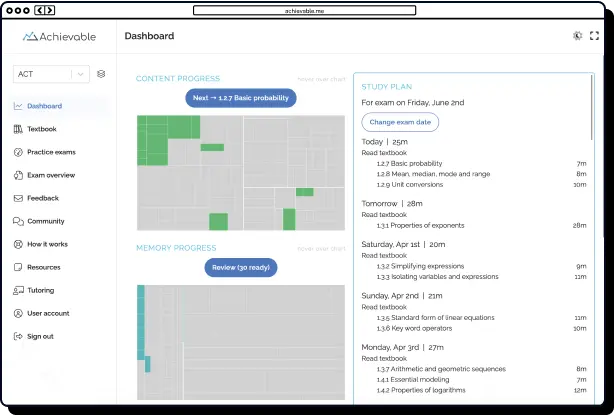
1. Develop an effective Praxis study plan
A clear plan makes it possible to balance test prep with school or work. Follow these steps to build an effective study strategy.
- Start with a diagnostic test: Take a full-length practice exam to gauge your current knowledge. Treat the result as a baseline rather than fixating on the score.
- Collect study materials: Use reliable Praxis study guides, practice questions, formula sheets, and study tools to strengthen your understanding.
- Focus on key topics: Use your diagnostic results to prioritize subjects by importance and by how difficult you find them.
- Create a study schedule: Divide your available study time into manageable blocks and assign each to a subtopic.
You can organize your study plan by exam; it’s generally recommended to devote about a month to each one. Within each month, divide your focus first by the content outline, then by the topics you’re less comfortable with. If you’re taking all three exams at once, set aside enough time to prepare, and don’t over-focus on one area at the expense of another. It might be tempting to avoid calculation-heavy math questions or the essay portion, but those may be the most important areas to target if you’re regularly making errors.
How long should I study for the Praxis exams?
Test-prep experts suggest most people take about three months to prepare for all three Praxis exams, though this depends on your familiarity with the content and format. To prepare efficiently, try these study strategies:
- Practice realistic problems and review any recurring errors or trouble spots.
- Use spaced-repetition tools, such as flashcards, to memorize content that requires frequent recall.
- Work through exam-style questions regularly, paying attention to tricky or ambiguous phrasing.
- Tackle practice problems soon after learning new material to deepen understanding.
- Create visual organizers such as mind maps or outlines to structure key concepts.
- Use memory aids and mnemonics, and teach concepts aloud as if explaining to someone unfamiliar with them.
- Summarize and paraphrase each topic in your own words immediately after studying.
- End each session by self-testing rather than merely rereading notes.
Consistently building your knowledge over several weeks will significantly improve retention and boost your performance on test day.
2. Practice under real Praxis exam conditions
Practicing under realistic test conditions is essential to an effective Praxis study routine. Taken together, the three subtests run about four and a half hours of testing time, so they challenge your mental endurance as well as your knowledge. The Math subtest, in particular, can be calculation-heavy at times. Reviewing content is important, but regularly taking full-length, timed tests under exam-like conditions can greatly improve your performance.
- Use high-quality Praxis practice exams within strict timed conditions.
- Lean on a combination of official ETS resources and well-crafted third-party materials for well-rounded prep.
- Practice with digital resources that match the actual test format, including the on-screen calculator for the Math test.
Aim to complete at least three full-length mock tests: begin with a diagnostic to assess your strengths and weaknesses, take a mid-preparation test to track progress, and finish with a final practice test just before your scheduled exam. Between these, keep practicing with questions that closely resemble the real exam. This builds confidence, stamina, and familiarity with the test format.
3. Identify and target problem areas
As you follow your Praxis study guide, concentrate on the areas that need the most work. Instead of reviewing all subjects equally, focus on the content that challenges you most. Keep a log of mistakes or confusing topics and revisit them regularly. Begin with broad topics and gradually narrow your focus to finer details. Spend extra time on the weak areas highlighted by your error log and practice tests. This targeted strategy helps you focus on the skills that will most improve your score.
4. Prepare for your Praxis exam day
The night before the exam, prioritize mental preparation over last-minute cramming. Make sure you have a valid government-issued photo ID to get into your testing center.
Additional advice before the test:
- Get 7-9 hours of sleep before exam day.
- Eat a nutritious breakfast.
- Quickly review essential summaries or flashcards and steer clear of new content. Remember that physical materials are NOT permitted during the test.
You’ve prepared for weeks: trust your knowledge and avoid piling on unnecessary stress before test day.
5. Ace the Praxis exams!
Exam day is your opportunity to apply everything you've practiced. To perform at your best:
- Calm your nerves with deep breathing and positive self-talk.
- Manage your time wisely; avoid obsessing over one question.
- If you hit a difficult question, skip it: it’s better to move on than to waste time on a single item.
- Practice self-care between exams (drink water, have a snack) if you’re testing all day.
Praxis exam scores are released on designated reporting dates, typically within about two to three weeks of your test. If you’re satisfied with your results, you can proceed toward your licensure requirements. You must wait 28 calendar days between attempts to retake any Praxis test or subtest, but you can test as many times as you need and may qualify for a free test after the third attempt.
After the exam, you can apply to teacher preparation programs and take the next step in your state certification.
Pro study tips
Approach your Praxis preparation with deliberate planning:
- Use high-quality study materials.
- Apply the strategies above and keep track of your progress.
- Regularly review and adjust your study methods.
Checking in on your progress helps you stay focused and adaptable, improving your chances of passing confidently and reducing the need for a retake.

Conclusion
The Praxis Core is a key milestone for aspiring teachers, and a foundation for the training and certification that follow. Success hinges on a structured review plan and consistent practice with realistic questions to strengthen both your knowledge and your test-taking skills.
Because the Praxis Core focuses on foundational reading, writing, and math skills rather than specialized subject material, a focused plan over a few weeks can cover each area well. Concentrating on the main topics and the areas that need improvement will boost your scores and build confidence for exam day. A disciplined review process, paired with strategic use of study materials, helps ensure you’re ready to pass and move forward in your teaching career.