SAT prep course or tutor? A guide for parents


Table of contents
- Course, live class or tutor at a glance
- Which one fits your student: a guide by practice-test result
- Low across both sections (below about 1000)
- One section well behind the other
- Close to the target
- Any starting point, but no habit of studying alone
- What the research says about score gains
- Free options, and when they’re enough
- How a parent can track progress with a course
- Where Achievable fits, and what it costs
- FAQ
- Is a prep course or a tutor better for the SAT?
- How much does SAT tutoring cost?
- Is Khan Academy enough for the SAT?
- When should my child start preparing?
- How much does the SAT itself cost?
- Can my child combine a course and a tutor?
- Key takeaways
Start with a full-length practice test, then let its result decide. A self-paced course suits a student with gaps across both sections who can work on a schedule and a limited budget; a tutor suits a student close to their target with a few specific weaknesses, or one who needs someone to answer to every week. Many families combine the two: a course for the lessons and the practice tests, plus a few tutoring hours on whatever the results keep showing.
- Achievable’s free practice test and course: Achievable’s free SAT practice exam gives one module of each section, 49 questions in all, scored instantly with explanations. Its SAT course is $99 for 12 months of access, paid once rather than as a subscription, with 3 full-length practice SATs, 610+ practice questions with explanations, unlimited Math practice with new numbers each time, and a score improvement guarantee whose terms are below.
- College Board’s free practice tests: the full-length, adaptive practice tests in College Board’s Bluebook app are scored, and the questions can be reviewed afterward in My Practice.
- Tutoring: private SAT tutoring packages on the tutoring companies’ own pages run from $396 for 4 hours (Prep Expert) to $4,795 for 32 hours (PrepScholar), or roughly $80 an hour (Prep Expert) to $420 an hour (Princeton Review’s 1500+ tutoring) at list price.
Course, live class or tutor at a glance
Here is what each format gives a family, with the self-paced course, Achievable’s format, first. Prices are list prices from each provider’s own pages; Black Friday and other sales are common, so check the price on the day you buy.
Self-paced course | Live online class | Private tutor | |
|---|---|---|---|
Cost | $99 for 12 months (Achievable); other self-paced courses run $199 (Kaplan On Demand) to $397 (PrepScholar Complete Online) | $799 for Kaplan Live Online and $895 for PrepScholar’s live classes, up to $2,199 for Princeton Review’s 1400+ course | About $80 an hour (Prep Expert) to $420 an hour (Princeton Review’s 1500+ tutoring); packages from $396 for 4 hours (Prep Expert) to $4,795 for 32 hours (PrepScholar) |
Hours | Your student’s pace; College Board suggests starting at least 2 to 3 months before test day | Fixed: 18 hours of class for Kaplan Live Online, 36 hours for Princeton Review’s 1400+ course | What you buy: most packages are 4 to 32 hours |
Structure | Lessons, quizzes and full-length practice tests in an order the course sets | Scheduled classes with homework between them | Sessions built around your student’s work |
Personalization | Achievable’s quizzes adjust to what your student hasn’t mastered yet | One pace for the whole class | Fully one to one |
Accountability | Your student’s own; progress charts show you where they stand | A class schedule and homework | A weekly appointment with an adult |
Best for | Gaps across both sections, a self-starter, a limited budget | A student who needs set times but not one-to-one help | A student near their target with a few specific weaknesses, or one who won’t study without an appointment |
Two things the table can’t show. A tutor’s hours go to explanation, so the full-length practice tests still happen at home, on your student’s own time. And more hours aren’t more practice: a tutoring package buys an adult’s attention, while a course buys a large set of questions and timed tests your student can take at any hour.
Which one fits your student: a guide by practice-test result
Have your student take a full-length practice test first: Achievable’s free practice exam for a quick read, then one of College Board’s Bluebook tests for a full, adaptive score. Convert section results with our SAT score calculator if you need an estimate. Then read the result against these patterns. The score bands are our rule of thumb, not College Board’s.
Low across both sections (below about 1000)
The gaps are in content, not test-taking, and there are many of them. That is what a course is built for: lessons in order, a quiz after each, and an explanation for every answer. Achievable’s course fits here, and its score improvement guarantee is largest at this starting point: +120 points, or your money back, when your student’s official SAT score from the last 5 years (not a practice test) is below 1000. A tutor can teach the same content, but at $150 to $250 an hour (PrepScholar’s packages) it is an expensive way to cover a whole test. If your student needs a person to keep them going, add a free group: Schoolhouse.world’s SAT bootcamps are free and built for sections scored 400 to 690, so they fit when each section is at least 400, though they are four weeks of small-group sessions with volunteer peer tutors on a fixed schedule, not one-to-one help.
One section well behind the other
Put the course to work on the weak section, and keep the strong one warm with the full-length tests. For Math, Achievable’s course generates new questions from 350+ SAT Math templates, so your student can practice a weak skill without running out of questions or memorizing answers. If a skill still doesn’t click after a few weeks, a handful of tutoring hours on that one skill is money well spent; Prep Expert’s 4-hour package is $396 at list. Bring the tutor the questions your student keeps missing, so the hours go to the problem rather than to a diagnosis.
Close to the target
A student within about 50 points of their goal usually needs repetition under time, not new content. Full-length practice tests, reviewed question by question, are the core: Achievable’s 3 practice SATs, then College Board’s own tests in Bluebook. A tutor earns the hourly rate here when the misses follow a pattern your student can’t see alone, such as running out of time in the second Math module or the same grammar rule in Reading and Writing. A few sessions, not a package, is usually enough.
Any starting point, but no habit of studying alone
If your student won’t open a course without someone waiting for them, accountability is the thing to buy. That can be a tutor, a live class with a set schedule, or a parent who checks the course’s progress charts every Sunday (more on that below).
What the research says about score gains
The research on SAT coaching is older than the digital SAT, and it finds gains smaller than most advertising suggests:
- College Board’s 2025 study of the digital SAT found that students who completed 1, 2, and 3 or more full-length digital practice tests scored about 25, 45 and 60 points higher than similar students who took none (148,154 juniors who took the SAT in school in March 2024). The report says plainly that its estimates are not causal, and the association was larger for students with lower PSAT scores.
- Derek Briggs’s 2009 review for NACAC puts the average effect of coaching at about 30 points in total, 10 to 20 points in math and 5 to 10 in critical reading.
- In the same review, a study of students who tested in 2002 to 2004 found that a commercial course and private tutoring raised math scores by about 13 and 15 points, and that no form of preparation had a statistically significant effect on verbal scores.
- An earlier study by Briggs of students who tested in the early 1990s, published in Chance, found raw differences of about 19 points in math and 7 in verbal for students with private tutors, and 17 and 13 for students who took a commercial course. Once he adjusted for differences between the students, the effect of coaching fell to about 21 points, math and verbal combined.
Two things follow for a parent. First, the studies don’t show a tutor beating a course by much on average, while a tutor costs many times more. Second, averages hide individual results: a student who does the work, takes several full-length tests and reviews every miss can gain far more than the average, and a student who attends sessions without practicing between them can gain nothing.
Free options, and when they’re enough
Free resources are enough for a student who is close to their target, studies well alone and can work out why each answer was wrong, with no pattern of misses they can’t explain on their own. Each one leaves something out:
- Achievable’s free practice exam: one module of each section, 49 questions in all with a 67-minute timer, scored instantly with explanations. It shows where your student stands, but it is not a full-length test, and it doesn’t teach the content behind the misses.
- College Board’s Bluebook practice tests: full-length and adaptive, like the real test, and scored in My Practice, where your student can read an explanation for each question. College Board’s parents’ FAQ counts eight of them. They test; they don’t teach, and there is no study plan between them.
- College Board’s Student Question Bank: thousands of official questions your student can filter by section, skill and difficulty, with no lessons or timed tests.
- Khan Academy: free SAT lessons and practice by skill, as College Board’s official partner. Khan Academy no longer offers full-length practice tests for the digital SAT (those moved to Bluebook), it has no live tutor, and its AI tutor, Khanmigo, costs extra: $4 a month or $44 a year on Khanmigo’s own page.
- Schoolhouse.world: free SAT bootcamps with volunteer tutors, high school students who scored in the 95th percentile or above on the section they teach. Each bootcamp is four weeks of two 75-minute sessions a week in a small group, about 10 hours in all, on a fixed schedule, not one to one, and built for sections scored 400 to 690.
When free isn’t enough: your student’s practice scores stop rising, they can’t explain their own misses, or the gap to the target is more than a couple of hundred points.
How a parent can track progress with a course
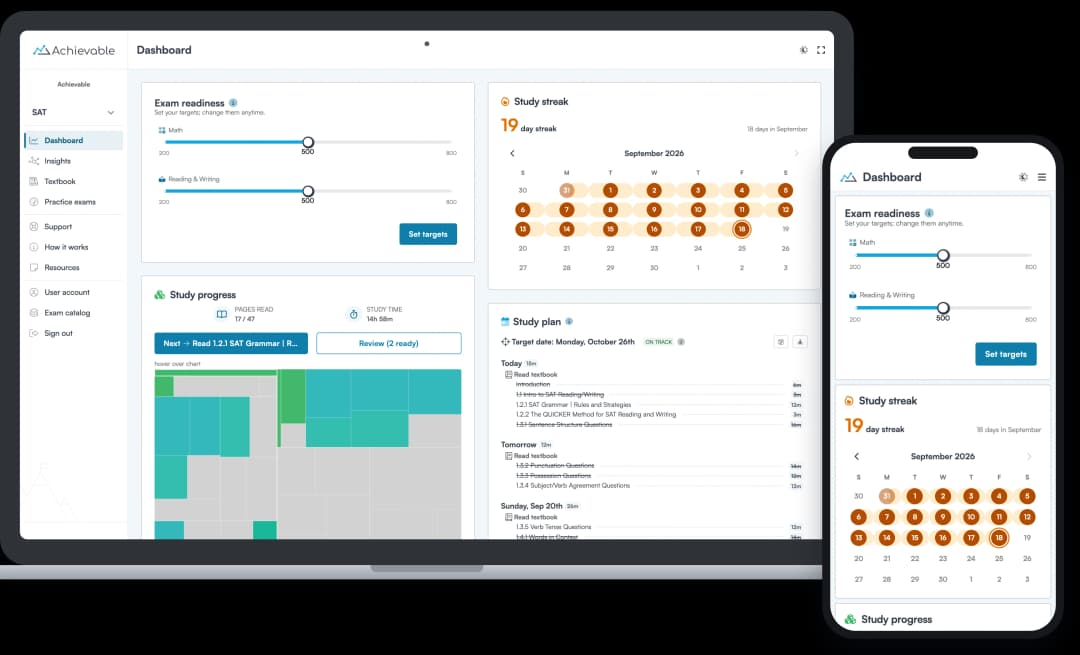
With a course, you can check the numbers yourself any week, not only when a session report arrives. With Achievable’s course, sit down with your student once a week and look at three things:
- Progress charts: they show how far your student is through the course and their current strength in each section, Reading and Writing and Math.
- Practice-test scores: each of the 3 full-length practice SATs has two Reading and Writing modules and two Math modules at the digital SAT’s question counts and time limits, and every answer comes with an explanation. Space them out, and the scores show whether the work is paying off.
- The study plan: Achievable’s study planner builds a day-by-day plan to finish the course by test day, so you can see whether your student is on schedule.
Between Achievable’s practice SATs, add College Board’s Bluebook tests, which report a scaled score, and use our score calculator to estimate an overall score from section results. Whatever the format, the bar is the same: practice-test scores comfortably above your student’s target, consistently, across several full-length tests, so test day doesn’t depend on the luck of the draw.
Where Achievable fits, and what it costs
Achievable’s SAT course is $99 for 12 months of access, paid once rather than as a subscription. It is a self-paced course, with no live classes and no human tutor: lessons from an expert author, an adaptive study plan, an AI tutor for questions, 3 full-length practice SATs, 610+ practice questions with explanations, and unlimited Math practice with new numbers each time. It runs on a computer or in a phone’s browser, with nothing to download, and the first lessons are free with no credit card.
Comparing self-paced courses and apps? Dolphin SAT alternatives: is Dolphin worth it? sets Achievable beside Dolphin, Khan Academy, Bluebook, UWorld, Magoosh and Acely on price, practice tests, phone use and guarantees.
What every format costs, side by side: How much does SAT prep cost? sets Achievable’s $99 course beside Kaplan, Princeton Review, PrepScholar, UWorld and Magoosh at list price, with live classes, tutoring and the SAT’s own fees.
Its score improvement guarantee promises +120 points for a starting score below 1000, +90 points for a starting score of at least 1000 and below 1200, and +60 points for a starting score of at least 1200 and below 1400, or your money back. It covers students with an official SAT score below 1400 from the last 5 years. Your student sends us that score report within 7 days of buying, takes the SAT again while their year of access is active, and if the score hasn’t risen by the points guaranteed, emails the new score report and a valid ID within 31 days of the test for a full refund. There is no minimum study time and no chapter to finish. Every Achievable course for a scored exam can also be refunded in full within 7 days of purchase, for any reason.
Here is how it compares with other paid options, at list price on each provider’s own page:
Format | List price | Full-length practice tests | |
|---|---|---|---|
Achievable | Self-paced | $99 for 12 months | 3 written for the course; unlimited extra Math modules |
Kaplan On Demand | Self-paced | $199 | 4 |
Princeton Review Self-Paced | Self-paced | $299 | 5 |
PrepScholar Complete Online Prep | Self-paced | $397 | College Board’s 8 official tests, taken in Bluebook and imported |
Magoosh Premium | Self-paced | Usually $49 a month | Up to 3 |
Kaplan Live Online | Live class | $799 for 18 hours of class | 4 |
Princeton Review Essentials | Live class | From $949 for 18 hours of class | Not stated on the course card |
Kaplan tutoring | Private tutor | $1,999 for 10 hours plus an 18-hour Live Online course (Standard) | 4 |
Princeton Review tutoring | Private tutor | $175 an hour; $2,000 for 10 hours, $3,150 for 18 hours | Included (the count varies across its page) |
PrepScholar tutoring | Private tutor | $995 for 4 hours to $4,795 for 32 hours | College Board’s 8 official tests |
Some providers count College Board’s own Bluebook tests among theirs. Those are free to every student, and your student may already have taken some of them at school, so a bigger count isn’t always more new practice. Achievable’s practice SATs are written for the course, so your student can’t have met them anywhere else, and its Math practice draws new numbers every time, so it never turns into recall.
If you want a tutor as well, our SAT tutor directory lists independent tutors with their rates and session lengths, and our guide to whether SAT or ACT tutoring is right for your student covers how to choose one. For a side-by-side look at the courses, see our best SAT prep courses comparison.
FAQ
Is a prep course or a tutor better for the SAT?
Neither is better for every student. A course is the better buy for a student with gaps across both sections who can study alone: Achievable’s is $99 for 12 months, with 3 full-length practice SATs. A tutor is worth it for a student close to their target with a few specific weaknesses, or one who needs a weekly appointment. Many families use a course for the content and add a few tutoring hours.
How much does SAT tutoring cost?
Far more than a course: Achievable’s SAT course is $99 for 12 months in all. On the tutoring companies’ own pages, at list price: Prep Expert from $396 for 4 hours (prices vary by tutor), PrepScholar from $995 for 4 hours to $4,795 for 32 hours, Princeton Review $175 an hour or $2,000 for 10 hours, and Kaplan $1,999 for 10 hours with an 18-hour Live Online course included. Private Prep’s pricing guide puts most families’ spending at $1,500 to $6,000 or more for 20 to 30 hours.
Is Khan Academy enough for the SAT?
For many students, a course is the surer route: Achievable’s is $99 for 12 months, with 3 full-length practice SATs written for the course, a study plan and the score improvement guarantee set out above. For a student who studies well alone and is close to the target, Khan Academy’s free lessons plus College Board’s Bluebook tests can be enough, but Khan Academy no longer offers full-length practice tests for the digital SAT, has no live tutor, and charges extra for its AI tutor, Khanmigo. Is Khan Academy enough for the SAT? has a checklist for deciding.
When should my child start preparing?
College Board recommends starting at least 2 to 3 months before the test date. Start with a practice test, so the time goes to the gaps it shows. Our guide to SAT registration and retakes covers test dates and planning a second attempt.
How much does the SAT itself cost?
The registration fee is $68. Eligible students can get a fee waiver and take the SAT for free.
Can my child combine a course and a tutor?
Yes, and it is often the best value. Let the course carry the lessons and the full-length tests, then book a few tutoring hours for the skill or the section that keeps costing points, with the missed questions in hand.
Key takeaways
- Achievable’s SAT course is $99 for 12 months, paid once, with 3 full-length practice SATs, 610+ explained questions and unlimited Math practice. Its guarantee promises +120 points for a starting score below 1000, +90 points for a starting score of at least 1000 and below 1200, and +60 points for a starting score of at least 1200 and below 1400, or your money back, for students with an official SAT score below 1400 from the last 5 years.
- Start with a full-length practice test: Achievable’s free practice exam, then College Board’s free Bluebook tests.
- Choose a course for gaps across both sections and a limited budget, a tutor for a few specific weaknesses close to the target or for weekly accountability, and both when one skill keeps costing points.
- Tutoring runs from about $80 an hour (Prep Expert’s 16-hour package) to $420 an hour (Princeton Review’s 1500+ tutoring) at list price; PrepScholar’s 32-hour package is $4,795.
- Research on coaching finds average gains of tens of points, not hundreds; full-length practice tests, reviewed question by question, matter whichever you choose.