The SAT is the most commonly used standardized exam for college admissions. The exam assesses academic readiness for college by testing your reading comprehension, analytical, and advanced mathematical skills. SAT scores can have a huge impact on your college admissions: test scores are one of the main criteria used to determine academic readiness and program fit, alongside high school GPA, letters of recommendation, and extracurricular activities. While the SAT is just one part of a holistic process, a good SAT score helps your application stand out.
Looking to increase your SAT score? Use our SAT score calculator to see how your raw scores convert to scaled scores and how you stack up to other test takers.

How are SAT scores calculated?
The SAT is scored on a scale of 400 to 1600, with a “perfect” score representing the highest possible achievement on the exam. The SAT consists of two major sections: Reading & Writing and Math, which are scored individually from 200 to 800 and then combined for a total score. The Reading and Writing section contains 54 questions, while the Math section features 44 questions, both designed to evaluate a broad range of skills necessary for success in college classes.
Understanding how SAT scores are calculated is key to mastering the test. Scaled scores are determined not only by the number of correct answers (raw scores) but also by factoring in the difficulty level of each question you answer. Since March 2024, the SAT has been administered exclusively as a digital, computer-based exam with an adaptive format, which makes SAT score calculation more dynamic than ever before. Each of the two main sections is divided into two modules. The first module offers a mix of easy, medium, and challenging questions to determine your starting level. Your performance in the initial module affects the difficulty of the second module, which can open up opportunities for earning a higher score by answering more challenging questions.
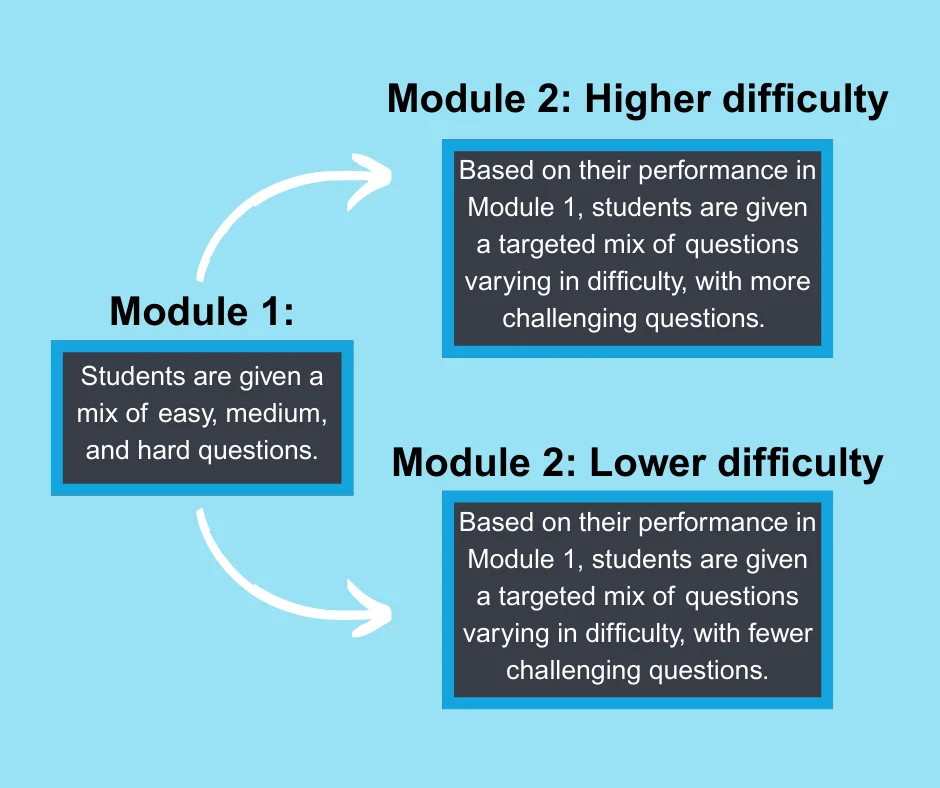
The diagram above illustrates the adaptive scoring process for each SAT section. All students begin with a similar blend of question difficulties. Performance in the first module determines the complexity of the questions in the second module. Answering more difficult questions correctly leads toward higher scaled scores and a shot at that perfect SAT score. Keep in mind, incorrect answers do not reduce your score; instead, every correct answer helps maximize your section and total scores.
Achieving a strong score on the SAT not only brings you closer to a perfect SAT score but also improves your overall SAT percentile. Higher percentiles indicate that your performance surpassed that of most other test takers, reflecting your academic competitiveness.
What do SAT score percentiles mean?
Each SAT section and the total score have corresponding percentile rankings from 1 to 100. SAT score percentiles indicate how much better your score is compared to the pool of test takers from that period. If your score is in the 75th percentile, it means it’s better than 75% of test takers. See below the College Board’s table of SAT percentiles and corresponding scores based on students who took the SAT in the last 3 years:
| Total score | Percentile |
|---|---|
| 1560 – 1600 | 99+ |
| 1530 – 1550 | 99 |
| 1500 – 1520 | 98 |
| 1470 – 1490 | 97 |
| 1450 – 1460 | 96 |
| 1430 – 1440 | 95 |
| 1410 – 1420 | 94 |
| 1390 – 1400 | 93 |
| 1380 | 92 |
| 1360 – 1370 | 91 |
| 1330 – 1340 | 89 |
| 1320 | 88 |
| 1310 | 87 |
| 1300 | 86 |
| 1290 | 85 |
| 1270 – 1280 | 84 |
| 1260 | 83 |
| 1250 | 82 |
| 1240 | 81 |
| 1230 | 80 |
| 1220 | 79 |
| 1210 | 77 |
| 1160 – 1200 | 71 – 76 |
| 1110 – 1150 | 65 – 70 |
| 1060 – 1100 | 57 – 63 |
| 1010 – 1050 | 50 – 56 |
If you’ve taken an SAT practice test, this means that you have estimated raw scores for your Reading & Writing and Math sections. You can use your raw scores to estimate your scaled section and total scores.
SAT score calculator
To use our SAT score calculator, simply adjust the sliders below to match your raw score, or the number of questions you answered correctly in the SAT Reading & Writing and Math sections from a practice exam. Instantly, the SAT score calculator will convert your raw results into estimated scaled section scores ranging from 200 to 800. You’ll also see your total SAT score and corresponding percentiles for both sections and overall performance, making it easier to understand how your results compare to the average SAT score.
Estimated score only. The digital SAT is adaptive, so the same number of correct answers can map to different section scores — treat these as approximate.
It’s important to remember that the College Board does not disclose its official scoring formulas, so all SAT score calculators provide estimates based on available test data. While these tools offer the ability to approximate your scaled scores and understand how SAT scores are calculated, there may be slight differences from your official SAT result. Nevertheless, using a SAT score calculator is a valuable way to track your test prep progress, estimate how much you need to raise your score for college admissions, identify what is considered a good SAT score for your goals, and make strategic decisions on how to increase your SAT score. Always keep in mind that your actual performance and percentile rankings on the real test could vary somewhat from these projections.
What is a good SAT score?
The average SAT score across all test-takers is 1050, with section averages of 529 for SAT Reading and Writing and 521 for SAT Math. Achieving an SAT score above these averages means you are performing better than most students nationwide. However, a truly competitive SAT score is generally recognized as one that falls above the 80th percentile, typically starting around 1210 (which lands at the 82nd percentile). This score range is often considered the lower threshold for a “good” SAT score.
When determining what a good SAT score is for your college goals, it’s important to remember that each college, including Ivy League schools, has its own average SAT score for admitted students. To strengthen your application, aim for an SAT score that exceeds the average SAT score of the incoming class at your desired college. At highly selective institutions, a strong SAT score often means a score well into the 90th percentile or higher. While a perfect SAT score of 1600 is rare, achieving a high percentile not only enhances your chances of admission to top universities but can also unlock valuable merit-based scholarship opportunities.
With college costs continuing to rise, earning a high SAT score can help offset tuition through scholarships and financial awards. If you’re searching for scholarships tied to SAT performance, you can explore a comprehensive directory of SAT-based merit scholarships to find opportunities that reward strong scores and help reduce the financial burden of higher education.

How do I increase my SAT score?
Increasing your SAT score requires a strategic study plan and consistent effort, but meaningful improvement is within reach. With focused preparation, the average test-taker can see a 40-point SAT score improvement for every 7 hours of rigorous, purposeful studying. High-quality SAT study involves completing practice questions, reviewing all relevant instructional materials, working through detailed examples, mastering important test concepts, and regularly taking full-length practice tests.
Begin your SAT study plan by taking a diagnostic exam to establish your starting score. To improve your SAT score, ensure that your initial SAT preparation is comprehensive so that you address every test topic. Regardless of your strengths in school subjects like English, it’s crucial to regularly practice SAT reading passage questions to get familiar with the test’s unique formats and specific question phrasing.
As you work through your chosen materials, tailor your SAT study plan based on your individual strengths and weaknesses. To effectively increase your SAT score, it’s important to practice one test section at a time, enhancing your understanding of the test’s structure. Identify the types of questions and concepts that pose the greatest challenge for you, and allocate extra preparation time to these specific areas. Keep thorough notes to track where you are struggling and analyze why, helping to fine-tune your study strategy for maximum impact.
Use reputable SAT study resources to discover proven techniques for solving challenging questions. Think of your SAT study plan as a funnel: start with broad coverage, then zero in on specific sections and skills that require further attention. By committing to purposeful study strategies and efficient habits, you’ll be set to improve your SAT score and confidently approach test day, often achieving remarkable results in just 2-3 months.
Explore our other score calculators
Sitting AP exams alongside the SAT? Our AP score calculator hub estimates those results too, for every subject we cover:
- AP English Literature Score Calculator
- AP Physics 1 Score Calculator
- AP Psychology Score Calculator
- AP US Government Score Calculator
- AP Statistics Score Calculator
- AP Calculus AB Score Calculator
- AP Calculus BC Score Calculator
Weighing up the other admissions test? Our ACT score calculator converts practice-test raw scores into section and composite scores on the 1–36 scale, plus the national percentile each one lands in, so you can compare where each exam puts you.
Key takeaways
Our SAT score calculator removes the uncertainty around scoring and helps you create an effective SAT study plan to improve scores section by section. By generating estimated scaled scores and percentiles, our calculator gives you important data points to track your progress and focus your efforts on how to increase your SAT score. Once you know your current performance, you can target your studying toward the areas that matter most for achieving your desired results.
To determine what a good SAT score is for the schools you’re targeting, consult reported statistics for incoming students at a range of colleges and universities. We’ve compiled these helpful benchmarks in our resource on colleges that match your present SAT scores, making it easier to set score targets that fit your ambitions. As you develop your SAT study plan, aim to dedicate at least 2-3 months to consistent preparation to maximize your potential and improve your SAT score outcomes. Integrate effective strategies, such as taking full-length practice exams, thoroughly reviewing mistakes, and regularly assessing progress with our SAT score calculator.
As your raw scores rise throughout your study period, revisit the SAT score calculator to see tangible improvements in your scaled scores. By following a structured SAT study plan and leveraging reliable tools, you are well-positioned to achieve your goals and unlock higher SAT scores over time.