Failed USMLE Step 1? What to switch to for your retake


Table of contents
- Start with your score report
- Decide which problem you had
- Content gaps
- Question technique
- Stamina and timing
- What to keep
- What to switch or add
- If content was the problem: switch to active recall
- If question technique was the problem: change how you use the bank
- If stamina was the problem: practice full days
- A sample 10-week retake schedule
- Retake rules to know
- Common questions
- Key takeaways
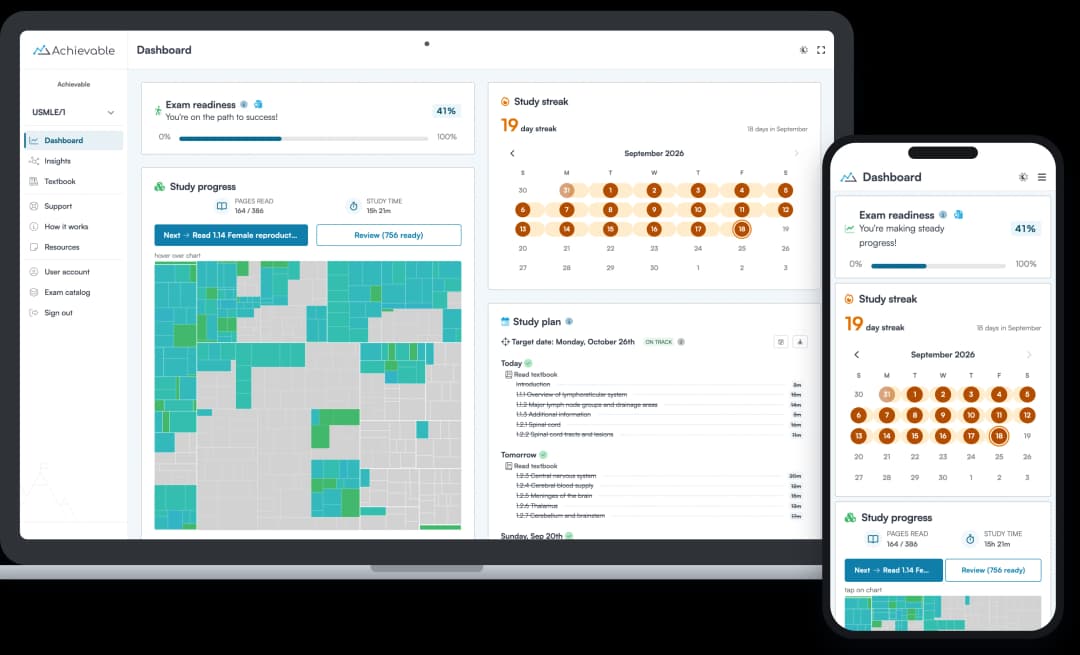
For most students who fail Step 1, the answer isn’t a new question bank. Keep a clinical-vignette bank and NBME’s self-assessments as the backbone of your retake, but don’t reset a bank you’ve finished and work through answers you half remember. Read your score report first. If it shows content gaps, replace passive video rewatching with an active-recall review of all the material, such as Achievable USMLE Step 1: $179 for a year, with 11 subjects in about 26 hours of narrated reading and 1,400+ review questions that come back on spaced repetition until the facts stick. If the problem was question technique or stamina, change how you practice rather than what you study from.
You have room to do this properly. The USMLE allows four attempts at each Step, and a failed attempt stays on the transcript that residency programs receive, so the goal is a retake you pass, not the earliest date you can book.
Start with your score report
Only failing examinees get content feedback on Step 1: a passing report gives no performance feedback at all. A failing report shows two things, explained on the USMLE’s score report FAQ:
- How far below the line you were. A chart places your performance against the minimum passing score.
- How you did in each content area. Every area is marked "Lower", "Same" or "Higher" compared with examinees who had a low-pass, which the USMLE defines as "performance that is above but near the passing standard." Each area also shows its share of the exam’s items.
The content areas come in three groups, which match the Step 1 content outline: physician tasks (applying foundational science, diagnosis, communication, practice-based learning), systems, and disciplines. The disciplines carry the most weight. Pathology is 45 to 55% of the exam and physiology 30 to 40%, with pharmacology, microbiology, and gross anatomy and embryology at 10 to 20% each (questions count toward several disciplines at once, so the shares add up to more than 100%). The systems are spread more evenly:
System | Share of Step 1 |
|---|---|
Reproductive and endocrine systems | 12–16% |
Respiratory and renal/urinary systems | 11–15% |
Behavioral health and nervous systems/special senses | 10–14% |
Blood and lymphoreticular/immune systems | 9–13% |
Musculoskeletal, skin and subcutaneous tissue | 8–12% |
Multisystem processes and disorders | 8–12% |
Cardiovascular system | 7–11% |
Gastrointestinal system | 6–10% |
Social sciences: communication and interpersonal skills | 6–9% |
Biostatistics and epidemiology/population health | 4–6% |
Human development | 1–3% |
Read your report in three passes:
- The gap. A result close to the passing line usually means a few weak areas and a plan that ran out of time. A result far below it means the foundations need rebuilding.
- The big areas. A "Lower" in pathology or physiology costs far more than a "Lower" in human development. Rank your weak areas by their share of the exam, not by how bad they look.
- Narrow or broad. Two or three "Lower" boxes point to gaps you can close. "Lower" across most of the report points to how you studied, or what you studied with.
Don’t plan to study only your weak areas, though. The USMLE’s own advice to failing examinees is to review every content area, weighting each by its share of the exam and your relative performance: "Remediation strategies focused solely on relatively weak areas of performance are unlikely to be the most effective for failing examinees." Step 1 questions mix disciplines and systems, so a weak area tends to show up inside questions you thought were about something else. Our Step 1 exam guide shows a failing report section by section.
Decide which problem you had
Most failing results come from one of three problems, and many from more than one. Each has a different fix.
Content gaps
- "Lower" in several systems, or in pathology or physiology.
- Your question bank percentage stayed low, and you were reading explanations as new information rather than as reminders.
- You recognize a topic when a video or a textbook explains it, but you can’t explain the mechanism yourself.
- Your NBME self-assessments never reached a high estimated probability of passing.
Question technique
- You know the facts when asked directly, but miss them inside a clinical vignette.
- You often narrow a question to two answers and pick the wrong one.
- You misread what the question asks: the next step instead of the diagnosis, or the mechanism instead of the drug.
- Your report shows "Lower" scattered across areas you know you studied.
Stamina and timing
- You ran short of time in blocks, or your accuracy fell in the second half of the day.
- You never sat a full-day practice exam under test conditions.
- Step 1 is one 8-hour session of fourteen 30-minute blocks, with no more than 20 questions in each block and at least 55 minutes of break time (USMLE). Practice that never looked like that won’t have prepared you for it.
If you had more than one, fix them in that order: content first, then technique, then stamina. Technique practice on material you don’t know yet turns into memorizing answers.
What to keep
Your question bank, if it still has questions you haven’t seen. If you didn’t finish your bank, finish it: questions you haven’t seen are worth more than anything new you could buy. If you did finish it, don’t reset it and go round again. A reset brings back questions whose answers you remember, so your percentage climbs without telling you whether you’re ready. UWorld’s 180-day and longer plans include a one-time reset, and its renewals only extend your time: in UWorld’s words, a renewal "will not start the subscription over, provide a reset, or grant access to additional questions." For new vignettes, add a bank you haven’t used (below).
NBME’s self-assessments. The Comprehensive Basic Science Self-Assessment comes in seven forms, from $62 each, and each gives your estimated probability of passing Step 1 if you test within a week. Save the forms you haven’t taken for the retake: NBME’s guidance on the self-assessments says results from a form you’ve taken before, or one taken self-paced or with resources open, are less reliable. It also says what a probability means: a 90% estimate "still means that among examinees with comparable performance, approximately 1 in 10 would be expected not to pass."
The free official sample questions. The USMLE’s Step 1 sample test questions, which students call the Free 120, are the closest you’ll get to the real exam’s style. Keep them for the last week, in the interactive version. Our Free 120 guide covers how to use them.
What to switch or add
Match the change to the problem your report shows:
Problem | What it looks like | What to switch or add |
|---|---|---|
Content gaps | "Lower" in several systems, or in pathology or physiology | Achievable USMLE Step 1, to relearn every subject with active recall ($179 a year). For a second explanation of one topic: Pathoma for pathology, or Boards & Beyond’s or Bootcamp’s videos |
Question technique | You know the facts but miss them inside vignettes | Keep your bank and change how you review it. If you’ve seen every question in it, add one you haven’t used, such as AMBOSS or Bootcamp |
Stamina and timing | Accuracy falls late in the day; no full-day practice | Full-day simulations with NBME forms and the free sample questions; UWorld’s self-assessments once you’ve used NBME’s |
Achievable costs $179 for a full year, less than UWorld’s 30-day question bank on its own ($349), and covers all 11 subjects with every page narrated and review questions that come back until you remember the answer. It’s a review course, not a vignette bank, so it goes beside your bank rather than replacing it.
If content was the problem: switch to active recall
Rewatching a lecture feels like studying, but it asks nothing of you. Answering a question from memory shows you exactly what you know and what you don’t. For a retake that has to cover every content area, that is the change that matters most.
Achievable USMLE Step 1 is built that way. It’s a review course written for Step 1 alone:
- 11 subjects in about 26 hours of reading, every page narrated, with 25 short videos.
- 1,400+ review questions that come back on a spaced-repetition schedule until the facts stick.
- An adaptive study planner.
- $179 for a full year of access, one payment, so a retake date that moves doesn’t cost you another course. The first lessons are free, with no credit card needed.
- A full refund within 7 days of purchase, for any reason.
Its review questions are short recall questions, not clinical vignettes, so Achievable sits beside your question bank rather than replacing it: learn or relearn a subject in Achievable, then apply it in the bank. Nicholas Flint, co-founder of AnKing, put it this way: "Very efficient…gets right to the point without giving you extra details."
Other content resources each do part of the job. Pathoma ($84.95 for three months of video with its textbook, or $99.95 for twelve) is a strong second explanation of pathology, but it covers pathology only and has no questions. Boards & Beyond, now sold by McGraw Hill, is a video library across the Step 1 subjects with linked questions, and its FAQ says digital sales are final, so there’s no refund if it doesn’t suit you. Bootcamp ($349 a year at list price) puts a video behind each of its 2,500+ bank questions, and Sketchy ($349.99 for six months), best known for microbiology and pharmacology, teaches through memory-association pictures. All of them teach mainly by video, so if rewatching is what failed you, use them for the one topic that needs a second explanation, not as the whole plan.
If question technique was the problem: change how you use the bank
Once you’ve reviewed a system, do its questions timed and mixed, and spend longer reviewing a block than doing it. For each miss, note why: you didn’t know the fact, you knew it but didn’t connect it to the vignette, or you misread the question. The first kind goes back to your content review; the other two are technique, and they shrink with this kind of review.
If you’ve used every question in your bank, add a fresh one rather than resetting. AMBOSS has 2,840+ Step 1 questions, a 5-day free trial and a 30-day money-back guarantee, though its $19.99-a-month membership includes only 50 bank questions a month and unlimited access costs more. Bootcamp has 2,500+, with a refund on its one- and two-year plans if you fail after meeting both of its Pass Targets: an overall score, and how much of its bank you’ve completed. Once you’ve used NBME’s forms, UWorld’s three self-assessments ($50 a form, or $120 for all three) add more scored practice.
If stamina was the problem: practice full days
Build up to the real day. Do blocks of 20 questions in 30 minutes, then several blocks back to back, then at least one full-day simulation: NBME forms and the free sample questions in timed blocks, with your breaks taken the way you’ll take them on test day.
A sample 10-week retake schedule
Ten weeks suits a retake whose report shows "Lower" in several areas. With a narrow gap, compress the content weeks; with "Lower" across most of the report, stretch them.
Weeks | Focus | Practice |
|---|---|---|
1 | Diagnose: rank your "Lower" areas by their share of the exam, and register for the retake | One unused NBME form, standard-paced, as your baseline |
2–5 | Rebuild content: every subject in Achievable, the biggest and weakest areas first | Daily spaced-repetition review questions; your bank in tutor mode on each system right after you review it |
6–8 | Apply: timed, mixed 20-question blocks | Two to four timed blocks a day, every explanation read; an NBME form every one to two weeks |
9 | Simulate the real day | One full-day practice under test conditions; relearn any topic you miss twice |
10 | Confirm and rest | A final NBME form, the free sample questions in the interactive version, then light review |
Don’t sit the exam on a single good result. Aim for 100% readiness: an NBME estimated probability of passing that stays high across several forms, not one form that came back high. Where a form’s lookup table gives a three-digit equivalent, aim for about 10 points above the 196 passing standard, repeatedly. If you aren’t there, move the date. The USMLE’s Bulletin says you shouldn’t feel compelled to test when you’re unprepared, and an eligibility period can be extended once.
Retake rules to know
All of these come from the USMLE’s eligibility rules and common questions, read in November 2026:
- Four attempts per Step. Incomplete attempts count. After four attempts at a Step without a pass, you can’t apply for any Step.
- Three attempts in 12 months at most. A fourth attempt must be at least 12 months after your first and at least 6 months after your most recent. Beyond these, the USMLE states no minimum wait between attempts.
- A new registration and fee. You apply again and pay again: the Step 1 fee is $695 for students and graduates of US and Canadian schools, for both 2026 and 2027 (NBME). You then test within a three-month eligibility period, which can be extended once by three months for $70.
- Results in about four weeks. Results are typically available within four weeks of your test date, though the USMLE says to allow eight (results and scoring).
- Your transcript shows every attempt. The USMLE transcript includes "your complete examination history," and it is the record residency programs receive. The performance profile on your score report isn’t on it.
- You can’t retake a passed Step to improve on it, except to meet a licensing authority’s time limit.
Common questions
How many times can you take Step 1? Four times. Incomplete attempts count, and after four attempts without a pass you can’t apply for any Step.
How soon can I retake Step 1? The USMLE states no minimum wait before a second or third attempt, only the limit of three attempts in 12 months. In practice, you register again, get a new three-month eligibility period and book a date within it. Book for when your NBME forms say you’re ready, not for the earliest date.
Will residency programs see that I failed? Yes. Your USMLE transcript shows your complete examination history, failed attempts included, and programs receive it through their application service.
Does Achievable have a pass guarantee for Step 1? No. Achievable’s Step 1 course has no full-length practice exam to qualify for a pass guarantee, so it carries a different promise: a full refund within 7 days of purchase, for any reason. That applies whether or not you’ve taken Step 1 before.
Should I switch from UWorld to AMBOSS? If your report showed content gaps, start with a content review such as Achievable, because a new bank won’t fix them. Then switch banks only if you’ve used every UWorld question. Questions you haven’t seen matter more than whose they are, so finish UWorld if you have questions left. If you’ve done them all, AMBOSS (2,840+ Step 1 questions) gives you a full bank you haven’t seen, where a UWorld reset would bring back answers you remember.
Should I take Step 2 CK before retaking Step 1? The USMLE lets you take Step 1 and Step 2 CK in either order, and you need both before Step 3. Your school may set its own rules about the order, so check with it before you change your plan.
How much does a Step 1 retake cost? The exam fee again ($695 for students and graduates of US and Canadian schools in 2026 and 2027), plus whatever you add to your prep. If your bank and NBME forms are still current, the content review may be the only new cost.
Key takeaways
- Read your failing score report by area, weighted by each area’s share of the exam, and still plan to review everything, as the USMLE advises.
- Work out whether the problem was content, question technique or stamina, and fix them in that order.
- Fix content gaps with active recall, such as Achievable’s narrated Step 1 review with 1,400+ spaced-repetition review questions ($179 a year), not by rewatching videos.
- Keep your question bank and NBME’s self-assessments as the backbone; don’t reset a finished bank and memorize.
- You get four attempts per Step, at most three in 12 months, and every attempt stays on your transcript, so book the retake when your practice says you’re ready.