How to raise your ACT score from 21 to 28, and which prep gets you there


Going from a 21 to a 28 on the ACT means climbing from the 68th percentile to the 91st, and on ACT’s own practice test it takes about 22 more right answers across English, Math and Reading if each section moves from a 21 to a 28. That is far more than the 1.1 points ACT reports as the average gain for students who retest, so it takes a plan: diagnose with a full-length timed test, put most of your hours into the section furthest from a 28, and keep taking timed full-length tests until your scores sit comfortably above 28, again and again.
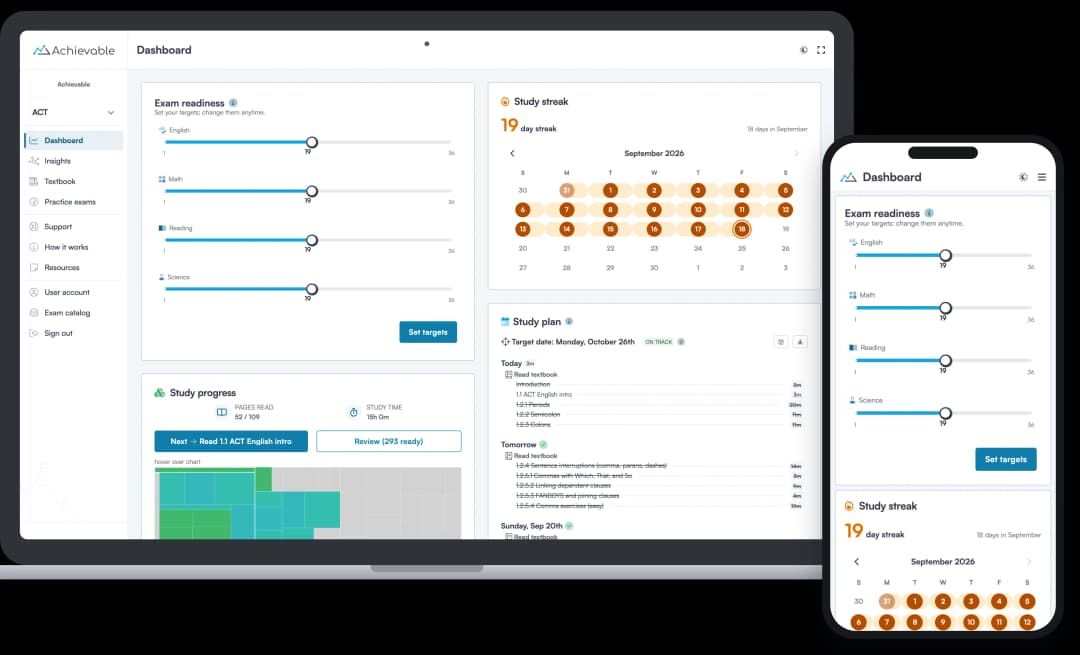
Achievable’s ACT course gives you each step of that plan for $99 with a full year of access: 4 full-length practice ACTs timed section by section like the real test, with a fresh Math section on every one, plus scoring for 14 official ACT practice tests (10 of them in the pre-2025 format), 1,500+ practice questions with explanations, and an adaptive study plan and AI tutor. From a 21, its score guarantee covers 5 more points, to a 26, or your money back, when you send your official ACT score report within 7 days of buying and retest during your year of access. No course we compared guarantees the full 7 points from a 21, so choose a course for the work it helps you do, not for the promise alone.
What a 21 and a 28 mean
ACT’s national ranks for the 2026–2027 reporting year (September 2026 through August 2027), based on ACT-tested high school graduates of 2024 to 2026, put a composite of 21 at the 68th percentile and a 28 at the 91st. A 28 means you scored as high as or higher than 91% of recent test takers. The national average composite for the class of 2026 was 19.2.
Score | Composite | English | Math | Reading |
|---|---|---|---|---|
21 | 68th | 70th | 71st | 61st |
26 | 86th | 87th | 88th | 81st |
28 | 91st | 90th | 93rd | 85th |
Since the Enhanced ACT, your composite is the average of three scores, English, Math and Reading, rounded to the nearest whole number, with a half rounding up (ACT’s scores page). Science and the Writing essay are optional and don’t count. So a composite of 21 means your three section scores add up to 62, 63 or 64, and a 28 needs them to add up to at least 83.
That is about 20 more scale points across three sections, and they don’t have to be spread evenly. A 30 in English, a 28 in Math and a 25 in Reading add up to 83, a composite of 28. For what each score range means for college admissions, see What’s a good ACT score?
Where the points come from, section by section
ACT’s scoring key for its first Enhanced ACT online practice test shows how many more right answers each section takes. Each section also includes unscored field-test questions you can’t pick out, so fewer questions count than you answer:
Section | Scored questions | Right for a 21 | Right for a 28 | More needed |
|---|---|---|---|---|
English | 40 of 50 | 26 | 34 | 8 |
Math | 41 of 45 | 22 | 30 | 8 |
Reading | 27 of 36 | 16 | 22 | 6 |
That is 22 more right answers out of 108 scored questions if every section climbs evenly. An uneven path can take fewer, because some steps on the scale are bigger than others: in Reading, each right answer from 21 to 25 correct adds 2 scale points on this key. Conversion tables vary a little from one test form to the next, so treat these as close, not exact. Achievable’s ACT score calculator turns your number right into scale scores with the same table.
English: rules that repeat
English is 50 questions in 35 minutes. ACT reports it in three categories: Production of Writing, Knowledge of Language and Conventions of Standard English. The conventions questions (punctuation, sentence structure and usage) test the same rules on every form, so each rule you learn pays off on every test. Sort your misses by the rule they test, learn the rule, then drill it until you spot it at a glance.
Math: content first
Math is 45 questions in 50 minutes, about a minute each. When a miss comes from a topic you don’t know, no timing trick earns it back. List the topics behind your misses, learn them one at a time, and practice each on new problems until you get them right. Achievable’s Math quizzes are generated from 150+ question templates with new numbers and wording each time, so you practice the skill rather than a remembered answer.
Reading: fewer questions, bigger steps
Reading is 36 questions in 40 minutes, with 27 of them scored, so each right answer moves your scale score further than in the other sections: on ACT’s practice test, 6 more right answers take a 21 to a 28. Reading has no content to memorize, so the work is method and timing. Practice whole passages under time, and for every miss, find the line in the passage that proves the right answer, then note whether you misread the question or ran short of time.
Science: optional
Science doesn’t count toward the composite, so for a 28 composite, put your hours into English, Math and Reading. Take it if a college or scholarship you’re applying to asks for it, or if you want ACT’s STEM score, the average of Math and Science.
An 8 to 12 week plan
ACT says the skills it tests aren’t built quickly: “only sustained instruction in the subject-matter areas tested is likely to be effective,” and “last-minute academic preparation is not advised” (the ACT User Handbook). Plan on 8 to 12 weeks at about 6 to 10 hours a week, and allow longer if your diagnostic shows big gaps in more than one section.
Weeks | Focus | What to do |
|---|---|---|
1 | Diagnose | Take a full-length timed test: one of Achievable’s practice ACTs or one of ACT’s free official tests. Score it, then sort each miss: didn’t know it, misread it, or ran out of time. |
2 to 5 | Your weakest section | Learn the content behind your misses in the section furthest from a 28. Take one timed section a week to see it move. |
6 to 8 | The other two | Do the same for the other two sections, with a short timed set from your first section each week so it holds. |
9 to 12 | Full-length tests | Take a full-length timed test each week, and review every miss before the next one. |
On 8 weeks, give the weakest section weeks 2 to 4, the other two weeks 5 and 6, and full-length tests weeks 7 and 8.
You’re ready when your full-length practice scores sit comfortably above 28, consistently, across several tests. One 28 can come from a friendly form or a good day; several scores above your target mean test day doesn’t depend on the luck of the draw. Achievable’s 4 practice ACTs, plus scoring for 14 official ACT practice tests (you take them from ACT’s booklets and enter your answers; 10 are in the pre-2025 format), let you check it on up to 18 full-length tests. If you aren’t there by your test date, move the test rather than hope.
Pick a test date at the end of your plan, and know the one after it. The ACT costs $70 for English, Math and Reading. You can’t retake a single section, but if you test more than once, ACT reports a superscore, the average of your highest English, Math and Reading scores across all your test dates, and many colleges use it. A 28 can come from your best sections over two sittings.
Choosing a course for a 21-to-28 gap
A 7-point gain is more than any course we compared guarantees from a 21. Here is what each one promises from that starting score, with its price and full-length practice tests, all read on the provider’s own site:
Course | Price and access | Full-length practice tests | Guarantee from a 21 |
|---|---|---|---|
Achievable | $99, 12 months | 4 written for the course, each with a fresh Math section, plus scoring for 14 official tests | +5, to a 26, or a full refund |
Magoosh Premium | $129, 12 months | Up to 34 official ACT tests | +4, to a 25, or a full refund |
Acely | $297 for the 3 months its guarantee needs | 20, with official ACT questions | +5, to a 26, or those 3 months’ fees back |
PrepScholar Complete Online | $397, 12 months | 4 official ACT tests | +4, to a 25, or a full refund |
Princeton Review Self-Paced | $299, 365 days | 5 in the Enhanced ACT format | Any higher score, or tuition back less materials fees |
UWorld | $299 for 30 days to $449 for 360 | 1 mock exam | None |
Achievable is self-paced, with no live classes. If you need a teacher and a schedule, the live courses that guarantee points from a 21 cost far more:
Live course | Price and length | Full-length practice tests | Guarantee from a 21 |
|---|---|---|---|
Prep Expert 6-Week Flagship | $1,196 for 72 hours over 6 weeks | 6 simulated exams | +4, to a 25, or a full refund |
Princeton Review ACT 31+ | $2,199 for 36 live hours | 5 in the Enhanced ACT format | +5, to a 26: tuition back (less materials fees) under +3, half for +3 or +4 |
These are list prices; several providers run holiday and coupon sales. Per guaranteed point from a 21, that is $19.80 with Achievable ($99 for 5 points), $32.25 with Magoosh, $59.40 with Acely, $99.25 with PrepScholar, $299 with Prep Expert’s Flagship and $439.80 with Princeton Review’s 31+ course.
What each guarantee asks of you matters as much as the points:
- Achievable: +6 points for a starting score below 20, +5 for 20 to 24 and +4 for 25 to 29, or your money back. Send Achievable the score report from an official ACT taken in the 5 years before you buy, within 7 days of buying, then retake the ACT while your year of access is active. If your new score hasn’t risen by the points guaranteed for your starting score, email its score report and a valid ID within 31 days of the test, and Achievable refunds the course in full. There is no minimum study time and no chapter to finish, and the course can also be refunded in full within 7 days of purchase, for any reason.
- Magoosh: you must have taken the ACT in the last five years and send that score report when you sign up. On its $399 On-Demand Classes plan, only the class portion is refunded.
- Acely: an official ACT of 26 or lower from the 3 months before you buy, sent in your first week; 3 months of continuous paid subscription; 500 ACT questions and 10 or more full-length Acely tests with every mistake corrected; the account used by the student alone; and a retest within 60 days of the subscription ending (only the first official ACT counts), with a claim within 30 days of that test.
- PrepScholar: an official ACT or PreACT score from the 4 years before you sign up; every assigned lesson passed (mastered, or repeated until it’s no longer assigned, with up to 10 paused) and every assigned practice test finished; the first official ACT within 60 days of finishing the course, or on the next test date after that; and a refund request within 360 days of purchase, with ACT sending the score report to PrepScholar. One refund per household.
- Princeton Review: the Self-Paced course needs its dashboard coursework and at least 4 timed practice tests finished, an ACT before your access ends and a claim within 60 days. The 31+ course needs all 36 live hours, all homework and 4 timed practice tests, an ACT on or before the course’s recommended test date and a claim within 60 days; a gain of 5 or more meets its guarantee, and students starting at 31 or higher aren’t covered.
- Prep Expert: the Flagship needs at least 10 of its 12 classes (80% of each class, answering 80% of the polls), 18 of 20 homework assignments and all 6 practice tests on time, each with the Writing essay, every installment paid, and the first official ACT within 60 days of the last class.
Achievable has the lowest price of any course here, and its guarantee of 5 points from a 21 needs no minimum study time. Its practice ACTs are written for the course, so you can’t have met them in school or in ACT’s Official Guide, and each one draws a fresh Math section; official tests are ACT’s published forms, which every course that licenses them shares and which you may already have taken. A full year of access covers a retake, and the adaptive study plan and AI tutor keep you on the skills that move your score. Prep Expert’s Flagship and Princeton Review’s 31+ course add live classes, at more than ten times Achievable’s price. Our comparison of the best ACT prep courses weighs each in more depth.
ACT’s four free official practice tests are the best final check before test day, and our guide to free ACT practice tests links each one. They’re tests, not teaching, so they show where your points are but don’t teach the content behind your misses.
Frequently asked questions
Is going from a 21 to a 28 on the ACT realistic? It’s a big goal, not a typical result. ACT reports that the class of 2026’s retesters gained 1.1 composite points on average between their first and most recent tests (ACT’s 2026 graduating class report). Plan for weeks of work on the content you miss, with timed practice, rather than counting on a retest alone, and judge your progress by full-length scores every week or two.
How many more questions do I need to get right for a 28? About 22 more across English, Math and Reading on ACT’s first Enhanced ACT practice test, if each section moves from 21 to 28: 8 more in English, 8 more in Math and 6 more in Reading. A path that leans on your strongest section can take fewer, and the exact numbers vary a little with each test form.
What percentile is a 28 on the ACT? On ACT’s ranks for the 2026–2027 reporting year, a composite of 28 is the 91st percentile and a 21 is the 68th.
Does Achievable’s score guarantee cover a 21 to a 28? Not the whole gain. From a starting score of 20 to 24, it covers 5 more points, so from a 21, a 26, or your money back. Send Achievable your official ACT score report within 7 days of buying, retake the ACT during your year of access, and if you haven’t gained 5 points, email the new score report and a valid ID within 31 days of the test for a full refund. There is no minimum study time.
Do I need a 28 in every section? No. The composite is the average of English, Math and Reading, so section scores that add up to 83 or more make at least a 28, such as a 30, a 28 and a 25.
Do colleges superscore the ACT? Many do. ACT calculates a superscore for any student who has tested more than once, from the highest English, Math and Reading scores across test dates, and you choose whether to send it. Check each college’s testing policy before you plan on it.
Key takeaways
- A 21 is the 68th percentile and a 28 the 91st, and on ACT’s practice test the gap is about 22 more right answers if every section moves from 21 to 28: 8 in English, 8 in Math and 6 in Reading.
- The composite averages English, Math and Reading, so section scores that add up to 83 or more make at least a 28; Science doesn’t count.
- Diagnose with a full-length timed test, work the section furthest from a 28 first, and take full-length tests until your scores sit comfortably above 28, consistently.
- Achievable gives you 4 practice ACTs, scoring for 14 official ACT practice tests, 1,500+ practice questions with explanations and a full year of access for $99, with a guarantee of 5 more points from a 21, or your money back, when you send your score report within 7 days of buying and retest during your year of access.
- No course we compared guarantees 7 points from a 21, so choose the course that fits how you study, and check what its guarantee asks of you.