

ACT
study guide
Every chapter of the course summarized, with each section linked to its lesson.
Reach your target score
Try Achievable ACT
No credit card required
This free ACT study guide summarizes all 5 chapters of Achievable's ACT course: what each covers, the points to remember, and its 107 sections in order. Read each chapter after you study it, or work through the whole guide before exam day.
Each section links to its full lesson in Achievable, with the review quizzes and full-length practice exams.
Chapter 1: ACT English
34 sections
- Section overview: The ACT English section has 50 passage-based questions, takes 35 minutes, and averages about 42 seconds per question.
- English content balance: Conventions of Standard English makes up 52-55% of the section, Production of Writing makes up 29-32%, and Knowledge of Language makes up 15-17%.
- Standard English focus: Conventions of Standard English tests grammar mechanics, including punctuation, sentence structure, and usage.
- Punctuation basics: A complete sentence needs a subject, a verb, and a complete thought, and semicolons and colons must connect clauses correctly.
- Comma and apostrophe rules: Commas mark interruptions, clauses, appositives, and some dependent-clause links, while apostrophes show possession or contractions, including the difference between it's and its.
- Usage and agreement: Conventions of usage include parts of speech, commonly confused words, subject-verb agreement, verb tense, a vs. an, adjective weight, pronoun-antecedent agreement, and misplaced modifiers.
- Structure and organization: Sentence structure questions test comma splices and fragments, while organization, unity, and cohesion test parallelism, transitions, transition sentences, text placement, and idea cohesion.
- Language and style: Knowledge of Language rewards concise, clear choices, careful vocabulary decisions, and rhetorical style answers that require multiple readings and strong annotation.
In this chapter
- ACT English introFree
- Punctuation
- Conventions of usage
- Sentence structure
- Organization, unity, cohesion
- Topic development
- Knowledge of language
Start this chapter free
Chapter 2: ACT Math
47 sections
- ACT math setup: The section has 45 questions in 50 minutes, calculator use is allowed, and questions generally increase in difficulty throughout the section.
- Time management strategy: Follow a consistent step-by-step process, move on quickly if stuck, and make educated guesses because unanswered questions are incorrect and there is no penalty for incorrect answers.
- Word problem reading: Quickly annotate and translate word problems, noting important numbers, units, and key wording so you can connect facts to relevant formulas or math topics.
- Pre-algebra essentials: Use PEDMAS, remember absolute value makes the final result non-negative, and know how fractions, percentages, ratios, proportions, decimals, scientific notation, and unit conversions relate.
- Elementary algebra skills: Combine like terms, use exponent rules, isolate variables with opposite operations, and work with GCF, LCM, linear equations, sequences, and basic probability.
- Intermediate algebra methods: Convert words to equations, use logarithm rules, prime factorization, radicals, systems of equations, quadratics, counting, percent change, expected value, complex numbers, matrices, and summary statistics.
- Geometry and coordinates: Know area, perimeter, circle, triangle, rhombus, conic section, parallel line, vector, domain and range, vertex form, and line formulas, including how to find slope, midpoint, distance, and intersections.
- Trigonometry basics: Use SOH CAH TOA with theta, solve right triangles with trig or inverse trig, and remember sine, cosine, tangent, amplitude, period, and .
In this chapter
- ACT math intro
- Pre-algebra
- Elementary algebra
- Intermediate algebra
- Essential modeling
- Properties of logarithms
- Prime factorization
- Radicals and rational exponents
- Solving a system of equations
- Factorization of quadratics and cubics
- Solving quadratic equations
- Counting problems, permutations, and combinations
- Percent change
- Expected value of x
- Imaginary and complex numbers
- Matrix multiplication
- Summary statisticsFree
- Plane geometry
- Coordinate geometry
- Trigonometry
Study this chapter in Achievable
Chapter 3: ACT Reading
8 sections
- Section overview: ACT Reading has 4 passages and 36 multiple-choice questions in 40 minutes, and the passages include articles or short stories.
- Passage order: The four passage types are literary narrative, social science, humanities, and natural science, and they appear in that order every time.
- Annotation focus: Circle names, box dates, jagged underline locations, and use parentheses or brackets for relevant information.
- Question patterns: Most questions are key ideas and details, followed by craft and structure, then integration of knowledge and ideas.
- Time and traps: Use time effectively, answer the question in your own words, and watch for familiar language, extreme language, and irrelevant information.
Study this chapter in Achievable
Achievable ACT
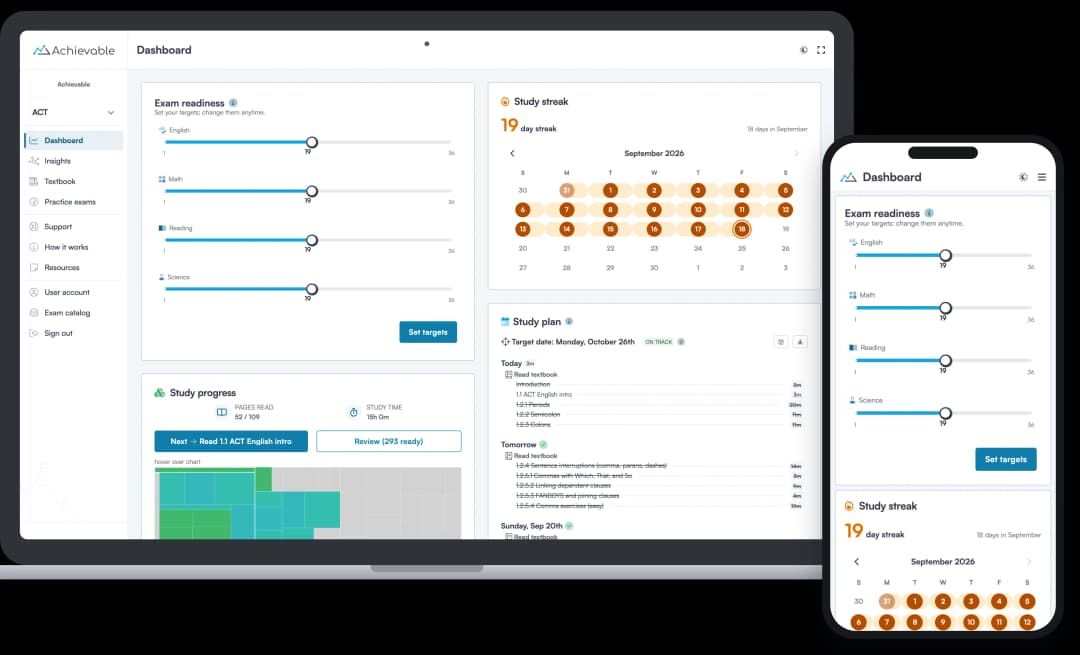
Get ACT test prep built for today's learners - mobile, guided, and personalized. Reach your target ACT score with our powerful online self-study course and practice questions for math, English, science, reading, and writing.
Easy-to-understand online textbook
1,000+ chapter quiz questions
3+ practice exams
Chapter 4: ACT Science
12 sections
- Test structure: The ACT Science test has 40 questions in 40 minutes, is optional as of the 2025 ACT format, usually has 6 passages, and focuses on finding and interpreting information in passages.
- Passage types: Research summaries, data representation, and conflicting viewpoints ask you to interpret study results, analyze graphs and tables, and compare multiple perspectives on a topic.
- Science topics: Biology, Chemistry, Earth/Space Science, and Physics are covered, with emphasis on biology and chemistry knowledge and background info provided for Earth/space science and physics.
- General strategies: Focus on reading, interpreting, and analyzing info, annotate questions not passages, go directly to questions first, guess after eliminating wrong answers, and use all the info.
- Time management: Aim for 1 minute per question, about 6.5 minutes per passage or about 5 minutes if 7 passages, and actively monitor your pacing.
- Question types: Coupled answer, new claim, figure, trend, inference, and prior knowledge questions all use the problem-solving process, and “cannot be determined” can be a valid answer.
In this chapter
- Must-know science strategies
- Types of passages
- Types of questions
Study this chapter in Achievable
Chapter 5: ACT Writing
6 sections
- Section overview: The ACT Writing section is an optional argumentative essay, takes 40 minutes, and can affect the ELA subscore, course placement, or testing out of classes.
- Prompt and scoring: You respond to a prompt with three provided perspectives, develop your own perspective, and are scored 1-12 by two graders in ideas and analysis, development and support, organization, and language use.
- Audience and language: Consider your audience as you write, and use stories, precise word choice, varied clear sentence structure, strategic tone and voice, and clarity over complicated language.
- Essay structure: The introduction has a hook, relevance link, optional credibility statement, and thesis; body paragraphs have a topic sentence, relevance link, personal narrative, and counterargument; the conclusion restates the thesis, summarizes the main points, and ends with a closer sentence.
In this chapter
- Overview of the ACT Writing section
- ACT Writing Test scoring rubricFree
- Know your audience
- How to structure the ACT essay
Study this chapter in Achievable
ACT exam at a glance
- Time
- 2 hours and 5 minutes
- Exam fee
- $70 (+$25 for Writing, +$5 for Science)
More on the ACT exam
- ACT exam prep courseAchievable's course: online textbook, review quizzes and full-length practice exams.
- ACT exam format, content and scoringWhat's tested, how long it takes, what it costs, and the score you need to pass.
- Free ACT practice examPractice questions written to match the real thing, with an explanation for every answer.
- ACT FAQThe questions asked most about the exam and preparing for it, answered.
- Best ACT exam prep coursesHow the leading providers compare on content, format and price.
- ACT study resourcesGuides and study advice from Achievable's instructors.
Hit your target score
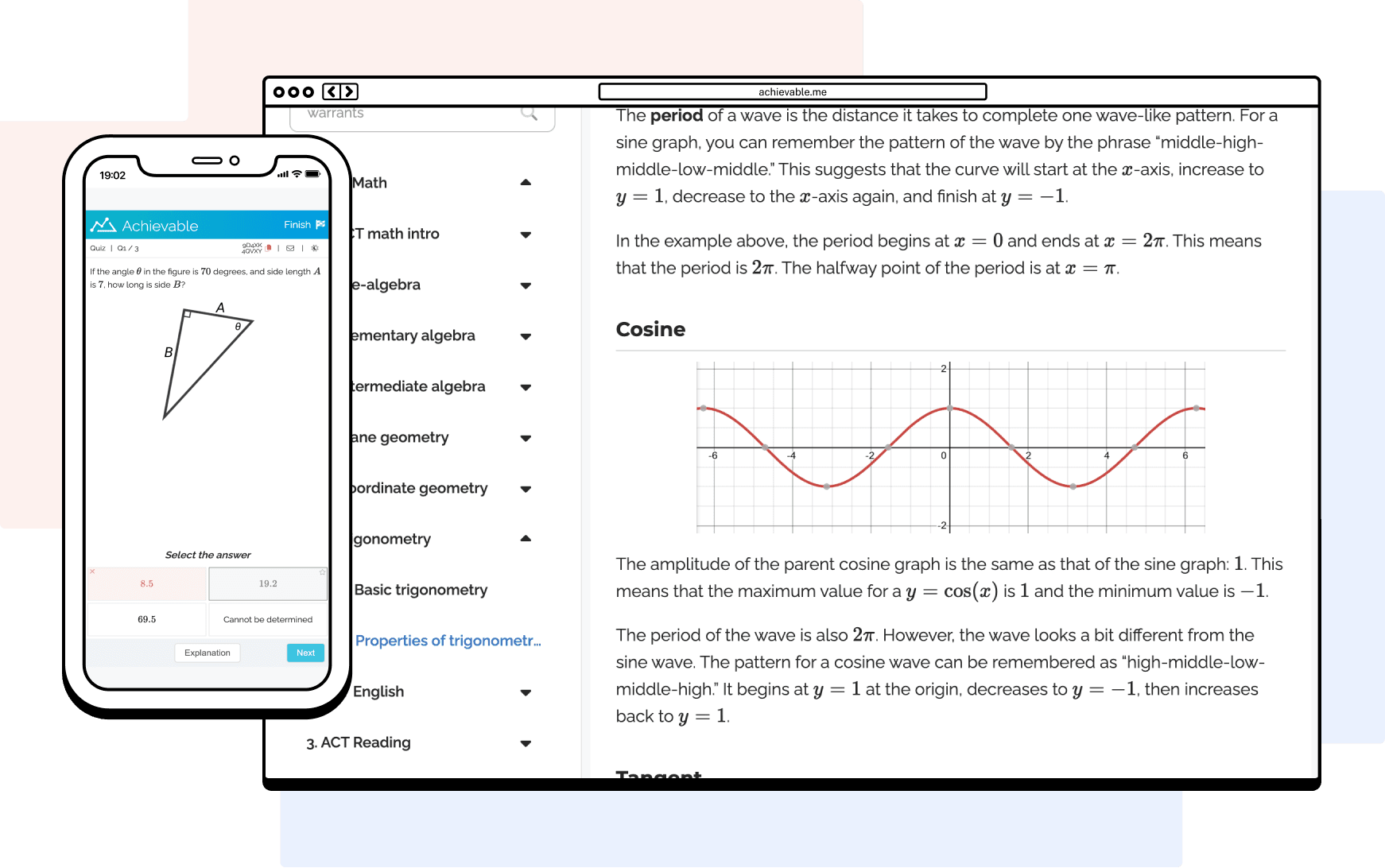
Achievable is the best online ACT exam prep course: effective, personalized, and convenient. With Achievable, you'll spend less time studying and hit your target score with confidence.