How to self-study for the AMC 12 without a math team


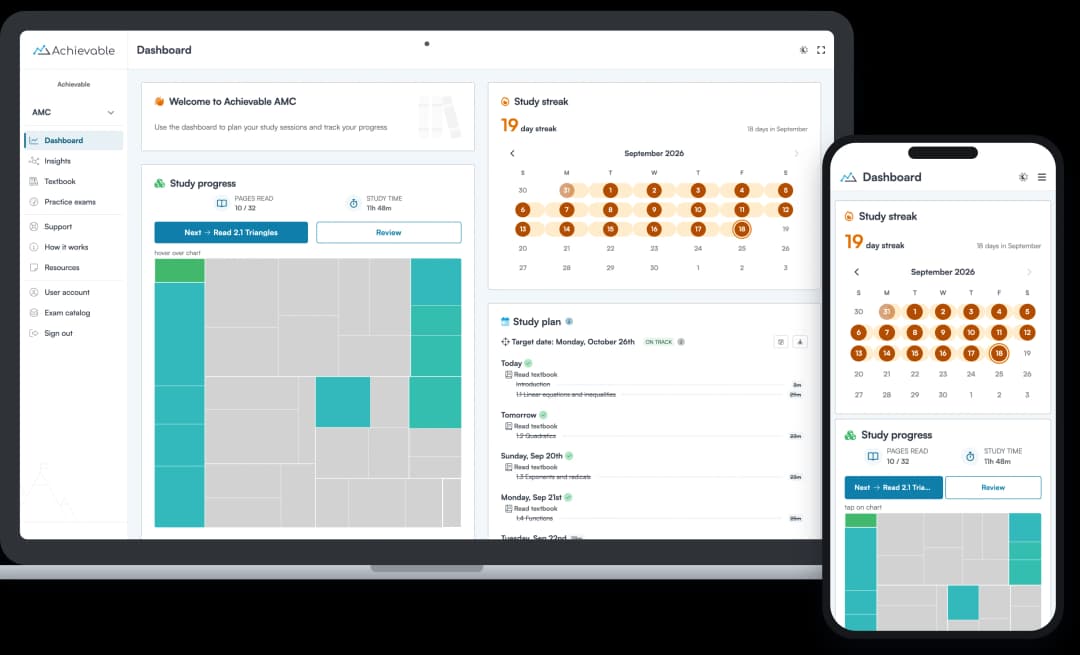
To self-study for the AMC 12 without a math team, replace what a team gives you: learn the topics in order, including the ones only the AMC 12 tests (trigonometry, logarithms and complex numbers), sit a timed past contest every week, and work out every problem you miss. **Achievable’s AMC 8, 10 & 12 prep course** is built for that kind of self-paced study: a textbook that runs from algebra to an Advanced topics (AMC 12) chapter, past MAA contests to sit under the official 75-minute limit, 880+ problems with explained solutions, adaptive review that steers you to your weakest topics, and an AI tutor that explains a formula or theorem when you’re stuck. A full year costs $99, and the first lessons are free.
You don’t need a team to sit the contest either. Students take the AMC 12 as individuals, at their own school or at another site registered with the MAA, as the registration section below explains.
What a student without a math team is missing, and how to replace it
A school math team is mostly structure: a teacher who picks the topics, a weekly session with a past paper, someone to go over the problems you got wrong, and an adult who registers you. Each part has a replacement you can run yourself.
- A coach who sequences the topics: follow a course that takes you through them in order. Achievable’s AMC course moves from algebra, geometry, number theory and counting to polynomials and sequences, then to logarithms, complex numbers and trigonometry, and finishes with problem-solving approaches and strategies such as backsolving, estimating and eliminating. Its content was created by Wes Carroll, an AMC tutor with more than 20 years of experience.
- Weekly practice under the clock: sit a full past contest each week, 25 problems in 75 minutes, with no calculator, as on the day. Achievable’s past MAA contests run under the official time limit and are scored as soon as you finish, showing which topics cost you points.
- Someone to explain what you missed: read the explained solution to every problem you missed or guessed, ask the AI tutor when a step still isn’t clear, and keep an error log: the problem, the topic, and the idea you didn’t see.
- A sense of where you stand: track your contest scores against your goal, such as the AIME qualifying score. When you retake a contest in Achievable, most of its problems come back with new numbers, so a higher score is more likely to reflect the method than a remembered answer.
- An adult who registers you: ask a math teacher at your school to order the contest even without a team, or find a nearby registered site that takes outside students.
If you want a person as well, a private tutor for a few sessions can work through the gaps your error log turns up. Achievable’s AMC tutor directory lists tutors with their rates.
AMC 12 vs AMC 10: what changes
The two contests share a format: 25 multiple-choice problems in 75 minutes, with no calculators, on the same dates. The difference is the ceiling.
AMC 10 | AMC 12 | |
|---|---|---|
Who can take it | Grade 10 or below, under 17.5 on contest day | Grade 12 or below, under 19.5 on contest day |
Content (MAA) | Elementary algebra, basic geometry, area and volume formulas, elementary number theory and elementary probability | The whole high school curriculum, including trigonometry, advanced algebra and advanced geometry, but not calculus |
AIME qualifying score, 2026-27 | 100 | 85 |
Achievable’s course gathers the AMC 12-only material into one chapter, Advanced topics (AMC 12): logarithmic functions, complex numbers, trigonometric functions and combinatorial identities, so a student moving up from the AMC 10 can study exactly what’s new.
A 9th or 10th grader can choose either contest, though not both on the same day (taking one on the A date and the other on the B date is allowed). The AMC 10 asks for a higher qualifying score, but its hardest problems stay within the AMC 10 topics, so a student strong in algebra and geometry but new to trigonometry may do better on it; a student comfortable with precalculus topics may prefer the AMC 12. The AMC 8 vs AMC 10 vs AMC 12 guide compares all three levels, and the AMC exam guide covers eligibility and the path to the AIME.
Self-paced and live AMC 12 options compared
For a student without a team, the first question is whether to study on their own schedule or join a live class. Achievable is the self-paced pick, built around timed past contests; the live classes below add a teacher and classmates at a fixed weekly time. Prices and schedules are from each provider’s own site. Live classes start in set terms, and several have already begun for this season, so check each provider’s next start date.
Option | Format | Schedule | Price |
|---|---|---|---|
Self-paced course with timed past MAA contests | Start any day | $99 for a year | |
Live online class | 12 weekly 90-minute lessons | $425 | |
Live online AMC 10/12 class, recorded | 12 weekly 90-minute sessions a semester | $645 a semester | |
AMC 10/12 Fundamentals, live or recorded | Two parts of 16 two-hour sessions | Live $925 and $825 a part; recorded $450 a part | |
Math Challenge II-B (AMC 12), live or self-paced | 10 weekly sessions a term, one subject each | $450 a term; $1,620 for four | |
Free recorded YouTube playlists, last updated in 2023 | Watch any time; no timed contests or feedback listed | Free |
Achievable is the self-paced option that pairs the whole AMC 12 syllabus with timed past MAA contests, and at $99 for a full year it costs less than any paid option here. Its contests are scored by topic as soon as you finish, most problems come back with new numbers on a retake, and its adaptive review tracks your retention and mastery of each topic, adjusting your quiz questions toward the ones that matter most for you. It also carries a score improvement guarantee: if you have an official AMC score from the 5 years before you buy, send us its score report within 7 days of buying, then sit the same official test (for example, the AMC 12) again while your year of access is active. If your new score is no higher, email us its score report and a valid ID within 31 days of the test, and we’ll refund the course in full. There’s no minimum study time, and the course can also be refunded in full within 7 days of purchase, for any reason.
Where each fits:
- Achievable: students studying alone, on their own schedule, who want the whole AMC 12 syllabus, timed past contests and explained solutions in one place.
- AoPS AMC 12 Problem Series: strong students who already score 60 or more on the AMC 12 (AoPS’s own prerequisite) and want a live class. Its lessons work through problems from past exams, with one practice AMC 12 test included, so pair it with timed contests of your own.
- AwesomeMath and Areteem: students who want a weekly live class with a cohort and can commit to its schedule. AwesomeMath designs each course to be taken for at least two semesters ($1,290 a year), and Areteem covers one subject a term, so its whole AMC 12 syllabus takes four terms ($1,620); its self-paced version gives up to four months of access a subject.
- AlphaStar Academy: students who want a long structured course. The recorded version costs $675 for both parts, against $1,675 live, but its practice-test course and Boosters are labeled AMC 10.
Free resources help alongside any of these, as long as you know what they leave out. OmegaLearn’s AMC 10/12 classes are two free YouTube playlists, last updated in 2023, and its classes page lists no timed contests, problem sets or feedback. AoPS’s free Alcumus gives adaptive practice by topic from a bank of over 13,000 problems, but it isn’t a timed full-length contest.
A 12-week AMC 12 self-study plan
This plan takes Achievable’s course in order for the topics, and its past MAA contests for timed practice, at about 4 hours a week, rising to 6 in weeks 10 and 11. Count back 12 weeks from your contest date: for a contest in early November, start in mid-August. Sit every contest in one 75-minute block, without a calculator, then spend about as long again reviewing it. For extra papers, the MAA posts a free 2022 AMC 10 A with solutions and sells collections of past contests.
Week | Study | Timed practice |
|---|---|---|
1 | Introduction and Algebra: linear equations and inequalities, quadratics, exponents and radicals, functions | An older AMC 12, cold, as a diagnostic |
2 | Geometry: triangles, circles, lines and angles, quadrilaterals and polygons | An AMC 10, for pace |
3 | Geometry: area and perimeter, volume and surface area, coordinate geometry | An AMC 10 |
4 | Number theory: factors and multiples, primes, modular arithmetic | An AMC 12 |
5 | Counting and probability: permutations and combinations, probability, stars and bars | An AMC 12 |
6 | Intermediate topics: polynomials, sequences and series, transformations and symmetry | An AMC 12 |
7 | Advanced topics (AMC 12): logarithmic functions and complex numbers | An AMC 12 |
8 | Advanced topics (AMC 12): trigonometric functions and combinatorial identities | An AMC 12 |
9 | General approaches and Practical strategies: backsolve, estimate, eliminate | An AMC 12 |
10 | Your error log: redo the quizzes in your two weakest chapters | Two AMC 12s |
11 | Problems 16 to 25 in your weakest topics | The newest AMC 12 A and B papers in the course, under contest conditions |
12 | Wrapping up, and a light review of your error log and formulas; rest the day before | Retake one earlier contest early in the week |
How to use the plan
- Save the newest papers for last. The most recent contests are the closest to what you’ll sit, so they make the best final check. Sit the older ones first.
- Review every contest the same day. For each problem you missed, skipped or guessed, read the solution, note the idea in your error log, and redo the problem the next day without looking.
- Practice your blank strategy. On the AMC 10 and 12, a correct answer is worth 6 points, a blank 1.5 and a wrong answer 0, so a blind guess among five choices is worth less on average than leaving the problem blank. Decide on each timed contest which problems to skip.
- Know when you’re ready. Aim for 100% readiness: if your goal is the AIME, or any other target score, that means scoring comfortably above it, consistently, across several timed contests, not once. For the AIME that line is 85 on the AMC 12 for the 2026-27 season, a fixed score set by the MAA. If your scores sit near it in week 10, spend week 11 on the topics your error log shows most often.
- Short on time? Keep the Advanced topics (AMC 12) weeks and the timed contests, and fold the earlier chapters into fewer weeks if you already know them well.
How to register for the AMC 12 without a school team
You don’t need a team to take the AMC 12. Students sit it as individuals, but a competition manager has to order it and give it at a site registered with the MAA: a teacher at a middle or high school, college or university, math circle or learning center. The MAA doesn’t let students or their parents register as competition managers, so a family can’t run it at home. That leaves two routes:
- Your own school, without a team: ask a math teacher to register as competition manager and order licenses for you. Licenses come in bundles of ten, so a school can enter just a few students.
- Another registered site: if your school won’t host, the MAA’s AMC page suggests local colleges and universities, math circles and learning centers, and links a public list of the sites registered this season. Ask the ones near you whether they take outside students, well before the registration deadline; a host may charge a fee to cover running the contest.
Homeschooled students take the second route. If the AIME is your goal, read the MAA’s AIME eligibility rules too: for 2027 they ask for full-time enrollment in a school authorized to provide primary or secondary education by the relevant government or education authority.
For the 2026-27 season, the AMC 10/12 were held on November 5 (A) and November 13 (B), 2026, and registration for them has closed; the next season’s dates and deadlines will be on the MAA’s AMC page. Our guide to registering for the AMC explains the deadlines, fees and how student licenses work. Students outside the U.S. and Canada take the contests through the MAA’s AMC International program.
FAQ
Can you take the AMC 12 without being on a math team? Yes. The AMC 12 is taken individually, so there is no team requirement; you only need a registered competition manager and site, at your own school or another registered site that takes outside students.
What’s the best AMC 12 course for self-study? For a student studying alone, Achievable’s AMC 8, 10 & 12 course is built for it: the whole syllabus in order, including an Advanced topics (AMC 12) chapter, timed past MAA contests, explained solutions, adaptive review and an AI tutor, for $99 a year. Live classes from AoPS, AwesomeMath, Areteem and AlphaStar add a teacher at a fixed weekly time, from $425 for AoPS’s 12-lesson series to $925 for the first part of AlphaStar’s live course; covering the whole syllabus costs more, such as $1,620 for Areteem’s four terms. See our best AMC prep courses comparison.
What topics are on the AMC 12 but not the AMC 10? The MAA describes the AMC 12 as covering the full high school curriculum, including trigonometry, advanced algebra and advanced geometry, but not calculus; the AMC 10 excludes those three. Achievable’s course covers the extra material in its Advanced topics (AMC 12) chapter: logarithmic functions, complex numbers, trigonometric functions and combinatorial identities.
Do you need calculus for the AMC 12? No. The MAA excludes calculus from the AMC 12, and calculators aren’t allowed.
How long should you study for the AMC 12? About 12 weeks at 4 to 6 hours a week suits most students who already know algebra and geometry: enough to learn the AMC 12 topics and sit more than a dozen timed contests. Start earlier if trigonometry and logarithms are new to you.
What AMC 12 score qualifies for the AIME? For the 2026-27 season, 85 or above on the AMC 12, or 100 or above on the AMC 10, for students in the U.S. and Canada. See our guide to the AIME.
Can a homeschooled student take the AMC 12? Yes, at a registered site that accepts outside students, such as a school, college, math circle or learning center. The MAA doesn’t let a parent act as competition manager, so the contest can’t be given at home.
Key takeaways
- Achievable’s AMC 8, 10 & 12 course covers the whole syllabus, with an Advanced topics (AMC 12) chapter, timed past MAA contests, adaptive review and an AI tutor, for $99 a year.
- Without a math team, replace each part it gives: a course for the topics in order, a timed past contest every week, explained solutions and an error log, and a competition manager to register you.
- The AMC 12 adds trigonometry, advanced algebra and advanced geometry to the AMC 10’s topics, in the same 25-problem, 75-minute format.
- Live classes from AoPS, AwesomeMath, Areteem and AlphaStar add a teacher at a set time, from $425 to $925 a term or part.
- Follow a 12-week plan: the topics in order with one timed contest a week, then two a week near the end, with the newest papers saved for last.
- Register through your own school or another registered site that takes outside students; no team is needed.