


Achievable logo

CSCS: Practical Applied practice exam

Studying for the CSCS? Scroll down to try 110 CSCS: Practical Applied practice exam questions for free.
Achievable white logo on blue background
Achievable blue logo on white background
Solve each of the CSCS practice test questions below to get a feel for what to expect on the actual CSCS exam. Achievable's free CSCS practice questions are scored instantly, providing the correct answer along with an easy to understand explanation. Get started on the path to passing the CSCS exam by solving 110 CSCS exam sample questions.
Question 1

Why is reliability critical in performance testing?

A.
So test results match athlete preferences
B.
So test scores are consistent across trials and testers
C.
To reduce the number of tests needed
D.
To make the test easier for beginners
Question 2

At what sprinting distance do athletes typically first reach maximum velocity?

A.
5-10 meters
B.
30-40 meters
C.
15-20 meters
D.
60-80 meters
Question 3

During a plyometric jump, if the athlete pauses too long after landing before jumping again, what happens?

A.
Elastic energy multiplies, enhancing the jump
B.
Force production automatically improves
C.
It becomes like a static squat with no jump
D.
Stored elastic energy is lost (dissipates as heat) and the stretch reflex effect is reduced
Question 4

In a fast stretch reflex, which sensory receptor in muscle initiates the reflex?

A.
Golgi tendon organ
B.
Motor neuron
C.
Muscle spindle
D.
Joint receptor
Question 5

In a push jerk, after catching the bar overhead, what action completes the lift?

A.
Keep the knees bent (stay in a squat)
B.
Forcefully shrug the shoulders
C.
Extend the hips and knees to stand fully upright
D.
Lean the torso backward
Question 6

Under U.S. regulations (DSHEA), which of these is NOT classified as a dietary supplement?

A.
Vitamins (like vitamin D)
B.
High-dose caffeine (in large quantities beyond normal food levels)
C.
Herbal extracts (like ginseng)
D.
Amino acids (like taurine)
Question 7

Which movement begins the dip phase in a push press?

A.
Extension of the knees
B.
Flexion of the hips and knees
C.
Shoulder elevation
D.
Plantar flexion of the ankles
Question 8

What is an appropriate recovery time between maximal sprints during testing?

A.
30 seconds
B.
1 minute
C.
3 to 5 minutes
D.
10 minutes
Question 9

How long is the postseason typically in an annual training plan?

A.
6-9 weeks
B.
1-4 weeks
C.
8-12 weeks
D.
12-16 weeks
Question 10

What is the main joint action during the concentric phase of a leg extension?

A.
Knee extension
B.
Hip flexion
C.
Ankle dorsiflexion
D.
Knee flexion
Question 11

In teaching both the clean and snatch, coaches often emphasize keeping what close to the body?

A.
A very narrow grip on the bar
B.
The barbell path - specifically keeping the bar close to the legs
C.
The lift as strictly vertical with no horizontal movement
D.
Only focusing on pushing up without hip drive
Question 12

A distance runner performs repeated 3-minute runs at a pace just below their mile race speed, with equal rest periods between efforts. Which training method is being used?

A.
Interval training
B.
LSD
C.
Fartlek
D.
Tempo
Question 13

What is the spotter's main responsibility during the flat barbell bench press after liftoff?

A.
Hold the bar the entire time for assistance
B.
Stand back once the lifter begins the rep
C.
Give verbal cues on each repetition
D.
Follow the bar closely without touching unless needed
Question 14

What is a primary purpose of assistance exercises?

A.
To target smaller muscle groups or correct imbalances
B.
To develop maximal power output
C.
To increase VO2 max
D.
To overload the primary movers
Question 15

When catching the bar in a power snatch, how should the athlete’s body be aligned?

A.
Barbell resting in front of the face
B.
Extreme lower-back arch with bent knees
C.
Torso upright and the bar overhead, generally over or slightly behind the head
D.
Torso leaning far forward with bar low
Question 16

What is the primary adaptation goal of plyometric exercises?

A.
Improved maximal strength only
B.
Enhanced long-distance endurance
C.
Increase in power output through rapid force production
D.
Greater flexibility at rest
Question 17

For an athlete focusing on plyometrics, how many sessions per week are generally recommended for safety and recovery?

A.
5-6 sessions per week
B.
Every day
C.
Once every two weeks
D.
1-3 sessions per week (typically 2-3)
Question 18

In a front squat, where should the barbell rest on the body?

A.
On the upper back (trapezius)
B.
Behind the neck on the scapula
C.
Across the front of the shoulders (anterior deltoids) using a clean grip
D.
Across the chest with arms crossed
Question 19

Core stability exercises help stabilize which parts of the body?

A.
The spine (back), the pelvis/hips, and the shoulder girdle
B.
The elbows, wrists, and knees
C.
The ankles, hips, and toes
D.
The tibia, collarbones, and neck
Question 20

Which of the following increases litigation protection?

A.
Having one staff member
B.
Clear policies and emergency procedures
C.
Open gym hours
D.
Informal instruction
Question 21

Which of the following exercises requires a spotter for safety?

A.
Lat pulldown
B.
Leg extension
C.
Barbell back squat
D.
Push-up
Question 22

Policies and procedures should be based on:

A.
Goals and objectives of the program
B.
Trends in fitness
C.
Coach preference
D.
Equipment popularity
Question 23

During an overhead press, an athlete finds the bar is brushing their face. What adjustment should they make with their neck?

A.
Keep the elbows bent under the bar
B.
Slightly extend (tilt) the head back
C.
Rotate the wrists forcefully
D.
Lean the torso backward
Question 24

In resistance training, what does a 'liftoff' refer to?

A.
The spotter helping move the bar into the starting position
B.
The first concentric contraction of the set
C.
The moment the athlete locks out the lift
D.
The transition between warm-up and working sets
Question 25

In the stretch-shortening (plyometric) model of muscle, which component stores and releases elastic energy?

A.
Parallel elastic component (PEC)
B.
The contractile (muscle fiber) component
C.
The series elastic component (SEC), mainly tendons, stores elastic energy
D.
The muscle fibers themselves
Question 26

A youth sports program includes kettlebell swings for older children. Why are kettlebells considered an appropriate training tool for children?

A.
They make hand grips larger and improve grip strength only
B.
They focus solely on very heavy strength training
C.
They provide static stretching instead of dynamic movement
D.
Light kettlebells allow nontraditional, full-body training in a fun, child-friendly way
Question 27

An athlete’s VO₂max is usually considered a strong predictor of what?

A.
Their potential for maximal aerobic endurance performance
B.
Their 1RM bench press strength
C.
Their flexibility
D.
Their resting heart rate
Question 28

In executing a power clean, after the initial pull (hip and knee extension) but before the final explosive pull, what crucial body movement should occur?

A.
Begin pressing the bar overhead
B.
Re-bending the hips and knees to bring the body under the bar
C.
Maintaining full leg extension without movement
D.
Letting the bar settle on the shoulders before completing lift
Question 29

Which of the following exercises primarily targets the chest (pectoralis major) and also engages the front deltoids?

A.
Hammer curl
B.
Standing calf raise
C.
Seated row machine pull
D.
Flat dumbbell chest fly on a bench
Question 30

What is the primary difference between the one-arm and two-arm kettlebell swing?

A.
The two-arm swing uses more quadriceps activation
B.
The one-arm swing eliminates posterior chain involvement
C.
The one-arm swing increases core and shoulder stabilization demands
D.
The two-arm swing provides greater aerobic benefits
Question 31

Which phase of the General Adaptation Syndrome results in supercompensation?

A.
Alarm phase
B.
Resistance phase
C.
Exhaustion phase
D.
Adaptation regression phase
Question 32

What is a key responsibility of athletes when using dietary supplements?

A.
Relying on their coach to approve the supplement
B.
Assuming all supplements sold in stores are legal
C.
Ensuring the supplement is legal and safe before use
D.
Only checking if the supplement contains vitamins or minerals
Question 33

Weightlifting belts are often worn during heavy lifts. What is their main purpose?

A.
To improve grip strength
B.
To help exhale more easily
C.
To increase intra-abdominal pressure and reduce spinal compression/stress during heavy lifts
D.
To allow greater chest expansion
Question 34

What is the primary purpose of the Hexagon Test?

A.
To measure cardiovascular endurance
B.
To evaluate vertical jump height
C.
To assess agility through multidirectional movement
D.
To test reaction time
Question 35

Which test is used to measure anaerobic capacity over 30 seconds?

A.
T-test
B.
1.5-mile run
C.
Vertical jump
D.
Wingate Anaerobic Test
Question 36

Which major muscle group is primarily targeted during this pressing movement?
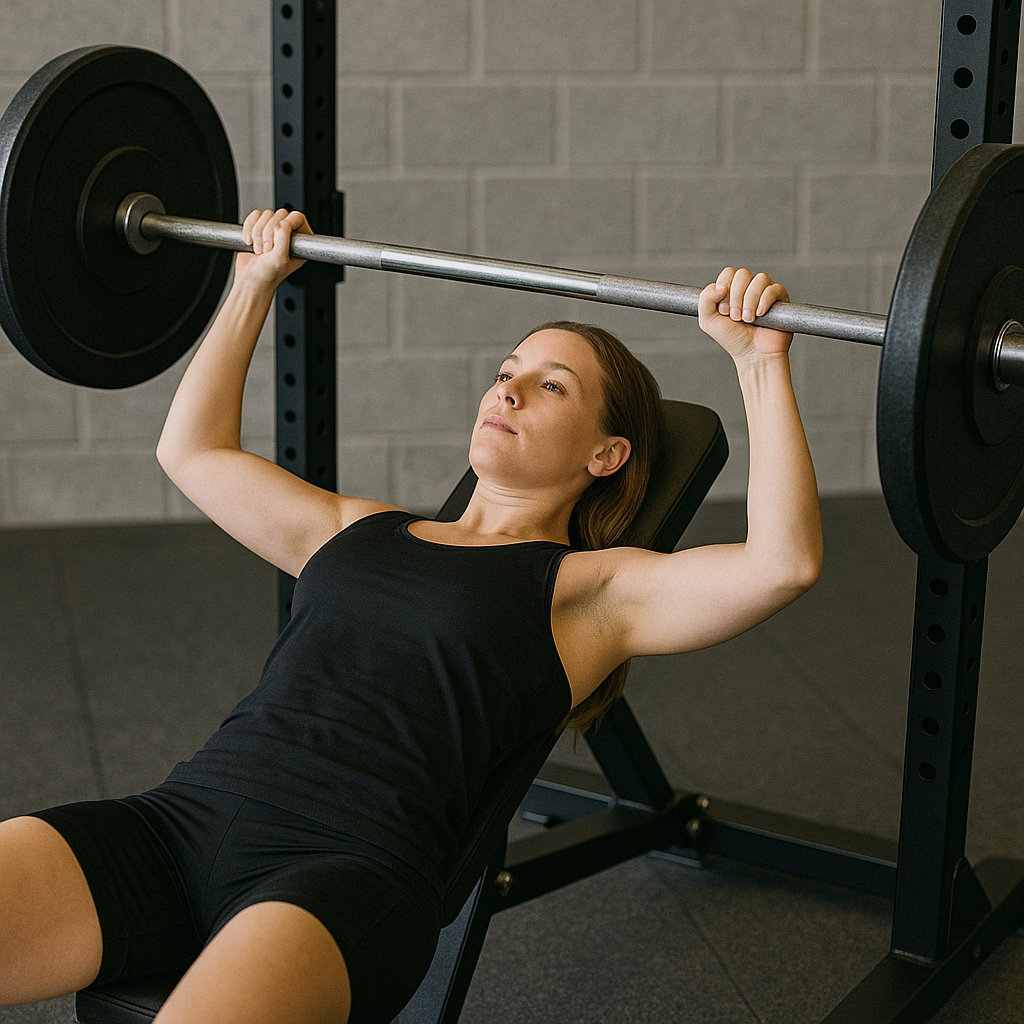
Pressing movement
A.
Latissimus dorsi
B.
Biceps brachii
C.
Pectoralis major
D.
Gastrocnemius
Question 37

Stretching and warm-up areas should be:

A.
Near free weights
B.
In stairwells
C.
Unobstructed with soft flooring
D.
Next to lockers
Question 38

During a soccer drill, players must react to coaches' unpredictable visual and auditory cues in real time. What primary benefit do these 'open' agility drills provide?

A.
They reinforce repetitive movement patterns
B.
They minimize joint stress through controlled movements
C.
They focus on maximizing straight-line speed
D.
They challenge decision-making by introducing variable stimuli
Question 39

What is the primary focus when progressing from basic to intermediate agility training?

A.
Performing all movements at submaximal effort
B.
Incorporating planned change-of-direction drills at higher speeds
C.
Focusing solely on linear sprinting technique
D.
Eliminating rest periods between drills
Question 40

Which factor is essential when selecting a performance test?

A.
Level of athlete’s motivation
B.
Athlete’s preference for testing format
C.
Relevance to the athlete’s sport and position
D.
Ease of test administration only
Question 41

As part of a movement screen, the overhead squat assessment is used to evaluate what primary attribute?

A.
Aerobic capacity
B.
Dynamic flexibility and mobility (especially thoracic/spine and shoulder mobility)
C.
Maximal strength
D.
Resting balance
Question 42

What is the recommended spine position during a bent-over row?

A.
Slightly flexed forward spine
B.
Rounded thoracic spine
C.
Hyperextended lumbar spine
D.
Neutral spine throughout the movement
Question 43

What characterizes athletes trained with explosive-ballistic methods?

A.
Increased flexibility with limited strength gains
B.
Greater endurance but reduced power
C.
Enhanced rate of force development and neural drive
D.
Slower contraction velocity with higher control
Question 44

What does VO2 max primarily assess in an athlete?

A.
The amount of oxygen in the lungs at rest
B.
The maximal rate of oxygen consumption during exercise
C.
The breathing rate during intense intervals
D.
The heart’s resting stroke volume
Question 45

Which joint type allows the greatest freedom of movement?

A.
Hinge joint
B.
Ball-and-socket joint
C.
Pivot joint
D.
Ellipsoidal joint
Question 46

When setting up for a back squat, how should the feet be positioned?

A.
Feet close together (narrow stance) with toes pointed inward
B.
Feet far wider than shoulders with toes pointing straight back
C.
Feet together with ankles flexed (heels raised)
D.
About shoulder-width apart (just outside hip width), with toes pointing forward or slightly outward
Question 47

When planning heavy lifts like bench press or squat, what factors determine how many spotters are needed?

A.
The width of the grip
B.
The height of the athlete
C.
The load being lifted and the experience/ability of the lifter and spotters
D.
The length of the barbell
Question 48

What grip is typically used in the lat pulldown?

A.
Pronated grip, slightly wider than shoulder-width
B.
Supinated grip, close to body
C.
Neutral grip, hands together
D.
Mixed grip, shoulder-width
Question 49

If an athlete’s THRR is 138-151 bpm, how many beats in 10 seconds is that?

A.
23-25 beats
B.
13-15 beats
C.
18-20 beats
D.
27-30 beats
Question 50

In running mechanics described by the spring-mass model, what is true at midstance?

A.
The leg is fully extended just before push-off
B.
The center of mass is at its lowest point and the stance leg is fully loaded (spring fully compressed)
C.
The runner's speed is maximal
D.
The swing phase has just begun
Question 51

Which muscle group is primarily activated during the bent-knee sit-up?

A.
Erector spinae
B.
Latissimus dorsi
C.
Rectus abdominis
D.
Gastrocnemius
Question 52

Which area should be closest to the main entrance?

A.
Reception or check-in desk
B.
Storage closet
C.
Weight room
D.
Locker room
Question 53

A coach asks an athlete to lean forward, extend the hips, and reach as far as possible. Which field test is this athlete performing?

A.
A pro-agility (shuttle) test
B.
A sit-and-reach test of hamstring and lower back flexibility
C.
A Yo-Yo intermittent recovery test
D.
A vertical jump test
Question 54

In a barbell biceps curl, to what height should the bar be raised for a full contraction?

A.
Directly above the head
B.
Up to about shoulder level (near the anterior deltoids)
C.
Only to knee height
D.
Down on the lower chest
Question 55

For a bodybuilder focused on muscle hypertrophy, what rest interval between sets is generally recommended?

A.
> 2-5 minutes
B.
Less than 30 seconds
C.
About 30 seconds to 1.5 minutes
D.
5-10 seconds
Question 56

Why is test reliability critical in performance testing?

A.
It makes the test harder
B.
It shortens the test
C.
It ensures consistent results over repeated trials
D.
It reduces fatigue
Question 57

While performing a heavy lift using the Valsalva maneuver, which of these should be avoided?

A.
Keeping the core braced
B.
Lifting heavy weight with proper technique
C.
Maintaining tension without exhaling prematurely
D.
Holding the breath for excessively long durations (beyond the lift phase)
Question 58

Which PNF stretching method uses both agonist and antagonist contractions?

A.
Hold-relax only
B.
Hold-relax with agonist contraction
C.
Contract-relax only
D.
Static-passive stretch
Question 59

What distinguishes High-Intensity Interval Training (HIIT) from other interval training?

A.
Using only steady-state low intensities
B.
Consisting solely of long continuous exercise
C.
Exercise intervals at near-maximal intensity (often above 90% VO₂max)
D.
Lasting longer than 10 minutes per interval
Question 60

What is a key training method used to emphasize maximum speed development?

A.
Light jogging for extended durations
B.
Plyometric drills performed at low intensity
C.
Sprint training at 90-100% of top speed over moderate distances
D.
Resistance training with high repetitions and low weight
Question 61

Which factor most affects the accuracy and consistency of test results?

A.
Athlete body weight
B.
Environmental noise level
C.
Tester reliability and protocol standardization
D.
Length of warm-up session
Question 62

At the start of a good morning exercise, which joint movement initiates the downward hinge?

A.
Bending the knees deeply first
B.
Arching the lower back
C.
Flexion at the hips (pushing the hips back) while keeping the spine straight
D.
Twisting the torso to one side
Question 63

Which test evaluates change-of-direction, maneuverability, and perceptual-cognitive ability?

A.
T-test
B.
Reactive Agility
C.
505
D.
L-run
Question 64

Which muscles are the main movers during the leg press exercise?

A.
Quadriceps and gluteus maximus
B.
Biceps femoris and deltoids
C.
Triceps brachii and adductors
D.
Tibialis anterior and abdominals
Question 65

Bodybuilders often supplement with HMB (beta-hydroxy-beta-methylbutyrate). What is its primary effect on muscle?

A.
It raises red blood cell count
B.
It stimulates the sympathetic nervous system
C.
It helps reduce muscle protein breakdown (anti-catabolic effect)
D.
It significantly slows heart rate
Question 66

Which professionals should be part of the facility planning committee?

A.
Architects, coaches, athletes, contractors
B.
Only architects
C.
Just strength coaches
D.
Athletes only
Question 67

What is the primary movement in the eccentric phase of a lat pulldown?

A.
Explosive elbow flexion
B.
Hip extension
C.
Knee flexion
D.
Controlled shoulder and elbow extension
Question 68

A coach uses skinfold calipers on an athlete. What is this measurement primarily used to assess?

A.
Flexibility
B.
Body composition (body fat percentage)
C.
Speed
D.
Muscular endurance
Question 69

Why should supervision policies be included?

A.
To promote autonomy
B.
To minimize staffing
C.
To ensure safety and accountability
D.
To reduce equipment usage
Question 70

Why must test administrators be properly trained?

A.
To help athletes cheat the test
B.
To reduce warm-up duration
C.
To encourage longer test times
D.
To ensure test validity, reliability, and athlete safety
Question 71

In a periodized training program, what generally happens to training volume (sets/reps) as intensity (load) increases?

A.
Volume increases with intensity
B.
Training volume typically decreases as intensity increases
C.
Volume remains the same regardless of intensity
D.
Volume becomes random
Question 72

Which element defines the organization's reason for existence?

A.
Training plan
B.
Budget report
C.
Emergency policy
D.
Mission statement
Question 73

Instructional policies help with:

A.
Marketing the program
B.
Teaching proper technique and ensuring safety
C.
Selling memberships
D.
Facility expansion
Question 74

During the downward phase of a front squat, how should the lifter move?

A.
Flex the hips and knees until the thighs are approximately parallel to the floor
B.
Extend the legs fully and keep the torso upright
C.
Only bend the knees, keeping hips fixed
D.
Lower until the bar touches the ground
Question 75

A strength coach wants to measure an athlete’s explosive strength (power) in lifting. Which test from the following is most appropriate?

A.
A 1-rep max bench pull
B.
A timed 1.5-mile run
C.
A sit-and-reach flexibility test
D.
A 1-rep max power clean
Question 76

Which of the following is NOT a typical benefit of bodyweight training?

A.
Provides low-cost, versatile workouts
B.
Enhances body control and proprioception
C.
Maximizes development of absolute maximal strength
D.
Can be done almost anywhere without equipment
Question 77

When performing the second pull of a power snatch, what actions do the shoulders and elbows take?

A.
Shrug the shoulders upward and flex the elbows to pull under the bar
B.
Keep the arms locked as the bar is lifted
C.
Lower the shoulders and extend the elbows
D.
Move only the hips with no arm movement
Question 78

When should resting heart rate and body composition typically be measured in a testing session?

A.
Immediately after exercise
B.
At the beginning, before physical activity
C.
During agility testing
D.
After a warm-up
Question 79

In the stretch-shortening cycle, what occurs during the amortization phase?

A.
Maximum muscle lengthening
B.
A brief pause between eccentric and concentric contraction
C.
Active force generation only
D.
Passive stretching for recovery
Question 80

Which environmental factor can most affect aerobic endurance test results?

A.
Time of day
B.
Temperature and humidity
C.
Tester’s voice
D.
Crowd size
Question 81

Which rest period range is most appropriate for maximizing strength gains in a resistance training program?

A.
30-60 seconds
B.
15-30 seconds
C.
2-5 minutes
D.
5-10 minutes
Question 82

What is the most noticeable technique issue in this deadlift form?
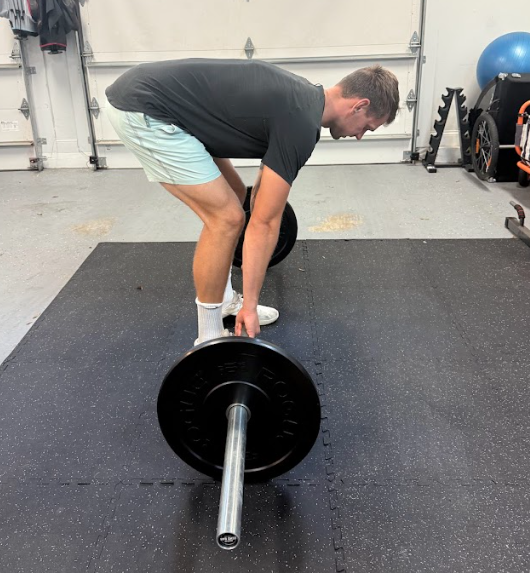
Deadlift form error
A.
Hips are too high
B.
Knees are locked out
C.
Back is excessively arched
D.
Feet are too wide
Question 83

An athlete attaches heavy chains to the barbell during squats. As the athlete stands up to parallel, what happens to the weight (resistance)?

A.
It stays the same weight
B.
It decreases as the movement ends
C.
It increases because more chain links lift off the ground
D.
It sharply drops to zero
Question 84

Why is a needs analysis performed before designing a testing battery?

A.
To reduce the number of training sessions required
B.
To eliminate the need for retesting
C.
To ensure tests align with sport-specific demands and goals
D.
To choose exercises based solely on equipment availability
Question 85

Which test is best used to assess lower body power?

A.
Push-up test
B.
T-test
C.
Vertical jump test
D.
Yo-Yo intermittent recovery test
Question 86

A trainer instructs an athlete on a seated row machine. To maintain proper spinal alignment, which body part should remain pressed against the pad during each rep?

A.
The head should stay off the pad
B.
The chest should stay in contact with the pad
C.
The shoulders should lift off the pad
D.
The lower back should arch away from the pad
Question 87

When programming a strength session focusing on power (e.g., cleans or snatches), what set/rep scheme is generally recommended?

A.
6-12 reps for 3-6 sets
B.
10-12 reps for 2-3 sets
C.
5-8 reps for 8-10 sets
D.
1-2 repetitions per set for 3-5 sets
Question 88

During the pec deck (chest fly machine) exercise, which muscle is NOT a primary mover?

A.
Pectoralis major
B.
Anterior deltoids
C.
Trapezius
D.
Triceps
Question 89

What is the primary emphasis of a resistance training program during the off-season phase?

A.
Developing foundational strength and hypertrophy
B.
Maximizing sport-specific skill execution
C.
Peaking power output for competition
D.
Reducing training volume to allow for full recovery
Question 90

Risk management includes all EXCEPT:

A.
Instruction
B.
Supervision
C.
Preseason ticket sales
D.
Emergency planning
Question 91

During a biceps curl, which muscle acts as the agonist?

A.
Biceps brachii
B.
Triceps brachii
C.
Deltoid
D.
Latissimus dorsi
Question 92

Which cue should be prioritized when coaching change of direction (COD)?

A.
Keep torso vertical throughout
B.
Avoid arm movement during turns
C.
Lower the center of mass before the cut
D.
Increase stride length when approaching cut
Question 93

During a barbell upright row, which muscle groups are primarily involved?

A.
Triceps and pectorals
B.
Biceps and rhomboids
C.
Latissimus dorsi and glutes
D.
The shoulder muscles (deltoids) and upper trapezius
Question 94

During lateral raises, how high should the dumbbells be lifted?

A.
Just above shoulder height
B.
Until arms are parallel to the ground
C.
Until elbows are at 90 degrees
D.
Until the dumbbells touch the ears
Question 95

When performing a push jerk, the athlete drives the bar overhead. What key action distinguishes the push jerk catch from the split jerk catch?

A.
Re-bending (dipping) the hips and knees under the bar to catch it overhead
B.
Landing in a split stance with one foot forward
C.
Catching the bar on the shoulders before standing up
D.
Keeping the elbows bent at the top of the movement
Question 96

What is the name of this barbell exercise being performed?
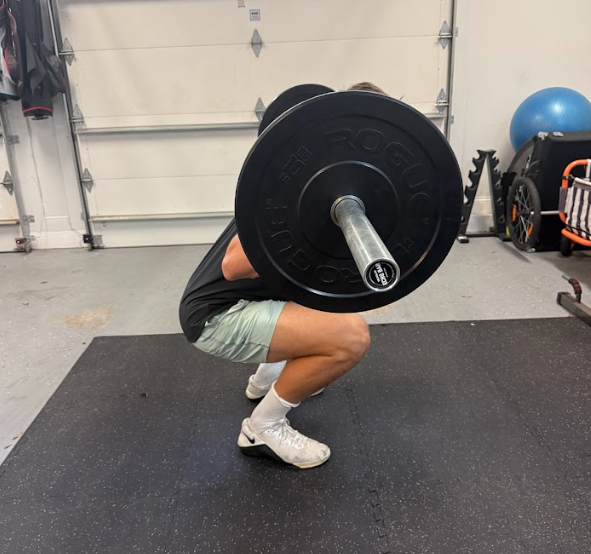
Lower body exercise
A.
Back squat
B.
Front squat
C.
Romanian deadlift
D.
Good morning
Question 97

On a machine abdominal crunch, how should the arms be placed during the exercise?

A.
Hanging loosely at the sides
B.
Pressed firmly against the machine’s arm pads
C.
Placed behind the head
D.
Crossed over the chest
Question 98

How is the target heart rate (THR) calculated using the percentage of maximal heart rate method?

A.
By multiplying MHR by the desired intensity percentage
B.
By subtracting age from resting heart rate
C.
By adding VO2 max to MHR
D.
By dividing MHR by the intensity percentage
Question 99

A football coach wants to test an athlete’s pure sprinting speed. Which test should he use?

A.
Pro-agility (T) test
B.
Overhead squat test
C.
Yo-Yo intermittent recovery test
D.
40-yard sprint test
Question 100

What is the main joint action in the leg curl machine?

A.
Hip abduction
B.
Hip flexion
C.
Knee extension
D.
Knee flexion
Question 101

Which performance metric is designed to quantify an athlete’s change-of-direction ability relative to their straight-line speed?

A.
Change-of-direction (COD) deficit
B.
Vertical jump height
C.
Stride angle
D.
Leg stiffness
Question 102

A basketball coach opts to use a timed 1.5-mile run on a track rather than laboratory VO2max testing. This running test is an example of what type of assessment?

A.
A questionnaire for training readiness
B.
A specialized lab-based endurance test
C.
A cognitive decision-making test
D.
A field test performed outside the laboratory
Question 103

During traditional periodization, in which phase is training volume usually highest?

A.
The first transition phase
B.
The preparatory (off-season) phase
C.
The competition phase
D.
The postseason phase
Question 104

Mirrors in the weight room should be placed:

A.
On the ceiling
B.
Behind equipment
C.
At least 6 inches above the floor
D.
Under lifting platforms
Question 105

What intensity range is recommended during the hypertrophy/endurance phase?

A.
30-50% of 1RM
B.
90-100% of 1RM
C.
10-25% of 1RM
D.
67-85% of 1RM
Question 106

A coach tells an athlete to perform a jackknife sit-up instead of a pike exercise. How does the jackknife movement differ?

A.
It involves jumping into the air
B.
It uses a resistance band
C.
It isolates only the legs without hip flexion
D.
It flexes both the hips and the spine (bringing torso and legs together)
Question 107

What is a benefit of cross-training for athletes?

A.
Reduced injury risk and improved overall fitness
B.
Increased sport specificity only
C.
Decreased muscle recruitment
D.
Elimination of recovery days
Question 108

After completing a training program, a coach administers the same performance tests used at the start. What is the purpose of this posttest?

A.
To identify the weakest athlete on the team
B.
To randomly change the original groups
C.
To determine new personal records only
D.
To evaluate improvements and the effectiveness of the training program
Question 109

An athlete wraps the thumb under the fingers while gripping the bar in the clean. What is this grip called?

A.
Suicide (false) grip
B.
Hook grip
C.
Mixed grip
D.
Overhand (pronated) grip without thumb
Question 110

Which exercise uses a cable and is focused on elbow extension (working the triceps)?

A.
Barbell overhead press
B.
Barbell upright row
C.
Cable triceps pushdown
D.
Romanian deadlift
Achievable blue logo on white background

Continue your practice

Level up your study with additional free practice exams for CSCS

CSCS: Scientific Foundations

Test your knowledge of exercise science, anatomy, and physiology
Achievable CSCS dashboard
Pass the CSCS. Guaranteed.
Achievable is the best online CSCS exam prep course: effective, personalized, and convenient. With Achievable, you'll spend less time studying and pass your exam the first time, or your money back.