CSCS for physical therapists: Is it worth it and how to prepare


If you’re a physical therapist who treats athletes, works in return-to-sport rehab or wants to run a cash-based performance practice, the CSCS is usually worth it: it covers what comes after the rehab protocol, which is periodized strength, power, speed and conditioning programming, and it tells athletes and coaches you speak their language. If you work in acute care, inpatient rehab, home health or a setting where your patients never get near a barbell, it adds little. Your DPT already meets the degree requirement, so most of your study time goes to what PT school covers lightly: program design, lifting and sprint technique, athletic testing, nutrition and facility administration.
To see where you stand before you plan anything, take Achievable’s free Scientific Foundations and Practical/Applied practice exams, both full length and timed like the real sections. Your scores will tell you whether you need four weeks or closer to eight.
Start with a free practice exam, then fill the gaps
Most PTs walk into CSCS prep with an uneven profile: very strong on anatomy and physiology, weaker on how a strength coach programs and teaches lifts. A timed practice exam shows exactly where that line falls for you, so you spend your weeks on the gaps rather than on the anatomy you already know.
- Achievable’s free practice exams. The Scientific Foundations practice exam has 80 questions in 90 minutes, and the Practical/Applied practice exam has 110 questions in two and a half hours, the same number of scored questions and the same time limit as each real section. Every question has an explanation.
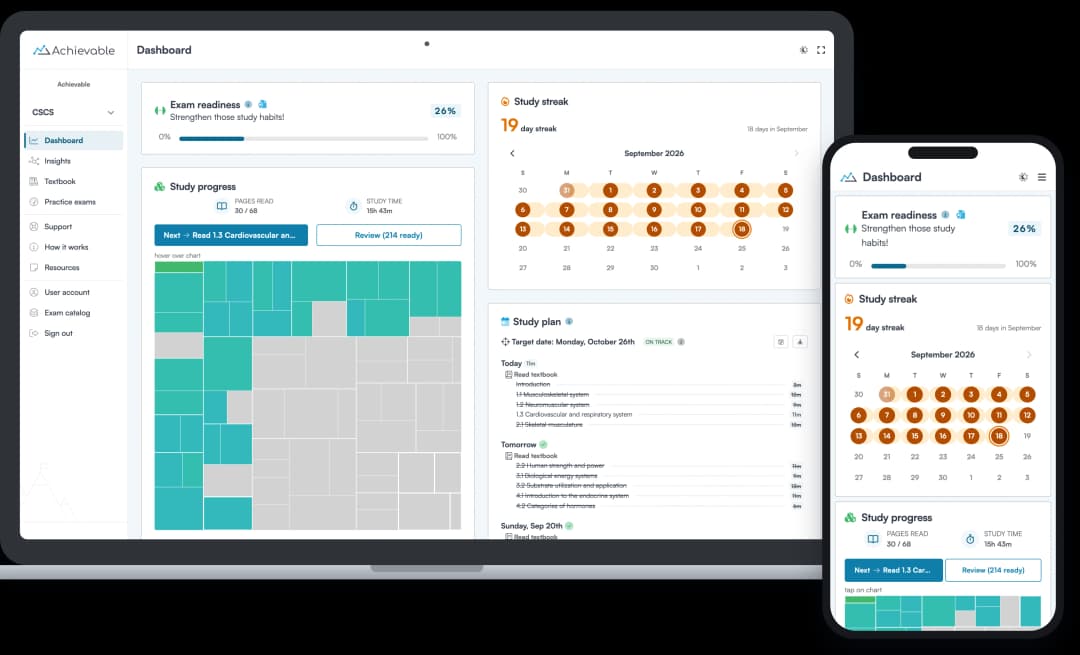
- Achievable’s CSCS course. The course has an online textbook written by an experienced coach who holds the CSCS, 1,200+ practice questions with explanations, and three full CSCS practice exams, each with both sections timed like the real ones. Its study planner builds a day-by-day plan to your exam date, and it works on the web or a phone, which suits studying around a clinic schedule. A full year of access is $199, and the first lessons are free, no credit card needed.
- Achievable’s pass guarantee. Pass at least one of the course’s full-length CSCS practice exams within the standard time, and if you then don’t pass the CSCS exam, you get your money back.
- NSCA’s own materials. NSCA publishes the CSCS Detailed Content Outline, which lists every task the exam tests, and recommends its textbook, Essentials of Strength Training and Conditioning, 5th edition, though it doesn’t require it.
Is the CSCS worth it for a physical therapist? Career value by setting
NSCA lists rehabilitation specialists, naming physical and occupational therapists, among the professionals who can benefit from the CSCS, alongside its main audience of strength and conditioning coaches (NSCA’s CSCS page). It isn’t a license, so it doesn’t change your scope of practice. Its value depends on how much of your work happens after a patient is cleared to train.
- Sports and orthopedic outpatient, return-to-sport. The strongest case. Late-stage rehab is where CSCS content lives: progressing load, plyometrics, speed and agility work, and testing whether an athlete is ready. NSCA’s Program Design domain even includes programming during an athlete’s injury and reconditioning.
- Cash-based and performance clinics. A strong case. When your business includes training patients after discharge, or working with athletes who were never injured, the CSCS shows you train athletes as well as treat them. NSCA built it in 1993 as the first strength and conditioning coach certification.
- Working alongside teams and strength staff. Useful. In college, professional and tactical settings, PTs hand athletes back to strength and conditioning coaches, and NSCA notes that many collective bargaining agreements in professional sports require those coaches to hold the CSCS. Knowing their programming and terms makes that handoff smoother.
- Acute care, inpatient rehab, neurology, home health, most geriatrics and pediatrics. Little value. The exam’s athletic programming, Olympic lifts and facility management rarely come up, and an advanced clinical credential in your own specialty will do more for you.
A practical test: read ten job postings in the setting you want. If the CSCS shows up as required or preferred in several, it’s worth your time. If it never appears, put the time toward the credential that does.
CSCS vs SCS: what each is for
The other credential PTs weigh is the Sports Clinical Specialist (SCS), the board certification in sports physical therapy from the American Board of Physical Therapy Specialties (ABPTS). They aren’t alternatives so much as two different jobs: the SCS certifies clinical sports physical therapy, from acute injury care to rehabilitation, and the CSCS certifies training athletes for performance. Many sports PTs eventually hold both, and the CSCS is the one you can earn early in your career. The SCS figures below are from the ABPTS sports specialty page, its eligibility requirements and its fee schedule.
Detail | CSCS | SCS |
|---|---|---|
Awarded by | NSCA | ABPTS, through APTA’s specialist certification program |
What it certifies | Training athletes for strength, power and conditioning | Clinical sports physical therapy: preventing, treating and rehabilitating athletes’ injuries |
Who can sit | Anyone with a bachelor’s degree or higher and current CPR/AED | A licensed U.S. PT with 2,000 hours of sports patient care in the last 10 years (500 in the last 3), including 100 hours of athletic venue coverage, or an accredited sports residency |
Other requirements | None | In-person CPR certification and approved emergency care training (such as EMR, EMT or ATC) |
Cost | $340 for NSCA members, $475 for non-members | Application $550 to $650 for APTA members or $895 to $995 for non-members, plus a $810 or $1,535 exam fee |
When PTs earn it | Any time, even during PT school | After years of sports practice or a sports residency |
Eligibility, fees and exam logistics
You can sit for the CSCS if you meet NSCA’s two requirements (NSCA’s CSCS page):
- A bachelor’s degree or higher. A DPT qualifies, and most DPT students already hold a bachelor’s degree, so you can take the exam during PT school. NSCA also accepts candidates enrolled as a college senior at an accredited institution.
- Current CPR/AED certification. You can send proof after the exam: NSCA gives you one year from your exam date to send it, with your transcript, before your results become invalid.
The rules change in 2036. Starting then, candidates must hold a bachelor’s degree (or higher) related to strength and conditioning from a program accredited by CASCE, NSCA’s accrediting body. Candidates with a related health degree can instead meet it with a CASCE-accredited post-baccalaureate certificate (NSCA’s CASCE page); confirm with NSCA how it treats a DPT before you rely on that route. Anyone who earns the CSCS before 2036 isn’t affected unless the certification lapses, so if you expect to want it, earning it before then saves you the question.
The rest of the logistics are the same for every candidate:
- Fees: $340 for NSCA members and $475 for non-members, so membership saves $135. Retaking both sections costs the same; retaking one section costs $250 for members or $385 for non-members.
- Testing: on a computer at a Pearson VUE test center. NSCA offers live remote proctoring only for its TSAC-F exam, not the CSCS.
- Timing: after you register, you have 120 days to sit the exam, and you must pass both sections within one year of your first exam date.
- Format: two sections, about four hours in all with a 15-minute break: Scientific Foundations (80 scored questions in 1.5 hours) and Practical/Applied (110 scored questions in 2.5 hours, including 30 to 40 video or image questions). Each section also carries 15 unscored pretest questions. You need a scaled score of 70 to pass each section (NSCA exam description).
Our CSCS exam info page keeps the full outline and eligibility rules in one place.
What PTs already know, and what to study
NSCA’s exam report shows why Practical/Applied is the section to plan around: in 2025, 71% of candidates passed Scientific Foundations, but only 55% passed Practical/Applied, and 50% passed both. That section tests coaching knowledge rather than clinical knowledge, which is exactly where a PT’s training is thinnest. The table maps each exam domain, with its number of scored questions, to what a PT usually brings and what to study.
Domain | What a PT brings | What to study |
|---|---|---|
Exercise science (48) | Anatomy, physiology and biomechanics, usually strong | Bioenergetics and metabolism, the endocrine response to training, training adaptations, research and statistics |
Sport psychology (20) | Motor learning | Arousal and anxiety, motivation and goal setting, mental health issues in athletes |
Nutrition (12) | Clinical basics | Fueling and hydration for performance, supplements and performance-enhancing substances |
Program design (44) | Exercise prescription and post-injury progressions | Needs analysis, exercise order, assigning load and volume, rest periods, periodization models |
Exercise technique (28) | Therapeutic exercise technique | Olympic lifts, plyometrics, sprint and agility technique, conditioning for each energy system |
Program implementation (22) | Clinical tests and measures | Choosing, ordering and running athletic field tests, coaching a session, and reading test results |
Organization and administration (16) | Little, outside clinic operations | Strength facility design and layout, professional practice, common litigation issues |
A 4 to 8 week study plan for PTs
NSCA’s own timeline depends on two things: whether your degree is in exercise science or a related field, and whether you’ve had internships or practical experience. With both, it estimates 3 to 6 weeks; with a related degree and no practical experience, 1 to 3 months (NSCA exam preparation). A PT who already coaches athletes or has trained in a strength setting fits the shorter range; a PT whose experience is all clinical should plan for the longer one. That makes 4 to 8 weeks a realistic target for most PTs. Plan on short weekday sessions and one longer weekend session for timed practice.
- Week 1, find your gaps: take both of Achievable’s free practice exams under timed conditions, read NSCA’s Detailed Content Outline, and register so your 120-day window covers the plan.
- Weeks 2 and 3, program design and technique: needs analysis, exercise selection and order, intensity and volume, rest periods and periodization; then Olympic lift, plyometric, sprint and agility technique. Practice reading technique from images and video, since 30 to 40 Practical/Applied questions use them.
- Week 4, testing and administration: which field tests to choose, how to order and run them and how to read the results; then facility design, professional practice and liability.
- Week 5, the Scientific Foundations gaps: bioenergetics, the endocrine response to training, sport psychology and performance nutrition, plus the research and statistics questions. Skim the anatomy you already know.
- Weeks 6 to 8, full-length practice: a full-length timed practice exam each weekend, with the weekday sessions spent on the topics you missed. Stop at week 6 if your scores are already where they need to be.
Sit the exam when you’re at 100% readiness and you score about 10 points above the passing score of 70 on full-length practice exams, again and again across several exams, so a pass doesn’t depend on the questions you happen to draw. If you’re not there by week 8, use the slack in your 120-day window rather than sitting early. For the same plan laid out by background, with a 12-week version for anyone working full time, see How to prepare for the CSCS exam: study plans by background.
Key takeaways
- The CSCS pays off for PTs in sports, orthopedic, return-to-sport and cash-based performance work, and adds little in acute care, inpatient, home health and similar settings.
- A DPT meets NSCA’s degree requirement today. From 2036 NSCA requires a CASCE-accredited degree, or a CASCE-accredited certificate for related health degrees, and anyone certified before then is unaffected while the CSCS stays current.
- The SCS certifies clinical sports physical therapy and needs 2,000 hours of sports patient care or a residency; the CSCS certifies performance training and can be earned early in your career.
- Most of a PT’s study time belongs in Practical/Applied: program design, lifting and sprint technique, testing and administration.
- Expect 4 to 8 weeks of study, and sit the exam once you’re scoring about 10 points above 70 on several full-length practice exams.