Is the NSCA textbook enough to pass the CSCS, or do you need a prep course?


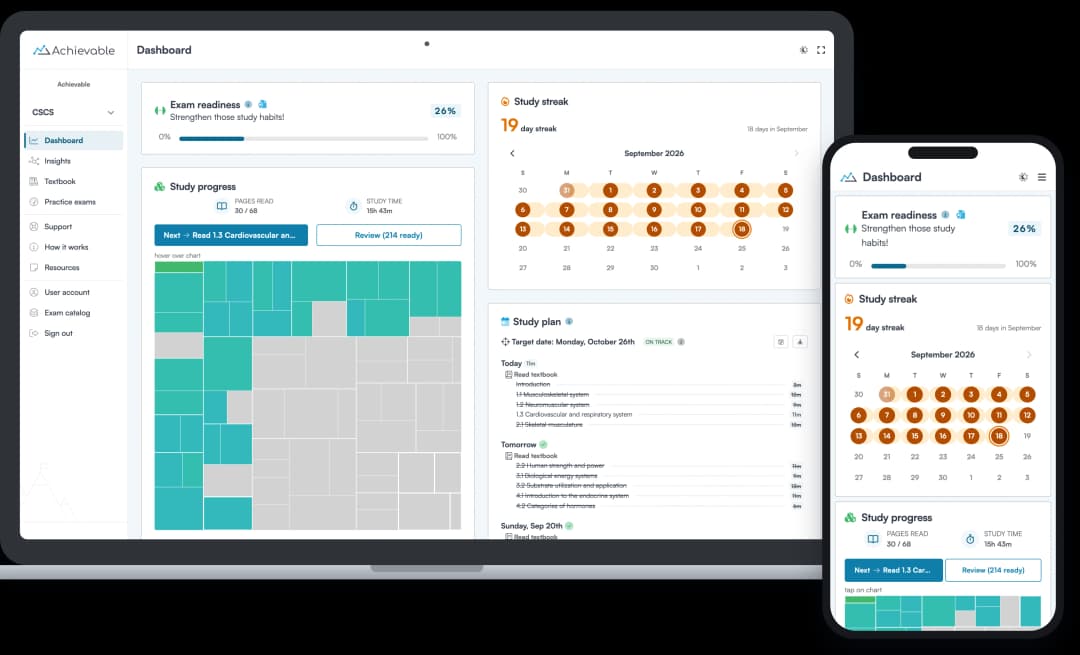
For many candidates, not on its own. NSCA’s textbook, Essentials of Strength Training and Conditioning, now in its 5th edition (26 chapters, 864 pages), covers the knowledge the CSCS draws on, but NSCA itself calls it recommended, not required, and says its exams are "not a test that recalls information from a textbook like a college course." Only 45 of the exam’s 190 scored questions are recall questions; the other 145 ask you to apply or analyze, and Practical/Applied includes 30 to 40 video or image questions. The book has no timed practice exam. If you have an exercise science degree and hands-on coaching experience, the book plus timed practice exams can be enough. Many other candidates should add a course built around full-length practice, such as Achievable’s CSCS course: $199 for a year, with a 24-chapter online textbook, 1,200+ practice questions, three full practice exams with both sections timed like the real ones, and a pass guarantee.
To see where you stand before you buy anything, take Achievable’s free Scientific Foundations and Practical/Applied practice exams: 80 questions in 90 minutes and 110 questions in two and a half hours, the same number of scored questions and the same time as each real section, with every answer explained.
This guide covers who can pass with the textbook alone, what the book includes and what it leaves out, NSCA’s latest pass rates, what each way of preparing costs, how Achievable’s course lines up with the exam, and a plan that uses both. Every NSCA, Human Kinetics and competitor detail below was checked against their own pages. Prices change, so confirm them there before you buy.
The short answer, by background
NSCA sorts its study-time estimates by two things: whether your degree is in exercise science or a related field, and whether you’ve had internships or practical experience (NSCA’s CSCS exam preparation page). The same two things decide whether the textbook can carry you, because the Practical/Applied section tests coaching judgment, which a book can describe but can’t practice for you.
Your background | NSCA’s estimated study time | What to use |
|---|---|---|
Exercise science degree and practical experience | 3 to 6 weeks | The textbook as a reference, plus full-length timed practice exams. This group is best placed to pass with the book plus practice exams. |
Exercise science degree, no practical experience | 1 to 3 months | A course with timed practice, with the textbook for depth. Your gap is applying the science to programs, technique and testing. |
Practical experience, no related degree | 4 to 6 months | A course with a structured textbook and quizzes. The Scientific Foundations section is your gap, and the 864-page book is a slow way to fill it. |
Neither | 6 to 9 months | A course from day one, with the textbook for depth. |
Whichever row you’re in, you’re ready when you’re at 100% readiness and you score about 10 points above the passing score of 70 on full-length practice exams, again and again across several exams, so a pass doesn’t depend on the questions you happen to draw. The textbook alone can’t tell you whether you’re there.
What the textbook covers, and what it doesn’t
Essentials of Strength Training and Conditioning, 5th edition, is edited by G. Gregory Haff and N. Travis Triplett and published by Human Kinetics (©2027, 864 pages). Its 26 chapters run from the structure and function of body systems through testing, exercise technique, program design and periodization to facility design and legal issues (NSCA’s 5th edition page). Human Kinetics lists the hardback with online access at $119 and the ebook at $89 (Human Kinetics).
What it gives you:
- The full body of knowledge. It’s the standard reference text for the field, organized from theory to program design to administration, and it stays useful long after the exam.
- Self-study questions. Each chapter has objectives, key points and study questions, with the answers at the back of the book.
- Some technique video. The online access includes videos of 21 foundational exercises.
What it doesn’t give you:
- A timed practice exam. The real exam is two timed sections: 95 questions in 1.5 hours for Scientific Foundations and 125 in 2.5 hours for Practical/Applied, each including 15 unscored pretest questions (NSCA’s exam description). Chapter questions don’t build that stamina or pacing.
- Exam-style application questions. NSCA’s Detailed Content Outline, in effect since July 1, 2025, sets the level of every question: in Practical/Applied, 21 of the 110 scored questions are recall, 53 are application and 36 are analysis; in Scientific Foundations, 24 of 80 are recall (NSCA’s 2025 job task analysis summary). The book’s 780-question test bank goes to instructors who adopt the book for a class, not to students.
- The exam’s structure. The exam is built from the Detailed Content Outline, not from the book’s chapters, and NSCA says it "does not require, provide, or endorse any specific study guides." Reading cover to cover weights topics by page count, not by exam weight, while Program Design alone is 44 of the 110 Practical/Applied questions.
- A read on whether you’re ready. Nothing in the book tells you which domains you’d fail today.
CSCS pass rates
NSCA’s annual exam report gives the clearest picture of how hard the exam is. In 2025, NSCA gave the CSCS exam to 9,650 candidates: 71% passed Scientific Foundations, 55% passed Practical/Applied, and 50% passed both sections (NSCA exam report). So half didn’t pass both sections, and Practical/Applied, the section that tests applied coaching knowledge, is where more candidates fall short.
NSCA doesn’t publish pass rates by how candidates studied, so no one can say what share of textbook-only candidates pass. What the numbers do show is that the science section is the smaller hurdle: more candidates pass it than the applied one.
Textbook alone vs. adding practice or a course
These are list prices on each seller’s own site, checked in November 2026. Trainer Academy was running a sale when we checked, and sales elsewhere are common.
Option | Price | What it adds to the textbook |
|---|---|---|
Achievable CSCS course | $199 for a year | Its own 24-chapter online textbook, 670+ review questions and 1,200+ practice questions in all with explanations, three full practice exams with both sections timed like the real ones, a study planner, and a pass guarantee with a refund |
NSCA textbook alone | $119 hardback, $89 ebook | Nothing beyond the book: self-study questions, 21 exercise videos, no timed exam |
NSCA Essential Collection | $346, or $273 for NSCA members | The textbook, NSCA’s study guide, and Scientific Foundations and Practical/Applied quizzes and tests |
NSCA Online Study Course | $199 without the book, $259 with the ebook | 160+ interactive activities and an end-of-course test |
Pocket Prep | $20.99 a month, $49.99 for 3 months, $124.99 a year | 1,500 questions with explanations and a mock exam mode; no lessons or textbook |
Trainer Academy | $49 or $69 a month, or MVP at $139 a month or $499 lifetime ($99 and $299 on sale) | A question bank, an interactive study guide and a timed exam simulator; no textbook |
For $199, Achievable is the only option here that pairs its own online textbook with three full-length practice exams timed like both real sections and a refund guarantee, and its first lessons are free, no credit card needed. Its pass guarantee: pass at least one of the course’s full-length CSCS practice exams within the standard time before your exam, and if you then don’t pass the CSCS, email a picture of your score report with a valid state ID, and once they’re verified, Achievable refunds the course in full. There’s no minimum study time.
The others’ guarantees work differently. Pocket Prep’s gives you three more months of access, not a refund. Trainer Academy’s refunds what you paid, apart from a one-time setup fee, plus the retake fee, but it covers the MVP plan only, and its terms require an in-app confidence score in its green zone, notice within 30 days, an exam taken while you’re subscribed or within 30 days after, and a first attempt. Its monthly plans also add up: three months of All-Star cost $207.
Whichever you choose, add the exam fee: $340 for NSCA members or $475 for non-members, so a $130 professional membership pays for itself (NSCA’s CSCS page).
How Achievable’s course lines up with the exam
Achievable’s course is organized in 24 chapters, each with a review quiz. The table shows the chapters that teach the material each domain of the Detailed Content Outline draws on most, with the number of scored questions the domain carries on the exam.
Exam domain (scored questions) | Achievable chapters |
|---|---|
Exercise sciences (48) | 1 to 7: body systems, biomechanics, bioenergetics, endocrine responses, anaerobic and aerobic adaptations, age and sex differences |
Sport psychology (20) | 8: psychology of athletic preparation and performance, with eating disorders in 10 |
Nutrition (12) | 9 to 11: sports nutrition, nutrition strategies for performance, performance-enhancing substances |
Program design (44) | 17 to 22: resistance, plyometric, speed and agility, and aerobic endurance program design, periodization, rehabilitation and reconditioning |
Exercise technique (28) | 14 to 16: warm-up and flexibility, free weight and machine technique, alternative modes, plus the technique sections of 18 to 20 |
Program implementation (22) | 12 and 13: test selection and administration, scoring and interpretation |
Organization and administration (16) | 23 and 24: facility design, policies, procedures and legal issues, with overtraining in 5 |
For a quick refresher, our free CSCS study guide summarizes the key points of all 24 chapters. Use it to review, not as a substitute for full study.
A study plan that uses the textbook well
1. Take a diagnostic. Sit both of Achievable’s free practice exams under timed conditions. Your score on each section tells you how much of the plan you need.
2. Get the outline. Download NSCA’s Detailed Content Outline from the NSCA Certification Handbook and use it as your checklist, weighting your time by each domain’s question count.
3. Learn in the course, deepen in the book. Work through each Achievable chapter and its review quiz, and open the textbook’s matching chapter when a topic needs more depth or you want its figures and photos.
4. Practice applying, not recalling. Spend most of your question time on Practical/Applied: program design, technique from images, and choosing and reading tests.
5. Sit full-length exams. Take Achievable’s three full practice exams in the final weeks, both sections in one sitting with a 15-minute break, as at a test center. Review every miss and reread the chapter behind it.
6. Book the exam when you’re ready to commit. After you register, you have 120 days to sit the exam. Sit it when you’re at 100% readiness and scoring about 10 points above 70, consistently, across several full-length exams.
For full study schedules by background, including a 12-week plan for working full time, see How to prepare for the CSCS exam: study plans by background. To compare every prep option in detail, see the best CSCS prep courses.
Key takeaways
- Achievable’s CSCS course is $199 for a year, with a 24-chapter online textbook, 1,200+ practice questions, three full practice exams and a pass guarantee.
- The NSCA textbook covers what the CSCS draws on, but NSCA calls it recommended, not required, and only 45 of 190 scored questions test recall.
- The book has no timed practice exam, and Practical/Applied is the harder section: in 2025, 55% passed it and 50% passed both sections.
- With an exercise science degree and practical experience, the book plus full-length timed practice can be enough. Many others should add a course.
- You’re ready at 100% readiness, scoring about 10 points above 70 on several full-length practice exams.