How to complete your FE requirements while working full-time


Table of contents
- What is the FE exam?
- How do you check your eligibility?
- How do you choose which FE exam to take?
- What are the FE exam pass rates?
- How do you prepare for the FE while working full-time?
- Getting started: Ask your employer for reimbursement
- Additional questions
- What happens if you fail the FE exam? How to come back stronger
- Will my previous work experience count toward my PE requirements?
- I’ve been out of school for more than a few years. Is it too late to take the FE exam?
- Closing
You can complete your FE (Fundamentals of Engineering) requirements while working full-time by planning two to three months of study, working in one to two focused hours on weekdays plus weekend sessions, and leaning on self-paced tools built around the FE Reference Handbook.
Passing the FE exam is a major milestone in the professional engineer (PE) pipeline, and many engineers take it a few years into their careers. Even if your last calculus or hydrology class was years ago, rigorous, thoughtful preparation can still help you pass in a matter of weeks.

What is the FE exam?
The NCEES FE exam, administered by the National Council of Examiners for Engineering and Surveying, is intended to be taken by engineers early in their careers. While it’s designed for recent graduates and students close to completing an undergraduate engineering degree in an ABET-accredited program, many engineers take it after two, five, or even ten years on the job. In fact, having more work experience can help you apply dense, complex engineering topics to real-life scenarios.
Overview of the FE exam:
- Administration: The exam is fully computer-based.
- Schedule: It is offered year-round at Pearson VUE test centers approved by NCEES.
- Cost: The current FE exam fee is $225.
- Number of questions: Each exam contains 110 questions.
- Length of exam: The appointment is about 6 hours total, which includes a tutorial, a scheduled break, and 5 hours 20 minutes of actual testing time.
- Scoring: The FE is pass/fail. NCEES sets the passing standard through psychometric analysis, so results are not compared with those of other test-takers in your session.
- Calculator policy: Candidates may use calculators, but only NCEES-approved models are permitted.
- Reference policy: The FE Reference Handbook is the only resource allowed during the exam; it provides key formulas, definitions, and data.
Passing the FE exam is a major milestone toward earning your Professional Engineer (PE) license. A passing score qualifies you for Engineer-in-Training (EIT) certification (some states use different names, such as EI), a credential employers value for entry-level engineering positions. After receiving this designation, you must gain the required progressive engineering experience under a licensed engineer (typically four years, though this varies by state) and pass the Principles and Practice of Engineering (PE) exam in your chosen field. Licensure lets you lead projects, pursue senior roles, and increase your earning potential.
The FE is offered year-round, but testing is organized into four quarterly windows: January-March, April-June, July-September, and October-December. These windows mainly affect retake timing rather than day-to-day availability.
Each FE exam covers foundational engineering topics such as mathematics, probability and statistics, engineering economics, ethics, and professional practice. About half of the questions assess core concepts shared by all examinees, while the remainder address discipline-specific subjects such as chemical reaction engineering, computer systems, environmental management, or hydrology. Although the exact subjects vary by discipline, foundational math and science topics, including calculus, geometry, and physics, remain fairly consistent across all FE exam versions.
How do you check your eligibility?
The FE exam is open to graduates of, or students nearing graduation from, a four-year undergraduate program accredited by ABET’s Engineering Accreditation Commission (EAC). There are exceptions to this rule: some people gain eligibility through graduate and international pathways.
Although the FE is a nationally standardized exam, official certification occurs at the state level, and each state has slightly different engineering-licensing policies. If you did not graduate from an accredited program or gained your primary engineering education through a graduate program, you may still qualify by petitioning your state’s engineering board. In some states, including California and Arizona, you must file an application before testing, which may involve an additional fee.
Confirming your eligibility and any other requirements with your state’s licensing board will give you a more realistic estimate of your testing timeline and costs. Fortunately, the FE exam is not always required for entry-level roles, so you can enter the field before beginning the certification process.
How do you choose which FE exam to take?
The right FE exam is almost always the one that matches your engineering degree or the field you have experience in. Still, it can be a chance to demonstrate competency in another area if you’re planning a career shift.
Future EITs may choose from seven FE exam types, each designed to assess fundamental engineering principles within a specific discipline.
- FE Chemical: Covers core engineering principles applied to chemical processes, including thermodynamics, fluid mechanics, heat and mass transfer, and reaction engineering.
- FE Civil: Includes fundamental civil engineering fields such as structural, geotechnical, transportation, water resources, environmental, and construction engineering.
- FE Electrical and Computer: Covers the fundamentals of electrical and computer engineering, including circuits, electronics, power systems, digital systems, communications, and computer networks.
- FE Environmental: Encompasses environmental engineering principles related to water and wastewater management, air quality, solid and hazardous waste, environmental health, and remediation.
- FE Industrial and Systems: Includes topics such as probability and statistics, engineering economics, operations research, quality, manufacturing, and systems engineering.
- FE Mechanical: Covers the fundamentals of mechanical engineering, including statics, dynamics, mechanics of materials, thermodynamics, fluid mechanics, heat transfer, and mechanical design.
- FE Other Disciplines: Provides a broad, multidisciplinary overview of essential engineering subjects, including mathematics, mechanics, thermodynamics, electrical engineering, materials, and engineering economics.
Each exam evaluates your foundational knowledge in its field, prepares you for related careers, and lays the groundwork for the PE exams, which license professional engineers with years of field experience.
What are the FE exam pass rates?
Another consideration when choosing an FE exam is the pass rate and relative difficulty of each discipline. Pass rates don’t perfectly reflect difficulty, but they offer useful insight into how challenging candidates find each version.
According to the 2025 NCEES FE exam pass-rate data, first-time and repeat pass rates by discipline were as follows:
| FE exam | First-time volume | First-time pass rate | Repeat volume | Repeat pass rate |
|---|---|---|---|---|
| Chemical | 1,873 | 68% | 316 | 35% |
| Civil | 16,639 | 61% | 9,863 | 32% |
| Electrical and Computer | 5,882 | 64% | 2,020 | 31% |
| Environmental | 2,543 | 67% | 1,092 | 37% |
| Industrial and Systems | 547 | 62% | 118 | 25% |
| Mechanical | 11,552 | 69% | 2,120 | 37% |
| Other Disciplines | 2,386 | 61% | 951 | 29% |
Pass-rate data generally show that candidates who have completed a bachelor’s degree pass at higher rates than those still enrolled, suggesting many benefit from testing after finishing their degree. Keep in mind, though, that the average FE exam taker is between 26 and 28 years old; a significant share of examinees appear to gain industry experience or additional training before attempting the test. Repeat test-takers pass at lower rates than first-timers, indicating some candidates need multiple attempts. To avoid this, it’s important to go into your studies with a plan and dedicate sufficient time to prep.
The Civil exam draws by far the most candidates each year, while disciplines like Chemical and Other Disciplines have much smaller volumes. Because volume varies so widely across disciplines, direct comparisons can be difficult. It’s clear, though, that the FE Civil exam challenges a large share of test-takers annually, as it also has one of the lowest pass rates. Students preparing for this test should not underestimate the effort and drive needed to get a passing score.
How do you prepare for the FE while working full-time?
The FE exam is challenging, with first-time pass rates roughly in the 60-70% range. Rates tend to be lower for those who wait until after graduation, since many candidates must review years of engineering coursework.
Refreshing content matters, but it’s just one part of a dedicated FE prep strategy:
- Develop an effective FE study plan: Devote at least two months to preparation, though three months are often recommended for those balancing full-time workloads.
- Practice under real FE conditions: FE tests endurance as much as it tests knowledge. Take full-length practice tests using the FE Reference Handbook and an approved calculator.
- Brush up on math and science fundamentals: You’ll likely need a refresher on calculus, differential equations, physics, chemistry, statics, and other core topics.
- Identify and target problem areas: Track the areas you find challenging and focus your review there. Actively engaging with weak spots is far more effective than covering every topic equally.
- Maintain a regular but flexible schedule: Aim for one to two hours on weekdays plus additional weekend study, while accepting that other obligations may shorten or interrupt some sessions. Spreading out your preparation makes it less stressful and easier to catch up on.
- Apply what you’ve learned: The FE asks engineers to think like professionals by applying knowledge to real-world situations. Use principles you see in your everyday work to reinforce your studying.
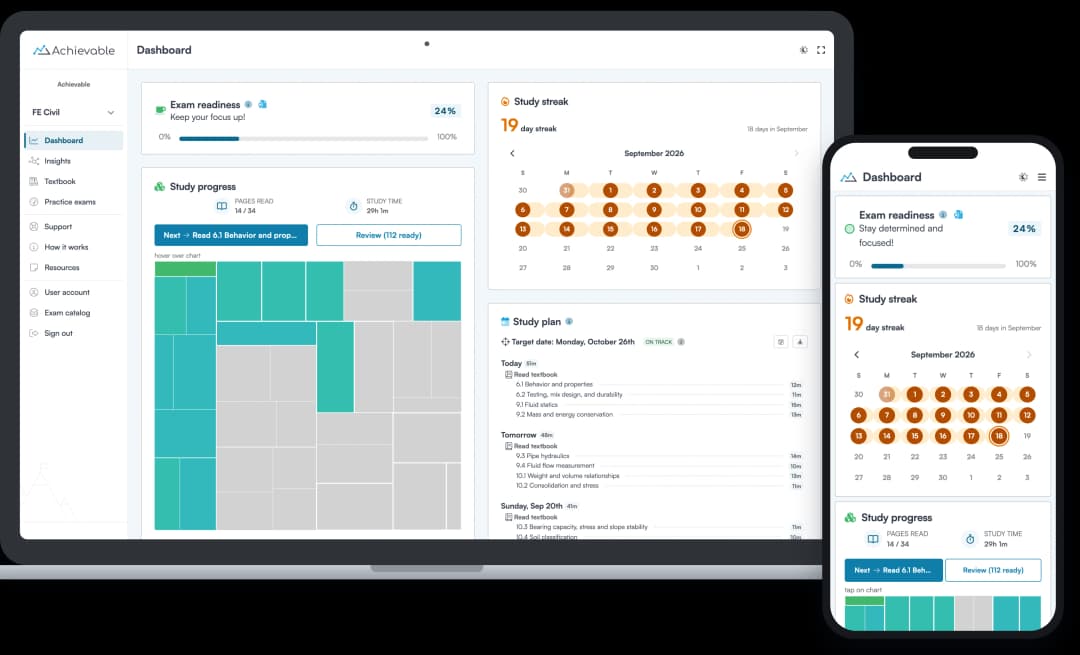
- Seek out smart self-study tools: With a busy schedule, lecture- or video-heavy courses can be hard to fit in. Look for FE study courses that emphasize self-directed learning, digestible reviews, and on-the-go study options.
As you study, you’ll learn which areas need the most work and which tools, such as practice quizzes, word lists, and flashcards, help you most. You’ll also build fluency with the FE Reference Handbook, the standardized, searchable digital guide given to all examinees that contains the formulas and facts you need. Preparing for a standardized test after graduating can be tough, but using your time outside of work efficiently and seeking high-quality resources makes it easier.
Getting started: Ask your employer for reimbursement
Once you decide to take the test, tell your manager. Many employers will help cover your FE exam and preparation, but you generally need to ask. The best approach is to:
- Confirm your employer’s professional-development policy
- Prepare an itemized cost estimate
- Put it in writing before your one-on-one
- Present the request as an investment in the firm
In your written request, explain how the FE exam supports your career goals. Demonstrate your long-term interest in staying with the firm and spell out the value that becoming a PE will bring to your company or office. You might also offer a retention commitment, promising to stay at least a year after passing the FE and expressing enthusiasm about gaining progressive experience in your current workplace.

Additional questions
What happens if you fail the FE exam? How to come back stronger
Failing the FE is usually a bump in the road, not a full stop. If you don’t pass, you’ll receive a detailed score report showing the areas you missed. It can be discouraging, but approach your next attempt with that feedback in mind. If you were using a testing provider, consider switching to a program that better fits your learning style.
Will my previous work experience count toward my PE requirements?
Generally, progressive work experience only counts once you’ve earned your EIT title. In most states, you must pass the FE exam before you can accrue experience toward PE licensure, so check your state board’s rules.
I’ve been out of school for more than a few years. Is it too late to take the FE exam?
Not at all. Many engineers take the FE later in their careers, whether they were balancing other responsibilities, gaining experience, or paying back student loans. There are self-study resources built for engineers returning to their testing requirements well into their careers, helping them get up to speed without overburdening their schedules. Pursuing the FE and eventually the PE is worth it no matter where you are in your career, because it opens the path to higher seniority, higher salaries, and greater professional responsibility and credibility.
Closing
The FE exam plays an important role in engineer licensure and professional development. If it’s been a while since you worked on a trigonometry problem or a material-property calculation, you’ll need to devote time to review. Set up a study schedule, reintroduce yourself to the material, and identify the areas that need the most work. A spaced, targeted approach, plus support from high-quality study materials, will help you reach a new milestone in your career.