Series 7 or Series 65: Which does your firm need you to take?


Table of contents
It depends on how your firm is registered and how you’ll be paid. A broker-dealer role that sells securities on commission needs the SIE and the Series 7, which only a firm can sponsor you for, and in most states the Series 63 as well. A fee-based adviser role at a registered investment adviser (RIA) needs the Series 65, which needs no sponsor and no other exam. A hybrid role, at a firm that does both, usually means the Series 7 plus the Series 66 rather than the 65.
Whichever exam your firm names, Achievable has a course for it: the Series 7, Series 65 and Series 66 courses are $199 each for a full year of access, each with its own full-length practice exams and Achievable’s pass guarantee. Before you pay for anything, try a free full-length practice exam for the Series 7 (125 questions), the Series 65 (130 questions) or the Series 66 (100 questions), and confirm the exam with your firm’s compliance department, since the registration you’ll hold is the firm’s decision, not yours.
The answer by firm type and pay
The two things that decide it are who you’ll work for and what you’ll be paid for. Commissions on securities sales are a broker-dealer’s business, and the people who earn them register with FINRA as registered representatives. Fees for investment advice (a flat fee, an hourly rate or a percentage of the assets managed) are an investment adviser’s business, and the people who give that advice register with the states as investment adviser representatives (IARs).
Firm | How you’re paid | Exams you need |
|---|---|---|
Broker-dealer (a FINRA member firm) | Commissions on the securities you sell | SIE and Series 7, with the firm as your sponsor, plus the Series 63 in most states |
Registered investment adviser (RIA) | Fees for advice: flat, hourly or a share of assets | Series 65 alone: no sponsor and no corequisite |
Both (a dual registrant, or a broker-dealer with an RIA affiliate) | Commissions and advisory fees | SIE, Series 7 and Series 66 (or the Series 63 and 65 in place of the 66) |
A few common cases, read against the table:
- A trainee or "financial advisor in training" program at a wirehouse or a large brokerage. These firms are broker-dealers, and many also run an advisory business, so expect the SIE and the Series 7, and often the Series 66 (or the 63 and 65) after them.
- An associate or paraplanner role at an independent RIA that doesn’t sell products. The Series 65 is the whole requirement, and you can take it before your first day.
- A role at a bank or credit union’s investment program. These are often run through a broker-dealer, sometimes with an advisory program too, so ask which registrations the role carries before assuming it’s the Series 7.
- A firm that sells only mutual funds and variable annuities. That is the narrower Series 6, with the SIE, rather than the Series 7. Ask whether the role will stay that narrow.
To see how a firm is registered, look it up on FINRA’s BrokerCheck, which lists broker-dealers and their representatives, and on the SEC’s Investment Adviser Public Disclosure site, which lists investment advisers. A firm that appears on both is a dual registrant.
Questions to ask your firm’s compliance department before you enroll
The firm files your registrations, so it already knows which exams it needs from you. Ask before you buy a course or pay an exam fee:
- Which registrations will I hold? Registered representative, investment adviser representative or both. This one answer settles most of the rest.
- Will the firm sponsor me for the Series 7, and when? FINRA lets only a candidate associated with and sponsored by a member firm take the Series 7, so the firm opens your enrollment. You can take the SIE on your own beforehand: FINRA says association with a firm isn’t required and the result is valid for four years.
- Series 66, or the Series 63 and 65? If you’ll hold the Series 7 and give advice, ask which the firm prefers. The 66 is one exam ($177) where the 63 and 65 are two ($147 and $187).
- Which states will I be registered in? NASAA says most states require the Series 63 for broker-dealer agents, on top of FINRA’s exams.
- What will the firm pay for? The exam fees (listed below), a prep course, and a retake if you need one. Ask whether it pays up front or reimburses you, and whether any of it is repaid if you leave.
- How long do I have to pass? Firms often set a deadline for each exam as a condition of the job. Know it before you plan your study weeks.
- Does a designation I hold waive the Series 65? NASAA’s list is the CFP®, ChFC, MSFS, CFA, PFS and CIMA designations. Most states accept them in place of the exam, but check with yours.
Series 7, 65 and 66 side by side
Here are the three exams’ facts as FINRA and NASAA state them:
Series 7 | Series 65 | Series 66 | |
|---|---|---|---|
Official name | General Securities Representative Exam | Uniform Investment Adviser Law Exam | Uniform Combined State Law Exam |
Written by | FINRA | NASAA (administered by FINRA) | NASAA (administered by FINRA) |
Firm sponsor needed | Yes, a FINRA member firm | No | No |
Corequisite | SIE | None | SIE and Series 7 |
Scored questions | 125 | 130, plus 10 unscored | 100, plus 10 unscored |
Time | 3 hours 45 minutes | 180 minutes | 150 minutes |
Passing score | 72% | 92 of 130 (about 71%) | 73 of 100 (73%) |
Exam fee | $395 | $187 | $177 |
What it qualifies you to do | Sell all securities products for a broker-dealer | Act as an investment adviser representative | Act as both a securities agent and an investment adviser representative, with the Series 7 |
Two other exams sit beside these. The SIE, the Series 7’s corequisite, is 75 questions in 1 hour 45 minutes, with a passing score of 70 and a $100 fee (FINRA’s SIE page). The Series 63 is 60 scored questions in 75 minutes, passed with 43 correct, for $147. Sources: FINRA’s Series 7, Series 65 and Series 66 pages and NASAA’s exam FAQs.
Plan to sit the Series 65 or 66 at a test center: FINRA offers them online only to candidates who need a testing accommodation, and NASAA’s FAQs say it stops offering remote testing for its exams on January 4, 2027.
Why the Series 66 needs the Series 7
The Series 66 looks like the easier route to an adviser registration, with 30 fewer questions and 30 fewer minutes than the Series 65. But on its own it registers you as nothing. NASAA’s exam study guides page says that passing the Series 66 qualifies you as if you had passed both the Series 63 and the Series 65, and that to register as an investment adviser representative based on the 66 you must also have passed the Series 7, with that exam still valid. NASAA’s FAQs add the SIE: a valid SIE and Series 7 are both corequisites for registering with the Series 66.
So the Series 66 is the right exam only for someone who will hold the Series 7 anyway, which in practice means someone a broker-dealer sponsors. If your firm is an RIA that doesn’t sponsor anyone for the Series 7, the Series 66 would leave you unable to register, and the Series 65 is the exam. Our Series 65 vs 66 guide goes through the two state-law exams in more detail.
What each path looks like from start to finish
Broker-dealer, commission-based:
- Take the SIE, on your own or after you’re hired.
- The firm sponsors you for the Series 7 and opens your enrollment.
- Pass the Series 7, then the Series 63 for the states you’ll be registered in.
- The firm files your registration.
RIA, fee-based:
- Pass the Series 65. You can enroll without a sponsor through FINRA’s site, before or after you’re hired.
- The firm registers you as an investment adviser representative in the states where it needs you.
Hybrid, commissions and fees:
- Take the SIE, then the Series 7 with the firm as sponsor.
- Pass the Series 66, or the Series 63 and the Series 65.
- The firm registers you both as a registered representative and as an investment adviser representative.
How Achievable prepares you for each exam
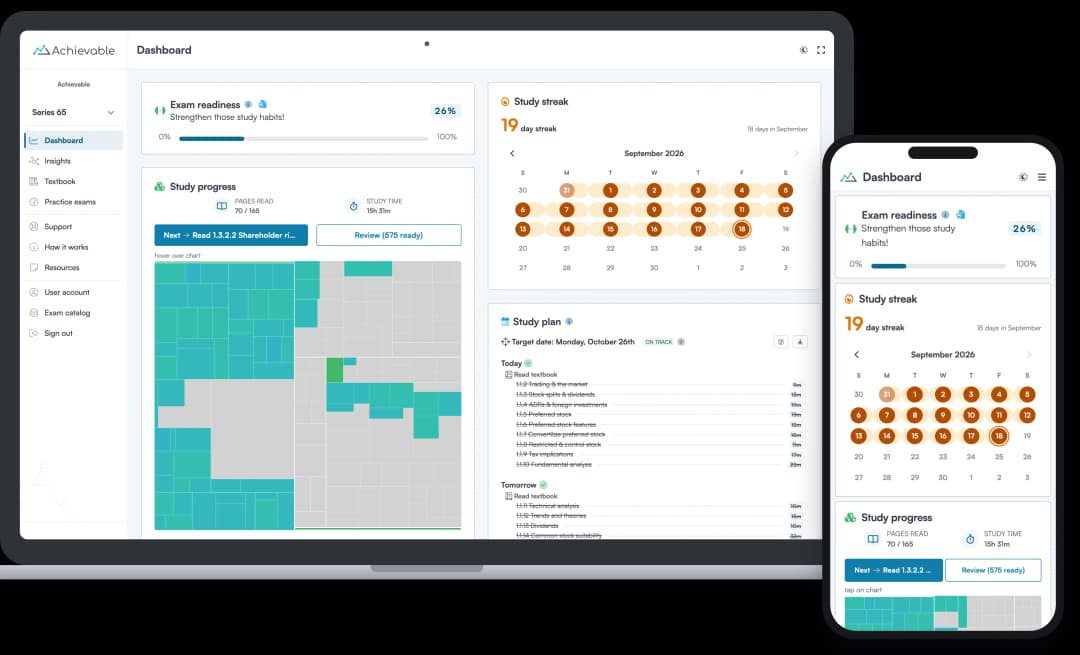
Achievable’s FINRA and NASAA courses share one design: a plain-English online textbook, chapter quizzes and full-length practice exams. Achievable’s pass rates are the industry’s best, and each of the three courses here has its own:
- Series 7: $199 for a full year of access, with 4,700+ practice questions, 35 full-length practice exams and 44 videos. Read the first lessons free, no credit card needed. We tell students to expect about 63 hours of study, over about 11 weeks. Achievable’s Series 7 pass rate is 97%: of the Achievable Series 7 students who completed their prep and reached their scheduled exam date, 97% passed, based on students’ self-reports and our corporate clients’ exam results.
- Series 65: $199 for a full year of access, with 3,300+ practice questions, 23 full-length practice exams and 50 videos. We tell students to expect about 52 hours of study, over about 8 weeks. Achievable’s Series 65 pass rate is 95%: of the Achievable Series 65 students who completed their prep and reached their scheduled exam date, 95% passed, based on students’ self-reports and our corporate clients’ exam results.
- Series 66: $199 for a full year of access, with 3,200+ practice questions, 29 full-length practice exams and 50 videos. We tell students to expect about 48 hours of study, over about 10 weeks. Achievable’s Series 66 pass rate is 95%: of the Achievable Series 66 students who completed their prep and reached their scheduled exam date, 95% passed, based on students’ self-reports and our corporate clients’ exam results.
The SIE course ($99) and the Series 63 course ($79) cover the rest of a broker-dealer or hybrid path.
Achievable’s pass guarantee: pass, or get your money back. Pass one of the course’s full-length practice exams within the standard time before your exam. If you then fail the exam, email a picture of your score report with a valid state ID, and once they’re verified, Achievable refunds the course in full. There is no minimum study time and no chapter to finish. The full terms are in the Achievable FAQ.
If your firm is paying for several new hires at once, Achievable for Organizations gives managers a dashboard that shows who is on track and who needs help, on a SOC 2 Type 2 audited platform.
How ready to be before you book
The bar is the same for all three exams, set against each one’s passing score:
- Before you book the Series 7, aim for 100% readiness: score about 82%, 10 points above the 72% passing score, on practice exams, again and again across several full-length exams, so a pass does not depend on the luck of the draw.
- Before you book the Series 65, aim for 100% readiness: score about 81%, 10 points above the 70.8% passing score, on practice exams, again and again across several full-length exams, so a pass does not depend on the luck of the draw.
- Before you book the Series 66, aim for 100% readiness: score about 83%, 10 points above the 73% passing score, on practice exams, again and again across several full-length exams, so a pass does not depend on the luck of the draw.
Then count back from your firm’s deadline, using the study hours above, to find the day you need to start.
Key takeaways
- The exam follows the firm and the pay: commissions at a broker-dealer mean the SIE and Series 7 (plus the 63 in most states); fees at an RIA mean the Series 65.
- Only a FINRA member firm can sponsor you for the Series 7. The SIE, 63, 65 and 66 need no sponsor.
- The Series 66 counts as the 63 and 65 together, but only with a valid Series 7 and SIE, so it’s for hybrid roles, not for an RIA that doesn’t sponsor the 7.
- Ask compliance which registrations you’ll hold, which states, what the firm pays for and your deadline, before you enroll.
- Achievable’s Series 7, 65 and 66 courses are $199 each for a year, with full-length practice exams, industry-best pass rates and the pass guarantee. Start with a free full-length practice exam.