Two exams down, one to go: Licensing while starting a new job and caring for a newborn


Peter is a Director of QIS Insurance Structured Sales at a sell-side firm in NYC.
Six weeks before my first exam, my second daughter was born. Three weeks before that, I started a new job. I don't recommend this sequencing, but it taught me something about how studying actually works.
Why I was doing this at all
I spent the earlier part of my career on the financial index side at a financial data firm, building and supporting the machinery behind benchmarks, working with the clients who used them, and sitting firmly on the analytics side of the wall. When I moved to a capital markets role structuring investment solutions for insurance clients, the work itself was a natural extension of what I already knew. The regulatory posture was not. A client-facing seat means registration, and registration means the SIE, the Series 7, and the Series 63.
There's a particular humility in studying for an entry-level exam well into a career. I knew a great deal about how index strategies are constructed and almost nothing about settlement conventions for a Euro call option on the SPX. The content wasn't hard so much as it was wide and unfamiliar, exactly where I had no instinct.
The constraint was never comprehension
Everyone warns you that the Series 7 is a volume problem. Worst advice was from all my seasoned friends at sell-side firms (those that took the exams 10 years ago - downplaying the difficulty and all saying "it's not that hard, just take a bunch of practice exams and you'll pass...") Nobody told me that with a toddler and a newborn, the binding constraint isn't understanding the material, it's getting interrupted every eleven minutes.
My older daughter was moving from a crib to a bed right as my younger one arrived, which produced exactly the sleep regression you'd expect. I gave up on the two-hour evening block early on. It was never going to happen, and every night I planned for one and didn't get it, I ended the day feeling like I'd failed.
What replaced it was less satisfying and far more effective: fifteen minutes on the train in the morning, fifteen on the way home, twenty after bedtime if bedtime went well, and one longer weekend block my wife protected for me. That last part deserves more credit than any study technique. None of this works without someone holding the line at home, and she held it while recovering from a delivery.
What actually moved the needle: Three things
I stopped treating practice questions as a measurement tool and started treating them as the study method itself. Reading a chapter felt productive. Getting a question wrong and then reading the explanation of why is what made anything stick.
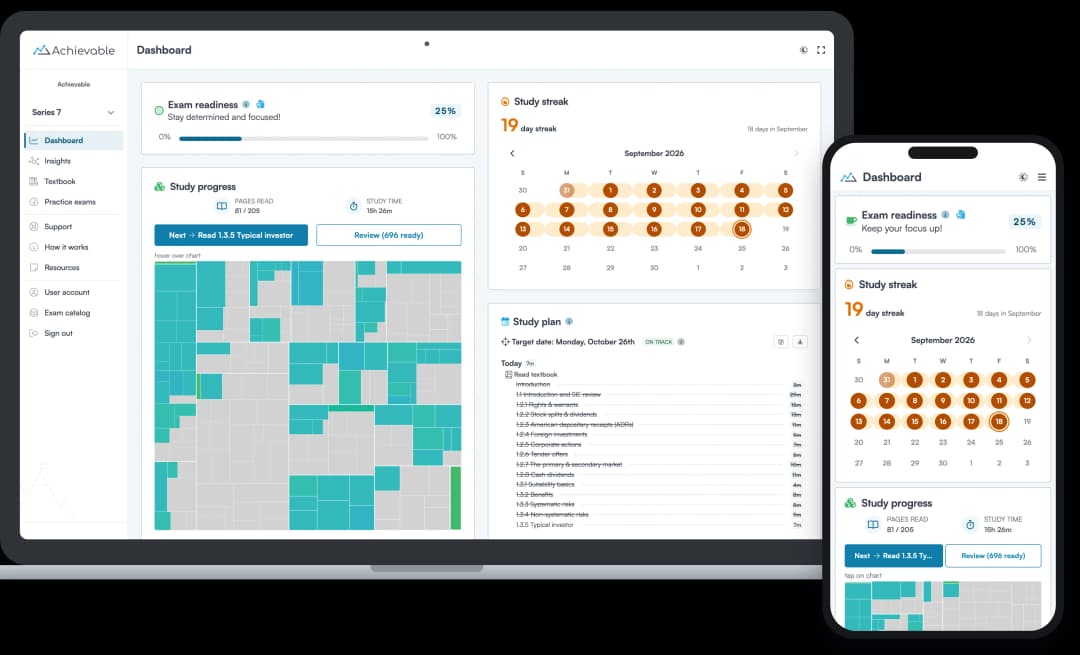
I mapped all three exams onto one calendar instead of running them as three separate projects. Seeing the whole runway at once made the SIE–Series 7 overlap obvious, so I stopped re-learning covered ground. It also exposed days when I'd overloaded myself beyond what any person with two small kids could finish, which let me fix the plan instead of failing it.
And I built a rhythm: full practice exam, targeted review of the weak chapters, then another full exam. Two exams back-to-back told me nothing. An exam, a day of repair work, then another exam told me whether the repair worked.
Test day
For the SIE, I was more nervous than the material warranted. For the Series 63, I was calmer, partly the familiar rhythm of the testing center, partly because I'd stopped chasing the last five percent the night before. The evening before an exam isn't a study session. It's a sleep session. I learned that by getting it wrong first.
Both passed. The Series 7 (2nd attempt) is at the end of this month, and I know it's a different animal, longer, broader, less forgiving of thin spots. But the system is built, and the system was the hard part.
If you're at the start of this, you won't get the study conditions you want. Plan for the ones you have. Fifteen honest minutes on a train, done daily, beat a two-hour block you keep postponing until the house is quiet because in some seasons, the house is never quiet, and the exam date doesn't move. But if I can do it, you can too. Give yourself credit. It's bold to surprise yourself, and passing these exams is a badge of honor - not a right to earn anything but proof you've been through the same grind just like all your peers.