

Series 9
study guide
Every chapter of the course summarized, with each section linked to its lesson.
Pass the first time
Try Achievable Series 9
No credit card required
This free Series 9 study guide summarizes all 4 chapters of Achievable's Series 9 course: what each covers, the points to remember, and its 56 sections in order. Read each chapter after you study it, or work through the whole guide before exam day.
Each section links to its full lesson in Achievable, with the review quizzes and full-length practice exams.
Chapter 1: Introduction
2 sections
Free chapter
- Options strategies: Contract fundamentals and types include single-leg, hedging, income, straddle, and spread strategies, and non-equity options included.
- Customer and rules: Customer accounts include account opening procedures, types of account registrations, margin account rules, and dispute resolution processes, while rules & regulations cover registration requirements, reporting, compliance, and taxation rules.
- Foundations and exam: The exam has 60 multiple-choice questions, 55 graded questions, a 70% passing score, and a 90-minute time limit, and issuers, securities, SEC, FINRA, and the OCC define the market framework.
In this chapter
Start this chapter free
Chapter 2: Strategies
30 sections
- Options basics: Options contracts are derivative securities that provide the right to perform a transaction at a fixed price for speculation, protection, or income.
- Expiration and rights: Standard options expire at 11:59pm ET on the third Friday of expiration month, and buyers have the right while sellers have the obligation.
- Market and contracts: The OCC standardizes, issues, guarantees performance, and clears trades, while options trades occur on CBOE and settle in one business day (T+1).
- Contract details: Option contracts cover 100 shares of stock, the strike price is the fixed exercise price, and non-standardized contracts include Jumbo and Mini.
- Premium and exercise: Premium = intrinsic value + time value, Delta predicts premium change, American-style options can be exercised at any time, and European-style options only at expiration.
- Basic strategies: Long calls and long puts are bullish or bearish rights to buy or sell, while short calls and short puts are obligated positions with formulas based on premium and strike.
- Advanced spreads: Collars, straddles, combinations, ratio strategies, and spreads use different legs, strikes, expirations, or wings to shape sentiment, risk, and breakevens.
- Non-equity and suitability: Index, VIX, foreign currency, and yield-based options derive value from their underlying measure, and suitability depends on the strategy’s risk, income, or volatility objective.
In this chapter
- FundamentalsFree
- Contracts & the market
- Basic strategies
- Advanced strategies
- Non-equity options
- Suitability
Start this chapter free
Achievable Series 9
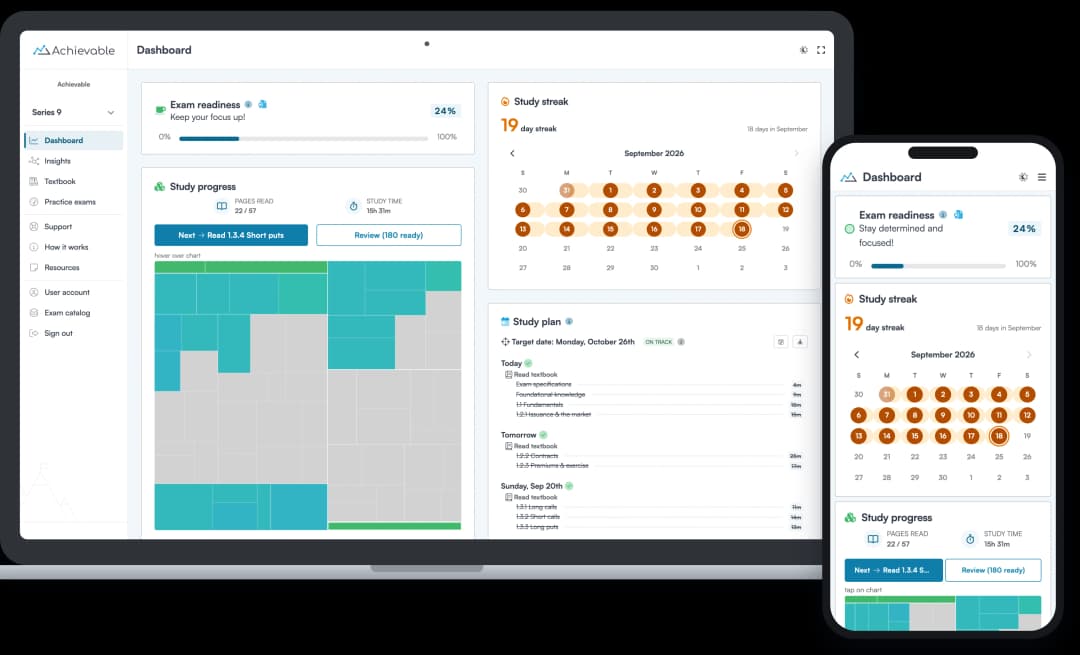
Series 9 exam prep course and study materials with a pass guarantee: online textbook, 1,600+ practice questions, and 25 full-length practice exams.
25 full-length Series 9 practice exams
1,600+ practice questions with explanations
21+ video lessons and audio narration
Pass guaranteed, or your money back
Chapter 3: Customer accounts
9 sections
- Opening records: Collect name, DOB, address, and SSN or TIN under the Patriot Act, verify them through valid government-issued I.D. or credit bureau database, and maintain records for six years.
- Options accounts: Open with a new account form, ODD, options supervisor approval, first trade, and a signed options agreement within 15 days, with suitability information confirmed by a negative confirmation letter.
- Fiduciary standards: Fiduciaries act in the best interest of the account owner, and discretionary trades, POA authority, guardianship, UGMA/UTMA, and trust accounts all follow specific authority and documentation limits.
- Margin requirements: Margin accounts use leverage, require the Regulation T 50% deposit and $2,000 minimum equity, and portfolio margin, SMA, and pattern day trading each add special rules and disclosures.
- Dispute rules: Written complaints go to a principal, mediation is voluntary, and arbitration is final and binding with claim-size procedures, arbitrator types, and six year limits.
In this chapter
- Opening accounts
- Margin accounts
- Dispute resolution
Study this chapter in Achievable
Chapter 4: Rules & regulations
15 sections
- Form U-4 filing: Form U-4 is the registration form for persons in finance, filed when joining a firm, updated when information changes, and it contains an embedded arbitration agreement.
- Fingerprinting and U-5: Fingerprints are required of all firm employees unless specific access or supervision exceptions apply, must be sent to the FBI within 30 days of U-4 submission, and Form U-5 removes registration status when leaving a firm.
- Disclosures and reporting: Statutory disqualifications may prevent or revoke registration, Form U-6 reports disciplinary actions, reportable events, and arbitration/litigation results, and legal or ethical violations must be reported within 30 days.
- CBOE trading structure: The CBOE is the primary options trading exchange, with DPMs, market makers, floor brokers, TPHs, a hybrid system, RAES, electronic and complex order books, rotations, and circuit breaker halts at 7%, 13%, and 20%.
- Manipulation and execution: Fast markets can trigger added CBOE regulatory authority, market manipulation is prohibited, and best execution requires considering the market's character, transaction size and type, markets checked, quote accessibility, and order terms.
- Options and taxes: Position and exercise limits apply on the same side of the market, LOPR reports 200 or more contracts by T+1 at 9:00pm CT, stock splits and dividends adjust contracts in specified ways, and exercise and tax rules follow the stated premium and holding-period rules.
- Communications and compliance: Public communications must be clear, fair, documented, and properly classified, Regulation BI, suitability, AML, and record retention rules impose specific obligations, and recordkeeping periods run from 3 years to lifetime with past 2 years readily available.
In this chapter
- Registration & reporting
- The market
- Options contracts
- Taxation
- Public communications
- Other rules & regulations
Study this chapter in Achievable
Series 9 exam at a glance
- Questions
- 55 multiple-choice questions
- Time
- 1 hour 30 minutes
- Passing score
- 70% (39/55)
- Exam fee
- $175
More on the Series 9 exam
- Series 9 exam prep courseAchievable's course: online textbook, review quizzes and full-length practice exams.
- Series 9 exam format, content and scoringWhat's tested, how long it takes, what it costs, and the score you need to pass.
- Free Series 9 practice examPractice questions written to match the real thing, with an explanation for every answer.
- Series 9 FAQThe questions asked most about the exam and preparing for it, answered.
- Best Series 9 exam prep coursesHow the leading providers compare on content, format and price.
- Series 9 study resourcesGuides and study advice from Achievable's instructors.
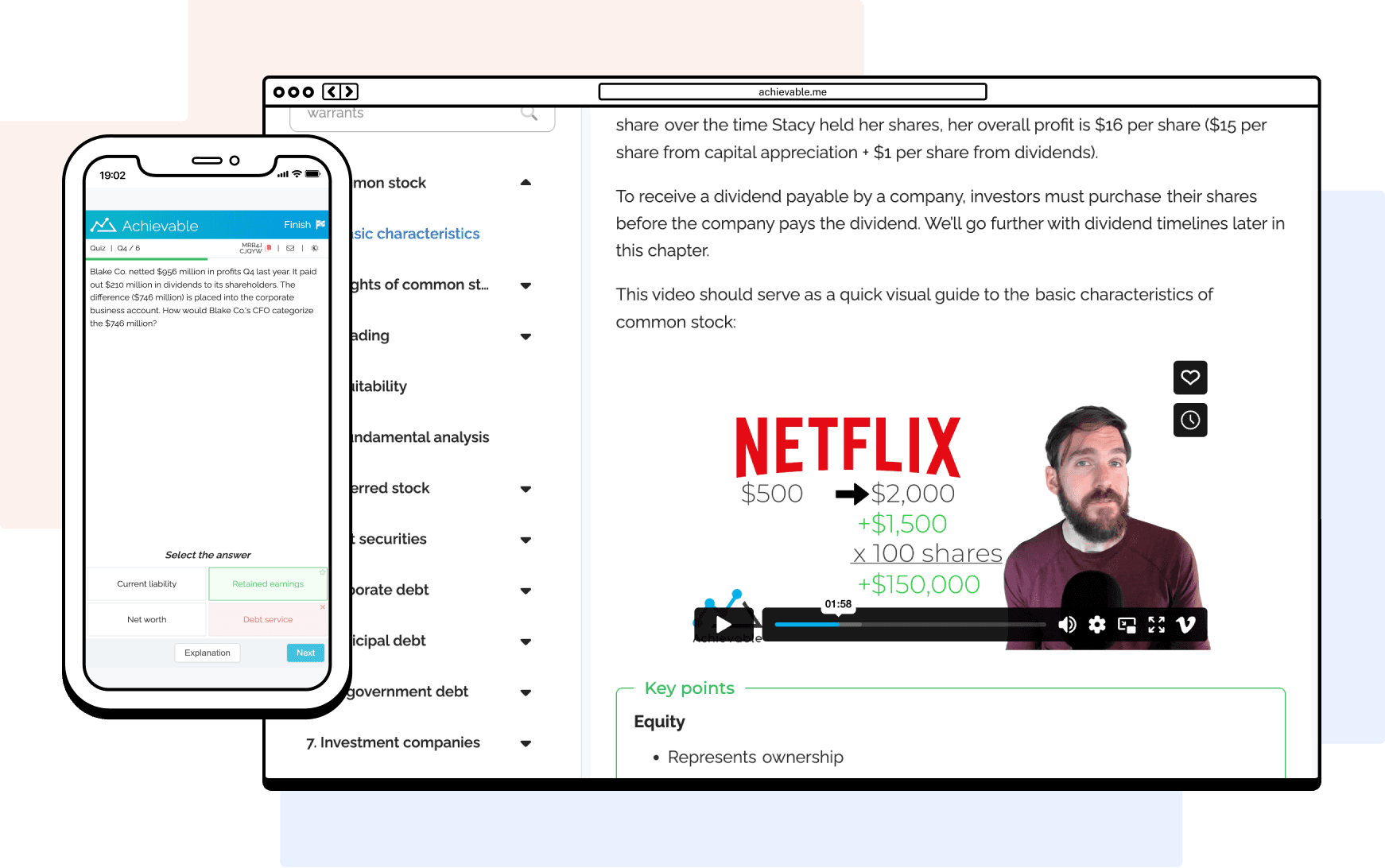
Pass the FINRA Series 9. Guaranteed.
Achievable is the best Series 9 exam prep course: effective, personalized, and convenient. With Achievable, you'll spend less time studying and pass your exam the first time, or your money back.