From portfolio tracking to passing the SIE: My exam prep story


Zachary Moss is a Finance student at the University of Houston's C.T. Bauer College of Business, where he maintains a 3.83 GPA and is expected to graduate in May 2027. He recently passed the FINRA SIE exam and manages a self-directed investment portfolio spanning equity and ETF positions across multiple sectors. Zachary also built StockLens, a personal equity research platform that aggregates live fundamentals, SEC filings, and macro indicators into a composite investment grade powered by the Claude API.
I've been obsessed with markets since before I could legally trade them. By the time I enrolled in the Finance program at the University of Houston's C.T. Bauer College of Business, I was already managing my own investment portfolio and building a personal equity research platform in my spare time. So when I decided to sit for the FINRA Securities Industry Essentials exam, it felt less like a box to check and more like a way to prove to myself, and to recruiters, that my interest in the industry was serious.
Why the SIE?
The honest answer is that I wanted an edge. I'm not at a target school. I don't have a family connection on a trading desk. What I do have is a strong GPA, some real technical skills, and the willingness to go further than the average finance student. Passing the SIE before anyone required me to feel like a concrete way to signal that. It also gave me a chance to fill in the gaps in my formal education: securities regulations, market structure, and investment products. My coursework touched on these topics, but didn't go deep enough for my taste.
The biggest challenge: Studying without a deadline
Most people studying for the SIE are doing it because their firm just hired them and gave them 90 days. I had no external deadline, no study group, and no one holding me accountable. That made it surprisingly hard to stay consistent. The material isn't brutal, but it's dense, and when you're also carrying a full course load, working part-time, and actively recruiting for internships, "I'll study tomorrow" becomes a very easy thing to tell yourself.
The turning point for me was treating the exam like a project with a real timeline. I picked a test date, worked backward, and committed to 45-minute sessions on weekday mornings before my first class. Not glamorous, but it worked.
What actually helped
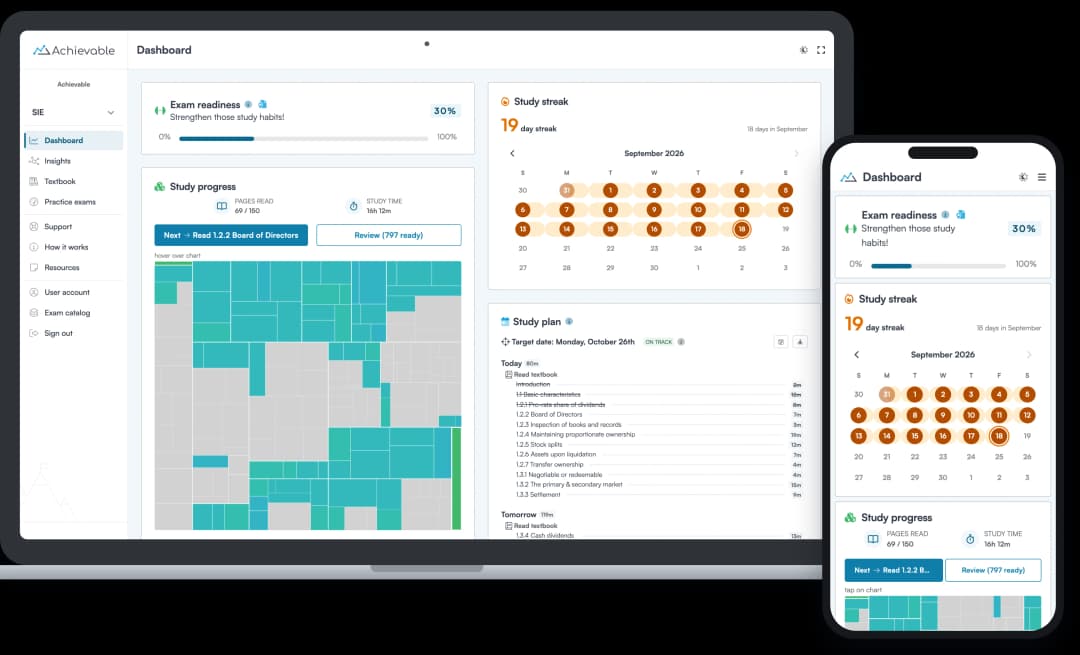
Achievable's approach clicked for me in a way that static textbooks didn't. The adaptive question sets kept me honest. I couldn't just skim a chapter and assume I understood it. Every time I thought I had a topic locked down, the platform would surface a question that revealed a blind spot. That feedback loop was genuinely useful, especially for topics like options mechanics and regulatory frameworks, where the devil is always in the details.
I also appreciated that the explanations didn't talk down to me. I've built financial models, I've parsed SEC filings, and I can handle real content. Achievable gave me that.
Test day
It was calmer than I expected, honestly. I'd done enough practice that the question format felt familiar. There were a few moments where I had to slow down and think carefully. Some of the regulatory questions are written to trip you up if you're moving too fast, but I never felt lost. I walked out confident before I saw the result.
What I'd do differently
Start earlier. I compressed my studying more than I needed to in the final two weeks, which added unnecessary stress. The material rewards steady review over cramming.
What's next
I'm planning to take the Series 63 next. It doesn't require sponsorship, and it's a natural follow-on. Longer term, I'm in the middle of recruiting for finance internships in investment banking and equity research, and I'm hoping the combination of my technical background and having the SIE on my resume helps open some doors that might otherwise take longer to crack.
If you're a finance student on the fence about taking the SIE before you have a job offer: do it. It took a few months of consistent effort, and it's already changed how I talk about myself in interviews.