SIE study plan: A 6-week schedule, week by week


Table of contents
- The 6-week SIE study plan at a glance
- Week-by-week breakdown
- Week 1: Equities and debt basics
- Week 2: Government debt and pooled investments
- Week 3: Options, taxes and the primary market
- Week 4: Markets and customer accounts
- Week 5: Rules and ethics, then the first full exams
- Week 6: Full-length practice exams
- How the plan is built
- Adjust the plan to your schedule
- The last few days before the exam
- Build your own SIE plan in Achievable’s study planner
- About the SIE exam
- Key takeaways
You can be ready for the SIE in about six weeks if you study 1 to 2 hours a day. Spend the first four and a half weeks working through the 15 chapters of Achievable’s SIE course, taking a short quiz after each chapter, then use the last week and a half for full-length practice exams. The plan below lays that out week by week, using the same time estimates as the study planner in our app.
The 6-week SIE study plan at a glance
Week | What to study | Approx. time |
|---|---|---|
1 | Chapters 1–4: common stock, preferred stock, debt securities and corporate debt, with a quiz after each chapter | 9 hours |
2 | Chapters 5–8: municipal debt, US government debt, investment companies and alternative pooled investments, plus the chapters 1–4 checkpoint | 10 hours |
3 | Chapters 9–11: options, taxes and the primary market, plus the chapters 5–8 checkpoint and Midterm 1 | 10 hours |
4 | Chapters 12–14: the secondary market, brokerage accounts, and retirement and education plans, plus the chapters 9–11 checkpoint | 10 hours |
5 | Chapter 15 (rules and ethics), the chapters 12–15 checkpoint, Midterm 2, then Final exams A and B | 10 hours |
6 | Full-length SIE practice exams, with the days between them spent on review | 10 hours |
Each week’s time covers reading, the review questions at the end of each section, and the quizzes and exams, all at the planner’s estimates. A chapter quiz is 20 questions, a checkpoint or midterm is 40, and a full practice exam is 75 questions, the same length as the real exam.
Week-by-week breakdown
Week 1: Equities and debt basics
Start with the short introduction, then read chapter 1 on common stock, the longest chapter of the first week. It covers shareholder rights, dividends, stock splits, ADRs and how stock trades, and much of it comes back in later chapters. Chapters 2 through 4 cover preferred stock, how bonds are issued and traded, their features and their yields and corporate debt. Take each chapter’s quiz the day you finish the chapter, while the material is fresh, and read the explanation for every question you miss.
Week 2: Government debt and pooled investments
Open the week with the checkpoint on chapters 1–4. It mixes questions from all four chapters, which is a better test of what you’ve kept than a single chapter quiz. Then read chapters 5 and 6 on municipal and US government debt, chapter 7 on investment companies (mutual funds, closed-end funds, ETFs and unit investment trusts) and chapter 8 on alternatives such as REITs and direct participation programs. Chapter 7 is long and heavily tested, so give it two or three sessions.
Week 3: Options, taxes and the primary market
Take the chapters 5–8 checkpoint and Midterm 1, which covers everything so far. Then move to chapter 9, options. Many candidates find it the hardest chapter in the course, so slow down: learn calls and puts, buyers and sellers, before the strategies. Chapters 10 and 11, on taxes and on how new securities are issued and registered, are shorter.
Week 4: Markets and customer accounts
After the chapters 9–11 checkpoint, read chapter 12 on the secondary market (the exchanges and over-the-counter markets, order types and the rules on customer orders), chapter 13 on brokerage accounts and chapter 14 on retirement and education plans. Chapter 13 has more sections than any other, but most are short: statements and confirmations, customer information, account types, margin accounts and SIPC coverage.
Week 5: Rules and ethics, then the first full exams
Finish chapter 15, on the regulators and the conduct rules (market manipulation, insider trading, communications with the public and the rules for registered representatives), then the wrapping-up section. The chapters 12–15 checkpoint and Midterm 2 (chapters 9–15) show which half of the course needs more review. End the week with Final exams A and B, your first two full-length practice exams. Sit each one in a single, timed session of 1 hour 45 minutes, the same as test day.
Week 6: Full-length practice exams
Take the full SIE practice exam five times, spread across the week, about every other day. Each sitting draws a fresh set of questions from the course’s question bank. On the days between, go back through the questions you missed or guessed on, and reread the sections they came from. When your scores sit comfortably above the 70% passing mark, rather than just reaching it, you’re ready to book or keep your test date.
How the plan is built
The plan totals about 59 hours over six weeks, an average of about an hour and a half a day, seven days a week. That’s in line with the 55 hours or so Achievable SIE students log on average before exam day. Reading takes about 28 of those hours, including the review questions at the end of each section. Quizzes, checkpoints, midterms and practice exams take the other 31, at the planner’s estimate of each exam’s time limit plus a fifth for reviewing your answers.
Days with a full practice exam run a little over 2 hours. If you work full time, put those on days off. The order follows the course: each quiz comes right after its chapter, each checkpoint after a group of chapters, and the full-length exams come only after you’ve read everything, so every score reflects the whole exam.
Adjust the plan to your schedule
Six weeks suits most people with a job or classes, but the plan stretches or shrinks:
- More time: spread the reading over two or three months at 30 to 45 minutes a day, and keep the last week and a half for practice exams.
- Less time: at 3 to 4 hours a day, the same plan fits in about three weeks. Don’t cut the practice exams; cut the time between them.
- Weekdays or weekends only: add a week or two, or move the practice exams to the days you have the most time.
- A finance background: take each chapter’s quiz before you read the chapter. If you score well, skim it and move on.
- Practice scores stuck below passing: add a week. Reread the chapters where you miss the most questions and retake their checkpoints before the next full exam.
The last few days before the exam
Don’t start new material in the final two or three days. Use them to retake the checkpoint for your weakest group of chapters, reread your notes on the questions you keep missing, and take one last full exam no later than two days out. The day before, check the details of your appointment: whether you test at a Prometric center or online, the ID you need, and, for an online exam, that your computer and room meet the requirements. You’ll see your result on screen when you finish.
For how long other candidates study and where their time goes, see how long to study for the SIE.
Build your own SIE plan in Achievable’s study planner
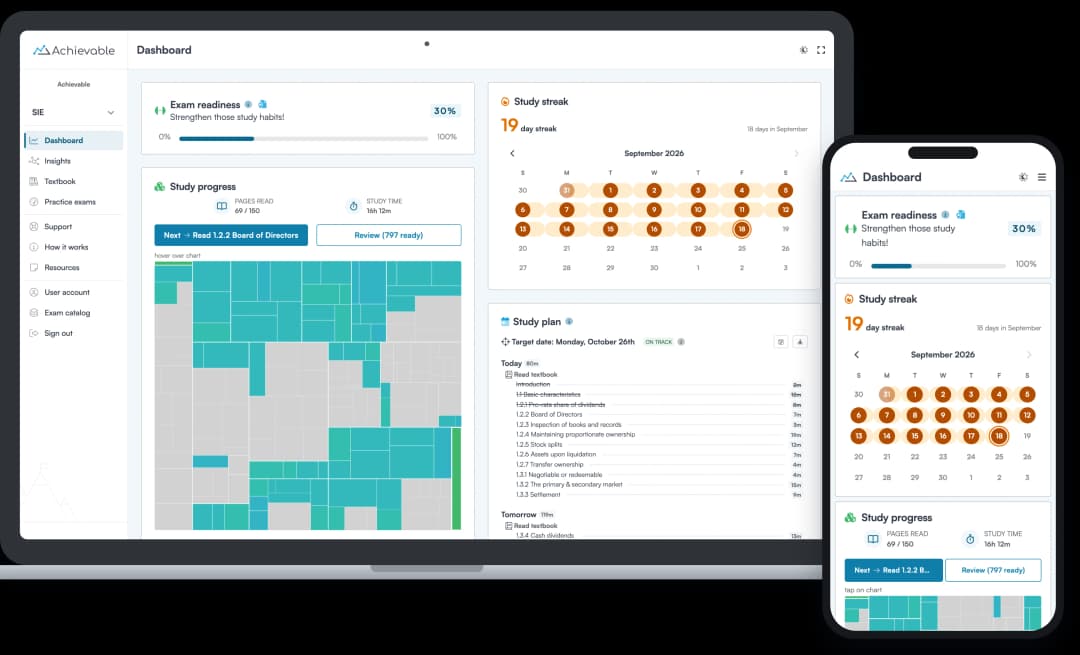
This calendar is a fixed version of what the study planner in Achievable’s SIE course does for you. Enter your exam date and choose which days you’ll study (every day, weekdays or weekends), and it lays out every textbook section, quiz and practice exam across those days, with a time estimate for each. As you check tasks off, it shows whether you’re on track for your date, and you can print the plan.

The course includes the online textbook, the chapter quizzes, checkpoints and midterms in this plan, and the full-length practice exams. You can also try a free SIE practice exam before you start.
About the SIE exam
The Securities Industry Essentials (SIE) exam is FINRA’s entry-level exam. It has 75 multiple-choice questions, you have 1 hour 45 minutes, and the passing score is 70. You don’t need a sponsoring firm to take it, and a passing result stays valid for four years. The questions come from four areas:
- Understanding products and their risks: 44% (33 questions)
- Understanding trading, customer accounts and prohibited activities: 31% (23 questions)
- Knowledge of capital markets: 16% (12 questions)
- Overview of the regulatory framework: 9% (7 questions)
That weighting is why the plan spends its first three weeks on products. See our SIE exam information page for the full outline, and FINRA’s page on scheduling your exam when you’re ready to book. Many candidates take the Series 7 study plan next.
Key takeaways
- Six weeks at 1 to 2 hours a day is enough for most people to prepare for the SIE.
- Spend about four and a half weeks on the 15 chapters, with a quiz after each chapter and a checkpoint after each group of chapters.
- Leave the last week and a half for seven full-length practice exams, with review days between them.
- Book your test once your practice scores are comfortably above 70%.
- Achievable’s study planner builds this kind of plan around your own exam date and study days.