

SIE
study guide
Every chapter of the course summarized, with each section linked to its lesson.
Pass the first time
Try Achievable SIE
No credit card required
This free SIE study guide summarizes all 15 chapters of Achievable's SIE course: what each covers, the points to remember, and its 148 sections in order. Read each chapter after you study it, or work through the whole guide before exam day.
Each section links to its full lesson in Achievable, with the review quizzes and full-length practice exams.
Chapter 1: Common stock
17 sections
Free chapter
- Equity and growth: Equity represents ownership, and capital appreciation occurs when stock prices rise, which are driven by supply and demand.
- Company earnings: Retained earnings are profits retained by the company.
- Cyclical and defensive: Cyclical stocks perform well during economic expansion, while defensive stocks provide essential goods and services and outperform during contractions or recessions.
- Stockholder rights: Common stockholders receive a pro-rata share of dividends, elect the board of directors through proxies, and can inspect books and records through required financial disclosures.
- Ownership maintenance: Dilution lowers your ownership percentage when total outstanding shares increase, and pre-emptive rights help maintain proportionate ownership by giving first opportunity to buy newly issued shares.
- Dilution and splits: Warrants, convertible securities, and stock options are dilutive, and stock splits require shareholder approval while changing share count and price per share without changing overall value.
- Trading and dividends: Common stock is negotiable, trades in the primary and secondary markets, settles T+1 on a regular way basis, and cash dividends follow declaration, record, payable, and ex-dividend dates.
- Risk and valuation: Common stock can provide capital appreciation and income, but investors face systematic and non-systematic risk, and the PE ratio equals market price per share ÷ earnings per share.
In this chapter
- Basic characteristicsFree
- Rights of common stockholders
- Trading
- SuitabilityFree
- Fundamental analysisFree
Start this chapter free
Chapter 2: Preferred stock
3 sections
- Basic characteristics: Preferred stock is an equity security but behaves like fixed income, with fixed, predictable dividend income that is typically paid quarterly and requires Board of Directors approval.
- Yield and features: Dividend rate is fixed at issuance on par, current yield changes with market price, and investor-friendly features like cumulative or convertible preferred stock generally mean higher market prices and lower yields.
- Risks and suitability: Preferred stock is riskier than bonds because dividends are not legally required, and it suits investors who seek income as the primary benefit and accept moderate risk with long-term time horizons.
In this chapter
Study this chapter in Achievable
Chapter 3: Debt securities
6 sections
- Basic bond terms: Debt securities let issuers borrow from investors, and principal, par value, and interest describe the original loan amount, face value, and cost of borrowing money.
- Maturity and issuance: Bond maturity and coupon determine payments, while term issuance, serial issuance, and series issuance describe when bonds are issued and when they mature.
- Trading and settlement: Bond prices move inversely to interest rates, settle T+1, and accrued interest is paid by the buyer to the seller until the payment date.
- Features and yields: Secured, callable, and puttable bonds shift risk, and yield relationships change across discount, premium, and par bonds based on coupon, price, and maturity.
Study this chapter in Achievable
Chapter 4: Corporate debt
7 sections
- Commercial paper: Commercial paper is short-term zero coupon corporate debt with a 270-day maximum maturity and is exempt from SEC registration.
- Long-term debt: Funded debt is long-term corporate debt, and debentures are long-term unsecured corporate bonds, also known as full faith and credit bonds, and riskier than secured bonds.
- Secured and special bonds: Guaranteed bonds are considered unsecured bonds, income (adjustment) bonds are high-risk securities, and mortgage bonds, equipment trust certificates (ETCs), and collateral trust certificates are secured by corporate real estate, corporate equipment, and marketable corporate assets.
- Convertible and mezzanine debt: Convertible bonds convert to common stock of the same issuer, and mezzanine debt is long-term corporate debt placed between senior debt and equity for liquidation purposes.
- Market and foreign debt: Most corporate bond trades occur in the OTC markets, corporate bond quotes use percentage of par format, CDs and banker's acceptances are bank issues, and Eurobond and Eurodollar bonds are not subject to SEC jurisdiction or registration.
Study this chapter in Achievable
Chapter 5: Municipal debt
6 sections
- Tax treatment: Municipal bond interest is exempt from federal taxes and subject to state and local taxes, while US territory bond interest is tax-free regardless of residence.
- General obligation bonds: General obligation bonds fund non-self-supporting projects and are paid off with property (ad valorem) taxes, with competitive bids awarding the bond to the cheapest underwriter.
- Revenue and notes: Revenue bonds finance self-supporting municipal ventures, and anticipation notes are short-term municipal debt paid off with future municipal cash flows.
- Trading and suitability: The municipal bond market has higher levels of liquidity risk and no short sales, and municipal bond suitability is best for wealthy investors at high tax brackets.
Study this chapter in Achievable
Chapter 6: US government debt
9 sections
- Government debt basics: U.S. Government debt is considered virtually default risk-free, directly backed by the U.S. Government, and the largest securities market in the world.
- Treasury products: Treasury bills, notes, bonds, STRIPS, and TIPS differ by maturity, interest payment timing, denomination, and risk, and Treasury bills are auctioned weekly while all other Treasury products are auctioned monthly.
- Agency securities: Agency bonds are indirectly backed by U.S. Government and subject to some default risk, while mortgage-backed securities make monthly payments of interest and principal and are subject to prepayment, extension, and reinvestment risk.
- Treasury market quotes: Treasury securities are initially offered in a Treasury auction, competitive bids set the yield for the entire offering, non-competitive bids are filled, and government debt quotes are generally percentage of par quotes.
- Fed and economy: Monetary policy controls money supply levels through the Federal Reserve Board, and tools of the Federal Reserve include discount rate, open market operations, reserve requirements, and margin requirements (Reg T).
Study this chapter in Achievable
Chapter 7: Investment companies
14 sections
- Investment companies: Financial institutions that invest their customers' money and are regulated by the Investment Company Act of 1940.
- Company classifications: Investment company classifications are management companies, unit investment trusts (UITs), and face amount certificates.
- Fund objectives: Fund type is based on investment objective and securities held, with key types including growth, balanced, income, specialized, sector, index, asset allocation, and international/global.
- Open-end funds: Mutual funds are open-end management companies with shareholders, variable shares outstanding, primary market purchases, and prospectus delivery required at sale.
- Shareholder rights: Shareholders may vote on the Board of Directors, the adviser contract, fund-specific matters, and receive pro-rata dividends and required fund disclosures.
- Transactions and share classes: Mutual fund transactions use forward pricing with NAV, loaded funds buy at POP and sell at NAV, and Class A, B, and C shares differ in sales charges and 12b-1 fees.
- Other fund types: Closed-end funds trade in the secondary market, ETFs are negotiable and usually passive, ETNs are debt instruments with default risk, UITs have fixed portfolios, and alpha and beta measure performance and volatility.
In this chapter
- Foundations
- Types of funds
- Open-end management companies
- Closed-end management companies
- Exchange traded products
- Unit investment trusts
- Alpha and beta
Study this chapter in Achievable
Chapter 8: Alternative pooled investments
3 sections
- REIT basics: Real estate investment trusts (REITs) typically invest in commercial real estate properties and mortgages, are negotiable securities, and qualify for conduit rule.
- Hedge fund traits: Hedge funds are unregulated investment funds for only wealthy investors, with high risk and high gain potential and subject to lock-up periods.
- DPP structure: Direct participation programs (DPPs) pass through business returns and losses to investors, and limited partnerships are the most common form with general partners and limited partners.
Study this chapter in Achievable
Achievable SIE
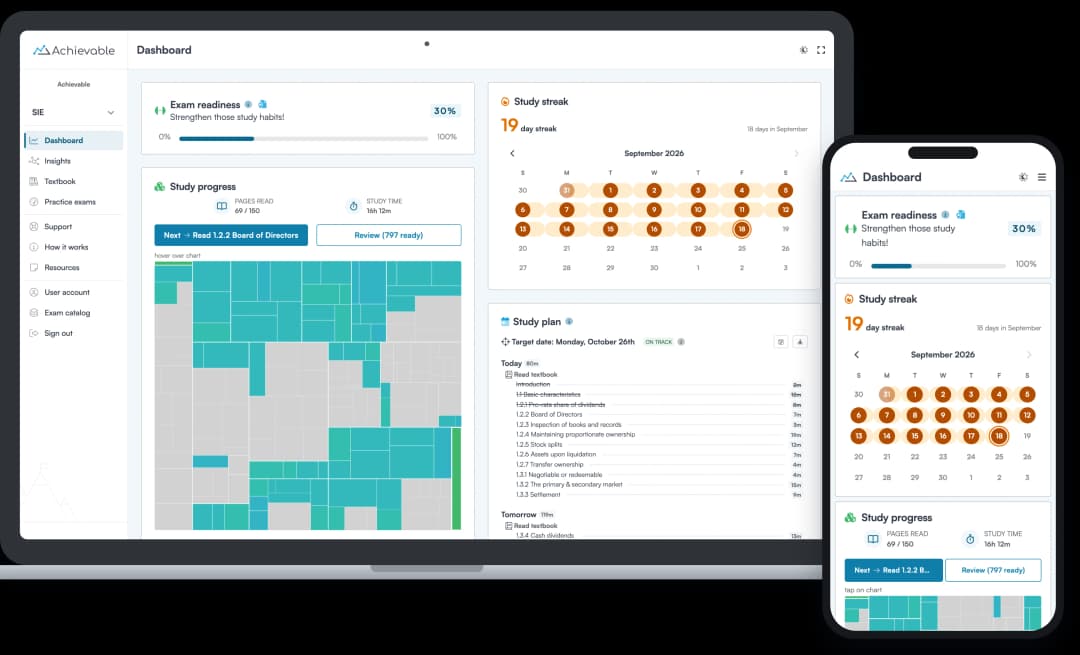
SIE exam prep course and study materials, 98% pass rate: online textbook, 3,800+ practice questions, and 40 full-length practice exams.
40 full-length SIE practice exams
3,800+ practice questions with explanations
36+ video lessons and audio narration
Pass guaranteed, or your money back
Chapter 9: Options
12 sections
- Option basics: Options contracts are derivative securities that provide the right to perform a transaction at a fixed price and can be used for speculation, protection, and income.
- Market mechanics: The Options Clearing Corporation (OCC) standardizes options, issues options, guarantees option performance, and clears trades, while options trades occur on Chicago Board Options Exchange (CBOE) and settle in one business day (T+1).
- Contract terms: Option contracts cover 100 shares of stock, the strike price is the fixed exercise price, and the premium is in multiples of 100.
- Rights and styles: Long options give the right to exercise the contract, short options create an obligation if assigned, standard options expire up to 9 months, and LEAPS are long-term options of up to three years.
- Calls, puts, and adjustments: Call options and put options have ITM and OTM conditions, premium equals intrinsic value plus time value, American style options can be exercised at any time, and European style options can only be exercised at expiration.
- Strategies and index options: Long calls and long puts are bullish or bearish investments with set maximum gain, loss, and breakeven formulas, while covered and hedging strategies use stock positions, and index options derive value from index fluctuations and are mostly European style except OEX.
In this chapter
Study this chapter in Achievable
Chapter 10: Taxes
4 sections
- Dividend taxation: Cash dividends from equity investments and passed through via mutual funds, closed-end funds, and ETFs are generally taxed at lower rates than bond interest, but tax treatment varies by security/transaction type and directly impacts investor's overall return.
- Qualified dividends: Qualified dividends are taxed at 0%, 15%, or 20% based on individual/joint filer income levels, while non-qualified dividends are taxed at the investor's marginal federal income tax bracket.
- Interest and gains: Interest is taxable only on the interest portion, with US Government debt taxed federally and exempt from state and local taxes, municipal debt exempt from federal taxes, and capital gains reported on 1099-B and taxed by holding period.
- Income categories: Earned income includes wages, salaries, tips, bonuses, and commissions and is taxable at the marginal income brackets, investment income includes interest, dividends, and capital gains, and passive losses only offset passive gains.
In this chapter
Study this chapter in Achievable
Chapter 11: The primary market
9 sections
- Primary market role: The primary market is the initial sale of a security by the issuer to investors, and proceeds always go to the issuer.
- Issuers and underwriters: Issuers sell securities to raise capital, while underwriters are hired by issuers to sell new issues and are also known as investment banks.
- SEC requirements: The Securities and Exchange Commission (SEC) requires issuers to register securities unless an exemption exists.
- Underwriting commitments: Firm underwriting commitments make the underwriter liable for unsold shares, while best efforts commitments make the issuer liable for unsold shares.
- Offering types: IPOs are the first public sale, APOs are a public sale after the initial sale, and private placements sell securities to private audiences.
Study this chapter in Achievable
Chapter 12: The secondary market
15 sections
- Secondary market basics: Trading occurs after initial issuance, investors trade with other investors at current market price, and firms earn revenue by facilitating trades as agent or principal.
- Agency and principal: Agency capacity matches customer orders for a commission with no inventory risk, while principal capacity trades from inventory for mark-ups or mark-downs with inventory risk.
- Market participants: Traders work for clients, broker-dealers may act in an agency or principal capacity, and market makers buy and sell with the public only in a principal capacity.
- Bid ask trading: Market makers maintain bid/ask spreads, buy at the bid, sell at the ask, and a round lot is 100 shares of stock.
- Major markets: The New York Stock Exchange is an auction market with a DMM, NASDAQ is a negotiated OTC market with numerous market makers, and OTC markets include OTCQX, OTCQB, OTCID Basic Market, and Pink Limited Market.
- Exchange regulation: The Securities Exchange Act of 1934 regulates the secondary market, applies to non-exempt securities and all market participants, and its anti-fraud rule applies to all securities.
- Customer orders: Market orders guarantee execution but not price, limit orders guarantee price or better but not execution, stop orders trigger then become market orders, and stop limit orders become limit orders after the trigger.
In this chapter
- Agency vs. principal capacity
- Roles
- Bid & ask
- The markets
- The Securities Exchange Act of 1934
- Customer orders
Study this chapter in Achievable
Chapter 13: Brokerage accounts
23 sections
- Quarterly statements: Quarterly statements can be sent by mail or electronically.
- Monthly statements: Monthly statements are sent if penny stocks are held in account and can be sent by mail or electronically.
- Holding mail: Holding customer mail requires the customer's written instructions giving the time period and can last up to 3 months.
- Trade confirmations: Trade confirmations are sent for each individual transaction and must include key trade details, including the firm's capacity and accrued interest for bond trades.
- Complaint records: A complaint is written dissatisfaction, forwarded to a principal for review, and kept on file for 4 years at OSJ.
- New account data: The four critical pieces of information are name, DOB, address, and SSN or TIN, and they must be verified as per Patriot Act.
- Ownership and authority: Individual, joint, POA, discretionary, custodial, guardianship, trust, business, and prime brokerage accounts each have specific ownership, authority, and probate rules.
- Margin and options: Margin accounts require the greater of Reg T 50% or FINRA minimum $2,000, options accounts require the five steps and ODD, and SIPC insurance is up to $500k per registration.
In this chapter
- Fundamentals
- New accounts
- Account registrations
- Margin accounts
- Options accounts
- Other account specifications
Study this chapter in Achievable
Chapter 14: Retirement & education plans
7 sections
- Cash and tax basics: Contributions must be made in cash only, most plans are tax-deferred, deductible contributions reduce taxable income immediately, and non-deductible contributions use after-tax funds.
- Investments, distributions, penalties: Prohibited investments include short sales, margin, uncovered/naked options, collectibles, and art, while distributions are generally taxed as ordinary income and excess contribution penalty is 6%.
- ERISA and workplace plans: Qualified plans meet legal requirements under ERISA, must follow minimum participation/non-discrimination, reporting and disclosure, funding, vesting, and plan document rules, and include defined benefit and defined contribution plans.
- IRAs and annuities: Traditional IRAs, Roth IRAs, Roth 401(k)s, and inherited IRAs follow distinct contribution, deductibility, withdrawal, RMD, and beneficiary rules, while variable life insurance and annuities use separate accounts and specific tax treatment.
- Education and disability plans: Coverdell ESAs, 529 plans, and ABLE accounts provide tax-sheltered education or disability savings with contribution limits, qualified-distribution rules, and penalties for nonqualified use.
Study this chapter in Achievable
Chapter 15: Rules & ethics
13 sections
- SEC and FINRA: The SEC regulates the primary and secondary markets, while FINRA regulates the financial industry and its participants.
- Registration forms: U-4 is filed when joining a firm, updated when information changes, and includes an arbitration agreement, while U-5 removes registration status when leaving.
- Fingerprinting and disqualifications: All applicants submit fingerprints within 30 days of U-4 submission, and statutory disqualifications may prevent or revoke registration.
- Other regulators: MSRB writes municipal regulations but does not enforce them, and NASAA regulates the financial industry at the state-level under the Uniform Securities Act.
- Prohibited conduct: Market manipulation, unethical activities, and insider trading are prohibited, including painting the tape, frontrunning, churning, and trade based on material non-public info.
- Investor protection rules: Trusted contact person, fund disbursement holds, elder abuse reporting, money laundering controls, Regulation S-P, and TCPA rules all protect customers and restrict conduct.
- Communications and records: FINRA rules govern correspondence, retail communications, proxies, CE, outside activities, gifts, disputes, and record retention requirements.
In this chapter
- The regulators
- Prohibited activities
- Ethical duties
- Other laws & regulations
Study this chapter in Achievable
SIE exam at a glance
- Questions
- 75 multiple-choice questions
- Time
- 1 hour 45 minutes
- Passing score
- 70% (53/75)
- Exam fee
- $100
More on the SIE exam
- SIE exam prep courseAchievable's course: online textbook, review quizzes and full-length practice exams.
- SIE exam format, content and scoringWhat's tested, how long it takes, what it costs, and the score you need to pass.
- Free SIE practice examPractice questions written to match the real thing, with an explanation for every answer.
- SIE FAQThe questions asked most about the exam and preparing for it, answered.
- Best SIE exam prep coursesHow the leading providers compare on content, format and price.
- SIE study resourcesGuides and study advice from Achievable's instructors.
Pass the FINRA SIE. Guaranteed.
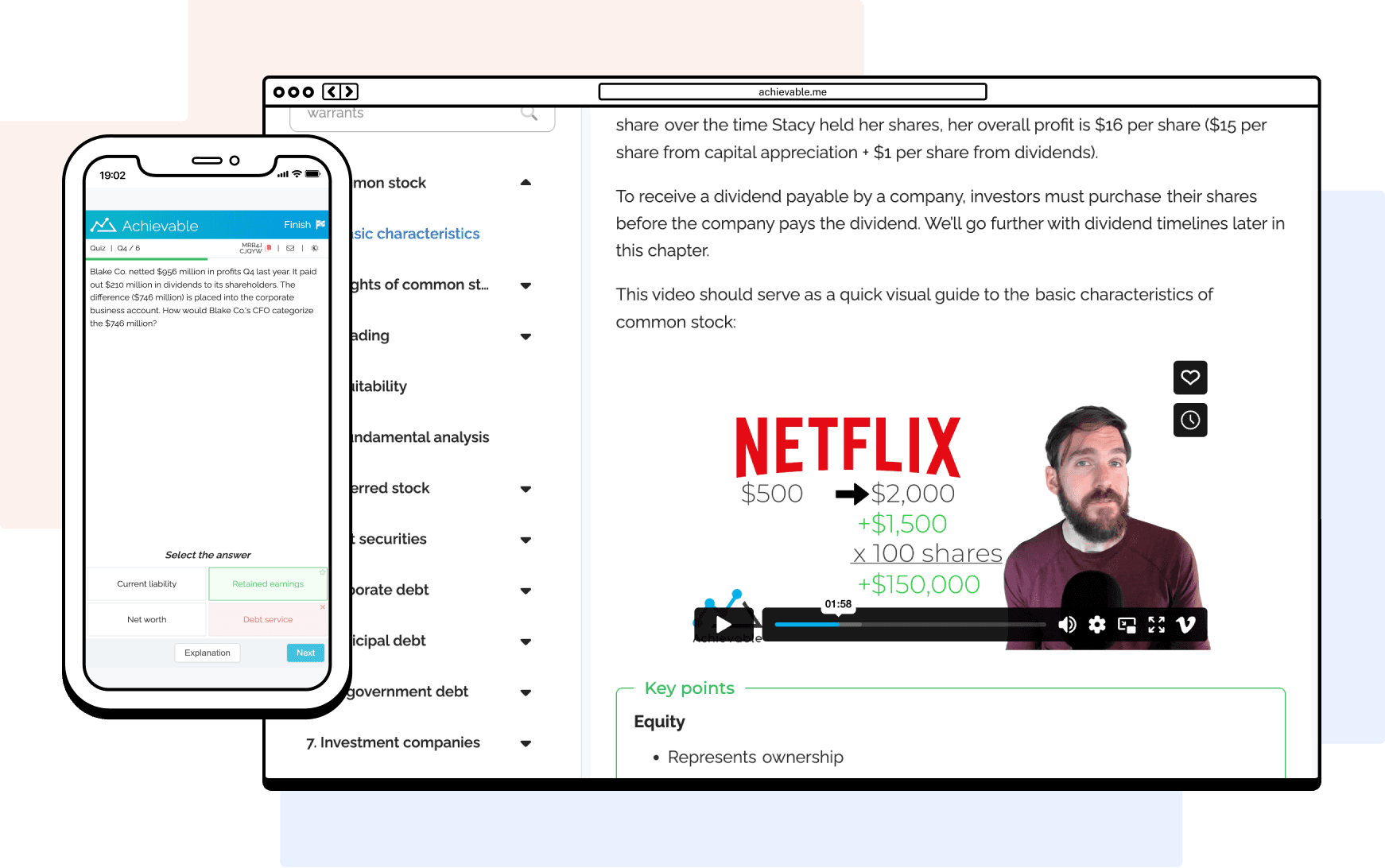
Achievable is the best SIE exam prep course: effective, personalized, and convenient. With Achievable, you'll spend less time studying and pass your exam the first time, or your money back.