SIE study time: How long is enough?


Table of contents
- What is the SIE?
- Hardest topics on the SIE
- How long should I study for the SIE overall?
- How to allocate your SIE study time effectively
- How long should I spend practicing with quiz questions?
- How long should I spend reading the textbook?
- How many SIE practice tests should I take?
- Train your brain for noticeable score gains
- Final thoughts
Financial licensing exams can be the bridge to an exciting new career path, whether you’re a recent graduate or an established professional making a switch. But preparing for exams like the Securities Industry Essentials (SIE) isn’t as simple as putting everything else on hold. Most candidates are balancing multiple responsibilities, including finance-heavy coursework, demanding jobs, and family commitments. Going into your prep with a clear sense of how long to study and how to allocate your time can bring much-needed structure to an often-uncertain process.
That said, figuring out the most productive way to organize your study plan (and whether it’s possible to under- or overprepare) isn’t always straightforward. At Achievable, we design flexible courses that adapt to busy schedules while still following proven learning strategies. Curious about what truly works best, we analyzed our SIE course data to uncover the most effective study approach.

By examining real data from test-takers like you, we identified a clear pattern: the most successful preparation combines focused, well-rounded study with high-impact practice. This includes engaging with high-quality instructional material, reinforcing concepts through quiz questions, and completing full-length exams to build mastery and improve scores.
What is the SIE?
If you’re new to licensing or building a career in financial services, it’s important to know that it all starts with the SIE. Passing the Securities Industry Essentials (SIE) exam is often the first step for individuals looking to establish themselves in the finance industry, opening doors to advanced certifications such as the General Securities Representative Qualification Examination, or the Series 7. The SIE, a 75-question, entry-level securities exam, is a common requirement for many early-career finance positions and is recognized as a key credential by employers across the industry. Earning the SIE helps candidates stand out in a competitive job market and provides a solid foundation for pursuing full professional licensing.
A strong performance on the SIE exam demonstrates that a candidate understands critical financial topics, including:
- The core characteristics of different investment products
- Fundamental financial regulations and industry compliance standards
- Basic principles of securities trading, buying, and selling
- The rules, responsibilities, and ethical standards governing the securities industry
There are no prerequisites to take the exam, though achieving a score of 70% or higher is required to proceed with additional securities licenses and further credentials. Studying for the SIE exam and diving headfirst into financial nomenclature prepares candidates for both the test itself and future roles in financial services.
Hardest topics on the SIE
The SIE exam covers a wide range of foundational topics crucial for those preparing to enter the field of finance. For many candidates, especially those new to the field, some topics can seem particularly challenging or opaque. Based on our internal data, the chapters and subjects in Achievable’s SIE textbook that learners most frequently struggle with include Options, Investment Companies, Common Stock fundamentals, and U.S. Government Debt securities.

To address these tough areas, every chapter in Achievable’s SIE course includes a final assessment designed as a review exam to reinforce knowledge. Consistently, average scores on practice exercises for the more difficult chapters hover just above the 70% passing threshold that defines competency.
Several other SIE exam topics are perceived as easier by candidates, including municipal debt securities, primary market mechanisms, tax rules, and various alternative pooled investments. In these sections, students typically excel in end-of-chapter SIE exams and targeted practice questions. Effectively preparing for the SIE means being aware of your own performance across these topic areas.
Adapting your study plan to target weaker subjects can make a significant difference. Fortunately, Achievable’s dynamic platform does this automatically, analyzing your results and personalizing your preparation, so you can focus your efforts precisely where they’re needed most.
How long should I study for the SIE overall?
Study schedules for the SIE can take many forms: yours will depend largely on your prior knowledge and familiarity with the material. Some candidates can pass after a few weeks of studying, while others need to spread out their preparation over several weeks or months to succeed. We found that learners who used Achievable studied for an average of 57 hours (the median was even lower at about 54 hours). This time includes reviewing the textbook, answering practice questions, and completing mock exams.

As you can see, there’s a lot of variation between test-takers, with the largest share studying between 50 and 75 hours. If, theoretically, you were to devote one hour of studying per day, you could expect to study for seven to ten weeks for the SIE based on this data. Of course, every candidate studies at a different pace, which is why Achievable’s platform automatically adjusts your study calendar based on your study goals. Aiming to study 60 hours, especially if you’re relatively new to finance or have not taken a standardized assessment in a while, is a good starting point.

In terms of calendar days, we found complementary results from Achievable students: the average test-taker spent 78 days studying for the SIE, with a large cluster of candidates studying between four and 12 weeks. These results are wide-ranging and sensitive to extreme values, so the median provides a better sense of how long a typical test-taker can expect to allocate to SIE study (about 60 days). By planning for about one hour of studying per day, you’re sure to meet the appropriate threshold for preparation for most candidates.
How to allocate your SIE study time effectively
When looking at how Achievable SIE students divide their time between reading the textbook, answering quiz questions, and completing exams, most of their time is devoted to practice exercises. On average, test-takers spend about 37% of their time on quizzes, 34% on exams, and 31% on the textbook. This translates to about 18 total hours of reading and 39 total hours of reviewing the material (completing both quizzes and full-length practice assessments).

This highlights the importance of actively engaging with material rather than passively skimming, and of using consistent reinforcement to deepen understanding. It becomes even more critical when you’re starting from a point where improvement is needed.
Scoring low on an initial exam can feel discouraging, but it doesn’t define your path. Many students score well below the passing threshold on their first exam, and this is not necessarily because they lack knowledge: in many cases, they may simply be unfamiliar with the exam format and question wording, resulting in lower-than-expected scores.

As you can see, students who started with a score below 50% and went on to pass their final knowledge test allocated even more time to practice tests (45%) than the average student. They also spent more time studying overall, which goes to show that you can’t cut corners in your preparation: no matter where your starting point is, you must create a plan that positions you to finish strong.
How long should I spend practicing with quiz questions?
The largest share of Achievable’s SIE candidates spent 15-20 hours completing practice problems, which are indispensable for reinforcing and fully understanding complex content. Note that this chart reflects hours spent drilling quiz questions, and does not include time spent on full-length practice exams (roughly about 20 additional hours on average).

Working through practice questions after learning a new topic reinforces your understanding and helps you get familiar with how those concepts will appear on the test. The SIE and other Financial Industry Regulatory Authority (FINRA) exams are known for their ambiguous, somewhat convoluted questions, so regular exposure to licensing exam question styles will make taking the actual test more approachable.
How long should I spend reading the textbook?
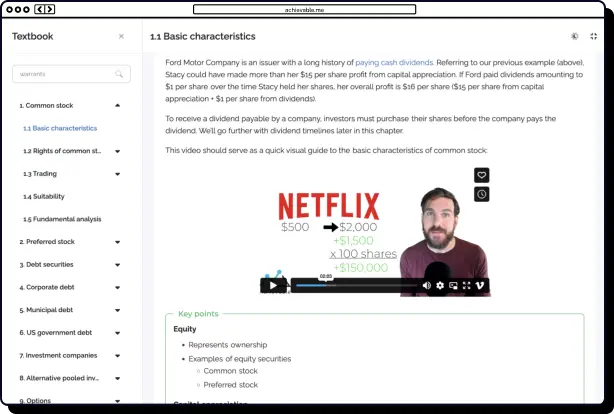
After a long day of class or work, many SIE candidates might find the thought of delving into a textbook exhausting. Still, regular reading and thorough review are necessary to build a strong foundation. Comprehensive textbook study allows you to grasp financial concepts in greater detail, going beyond the surface-level understanding achieved through practice questions alone.
Remember: Studying for the SIE is more than just test prep: it’s an investment in your future finance career, where mastering specialized knowledge is key.

As mentioned above, on average, students spent about 18 hours actively reading the textbook during their exam preparation, though individual study times ranged from just 12 to over 30 hours. If you have an affinity for reading or find financial material engaging, working through the textbook may feel less daunting and more enjoyable. The amount of textbook study you’ll need will ultimately depend on your personal learning style. Selecting a well-written, engaging text is crucial for making this part of your study plan both manageable and highly effective, particularly when tackling complex financial topics.
Pro study tip: If you’re stuck, try reinforcing challenging sections with supplemental video resources that break down core exam concepts, further strengthening your understanding and boosting retention. Combining reading with listening to the textbook is especially effective for auditory learners.
How many SIE practice tests should I take?
The average number of SIE practice exams completed by Achievable’s test-takers was approximately ten. We strongly encourage candidates to take as many full-length SIE practice exams as possible, as the most significant score improvements were seen after completing more than three mock exams.

When it comes to the amount of time dedicated to full-length exam practice, most students completed about 20 hours of mock-test prep. While drilling concepts with quiz questions matters a lot, completing realistic, timed SIE practice exams during your prep is the best way to truly gauge your readiness for the exam.

Overall, high-engagement practice (quizzes + exams) accounted for nearly 40 hours of a typical test-taker's total study time:

Every student’s study plan is unique, and Achievable provides access to over 35 SIE practice exam options for truly comprehensive preparation. When working through a full-length SIE practice exam, aim to replicate the official testing environment: eliminate distractions, use a timer, and avoid referencing your notes during the test (but do make note of challenging questions for later review).
Train your brain for noticeable score gains
So, how do you know if your efforts are worth it? Our data show exceptional improvements for learners who engaged with established study methods. When comparing initial exam results with final test scores, the majority of test-takers exceeded the passing threshold on their last (most recently completed) assessment:

Completing quiz questions also makes a noticeable difference in final grades. There was a noticeable jump in final exam performance from examinees who completed fewer than 1,500 practice questions and those who completed more. Learners who completed an impressive 3,000 questions or more saw the best final exam results.

Of course, when you’re in the thick of studying, you can sometimes find yourself plateauing in your results after a certain amount of time. When looking at percent changes in exam performance from the first to the final test, we found that the greatest improvements came from test-takers who studied 50-60 hours. Students in this category saw a nearly 50% increase in their final test scores, rivaling the improvements of students who studied well over this amount.

This highlights three key points: first, many students begin at a level where roughly 50-60 hours of study is optimal, with additional time yielding diminishing returns; second, Achievable’s SIE test-takers represent a diverse population with varying backgrounds and study needs; and third, it's about how you study, not necessarily how much.
Students who studied fewer than 10 hours tended to show smaller average score improvements, though some may have started with a stronger baseline and therefore needed less preparation. Those who invested more time but saw moderate gains may have come from non-finance backgrounds and required additional study to reach a passing level. Overall, relying too much on one method of studying (reading, quizzes, or practice exams) may not be as effective as breaking up study hours between tasks that work your brain differently.
Regardless of your path into the financial industry, it’s important to be honest about the amount of preparation you’ll need, set bold but achievable study goals, and be open to flexibility. Life happens to us all, and what’s important is that you take the time to ensure you’ll score a 70% or above on test day.

Final thoughts
Here’s a rundown of what we learned:
- Don’t skimp out on the textbook: true proficiency starts with thoroughly understanding the material.
- Practice questions are one of the most effective ways to raise your score; for many learners, spending slightly more time on questions than reading leads to better outcomes.
- Completing full-length practice exams leads to clear improvements in final test performance.
- A well-structured but flexible study plan helps make your preparation more efficient and less rigid.
This guide isn’t meant to be a strict formula, but rather a set of principles to help you approach your studying more effectively. Ultimately, it reinforces that proven study strategies for the SIE do work, and now it’s up to you to apply them in a way that fits your routine. With the right approach, even the most challenging financial topics can be mastered over time, with effort and meaningful engagement.