

GRE
study guide
Every chapter of the course summarized, with each section linked to its lesson.
Reach your target score
Try Achievable GRE
No credit card required
This free GRE study guide summarizes all 4 chapters of Achievable's GRE course: what each covers, the points to remember, and its 75 sections in order. Read each chapter after you study it, or work through the whole guide before exam day.
Each section links to its full lesson in Achievable, with the review quizzes and full-length practice exams.
Chapter 1: Vocabulary approach
Free chapter
- GRE vocabulary role: Vocabulary is not tested as a separate skill, but it is essential for distinguishing challenging words and understanding context.
- Page features: Each vocabulary page provides definitions, supplementary info, example sentences, and a quiz at the end.
- Review method: Flashcards can create a false sense of mastery and inefficient review scheduling, while memory-tracked vocabulary quizzes use memory algorithms for optimal review timing.
Start this chapter free
Chapter 2: Quantitative reasoning
62 sections
- Section overview: The GRE Quantitative section has 12 or 15 questions per section and 21 or 26 minutes to complete, so study schedule and missed problems matter.
- Question formats: Quantitative comparison, multiple choice, number entry, and data interpretation appear in fixed ranges per section, and each format uses its own answer structure.
- Comparison rules: Quantitative comparison is always first, compares Quantity A vs. Quantity B, and uses A, B, C, or D for the relationship.
- Choice and entry rules: Multiple choice uses ovals or squares, number entry requires typing an answer, and data interpretation often comes in sets with extra distracting data.
- Equation notation: GRE math allows , , or for multiplication, several forms for division, and parentheses control exponent results.
- Arithmetic and algebra: Sign rules, defined versus undefined expressions, fractions, percent change, radicals, exponents, functions, and quadratic equations all rely on careful algebraic manipulation.
- Number properties: Divisors, multiples, prime factors, GCF, LCM, permutations, combinations, sequences, ratios, probability, and SOLE problems each use specific counting or factor rules.
- Geometry and statistics: Mean, median, percentiles, standard deviation, and data interpretation join angles, triangles, polygons, circles, 3D shapes, coordinate graphs, and line equations in the geometry chapter.
In this chapter
- Quant introFree
- Arithmetic & algebra
- Positive negative problemsFree
- Defined & undefinedFree
- GRE vocabulary list 01 (alacrity)Free
- Odd even problemsFree
- GRE vocabulary list 02 (adulterate)Free
- AlgebraFree
- Fraction math
- GRE vocabulary list 03 (abstain)
- Percent change
- GRE vocabulary list 04 (anachronism)
- Function problems
- GRE vocabulary list 05 (ameliorate)
- Divisors, prime factors, multiples
- Greatest common factor (GCF) & Least common multiple (LCM)
- GRE vocabulary list 06 (acumen)
- Permutations and combinations
- GRE vocabulary list 07 (aesthetic)
- Decimals
- GRE vocabulary list 08 (aggrandize)
- FOIL and quadratic equations
- GRE vocabulary list 09 (anodyne)
- Exponent rules
- GRE vocabulary list 10 (aberrant)
- Square roots and radicals
- Sequences
- Venn diagrams & tables
- Ratios
- Mixtures
- Probability
- Algebra word problems
- Number line, absolute value, inequalities
- Simple and compound interest
- System of linear equations (SOLE)
- Positive negative problems
- Statistics and data interpretation
- Geometry
- Angles
- Triangle basics
- Sum of interior angles
- Pythagorean theorem
- Right triangles (45-45-90)
- Right triangles (30-60-90)
- Triangle inequality theorem
- Coordinate plane
- Equation for a line
- Graphing inequalities
- Graphing parabolas
- Graphing circles
- Parallel and perpendicular lines
- Quadrilaterals
- Circles
- 3D shapes
- Polygons
- Regular polygons
- Shaded region problems
- Strategies
Start this chapter free
Achievable GRE
Hit your GRE target score on the first try with Achievable's interactive online exam preparation course. Includes everything you need: unlimited quantitative practice questions, an easy-to-understand online textbook, 24 verbal / reading comprehension practice exams, 250 vocabulary words, and unlimited instant essay grading.
Easy-to-understand online textbook
Infinite randomized questions
200+ quant templates
30+ verbal sections
250 vocab words
Unlimited essay grading

Chapter 3: Verbal reasoning
10 sections
- Verbal section overview: The GRE Verbal Section tests reading comprehension, verbal reasoning, and vocabulary in 12 or 15 questions over 18 or 23 minutes, using text completion, reading comprehension, and sentence equivalence.
- Question type focus: Text completion and sentence equivalence rely on verbal reasoning and vocabulary, while reading comprehension requires analyzing dense passages and drawing conclusions.
- Practice structure: There are no repeatable review quizzes for verbal, and full-length verbal sections on the practice exams page can be taken only once, so complete the verbal reasoning chapter first.
- Text completion strategy: Read the entire sentence or passage first, create your own filler word from context clues, and match answer choices to that filler word in meaning and tone.
- Sentence equivalence methods: Guess the blank before viewing choices, group answers into synonym pairs, and use vocabulary plus mirrored or logical context to find the pair matching your predicted meaning.
- Reading comprehension approach: Use the author’s perspective and textual evidence to answer regular and reasoning prompts, identify facts and conclusion in arguments, and choose the option that most directly strengthens or weakens the claim.
In this chapter
- Verbal intro
- Text completion and sentence equivalence
- Reading comprehension
Study this chapter in Achievable
Chapter 4: Analytical writing
2 sections
- Intro essay basics: The GRE Issue Essay is the first section of the GRE exam, takes 30 minutes to write, and is graded on essay-writing skills and English language skills.
- Grading benchmarks: A strong essay directly answers the prompt, stays on topic, uses clear, logical, and convincing arguments, and maintains effective logical flow with correct spelling, grammar, and variety in sentence structures.
- Structure and strategy: Take a clear position on a debatable claim, use a 5-paragraph essay format, and support it with pro/con planning, a concise thesis and conclusion, and practice that limits brainstorming to ~6 minutes.
In this chapter
Study this chapter in Achievable
GRE exam at a glance
- Questions
- 56 multiple-choice questions and 1 essay
- Time
- 1 hour 58 minutes
- Exam fee
- $249
More on the GRE exam
- GRE exam prep courseAchievable's course: online textbook, review quizzes and full-length practice exams.
- GRE exam format, content and scoringWhat's tested, how long it takes, what it costs, and the score you need to pass.
- Free GRE practice examPractice questions written to match the real thing, with an explanation for every answer.
- GRE FAQThe questions asked most about the exam and preparing for it, answered.
- Best GRE exam prep coursesHow the leading providers compare on content, format and price.
- GRE study resourcesGuides and study advice from Achievable's instructors.
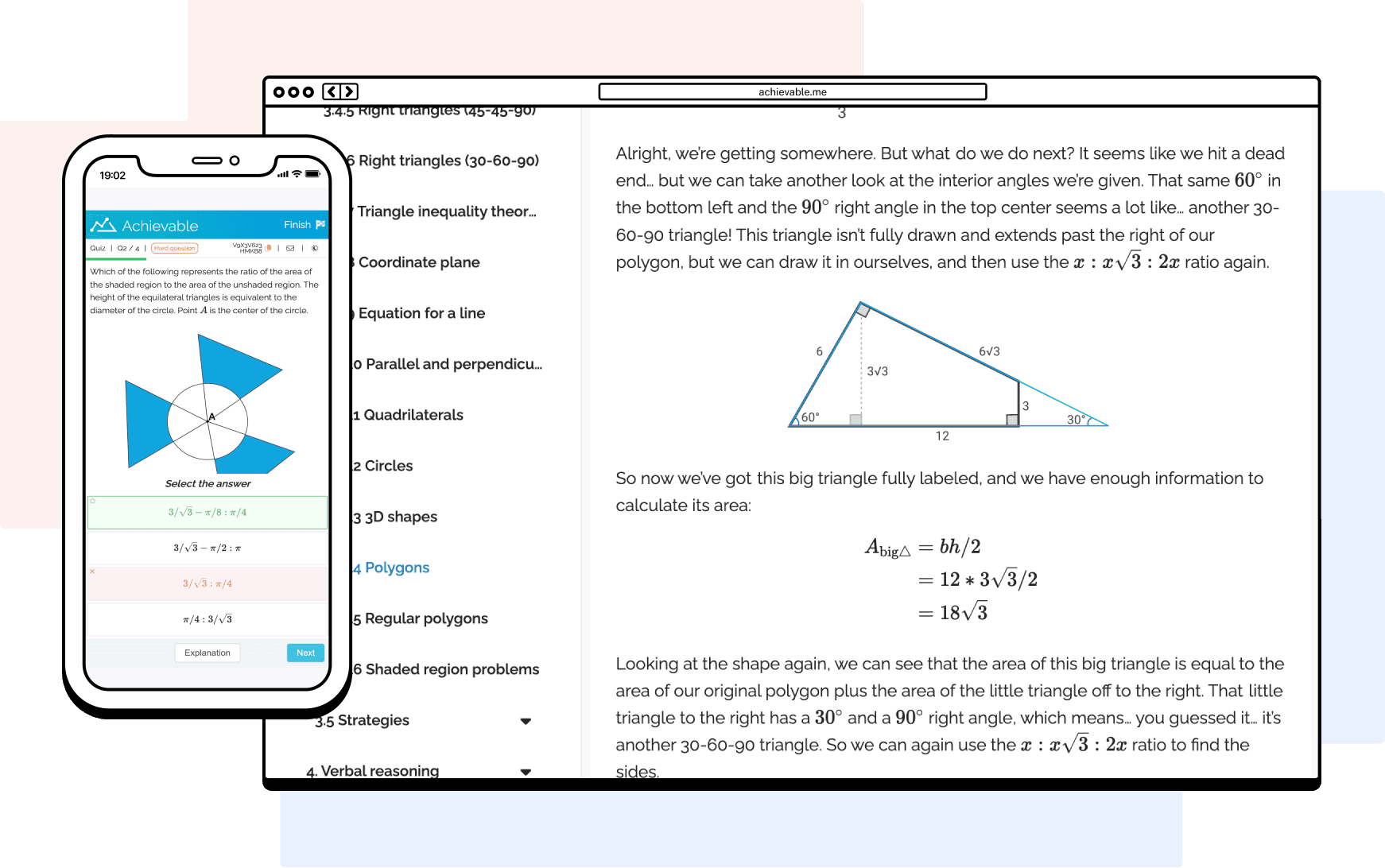
Hit your target score
Achievable is the best online GRE exam prep course: effective, personalized, and convenient. With Achievable, you'll spend less time studying and hit your target score with confidence.