Best MCAT practice tests: every full-length compared


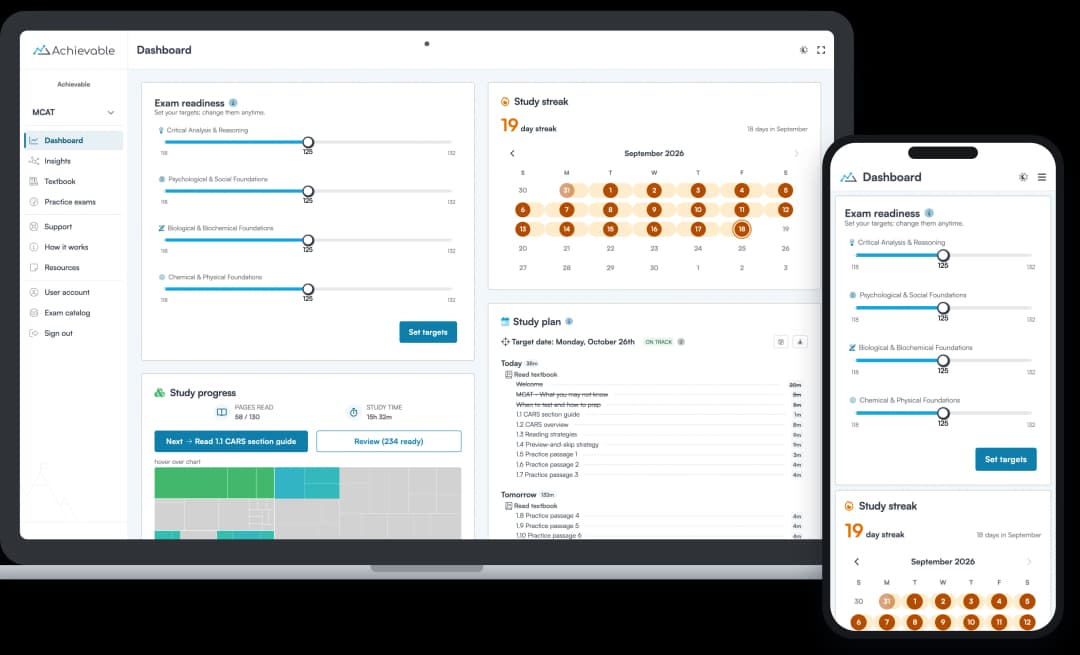
The best MCAT practice tests are the ones you take in the right order. Use Achievable’s free section practice exams and its course’s three full-length practice MCATs early in your prep to build stamina and find gaps, then save the AAMC’s official full-lengths, the most representative of the real exam, for your final four to six weeks. Achievable MCAT includes three full-lengths in its $399 course, and its four free section practice exams add up to a full test’s worth of questions at no cost.
Below, we compare the full-length practice tests from Achievable, the AAMC, Blueprint, Kaplan, Altius, The Princeton Review, UWorld and Jack Westin, list the free ones, and show how to schedule them so your last practice scores tell you something real.
MCAT practice tests compared
Every count and price below comes from the provider’s own site. Prices are list prices: several of these companies run frequent sales, so check before you buy. A "full-length" means all four sections, 230 questions, timed like the real exam.
Provider | Full-length exams | Free option | Score report | Price | Best used for |
|---|---|---|---|---|---|
3, written for the course | 4 free section exams (230 questions in all) | Scaled section scores (118–132), every question explained | $399 for 1 year, with the full course | Stamina and finding gaps, early and mid-prep | |
AAMC (official) | 7: Sample Test, Practice Exams 1–6 | Sample Test (unscored) and Practice Exam 1 | Scaled score and percentile rank, every answer explained | $35 per exam for 1 year; $336.15 for the online bundle with its section banks | Your final 4–6 weeks |
Blueprint | 6 | 1 with a free account | Explanations and score analytics | $99 a month, or $299 for 6 months | More full-lengths mid-prep, paid by the month |
Kaplan | 3 or 12 in a pack; 21 in its courses, AAMC exams included | 1, with a 30-day starter pack | Score report, every question explained | $129 (3) or $329 (12) for 6 months; courses from $1,599 | Students who want many exams |
Altius | 1, 5 or 10, each retakeable | A half-length (113 questions) | Detailed analytics on each attempt | $40, $169 or $299 for 1 year | Volume of third-party exams |
The Princeton Review | 6 or 10 in a pack; 18 in its self-paced course, AAMC exams included | 1 when you register | Score reports with explanations | $199 (6) or $299 (10) for 180 days | Exams alongside its books |
UWorld | 2 of its own; its Comprehensive course adds the AAMC’s 7 | 7-day trial | Scaled section and total scores, illustrated explanations | QBank with 2 exams from $339 (90 days) | Students already using its question bank |
Jack Westin | 6 | 7-day trial of Jack Westin+ | Scaled score and percentile rank | $29.99 a month (Jack Westin+) | CARS-focused students |
Two of the courses with the highest counts, Kaplan’s and The Princeton Review’s, include the AAMC’s official exams in that total, so you aren’t getting that many tests written by the company itself. UWorld’s Comprehensive course includes the same seven AAMC exams alongside its own two.
What Achievable’s full-length practice exams include
Achievable MCAT is $399 for a full year of access, and its practice is built to be taken the way the real MCAT is:
- Three full-length practice MCATs. Each one is the exam’s four sections at their real length and time limit: Chemical and Physical Foundations (59 questions, 95 minutes), Critical Analysis and Reasoning Skills (53 questions, 90 minutes), Biological and Biochemical Foundations (59 questions, 95 minutes) and Psychological, Social and Biological Foundations (59 questions, 95 minutes). Take the four back to back for a test-day rehearsal, or one section at a time.
- Scaled section scores. Each section is scored on the MCAT’s 118 to 132 scale, the same scale as the real exam, so you can see which section stands between you and your target total.
- An explanation for every question, so each test is also a review session.
- Questions written for the course. You won’t have met them in a free PDF, a forum or a used book, so a high score means you reasoned your way there rather than remembered the answer. Each practice exam form is taken once, which keeps its score honest.
- More than 1,400 practice questions in all, with a study planner that schedules your full-lengths after your content review.
- A score improvement guarantee. Send us an official MCAT score from the five years before you bought the course within 7 days of buying, then retest while your year of access is active. If your new score hasn’t risen by at least 5 points (for a starting score below 502), 4 points (502 to 507) or 3 points (508 to 514), email us the score report and a valid ID within 31 days of the test for a full refund. There’s no minimum study time. You can also get a full refund within 7 days of purchase, for any reason.
The first lessons are free, with no credit card needed, and your full-lengths sit on the course’s practice exams page.
Free MCAT practice tests
You can take several full-lengths without paying anything. In the order we’d use them:
- Achievable’s free section practice exams. Four free exams, one per section, each at the real section’s length and time limit: Chem/Phys, CARS, Bio/Biochem and Psych/Soc. Together they’re 230 questions, a full test’s worth, scored as you go with an explanation for every answer. Take one section a day early on, or all four in one sitting as a baseline.
- The AAMC’s Unscored Sample Test and Practice Exam 1. The AAMC offers "two free full-length practice exams" on its official prep page. The Sample Test gives no score; Practice Exam 1 gives a scaled score and percentile rank like the real exam.
- Blueprint: one full-length with a free account.
- Kaplan: one full-length, plus a 30-day starter pack.
- The Princeton Review: one full-length when you register.
- Altius: a free half-length exam of 113 questions.
- UWorld and Jack Westin: 7-day free trials.
If you qualify for the AAMC’s Fee Assistance Program, its benefits include free MCAT Official Prep products as well as a discounted registration fee, so apply before you buy the AAMC’s paid exams.
Which practice tests are most like the real MCAT?
The AAMC’s. It writes the MCAT, and its practice exams are scored on the same scale as the real exam, with the same percentile ranks. That’s why they’re the best predictor of your score, and why it’s worth keeping them for the end, when a prediction is what you need.
No other company’s exams are reviewed or endorsed by the AAMC, and their scoring varies. Some providers say how closely their scores match the real thing (Blueprint and Altius both do), but those are the companies’ own claims. Third-party tests are best used for what they do well: building the stamina to sit a seven-and-a-half-hour exam, practicing your pacing and finding the topics you haven’t mastered. A score that’s a few points off the AAMC’s doesn’t matter much at that stage. What matters is that you review every question you missed.
How to schedule your full-lengths
Plan on six to ten full-lengths over two to four months of prep. A schedule that works:
- Weeks 1 to 2: a baseline. Take Achievable’s free section exams, or the AAMC’s Unscored Sample Test, to find your starting point and your weakest section. Don’t worry about the number.
- Middle of your prep: one full-length every two weeks. Use third-party exams, such as Achievable’s three, while you’re still reviewing content. Each one shows what to study next.
- Final four to six weeks: one a week, then the AAMC’s. Switch to the AAMC’s scored practice exams, Practice Exam 1 first, and save the last one or two for the final two weeks.
- The last week: no new full-lengths. Review your notes on missed questions and rest before test day.
Treat each one like the real exam. Start at the same time of day as your appointment, keep to the real section order (Chem/Phys, CARS, Bio/Biochem, Psych/Soc) and take only the official breaks: 10 minutes after the first section, 30 minutes after CARS and 10 minutes after the third. Then spend at least as long reviewing as you spent testing, writing down why you missed each question: a content gap, a misread, or running out of time.
When are you ready? Aim for 100% readiness: practice-exam scores comfortably above your target score, consistently, across several full-length exams, not one good day. If your scores are still below your target a few weeks out, our guide to when to take the MCAT covers how to decide whether to move your date. For the rest of your plan, see how to build your MCAT study schedule and how MCAT scoring works, and for the habits that make each test count, realistic practice strategies for the MCAT.
Which MCAT practice tests should you buy?
It depends on how much practice you need beyond the AAMC’s, and what else you’re buying:
- You want a course and full-lengths in one place: Achievable MCAT at $399 covers your content review, more than 1,400 practice questions and three full-lengths for a year, backed by a score improvement guarantee. Add the AAMC’s exams for the final weeks.
- You only want the official exams: the AAMC’s Practice Exams 2 to 6 at $35 each, after its two free ones.
- You want more third-party full-lengths on top: a pack from Altius, Blueprint, Kaplan or The Princeton Review, or a month of Jack Westin+. Buy only as many as your schedule leaves room to review properly.
- You’re already paying for a big course: check what it includes before buying more. Kaplan’s and The Princeton Review’s course totals include the AAMC’s exams, and UWorld’s Comprehensive course does too.
MCAT practice test FAQ
How many MCAT practice tests should I take? Six to ten full-lengths suits most students, including all of the AAMC’s scored exams. More than that helps only if you have time to review each one thoroughly; an unreviewed test teaches you little.
When should I take the AAMC practice exams? In your final four to six weeks, once your content review is done, so their scores predict your real result. Take Practice Exam 1, the free scored one, first.
Is Achievable’s free MCAT practice test a full-length? It’s four free section exams, each at the real section’s length and time limit, so together they’re a full test’s worth of 230 questions. Take them in one sitting, in the real order and with the real breaks, and they work as a free full-length rehearsal.
Are third-party full-lengths harder than the real MCAT? Many students find them harder, and scoring varies from one company to the next. Use their scores to track your progress across one company’s exams, and trust the AAMC’s for a prediction.
Do I need to buy the AAMC’s practice exams? Yes, if you can: they’re the closest thing to the real MCAT, and at $35 each they cost less than most third-party packs. If cost is a barrier, the AAMC’s Fee Assistance Program includes free official prep products.
Key takeaways
- Start with Achievable’s free section practice exams and its course’s three full-lengths to build stamina and find gaps.
- Save the AAMC’s official practice exams, the most representative of the real MCAT, for your final four to six weeks.
- The AAMC’s Sample Test and Practice Exam 1 are free; Practice Exams 2 to 6 cost $35 each.
- Third-party scores vary, so use those tests for pacing and finding gaps, and review every missed question.
- Take each full-length under real conditions, with the real section order and breaks.
- You’re ready when your practice scores sit comfortably above your target across several full-lengths.