How to use your last month before the MCAT: a 4-week plan


Table of contents
- Your four-week MCAT plan
- Why Achievable’s full-lengths come first
- Why the AAMC’s exams come last
- Sit every full-length like the real one
- How to review a full-length
- Keep an error log
- Patch your weak topics with Achievable’s course
- Are you ready? Decide before the 10-day cutoff
- The final week and test day
- FAQ
- Key takeaways
Spend about four-fifths of your last month before the MCAT on timed full-length practice exams and on reviewing them, and the rest on the gaps those exams reveal. Take one or two full-lengths a week: Achievable’s three full-length practice MCATs first, while there’s still time to act on what they show, and the AAMC’s official practice exams from three weeks out, when you want a prediction of your score. Stop taking new full-lengths about a week before test day.
Finishing a content course is the right moment to switch from learning material to performing under exam conditions. The plan below assumes you’ve covered all four sections and have about four weeks left. Studying part time, or already used some of these exams? Adjust the number of full-lengths, not the order.
Your four-week MCAT plan
This schedule fits a student studying close to full time. Each full-length takes about seven and a half hours to sit and most of a day to review, so two a week leaves two or three days for targeted review.
Week | Full-length exams | Between exams | Goal |
|---|---|---|---|
4 weeks out | Achievable full-lengths 1 and 2 | Review each one fully; restudy the topics your error log points to; one CARS passage set a day | Find your weak sections and topics under real timing |
3 weeks out | Achievable full-length 3, then the AAMC’s free Practice Exam 1 | Start the AAMC Section Bank in your weakest science section; keep up daily CARS | Confirm what you fixed; get your first official score |
2 weeks out | Two more AAMC practice exams | AAMC Section Bank and Question Packs for the topics you keep missing; the CARS Question Bank if CARS is behind | Close the last gaps; check your scores against your target |
Final week | One last AAMC practice exam, six or seven days before test day | Error log review, light CARS, sleep on your test-day schedule | Arrive rested, with nothing new to learn |
That’s seven full-lengths in the month: Achievable’s three and four of the AAMC’s. If you study part time, take one a week instead. Use an Achievable full-length four weeks out and the AAMC’s three, two and one week out, and take the other two Achievable exams one section at a time on weeknights, since each section can be sat on its own at its real length and time limit.
Why Achievable’s full-lengths come first
Achievable’s three full-length practice MCATs each hold all four sections at their real length and time limit, scored on the MCAT’s 118 to 132 section scale, with an explanation for every question. Each form is taken once, so its score reflects how you reasoned, not what you remember. Taken early in the month, they show which section stands between you and your target total while you still have three weeks to fix it.
No Achievable course? Achievable’s free section practice exams, one for each of the four sections at the real section’s length and time limit, add up to a full test’s worth of 230 questions. Take them in one sitting, in the real order and with the real breaks, as your week 4 rehearsal.
Already took Achievable’s three full-lengths during your course? Each form is taken once, so use the free section exams in one sitting as your week 4 rehearsal if you haven’t taken them, and start the AAMC’s Practice Exam 1 that week instead.
Why the AAMC’s exams come last
The AAMC writes the MCAT, and its practice exams give a scaled score and percentile rank like the real exam’s. That makes them the best predictor of your score, which is what you need in the final weeks. The AAMC’s official prep includes, as of November 2026:
- Unscored Sample Test (free): 230 questions with no scaled score. Useful as a baseline, less so in the final month.
- Practice Exam 1 (free) and Practice Exams 2 to 6 ($35 each): 230 questions each, with scaled scores and percentile ranks.
- Section Bank, Volumes 1 and 2 ($45 each): 300 science questions in each, from the Chem/Phys, Bio/Biochem and Psych/Soc sections. Volume 2 explains all four answer choices; Volume 1 explains the correct answer.
- Question Packs ($15 each): Biology Volumes 1 and 2, Chemistry and Physics, 120 questions each.
- Independent Question Bank ($10): 150 standalone questions, not tied to a passage: 25 each in biochemistry, biology, chemistry, physics, psychology and sociology.
- CARS Question Bank ($70): 575 passage-based questions, released in September 2026. It replaces the CARS Question Packs and the CARS Diagnostic Tool, which are no longer sold.
Each product is a one-year subscription, and the Online-Only Bundle covers all of the paid ones. If you qualify for the AAMC’s Fee Assistance Program, that bundle is one of its benefits, so apply before you buy. For how these compare with other companies’ full-lengths, see the best MCAT practice tests.
Sit every full-length like the real one
Start at the time of your real appointment and keep the real order: Chem/Phys (59 questions, 95 minutes), CARS (53 questions, 90 minutes), Bio/Biochem (59 questions, 95 minutes) and Psych/Soc (59 questions, 95 minutes). Take only the three optional breaks, 10 minutes after the first section, 30 minutes after CARS and 10 minutes after the third, and no phone during them. A full-length taken with pauses and a snack run tells you little about test day.
How to review a full-length
The review is where the score improves. Spend at least as long reviewing an exam as you spent taking it, and finish the review before you take the next one. The AAMC’s own study plan advice says the same: review every incorrect or flagged question, "identify why you missed questions and how you will address those issues", and work on your weaknesses between exams.
Go through every question you got wrong, every one you flagged, and every one you got right by guessing. For each, decide which of these went wrong:
- Content gap: you didn’t know the fact, formula or concept.
- Misread: you misread the question, the passage or a figure.
- Reasoning: you narrowed it to two answers and chose the wrong one, or didn’t use the passage.
- Timing: you rushed it, or ran out of time before you reached it.
Keep an error log
Write each missed question in one place, a spreadsheet or a notebook, so patterns show across exams instead of disappearing into each one. For example:
Exam and question | Section and topic | Why you missed it | What you’ll do | Rechecked |
|---|---|---|---|---|
Achievable full-length 1, Q14 | Chem/Phys: electrochemistry | Content gap: mixed up anode and cathode in an electrolytic cell | Reread the chapter, then answer its quiz questions | Yes, 3 weeks out |
AAMC Practice Exam 1, Q31 | CARS: author’s argument | Reasoning: picked an answer true in general, not in the passage | Do two CARS passages a day, justifying each answer from the text | Yes, 2 weeks out |
AAMC Practice Exam 2, Q40 | Psych/Soc: research design | Misread: missed "except" in the question | Circle the stem’s qualifiers on every question | Next exam |
After each new exam, sort the log by topic and by reason. Two misses on the same topic is a topic to restudy. Several misreads or timing misses mean you need to change how you take the test, not what you know: slow down on the question stems, or practice timed passage sets. The realistic practice strategies post goes deeper on reviewing mistakes.
Patch your weak topics with Achievable’s course
The error log tells you what to fix. Achievable MCAT has what you need for it:
- Go back to the chapter. Find the chapter of the course’s online textbook that covers each missed topic, and reread the part your error log names, not the whole unit.
- Answer its chapter quiz questions. Practice questions come with explanations, so you see why each answer is right or wrong, not just whether you got it.
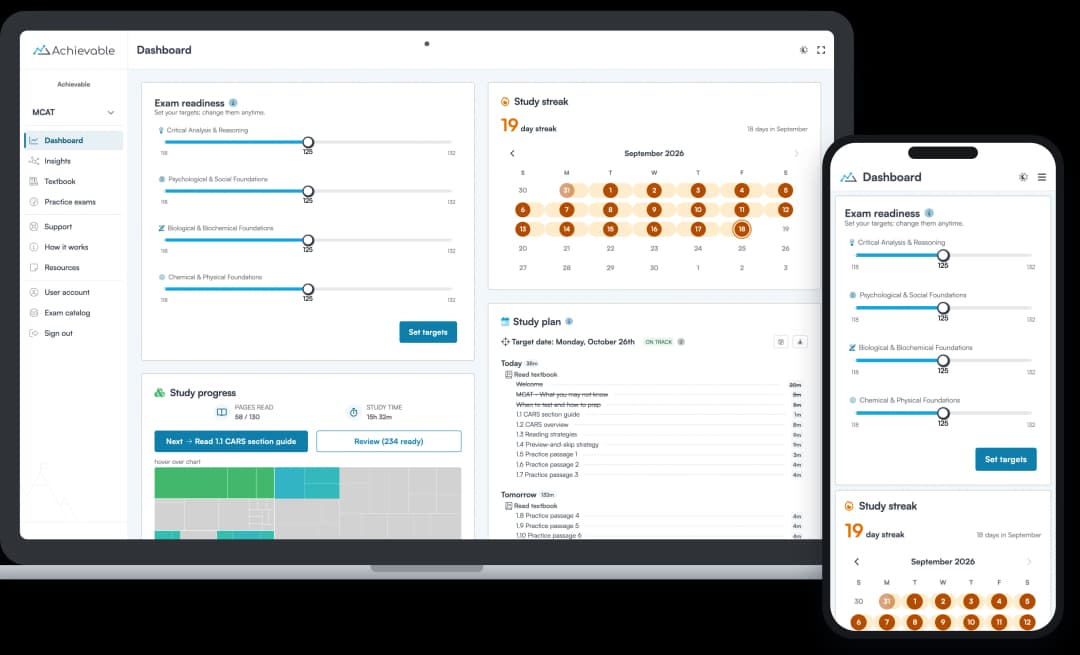
- Use the section scores. Each Achievable full-length scores the four sections on the 118 to 132 scale, so you can see which section is costing you the most points against your target.
- Plan it. The course includes an interactive study planner, so the rest of your month is laid out in one place.
Then check the fix with official questions: a Section Bank set or a Question Pack on the same topic, a few days later. If you get it right then, mark it done in your log.
Achievable MCAT is $399 for a full year of access, with more than 1,400 practice questions and the three full-lengths. If you’ve taken the MCAT before, it carries a score improvement guarantee. The first lessons are free, with no credit card needed.
Are you ready? Decide before the 10-day cutoff
Aim for 100% readiness: practice-exam scores comfortably above your target score, consistently, across several full-length exams, not one good day. Your AAMC score from three weeks out and your first AAMC exam two weeks out are the ones to judge by. Take that exam at least 11 days before your test, so you can still move your date.
If they’re still below your target, decide about your date early. The AAMC allows no changes less than 10 days before your exam. For 2027 test dates, once you’re inside 30 days, as you are when this plan starts, rescheduling costs $210 and cancelling refunds nothing ($85 to reschedule with fee assistance). Thirty to 59 days out, rescheduling costs $110 and cancelling refunds $180, so if your scores are far from your target with five or more weeks to go, decide then. Also check that a later date still gets your score to schools in time: scores are released 30 to 35 days after the exam. Our guide to when to take the MCAT covers how to choose a new date.
The final week and test day
Your last full-length goes six or seven days before the exam, leaving time to review it. After that, take no new full-lengths: a bad score two days out teaches you nothing you can use, and a long exam costs you energy you need on the day.
- Review, don’t learn. Go through your error log, your notes on high-yield formulas and the topics you’ve missed twice. Leave anything you’ve never studied.
- Keep CARS warm. One or two timed passages a day keeps your reading pace without tiring you.
- Shift your sleep. The standard U.S. start time is 8:00 a.m.; check yours on your registration. Wake at your test-day time for the whole week, so your brain is awake when the clock starts.
- Take the last day off. Do the logistics, eat normally and go to bed on time.
For test day itself, from the AAMC’s rules:
- Arrive at least 30 minutes before your start time. The AAMC’s check-in rules treat a late arrival as a possible no-show, with no refund.
- Bring an accepted ID. It must be government-issued, unexpired, with your photo and a printed expiration date, such as a driver’s license or passport, and the name must match your registration exactly. Digital and school IDs aren’t accepted. See the AAMC’s ID requirements.
- Plan for about seven and a half hours. That’s the seated time, check-in not included. Only your ID, eyeglasses and the center’s earplugs go into the room, so pack a lunch and water for the 30-minute break; you can’t leave the building for food.
- Watch the break clock. Time you take over a break comes off the next section.
FAQ
I just finished my MCAT course. What now? Switch from content review to full-length practice. If you used Achievable, take its three full-lengths in the next two weeks and use its chapters and quizzes to patch what they show. With another course, take its remaining full-lengths. Then move to the AAMC’s practice exams, one or two a week. Keep an error log, restudy only the topics it shows you missing, and use the AAMC Section Bank and Question Packs to check each fix.
How many full-lengths should I take in the last month? Four to seven, depending on how many hours you have. Fewer exams with a full review beat more exams without one. Make at least three of them AAMC practice exams.
Should I learn new content in the last month? Only what your full-lengths show you missing. A topic that hasn’t appeared in your mistakes after several exams is a poor use of your final weeks.
When should I take the AAMC practice exams? In your final weeks, once your content review is done, so their scores predict your real result. In this four-week plan, that’s from three weeks out. Take Practice Exam 1, the free scored one, first.
What if my scores are dropping in the final weeks? Look at the error log before the score. A drop that comes from timing or misreads usually means fatigue: take fewer exams and rest more. A drop from content gaps means a topic to restudy. If your scores stay below your target, consider moving your date before the 10-day cutoff.
Can I still buy the AAMC’s CARS Question Packs? No. The AAMC stopped selling the CARS Question Packs and the CARS Diagnostic Tool; their questions are now part of the $70 CARS Question Bank, with new ones added. If you already own them, your access lasts until it expires.
Key takeaways
- Spend about four-fifths of the month on timed full-lengths and their review, and the rest on the gaps they show.
- Take Achievable’s three full-lengths first and the AAMC’s practice exams in the last three weeks.
- Review every exam fully and keep an error log; it decides what you restudy.
- Use the AAMC Section Bank, Question Packs and the new CARS Question Bank to check your fixes.
- Aim for 100% readiness: scores comfortably above your target across several full-lengths. Decide about rescheduling before the 10-day cutoff.
- Take your last full-length six or seven days out, then review, rest and shift your sleep to test time.