How to prep for the MCAT as a working adult or career changer


Table of contents
- Before you start: prerequisites and the time since your science classes
- Start with a free diagnostic
- A weekly schedule for full-time workers
- 6-month and 12-month timelines
- Resources and cost
- Studying on your phone: commutes and lunch breaks
- Common questions
- Can I study for the MCAT while working full time?
- Should I cut back at work before the test?
- What should I do first?
- Key takeaways
If you work full time and are changing careers into medicine, plan 6 to 12 months of MCAT prep at about 10 to 15 hours a week. Start with a free diagnostic, rebuild the prerequisite science in short weekday sessions with a self-paced course, and save weekends for long practice blocks. In your last few months, sit timed full-length practice exams, finishing with the AAMC’s official ones.
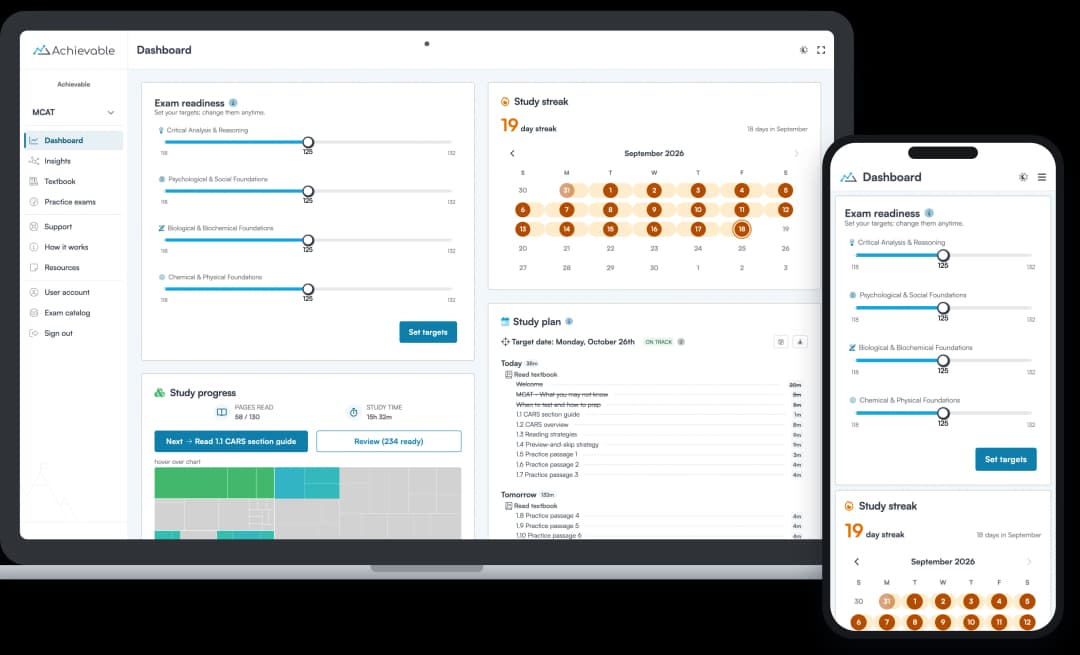
Achievable’s MCAT course fits that schedule: lessons and 1,400+ practice questions with explanations that you work through on your own time, an adaptive study plan, an AI tutor and three full-length practice MCATs, for $399 with a year of access. It works in your phone’s browser, so a lunch break or a train ride counts as study time.
Before you start: prerequisites and the time since your science classes
The MCAT tests introductory college science. The AAMC’s section outlines say what each section draws on:
- Biological and Biochemical Foundations of Living Systems: introductory biology (about 65%), first-semester biochemistry (25%), general and organic chemistry (5% each).
- Chemical and Physical Foundations of Biological Systems: general chemistry (30%), first-semester biochemistry (25%), introductory physics (25%), organic chemistry (15%) and introductory biology (5%).
- Psychological, Social, and Biological Foundations of Behavior: introductory psychology (65%), introductory sociology (30%) and introductory biology (5%).
- Critical Analysis and Reasoning Skills (CARS): reading passages from the humanities and social sciences. It needs no science background, which makes it the section where a career changer’s reading habits can pay off.
The exam has 230 questions across those four sections, with 6 hours 15 minutes of testing time and about 7.5 hours at the test center once breaks are counted. Breaking down the MCAT sections goes through each one.
Where you start decides how long you need:
- You haven’t taken the prerequisite courses. Take them first, or alongside the first months of MCAT study. Most medical schools require these courses for admission anyway, each school sets its own list, and many career changers take them in a postbaccalaureate program or at a local college while still working. Study a subject’s MCAT content right after you finish that course, while it’s fresh.
- You took the courses years ago. You’re relearning, not learning from scratch. Plan the full 12 months if it’s been more than a few years, or if physics and organic chemistry were never your strong subjects.
- You finished the courses recently. Six months is realistic, since you mostly need review and practice.
Time your test date to your application, too. The AAMC says medical schools generally accept MCAT scores from the past two or three years, so a score earned too early can expire before you apply. When should you take the MCAT? works through the timing.
Start with a free diagnostic
Before you buy anything, find out where you stand. Two free options:
- Achievable’s free MCAT practice exams: one for each section, at the real section’s length and time limit, with an explanation for every question: Chemistry and Physics, CARS, Biology and Biochemistry and Psychology and Sociology. Because each one is a single section of 90 to 95 minutes, you can take them over four longer evenings instead of giving up a whole Saturday.
- The AAMC’s free Unscored Sample Test: a full 230-question exam in the AAMC’s own testing interface. The AAMC’s study plan guide suggests taking it to set your baseline, then using its Content and Skills Breakdown to mark each topic as low, medium or high confidence. It’s unscored, so you get section-level feedback but no scaled score.
Don’t worry about a low first score: if you’ve been out of school for years, a diagnostic measures what you’ve forgotten, which is exactly what you need to know. Rank the four sections weakest first, and list the topics you couldn’t start at all. That list is your content plan.
A weekly schedule for full-time workers
Ten to fifteen hours a week is enough for steady progress without burning out at work. Spread it across short weekday sessions and two longer weekend blocks:
Day | When | What to do | Time |
|---|---|---|---|
Monday to Thursday | Commute or lunch | A CARS passage, or a short set of practice questions on your phone | 20–30 minutes |
Monday to Thursday | Evening | One lesson, then its practice questions; review every miss | 60–75 minutes |
Friday | Any time | Rest, or review the week’s missed questions | 0–30 minutes |
Saturday | Morning | A long content block in your weakest subject, or a timed full-length practice exam in your last months | 3–4 hours (a full-length takes about 7.5) |
Sunday | Any time | Mixed review of earlier topics, and a full review of any practice exam you took | 2–3 hours |
That adds up to about 10 to 15 hours. A few habits make it work:
- Protect the weekday sessions. Short sessions on most days beat a three-hour cram on Sunday, because you revisit the material before it fades. Put the sessions in your calendar like meetings.
- Review every question you miss. Don’t move on from a wrong answer until you can say why the right one is right and what made you choose the wrong one. Keep a running list of those reasons; the patterns in it are your weak topics.
- Do CARS a little every day. CARS improves slowly and responds to regular practice, and a single passage fits a lunch break.
- Plan the hard weeks at work. When a busy stretch is coming, drop to the weekday sessions only and keep going. A slower week is fine; a missed month means relearning.
6-month and 12-month timelines
Pick the timeline that matches your starting point, and count each phase in weeks, not calendar dates. If a phase runs long, move your test date rather than cutting the practice exams.
Phase | 6-month plan (recent coursework, 12–15 hours a week) | 12-month plan (science years ago, 10–12 hours a week) |
|---|---|---|
Diagnostic | Week 1: free diagnostic, rank your sections | Week 1: free diagnostic, rank your sections |
Content review | Months 1–3: every topic in your weakest sections first, with daily practice questions and CARS | Months 1–7: every topic, starting with general chemistry and biology, which the rest builds on; daily CARS |
Practice and gaps | Month 4: timed section practice, restudy weak topics, first full-length practice exam | Months 8–9: timed section practice, restudy weak topics, first full-length practice exams |
Full-lengths | Months 5–6: one full-length every one to two weekends, with a full review each Sunday; the AAMC’s practice exams in the final four to six weeks | Months 10–12: one full-length every one to two weekends, with a full review each Sunday; the AAMC’s practice exams in the final four to six weeks |
Achievable’s course comes with a year of access, so starting it on the first day of MCAT study covers either timeline through test day; if your test date slips past that year, plan for it. The AAMC’s paid products give you 365 days from the date of purchase, so buy them for the final phase, not on day one.
Aim for 100% readiness, not for scraping by. Before you sit the real exam, score comfortably above your target score on full-length practice exams, consistently, across several of them, so your result doesn’t depend on which passages you draw. A single good practice score isn’t the bar.
Resources and cost
Here’s what the core resources cost, from each provider’s own site:
Resource | What you get | Price | Access |
|---|---|---|---|
Achievable MCAT course | Lessons, 1,400+ practice questions with explanations, 3 full-length practice MCATs, a study planner and an AI tutor | $399 | 1 year |
Achievable free practice exams | One exam per section, at real length and timing, with explanations | Free | |
AAMC free resources | Unscored Sample Test (no scaled score), Practice Exam 1, and the Content Outline course with 120 practice questions | Free | AAMC account |
AAMC Online-Only Bundle | Practice Exams 2–6, two Section Banks, the CARS Question Bank, four question packs and the Independent Question Bank: 2,876 questions in all | $336.15 (listed at $405) | 365 days |
AAMC Practice Exams 2–6, bought separately | One official full-length exam each | $35 each | 365 days |
MCAT registration | The exam itself | $360 for 2027 test dates; $145 through the Fee Assistance Program |
Achievable’s course is the core of a working adult’s plan: lessons and chapter quizzes you work through on your own time, practice questions with explanations, and an adaptive study plan that adjusts to your progress, which takes the guesswork out of building a study schedule around your job. Its three full-length practice MCATs each cover all four sections, and each form is taken once. You can try the first lessons free, with no credit card. The course can be refunded in full within 7 days of purchase, for any reason. If you’ve taken the MCAT before, it also carries a score improvement guarantee: +5 points for a starting score below 502, +4 points for a starting score of at least 502 and below 508, and +3 points for a starting score of at least 508 and below 515, or your money back. Send the score report from an official MCAT you took in the five years before buying within 7 days of buying, then retest while your year of access is active; there’s no minimum study time.
The AAMC’s official materials are written by the people who write the exam, and its practice exams use questions from past MCATs, so they belong in your final weeks. The AAMC’s product comparison lists each one. Its practice exams report a scaled score and percentile rank, but resetting one shows you the same questions, and AAMC sales are final. Its question packs are mobile-optimized, which suits commute study late in your prep.
Free material goes a long way at the start. The AAMC’s free planning and study resources include the Content Outline course, which links each topic to open-access textbooks and video lessons. Use them to check what a topic covers, then practice it with questions that are scored and explained.
Fees add up, so plan for them. Registration is $360 for 2027 test dates, and moving your date costs $55 to $210 depending on how close you are; no changes are allowed in the last 10 days (MCAT scheduling fees). If money is tight, check the AAMC’s Fee Assistance Program, which lowers the registration fee to $145 and includes free official prep products. For a fuller comparison of courses, see how much an MCAT prep course costs.
Studying on your phone: commutes and lunch breaks
Short sessions on your phone are where a working adult finds the hours. Achievable runs in any smartphone browser, so there’s nothing to install; add it to your home screen for one-tap access. Make the short sessions count:
- Do questions, not reading. Ten minutes of practice questions, each followed by its explanation, does more than ten minutes of rereading notes, because recalling an answer is what makes it stick.
- Mix in old topics. Start each short session with a few questions from earlier chapters. Coming back to a topic days and then weeks after you learned it is what keeps it from fading, and it matters more the longer your timeline is.
- Use dead time for CARS. One passage and its questions take about 10 minutes, and you need no notes to practice them.
- Save the heavy work for the desk. Long physics and chemistry calculations, and full practice exams, belong at a desk with the real timing, not on a phone.
Common questions
Can I study for the MCAT while working full time?
Yes. At 10 to 15 hours a week over 6 to 12 months, you’ll put in roughly 300 to 600 hours, which is enough to cover all the content and still sit several full-length practice exams. What matters is studying most days, not finding long blocks.
Should I cut back at work before the test?
If you can, take a few days off in your final weeks, so a full-length practice exam and its review don’t both have to fit into one weekend, and take the day before the exam off. Most of the work, though, fits around a full-time job.
What should I do first?
Take a free diagnostic: Achievable’s section practice exams over four evenings, or the AAMC’s Unscored Sample Test on a weekend. Then decide between the 6-month and 12-month plans based on your results and on how long ago you took the science courses.
Key takeaways
- Plan 6 months if your science courses are recent and 12 months if they were years ago, at 10 to 15 hours a week.
- Start with a free diagnostic and study your weakest sections first.
- Use short weekday sessions for lessons, questions and CARS, and weekends for long blocks and full-length practice exams.
- A self-paced course like Achievable’s ($399, one year of access) keeps your study plan organized; finish with the AAMC’s official practice exams.
- Before test day, score comfortably above your target on several full-length practice exams, not just once.