

NCLEX Exam info
What it is, what's tested, and how it's scored.
NCLEX exam details
The NCLEX-RN (National Council Licensure Examination for Registered Nurses) is a standardized, computer-adaptive licensing exam for nursing school graduates. To practice as a registered nurse (RN) in the U.S. or Canada, candidates must pass the NCLEX-RN. Internationally qualified nurses following Australia’s outcomes-based assessment pathway must also pass the NCLEX-RN as part of the registration process.
Most NCLEX-RN questions are organized around four major Client Needs categories: Safe and Effective Care Environment, Health Promotion and Maintenance, Psychosocial Integrity, and Physiological Integrity. The NCLEX also includes case-study items designed to assess clinical judgment, decision-making, and critical thinking in realistic patient-care scenarios. Candidates will typically answer between 85 and 150 questions. The exam allows up to five hours to complete, including any breaks, and all scored items must be answered within that time limit.
Successfully passing the NCLEX confirms that a nursing graduate can provide safe and effective care at the entry level.
The NCLEX exam is hosted by NCSBN and costs $200 to register. Participants have 5 hours to answer 85–150 questions (computer-adaptive, variable-length). The passing score is No pre-determined passing score.
Time
5 hours
Format
85–150 questions
Computer-adaptive, variable-length
Exam fee
$200
Passing score
No pre-determined passing score
Exam dates
Available year-round, on demand
Details
To sit for the NCLEX, nursing candidates must:
Have completed a state-approved nursing education program. This may include a bachelor's degree in nursing (BSN), an associate degree in nursing (ADN), or a hospital-based diploma program.
Apply for licensure or registration with the nursing regulatory body (NRB) in the state or jurisdiction where you intend to practice. Depending on the location, this may be the state board of nursing, an office within the state education department, or another designated regulatory authority.
Register with Pearson, the organization that distributes the exam.
Pay the $200 registration fee.
Receive your Authorization to Test (ATT) email, which will confirm your eligibility to test.
Schedule an appointment to take the NCLEX at your local testing center. Have your ATT email prepared for your appointment.
How the NCLEX is scored
The NCLEX uses a computerized adaptive testing (CAT) format to assess candidates' performance, rather than relying on a fixed passing score. As candidates answer questions, the testing software continuously evaluates their performance and adjusts the difficulty of subsequent questions. Generally, candidates who answer questions correctly receive more challenging items, while those who answer incorrectly receive less difficult ones.
Unlike traditional exams, NCLEX results are based on whether a candidate's ability estimate is above or below the established passing standard, not simply on the number of questions answered correctly. Both the difficulty of the questions and the candidate's performance on those questions are considered.
The exam automatically ends when the testing system determines, with 95% confidence, that a candidate's ability is either above or below the passing standard. If this determination cannot be made earlier, the candidate may receive up to 150 questions. Many candidates pass or fail before reaching this maximum number of items.
You can find more information about eligibility and the exam at NCSBN's official website.
NCLEX exam summary
Management of Care
15-21%
13-18 questions
Part of the Safe and Effective Care Environment category. Evaluates the ability to provide and direct nursing care in a delivery setting while ensuring the protection of clients and health care personnel.
Safety and Infection Prevention and Control
10-16%
9-14 questions
Part of the Safe and Effective Care Environment category. Assesses knowledge of steps and protocols that must be taken to ensure clients and health care personnel are safe from health and environmental hazards.
Health Promotion and Maintenance
6-12%
5-10 questions
Covers aspects of direct nursing care, understanding of treatment plans, prevention, and early detection of health issues, and strategies for optimal health.
Psychosocial Integrity
6-12%
5-10 questions
Focuses on maintaining patients' emotional, mental, and social well-being, supporting patients experiencing stress, and protocols for treating patients with mental illness.
Basic Care and Comfort
6-12%
5-10 questions
Part of the Physiological Integrity category. Tests the ability to properly care for and treat patients, promoting physical health, wellness, and comfort while reducing risk.
Pharmacological and Parenteral Therapies
13-19%
11-16 questions
Part of the Physiological Integrity category. Tests understanding of medications, proper administration, parenteral therapies, and safety.
Reduction of Risk Potential
9-15%
8-13 questions
Part of the Physiological Integrity category. Assesses a nurse's ability to reduce the risk of complications or health problems related to existing conditions, treatments, or protocols.
Physiological Adaptation
11-17%
9-14 questions
Part of the Physiological Integrity category. Covers emergency care, health management, proper device usage, and certain procedures.
Case Studies
~20%
18 questions
Contains six items associated with a client presentation. These questions test candidates on practical skills using real-world examples.
Unscored Questions
18%
15 questions
Throughout the exam, random questions will be dispersed for "pretesting" purposes and will not be scored. These questions will not be marked or labeled and will appear as normal questions.
Achievable NCLEX content outline
1
Safe and effective care environment
Covers management of care, client advocacy, prioritization, delegation, and interdisciplinary collaboration. Emphasizes safety and infection control, including precautions, sterile technique, error prevention, and emergency preparedness.
2
Health promotion and maintenance
Focuses on growth and development across the lifespan, from infancy through older adulthood. Covers maternity care, newborn care, health screenings, preventive care, lifestyle counseling, and end-of-life considerations.
3
Psychosocial integrity
Introduces mental health concepts, therapeutic communication, and culturally sensitive care. Covers psychiatric disorders, substance use, crisis intervention, behavioral safety, and grief and end-of-life support.
4
Physiological integrity
Covers basic care and comfort, pharmacological therapies, risk reduction, and physiological adaptation. Emphasizes medication administration, diagnostic testing, management of acute and chronic conditions, medical emergencies, and alterations in body systems.
NCLEX exam: quick answers
- What is on the NCLEX exam?
- The NCLEX exam has 85–150 questions (computer-adaptive, variable-length), and candidates have 5 hours to complete it. The content outline on this page lists every tested topic with the number of questions and the percentage of the exam it accounts for.
- How long is the NCLEX exam?
- Candidates have 5 hours for the NCLEX exam, covering 85–150 questions (computer-adaptive, variable-length).
- How much does the NCLEX exam cost?
- Registering for the NCLEX exam costs $200, paid to NCSBN. Prep materials are a separate cost.
- Who administers the NCLEX exam?
- The NCLEX exam is administered by NCSBN, which sets the official content outline and scoring.
More questions about the exam and how to prepare for it? NCLEX FAQ
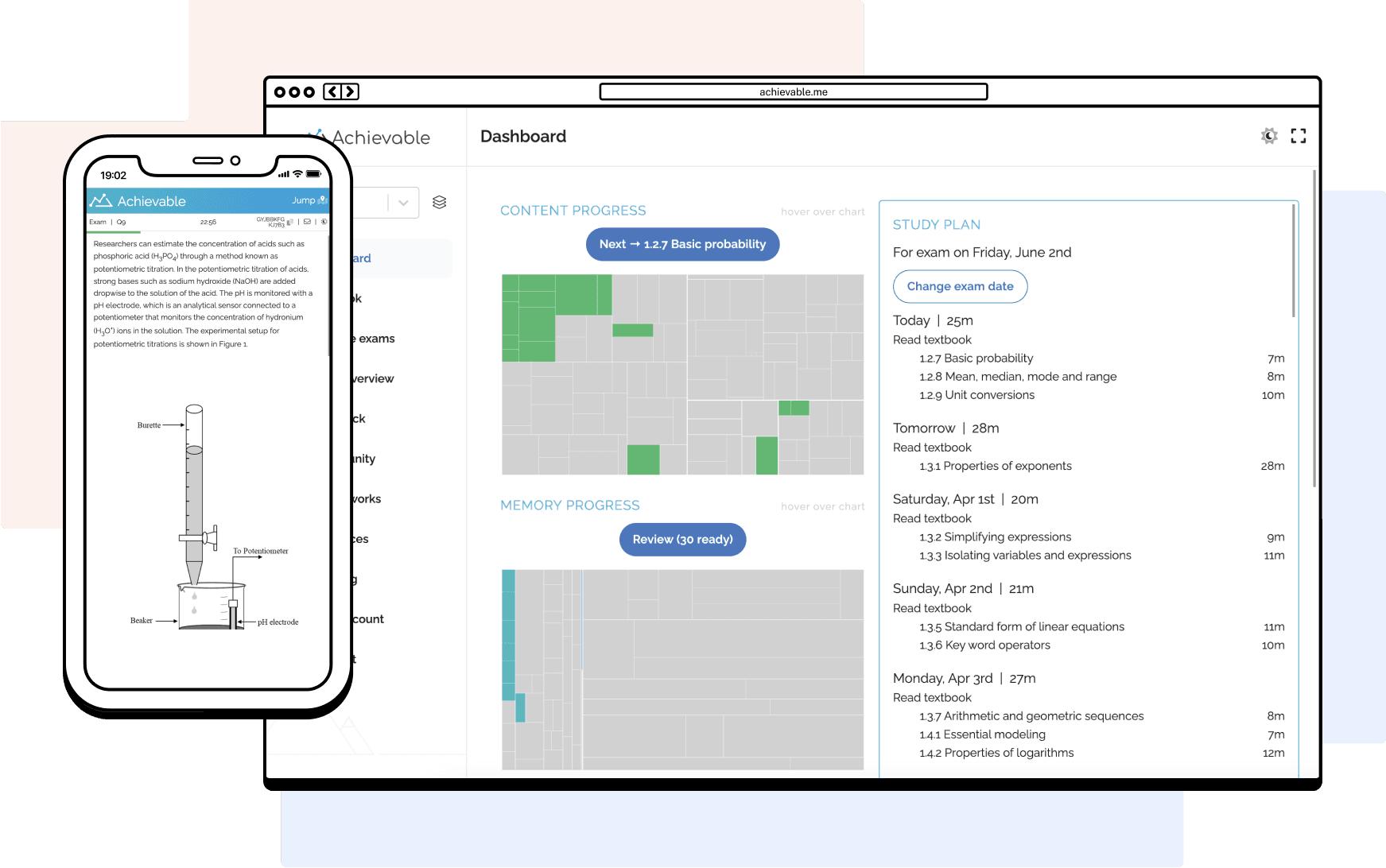
Pass the NCLEX-RN. Guaranteed.
Achievable is the best NCLEX-RN prep course: effective, personalized, and convenient. With Achievable, you'll spend less time studying and pass your exam the first time, or your money back.