Didn't hit your SAT target? When to switch prep courses before a retake


Table of contents
- Should you switch? A quick checklist
- How to read your SAT score report
- Match the reason you fell short to the fix
- Check your current course’s guarantee before you buy another
- A retake timeline to your next test date
- Where Achievable fits for a retake
- Frequently asked questions about retaking the SAT
- How many times can you take the SAT?
- Do colleges see all of your SAT scores?
- Can you see the questions you got wrong on the SAT?
- How long should you wait before retaking the SAT?
- Should you switch SAT prep courses after one attempt?
- Does Achievable’s SAT guarantee work for a retake?
- What should you score on practice tests before you retake?
- Key takeaways
Switch SAT prep courses before a retake only if the course was the problem: it didn’t fit how you learn, or it never drilled the skills your score report shows you missed. Otherwise, keep the course and change how you study, because a new course with the same habits tends to give the same score. Decide after you’ve read your score report’s Knowledge and Skills section and taken a fresh, timed practice test, not before you’ve done both.
For that fresh baseline, start with Achievable’s free SAT practice test: one Reading and Writing module and one Math module (27 and 22 questions), timed, with every answer explained. If you decide you need a new course, Achievable SAT is $99 for 12 months of access, paid once rather than as a subscription. It includes 3 full-length practice SATs, 610+ practice questions with explanations, and Endless Math practice that changes the numbers every time. Its score improvement guarantee covers students with an official SAT score below 1400 from the last 5 years: +120 points for a starting score below 1000, +90 points for a starting score of at least 1000 and below 1200, and +60 points for a starting score of at least 1200 and below 1400, or your money back.
You have time to do this properly. College Board puts no limit on how many times you can take the SAT, and it says "most students get a higher score the second time". The goal is a retake that raises your score, not the earliest seat you can book.
Should you switch? A quick checklist
Switch prep courses when the course itself held you back:
- Its practice tests didn’t predict your score. If you scored well above your real result in practice, or had seen its questions so often you remembered the answers, it can’t tell you when you’re ready.
- It didn’t cover what your score report says you missed. If your weakest domains got little practice in the course, more of the same won’t fix them.
- It didn’t fit how you learn. Hours of video you watched without answering questions, or a class schedule you couldn’t keep.
- You’ve run out of questions you haven’t seen. Answering the same questions again tests your memory, not your skills.
- Your access ends before your next test date.
Keep your course when it wasn’t the problem:
- You didn’t finish it, or you skipped its full-length practice tests.
- Your practice scores were still climbing on test day. The plan was working; you tested before you were ready. It needs more weeks, not a new course.
- One domain or one habit cost you most of the points, such as pacing in the second Math module. A targeted plan fixes that inside the course you have.
Switching has a cost too: weeks spent learning a new platform instead of practicing. Make the switch because it fixes a cause you can name.
How to read your SAT score report
Your score report gives a total score from 400 to 1600, which is the sum of two section scores from 200 to 800, one for Reading and Writing and one for Math. Alongside them, College Board’s score report guide shows:
- Percentiles. Where your scores sit among students who took the SAT in 12th grade over the last three years. See SAT percentiles explained for what they mean.
- Score ranges. College Board says they "show how much a student’s scores would likely vary if they took a different administration of the test under identical conditions." Two section scores a few points apart may not really differ.
- Knowledge and Skills. A bar for each of the eight content domains, with the approximate number of questions in that domain and a performance range. This is the part that tells you what to fix (what your scores mean).
The eight domains aren’t the same size, so a weak domain with many questions costs more points than a weak one with few. From College Board’s 2026–27 SAT student guide, the approximate number of questions in each:
Section | Domain | Questions per test |
|---|---|---|
Reading and Writing | Craft and Structure | 13–15 |
Reading and Writing | Information and Ideas | 12–14 |
Reading and Writing | Standard English Conventions | 11–15 |
Reading and Writing | Expression of Ideas | 8–12 |
Math | Algebra | 13–15 |
Math | Advanced Math | 13–15 |
Math | Problem-Solving and Data Analysis | 5–7 |
Math | Geometry and Trigonometry | 5–7 |
Two things the report won’t do. It won’t show you the questions you missed: College Board’s Question-and-Answer Service isn’t available for the digital SAT. And it can’t be turned into a count of wrong answers, because the SAT is adaptive: the second module of each section is harder or easier depending on how you did on the first, and your score depends on which questions you answered and how hard they were, not just how many (how SAT scores are calculated).
That’s why your practice history matters as much as the report. List every full-length practice test you took, in order, with its date, its source and its score, next to your real score. Then read the trend:
- Practice ran well above your real score. Either test day went differently from practice (pacing, stamina, nerves), or the practice scores were inflated by questions you’d seen before. The fix is fresh, timed practice tests.
- Practice stayed flat for weeks. The hours went in, but the score didn’t move. That usually means passive study: watching and rereading instead of answering questions and reviewing every miss.
- Practice was still rising. You tested too early. Keep the plan and give it more weeks.
- One section or domain stayed low on every test. A targeted problem that a plan for that domain fixes.
Match the reason you fell short to the fix
Most first attempts fall short for one or two of these reasons. Fix the one costing you the most points first: the domain with the most questions where your report and your practice tests agree you’re weak.
Why it fell short | How it shows up | What fixes it |
|---|---|---|
No structure | You studied when you could, with no plan to a test date, and some domains barely got practice | A week-by-week plan counted back from your test date, with every domain scheduled and a full-length test every two weeks |
Too much video | You recognized the methods on test day but couldn’t do them on the clock | Questions first, then the explanation for every miss, kept in an error log you review weekly |
Weak Math | Your Math score trails Reading and Writing, often in Algebra or Advanced Math, the two largest Math domains | Domain-by-domain practice starting with the largest domains, done with the built-in Desmos calculator you’ll have on test day, on problems you can’t answer from memory |
Pacing | You rushed or guessed at the end of a module, and untimed practice scored higher than timed | Timed modules (32 minutes for Reading and Writing, 35 for Math), then full-length tests under real timing |
Forgetting material | You knew a rule or topic weeks ago but missed it on test day, often in Standard English Conventions | Spaced review: short, regular quizzes that bring back what you’ve learned before you forget it |
On pacing, answer every question. College Board’s student guide says that "for most students, it’s better to guess than leave a question blank, especially if you can eliminate one or two wrong answers first." For more on why hours alone don’t move a score, read How to improve SAT and ACT scores that stall.
Check your current course’s guarantee before you buy another
If your first course came with a score guarantee, read its terms before you spend money elsewhere. Score guarantees usually carry conditions, such as finishing the course’s work, taking its practice tests, or retesting within a set time, and some require an official score from before you started. If you qualify for a refund or an extension, claim it first; then decide whether the course was the problem.
If you buy a new course for your retake, its guarantee should start from the score you already have. Achievable’s SAT guarantee does: +120 points for a starting score below 1000, +90 points for a starting score of at least 1000 and below 1200, and +60 points for a starting score of at least 1200 and below 1400, or your money back. To claim it:
- Have an official score from a test you took in the 5 years before buying the course, and send Achievable its score report within 7 days of buying.
- Take the same official test again while your year of access is active.
- If your new score has not risen by the points guaranteed for your starting score, email Achievable its score report and a valid ID within 31 days of the test, and the course is refunded in full.
- There is no minimum study time and no chapter to finish.
Every course for a scored exam can also be refunded in full within 7 days of purchase, for any reason. The full terms are on Achievable’s FAQ.
A retake timeline to your next test date
After December 5, 2026, whose late registration closes on November 24, the SAT Weekend dates are these (every deadline is 11:59 p.m. Eastern Time; from College Board’s dates and deadlines and score release dates):
Test date | Register by | Late deadline ($38 fee) | Scores out |
|---|---|---|---|
March 6, 2027 | February 19 | February 23 | March 19 |
May 1, 2027 | April 16 | April 20 | May 14 |
June 5, 2027 | May 21 | May 25 | June 21 |
Each set of scores arrives before the next date’s regular deadline, so you can decide on another attempt without paying the late fee. Registration is $68 for each test, plus $38 if you register late. For every date, fee and change rule, see SAT test dates and registration deadlines.
Here is a plan counted back from the test date you choose:
When | What to do |
|---|---|
Week 1 | Read your Knowledge and Skills section, take a timed baseline test, list the causes, and decide whether to keep or switch your course |
Every two weeks | A full-length practice test under real timing, then a review of every miss; College Board recommends spacing practice tests at least two weeks apart |
The weeks in between | Work on the causes, largest weak domain first, with timed modules once a week |
The last two to three weeks | Full-length tests you haven’t taken before, pacing, and light review; no new material |
If your last test was in the fall, March 6 leaves three months or more, room to fix content gaps. The later gaps are shorter: March 6 to May 1 is eight weeks, and May 1 to June 5 only five, which suits a retake when you’re close to your target and the cause was pacing or test-day nerves. If you need to cover a lot of material, How many hours to study to raise your SAT score 200 points helps you size the plan.
Book the retake once your practice scores sit comfortably above your target score, consistently, across several full-length practice tests. Aim for 100% readiness, so your result doesn’t depend on the luck of the draw. Save the official full-length practice tests in College Board’s Bluebook app that you haven’t taken for the final weeks: they’re written by the people who write the SAT, and a score on a test you’ve already seen tells you less.
Where Achievable fits for a retake
A second attempt needs practice you haven’t seen, review aimed at your weak domains, and a plan to a new date. Achievable SAT is built for all three:
- Practice you haven’t seen. 3 full-length practice SATs, each with two Reading and Writing modules and two Math modules at the digital SAT’s question counts and time limits. Each practice exam form is taken once, which keeps its score honest. Every answer comes with an explanation.
- Math practice that can’t turn into recall. Endless Math practice draws new versions of the questions from 350+ SAT Math question templates, with new numbers every time, so you learn the method rather than the answer.
- Review aimed at your weak spots. The course tracks your retention and mastery of each SAT learning objective and adjusts your quiz questions to focus on the topics that matter most for you. The AI tutor answers your questions as you study.
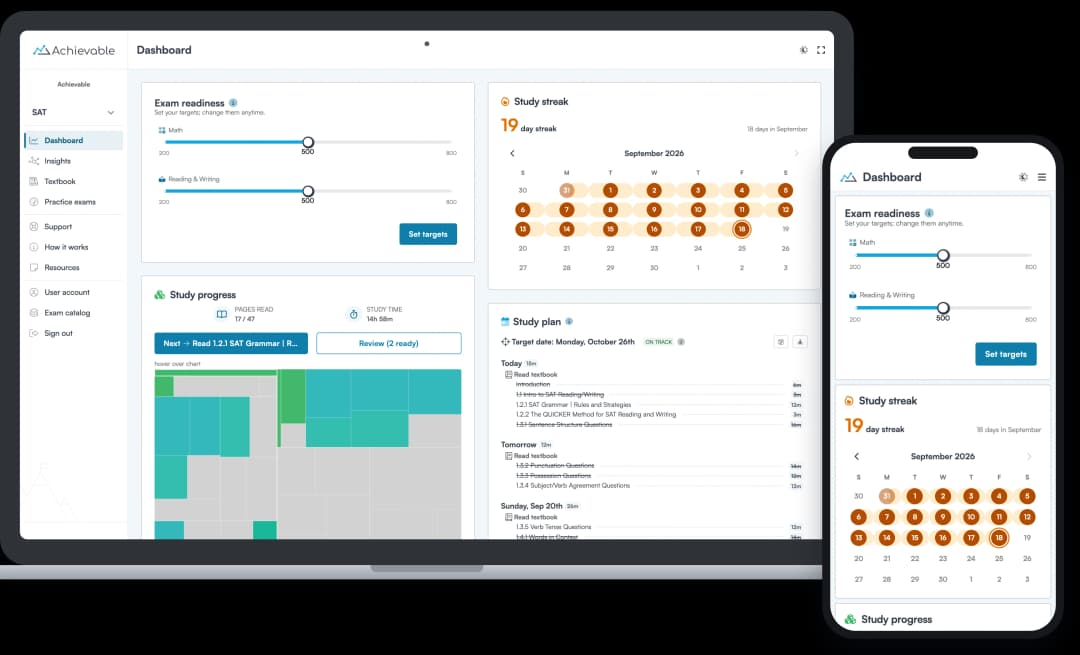
- A plan to your new date. The study planner builds a personalized day-by-day plan so you finish the course by test day.
- Written by an expert tutor with more than 25 years of experience and over 2,000 hours of SAT tutoring.
It’s $99 for 12 months of access, paid once rather than as a subscription, and the first lessons are free, no credit card needed. It pairs well with College Board’s official Bluebook practice tests for your final benchmark.
If one section hasn’t moved despite steady practice, a tutor for that section can help; Achievable’s SAT tutor directory lists tutors and what they offer.
Frequently asked questions about retaking the SAT
How many times can you take the SAT?
As many times as you want. College Board recommends taking it at least twice, in the spring of junior year and the fall of senior year, and says "most students get a higher score the second time." Each attempt costs the $68 registration fee.
Do colleges see all of your SAT scores?
Not necessarily. With Score Choice, you choose which test dates’ scores to send, though some colleges and scholarship programs require all of them. College Board also says some colleges superscore, using your highest section scores across test dates. Check each college’s policy. More in Everything about SAT registration and retakes.
Can you see the questions you got wrong on the SAT?
Not for the real test: the Question-and-Answer Service isn’t available for the digital SAT. Your score report’s Knowledge and Skills section shows how you did in each domain instead. Bluebook practice tests do show every question with the correct answer and the one you chose, which is why timed practice tests are your best diagnosis.
How long should you wait before retaking the SAT?
Until your practice scores show you’re ready, then the next date that fits. College Board says most scores come out two to four weeks after the test (13 to 16 days for the 2027 dates), before the next date’s regular registration deadline, so you can decide with your score in hand.
Should you switch SAT prep courses after one attempt?
Only when the course was the problem: its practice tests didn’t predict your score, it didn’t cover the domains you missed, it didn’t fit how you learn, or you’ve run out of questions you haven’t seen. If you didn’t finish it or skipped its practice tests, keep it and change the plan.
Does Achievable’s SAT guarantee work for a retake?
It’s built on your previous official score. Send its report within 7 days of buying, take the SAT again while your year of access is active, and if your score hasn’t risen by the points guaranteed for your starting score, the course is refunded in full: +120 points for a starting score below 1000, +90 points for a starting score of at least 1000 and below 1200, and +60 points for a starting score of at least 1200 and below 1400. It covers students with an official SAT score below 1400 from the last 5 years.
What should you score on practice tests before you retake?
Comfortably above your target score, consistently, across several full-length practice tests, not on one good day. The SAT score calculator shows what your practice results add up to.
Key takeaways
- Switch SAT prep courses only when the course was the problem; otherwise keep it and change how you study.
- Read your score report’s Knowledge and Skills section and your practice-test trend to find the cause; the report shows domains, not the questions you missed.
- Fix the largest weak domain first, with questions and reviewed misses rather than more video.
- Take a full-length practice test every two weeks, and save unseen official Bluebook tests for the final weeks.
- Book the retake once your practice scores sit comfortably above your target across several full-length tests; the next SAT Weekend dates are March 6, May 1 and June 5, 2027.