How many hours to study to raise your SAT score 200 points


Table of contents
- How many hours a 200-point gain takes, by starting score
- Weekly schedules for 8, 12 and 16 weeks
- 8 weeks: 10 to 19 hours a week
- 12 weeks: 7 to 13 hours a week
- 16 weeks: 5 to 9 hours a week
- Where the points come from on Math and Reading and Writing
- How to measure progress with full-length practice tests
- How Achievable’s study plan uses your hours
- FAQ
- Can I raise my SAT 200 points in a month?
- Is 20 hours of study enough for 200 points?
- How many hours a day should I study?
- Should I study Math or Reading and Writing first?
- Are Khan Academy and Bluebook enough, or do I need a course?
- How many full-length practice tests should I take?
- Key takeaways
Raising a digital SAT score by 200 points usually takes about 80 to 150 hours of focused study, spread over 8 to 16 weeks, and the higher your starting score, the nearer the top of that range you’ll be. See where you stand first: Achievable’s free SAT practice test is one module of each section, 27 Reading and Writing questions and 22 Math questions, scored instantly with every answer explained. Achievable’s SAT course adds 3 full-length practice SATs, 610+ practice questions and Math practice with new numbers every time, for $99 for 12 months of access, paid once rather than as a subscription.
PrepScholar, a test-prep company, gives the most-quoted study-hours chart: about 80 hours for a 130- to 200-point gain and 150 hours or more for 200 to 330 points, which it calls a rough estimate from its experience. The College Board’s own data, from the paper SAT, found that 20 hours on Official SAT Practice on Khan Academy went with an average gain of 115 points. The 80- to 150-hour range is our planning estimate from those figures.
How many hours a 200-point gain takes, by starting score
Before you plan the hours, get a real baseline: a full-length timed test, either one of the 3 in Achievable’s course or one of the College Board’s tests in its Bluebook app (practice tests and score reports, no lessons), or an official score from the last year. Then read the gain you want against PrepScholar’s chart.
Points you want to gain | Study hours (PrepScholar’s estimate) |
|---|---|
0 to 30 | 10 hours |
30 to 70 | 20 hours |
70 to 130 | 40 hours |
130 to 200 | 80 hours |
200 to 330 | 150+ hours |
A gain of exactly 200 points sits on the line between the last two rows. PrepScholar reads its chart as about 80 hours for 200 points; we’d plan on 80 to 150, and where you start decides which end you’re on. A lower score usually means you’re missing medium questions you can learn to answer, while from 1200 or above you already get most of those right, and the points you still need are on the hardest questions.
Starting score | 200 points takes you to | Hours to plan for (our estimate) |
|---|---|---|
Below 1000 | Up to 1190 | About 80 |
1000 to 1190 | 1200 to 1390 | 80 to 150 |
1200 to 1390 | 1400 to 1590 | 150 or more |
1400 | 1600, a perfect score | 150 or more |
Above 1400, a 200-point gain would pass the 1600 maximum, so the question becomes how many hours each remaining 10 points takes.
The College Board’s figures are a useful reality check. Its help center still says 6 to 8 hours of Official SAT Practice is associated with a 90-point increase from the PSAT/NMSQT to the SAT, or from one SAT to the next, and 20 hours with 115 points, which its 2017 release called nearly double the average gain of students who didn’t use Khan Academy. Those figures come from the paper SAT’s first full year: of nearly 250,000 test takers studied, more than 16,000 gained 200 points or more between the PSAT/NMSQT and the SAT, about 1 in 16. They’re averages that went with practice, not promises, and they predate the digital SAT.
Weekly schedules for 8, 12 and 16 weeks
Divide your hours by your weeks. For 80 to 150 hours, that comes to:
Plan | Hours per week | Full-length practice tests |
|---|---|---|
8 weeks | 10 to 19 | 4 |
12 weeks | 7 to 13 | 5 |
16 weeks | 5 to 9 | 5 |
Pick the longest plan your test date allows. Spreading the same hours over more weeks gives you more time between full-length tests to fix what each one shows, and more time for what you’ve learned to stick.
8 weeks: 10 to 19 hours a week
- Week 1: take a full-length timed test and sort every miss by domain and by why you missed it.
- Weeks 2 to 5: study the content where you lost the most points, six days a week, with a short quiz at the end of each session.
- Weeks 5 and 7: full-length timed tests, each followed by a review session that takes as long as the test did.
- Weeks 6 and 7: timed modules, one Reading and Writing and one Math per session, to build pace.
- Week 8: a last full-length test early in the week, then light review and sleep.
12 weeks: 7 to 13 hours a week
- Week 1: full-length timed test and error sort.
- Weeks 2 to 7: content, about 1 to 2 hours a day, weakest domains first; a full-length test at the end of week 4.
- Weeks 8 to 11: timed modules three times a week, and full-length tests in weeks 9 and 11.
- Week 12: one last full-length test, then review only.
16 weeks: 5 to 9 hours a week
- Week 1: full-length timed test and error sort.
- Weeks 2 to 10: content at about 1 to 1.5 hours a day, with full-length tests at the end of weeks 5 and 10 to check that the new skills hold under time.
- Weeks 11 to 15: timed modules three times a week, and a full-length test in week 13.
- Week 16: a final full-length test early in the week, then rest.
Where the points come from on Math and Reading and Writing
Each section is scored from 200 to 800, so a 200-point gain can mean about 100 points in each, or more in the section where you have more room. The College Board describes the test as two sections of two modules each: Reading and Writing has 54 questions in 64 minutes, and Math has 44 questions in 70 minutes. The first module of each section mixes easy, medium and hard questions, and how you do on it decides whether the second module is harder or easier, so accuracy on the first module is what opens up the higher scores.
- Math, Algebra and Advanced Math: 13 to 15 questions each, according to the College Board’s Math overview, so together about two-thirds of the section. Linear equations, systems, functions, quadratics and exponentials are where most Math points are.
- Math, Problem-Solving and Data Analysis, and Geometry and Trigonometry: 5 to 7 questions each. Worth learning, but with so few questions they rarely carry a big Math gain on their own.
- Reading and Writing, Standard English Conventions: sentence boundaries and form, structure and sense. These follow rules, so they’re often among the quickest points to win.
- Reading and Writing, the other three domains: Information and Ideas, Craft and Structure, and Expression of Ideas test skills such as central ideas, evidence, inferences, words in context, text structure, transitions and rhetorical synthesis (the College Board’s content domains page lists them all). All four Reading and Writing domains appear in every module, grouped by skill from easiest to hardest.
Achievable’s Math practice is drawn from 350+ question templates with new numbers each time, so working Algebra and Advanced Math until they’re automatic never turns into remembering answers, and every question has a step-by-step walkthrough.
How to measure progress with full-length practice tests
Use full-length timed tests as your scoreboard, and treat everything between them as training.
- Achievable’s full-length practice SATs: 3 of them in the course, each with two Reading and Writing modules and two Math modules at the digital SAT’s question counts and time limits, and every answer explained.
- The College Board’s Bluebook tests: the full-length practice tests in Bluebook are adaptive like the real SAT and scored, with correct answers and rationales in My Practice. Bluebook is a testing app, not a course: the lessons for what you missed are on Khan Academy.
- Khan Academy’s Official SAT Prep: free leveled practice by skill, with quizzes, unit tests and short videos of worked examples, but no full-length timed practice SAT of its own; its SAT Math course sends you to Bluebook for those.
To read your results:
- Take every full-length test in one sitting, timed, with the 10-minute break and nothing else.
- Track each section score, not only the total: a 60-point jump in Math with a flat Reading and Writing score tells you where the next hours go.
- Log every miss by domain and by cause (didn’t know it, misread it, ran out of time), and check that a cause stops showing up after you’ve worked on it.
- Look at the trend across several tests, not one result.
Aim for 100% readiness before test day: practice-test results comfortably above your target score, consistently, across several full-length exams, so your result doesn’t depend on the luck of the draw.
How Achievable’s study plan uses your hours
Hours only turn into points when they go to what you don’t know yet. That’s what Achievable’s course is built to do with your time:
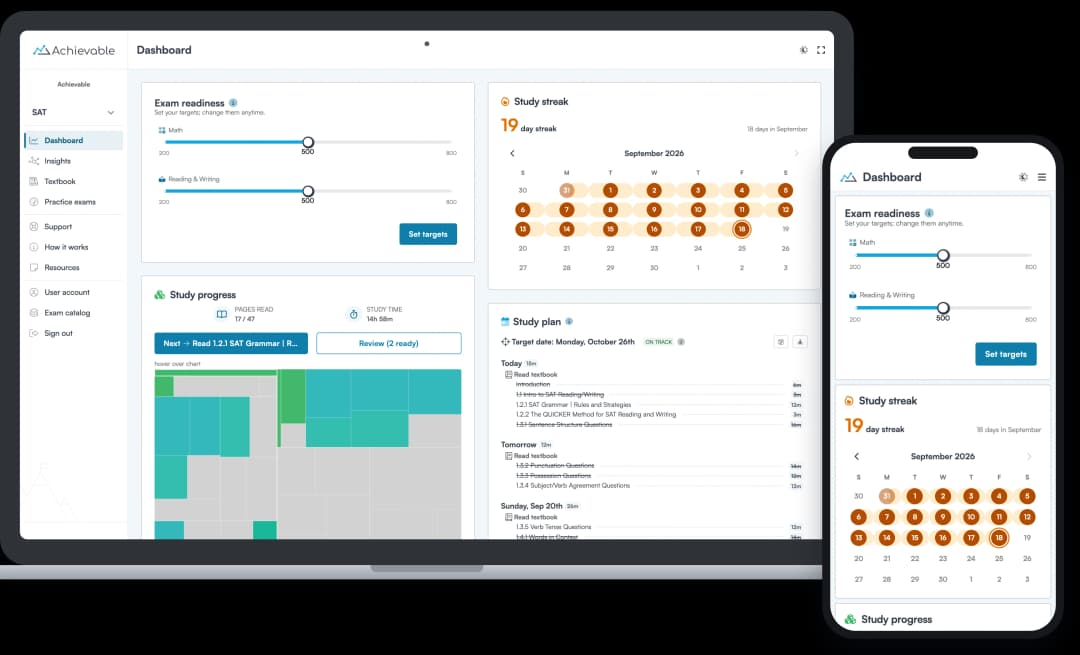
- An adaptive study planner builds a personalized day-by-day plan that gets you through all of the SAT content by your test date, so you know what to study each day.
- A personalized model of your memory tracks your retention and mastery of each SAT learning objective, and the quizzes keep adjusting so that you’re working on the topics that matter most for you.
- Unlimited Math practice from 350+ templates, with new numbers every time and a step-by-step walkthrough for each question.
- 3 full-length practice SATs at the real test’s question counts and time limits, with every answer explained, plus 610+ practice questions.
- An AI tutor for when a lesson or an explanation doesn’t click.
- Your phone’s browser: the whole course runs at app.achievable.me with nothing to download, and your progress syncs between phone and computer.
It’s $99 for 12 months of access, paid once rather than as a subscription, and the first lessons are free with no credit card needed. The course carries Achievable’s score improvement guarantee: +120 points for a starting score below 1000, +90 points for a starting score of at least 1000 and below 1200, and +60 points for a starting score of at least 1200 and below 1400, or your money back. It covers students with an official SAT score below 1400 from the last 5 years. Send us that score report within 7 days of buying and retake the SAT while your year of access is active; if your new score hasn’t risen by the points guaranteed for your starting score, email us its score report and a valid ID within 31 days of the test, and we’ll refund the course in full. There’s no minimum study time and no chapter to finish.
To see where a practice result puts you, use the SAT score calculator.
FAQ
Can I raise my SAT 200 points in a month?
Only with near full-time study. Spreading 80 to 150 hours over four weeks means 20 to 38 hours a week, on top of school. It’s most realistic from a start below 1000, where more of the missed questions are ones you can learn to answer quickly. From 1200 or above, give it 12 to 16 weeks.
With a month and about an hour a day, follow our 30-day SAT study plan: about 40 hours, laid out day by day, aimed at the skills that pay off fastest.
With three months, follow our 3-month SAT study plan: about 70 hours over 12 weeks, five study days a week, built from the chapters of Achievable’s SAT course.
Working full time, with 20 to 30 minutes a day to give it? How to study for the SAT on your phone has a lighter 12-week plan built around short weekday sessions and a full-length test every two to three weeks.
Is 20 hours of study enough for 200 points?
Usually not. Twenty hours is a good start, not a 200-point plan, and a full-length test, such as one of Achievable’s 3 practice SATs, shows whether your hours are turning into points. The College Board’s figures, from the paper SAT, found an average gain of 115 points for students who practiced 20 hours on Official SAT Practice on Khan Academy, and PrepScholar’s chart puts 20 hours at a 30- to 70-point gain.
How many hours a day should I study?
About 1.5 to 3 hours a day, six days a week, for an 8-week plan, and about 1 to 1.5 hours a day for a 16-week plan. Short daily sessions beat a single long weekend session, because you remember more of what you study when it’s spread out.
Should I study Math or Reading and Writing first?
Start with the section where your first full-length test left more room, and within it the domains where you missed the most questions. For many students that’s Algebra and Advanced Math, which make up about two-thirds of the Math section, or Standard English Conventions in Reading and Writing.
Are Khan Academy and Bluebook enough, or do I need a course?
Achievable’s course gives you lessons, 3 full-length practice SATs, unlimited Math practice and a day-by-day study plan for $99 for 12 months of access, paid once. Khan Academy’s Official SAT Prep is free and covers every skill at three levels, but it has no full-length timed practice SAT of its own. Bluebook has the College Board’s full-length adaptive practice tests, but no lessons. If free practice leaves you unable to explain your own misses, a course gives the hours structure: a lesson for each miss, a plan to your test date and full-length tests to measure progress. For a checklist, see is Khan Academy enough for the SAT?
If you’re choosing between paid options, Dolphin SAT alternatives: is Dolphin worth it? compares Achievable with Dolphin, UWorld, Magoosh and Acely, and what each costs for the months you’ll study.
How many full-length practice tests should I take?
Plan on 4 or 5 over your prep, with a full review after each one: the review is where the points come from. Achievable’s course has 3, and the College Board’s Bluebook app has its own, with scores and answer rationales but no lessons. For ideas on what to change when your scores stop climbing, read how to improve SAT and ACT scores that stall.
For a test schedule by timeline and an error log to fill in after each test, see how to use SAT practice tests to raise your score.
Key takeaways
- See where you stand with Achievable’s free SAT practice test, then take a full-length timed test for your baseline.
- Plan on 80 to 150 hours for a 200-point SAT gain: nearer 80 from below 1000, and 150 or more from 1200 and up. PrepScholar’s chart reads about 80 hours for 200 points.
- On the paper SAT, the College Board found 20 hours of Official SAT Practice went with an average 115-point gain, and about 1 in 16 of the test takers it studied gained 200 or more between the PSAT/NMSQT and the SAT.
- Spread the hours over 8 to 16 weeks, with 4 or 5 full-length timed tests through the plan.
- Most Math points are in Algebra and Advanced Math; Standard English Conventions are often among the quickest Reading and Writing points.
- You’re ready when your practice-test results sit comfortably above your target, consistently, across several full-length exams.